Regulating Tokenization in Cosmos
Beyond Cosmoverse: Talk Series with Anina Milanović, The World Bank
Regulating Tokenization in Cosmos
Beyond Cosmoverse: Talk Series with Anina Milanović, The World Bank
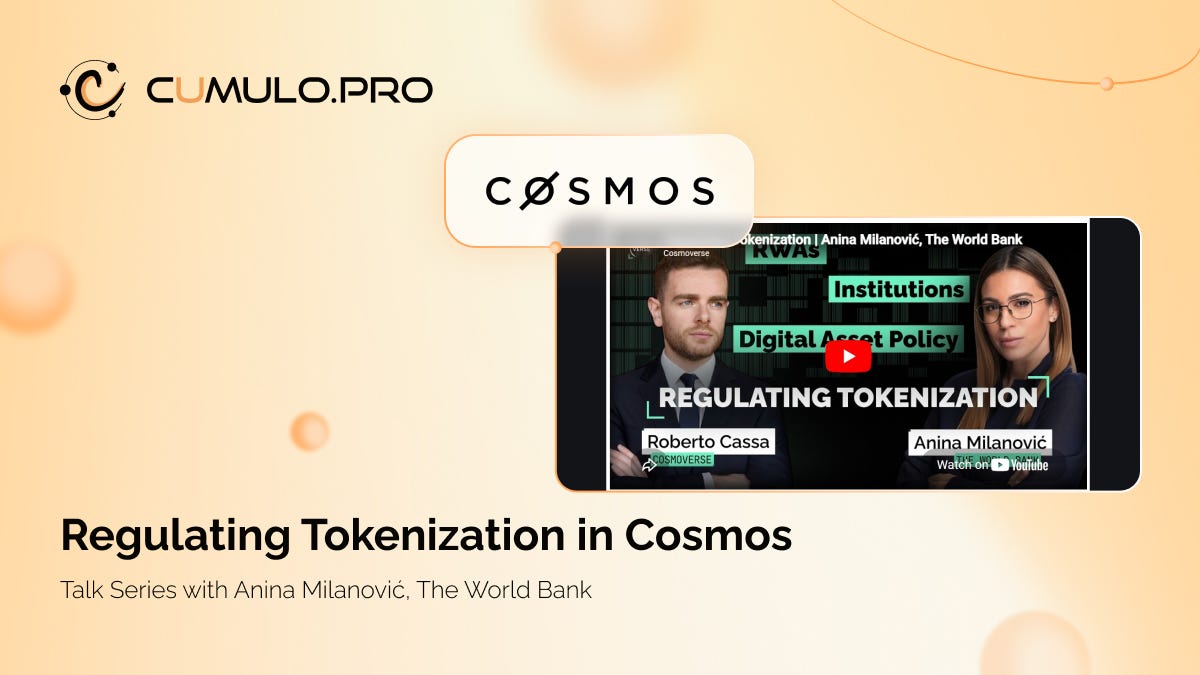

Summary and analysis of the episode “Regulating Tokenization | Anina Milanović, The World Bank”, published on April 8, 2026, on the Beyond Cosmoverse channel. You can watch the full episode here:
[embed]
Tokenization is not going to replace traditional capital markets. It is going to upgrade them.
Anina Milanović helped build Serbia’s digital asset regulatory framework three years before MiCA, and now works on the digitalization of capital markets at the World Bank. These are the main takeaways from her conversation with Roberto Cassa.
Anina is not an academic technocrat or a crypto enthusiast. She started as a lawyer at the largest law firm in Southeastern Europe, joined the Serbian Securities Commission to work on market development, and eventually led its international cooperation department for seven years.
The turning point came in 2019–2020, when her institution began exploring blockchain. “Crypto never interested me professionally. What interested me was the real application of blockchain technology in capital markets.” That focus, real-world asset tokenization, not speculation, has defined her entire career path since then. Today, from the World Bank, she is working on building a digital asset trading platform for an emerging stock exchange, with the goal of fully digitalizing its capital markets.
How do you regulate something completely new? Serbia’s experience
Serbia adopted its digital assets law in 2020, which came into force in 2021, at a time when MiCA did not yet exist and global regulation was almost entirely limited to AML.
The challenge was conceptual: how do you fit something new into existing legal categories when it does not really fit into any of them?
Serbia’s answer was simple: don’t try to force it.
The law created two dedicated categories: Virtual currencies, supervised by the central bank and Digital tokens, supervised by the Securities Commission and classified according to what they represent: investment, utility, or payment. This enabled something very concrete: Serbia became one of the few countries to explicitly allow the tokenization of financial instruments under a dedicated regulatory regime.
The first use cases involved digital bonds, with a clear conclusion: tokenization can open new financing channels for SMEs that are structurally excluded from the banking system. The current issuance limit, set at €3 million per project, is now under review and may be raised.
Stablecoins as the trigger, and the three institutional requirements
One of the key ideas validated by Anina is that it was stablecoins, not DeFi, that forced traditional finance to take blockchain infrastructure seriously.
Once volumes reached trillions of dollars, institutional capital followed. Not because of ideology, but because of capital logic.
For that capital to truly operate on-chain, three things are needed:
1. Legal certainty Clear and consistent rules are essential. Otherwise, capital simply moves to another jurisdiction.
2. Trusted infrastructure The technical layer must be reliable, audited, and robust enough for institutional use.
3. A liquid secondary market This is the most underestimated point. Without secondary liquidity, a tokenized asset faces a structural limitation.
This last piece is exactly what the World Bank is now trying to build.
The global regulatory moment: evolution, not revolution
The SEC’s shift in 2025–2026 toward a clearer position on digital assets prompted a brief but telling reaction from Anina:
“Finally.”
Together with developments such as Hong Kong’s stablecoin licensing framework, the global regulatory map is changing.
Her broader view is clear:
“This is not a revolution. It is an evolution.”
Bonds will remain bonds. Funds will remain funds. But they will run on digital infrastructure.
The assets likely to lead the first wave are:
- Tokenized deposits for institutional use.
- Digital bonds that can expand access to financing for SMEs without traditional banking access.
Regulatory fragmentation across jurisdictions remains the most concrete obstacle. Capital is global, but regulation is local.
Still, Anina does not see this as a permanent wall. The principles are converging, even if implementation differs from country to country.
Serbia, as an EU candidate country, is planning to harmonize with MiCA. For now, however, its framework remains more flexible and more tokenization-friendly, turning the country into a testing ground for use cases that would be more complex to launch inside the EU.
The advice for emerging markets: move now or miss the train
Anina’s advice for markets that want to replicate Serbia’s experience is based on three pillars:
1. A flexible and clear legal framework from the beginning It does not need to be perfect, but it must be predictable.
2. Regulatory credibility This comes from the willingness to learn, engage with the industry, and understand the technology.
3. Legislation adapted to the local market problem Copying another jurisdiction’s framework without understanding the specific local context is not enough.
On timing, she is even more direct.
Today, there is a “Game of Thrones battle”, in her words, between large and small economies trying to position themselves in the new digital financial landscape.
For the first time in a long time, a small economy can compete on equal terms with a large one, because the starting point is almost the same.
But that window will not remain open forever.
Serbia understood this in 2020 and has spent five years building regulatory advantage. Those who wait too long will not board the same train.
Our conclusion from Cumulo
Cosmos-IBC modular architecture, chain sovereignty, and interoperability, is exactly the kind of infrastructure that Anina’s use case needs: financial assets moving across jurisdictions, operating in multiple markets, remaining transferable, auditable, and programmable.
What is changing is not only regulation. It is the narrative.
We are no longer talking only about speculation around volatile assets.
We are talking about the World Bank building trading platforms for tokenized assets. About regulators seeing their own laws work in practice. About multilateral institutions building on blockchain infrastructure in 2026.
For validators supporting these networks, this has direct implications: higher technical requirements, greater responsibility in preserving real decentralization, and growing demand for infrastructure that is as robust as the assets moving across it.
Resources
- 🎬 Full episode: Regulating Tokenization | Anina Milanović, The World Bank — Beyond Cosmoverse


Twitter | Medium | LinkedIn | Discord | Telegram | cumulo.pro
메타데이터
- post_id
- 9e2762ea294c
- slug
- regulating-tokenization-in-cosmos-9e2762ea294c
- url
- https://medium.com/cumulo-pro/regulating-tokenization-in-cosmos-9e2762ea294c
- canonical_url
- https://medium.com/cumulo-pro/regulating-tokenization-in-cosmos-9e2762ea294c
- author_url
- https://medium.com/@cumulo.pro
- status
- ok
- fetched_at
- 2026-06-10 21:21:38