A chilling lesson about the power of situations, roles, and authority.
In the summer of 1971, a young psychology professor named Philip Zimbardo conducted an experiment that would become one of the most famous…
The Stanford Prison Experiment: How Ordinary Men Became Monsters in Just 6 Days
A chilling lesson about the power of situations, roles, and authority.
In the summer of 1971, a young psychology professor named Philip Zimbardo conducted an experiment that would become one of the most famous — and controversial — studies in the history of psychology. Its findings seemed to reveal something dark and uncomfortable about human nature: that ordinary, healthy, mentally stable people could be transformed into brutal oppressors or helpless victims simply by putting them in a prison environment.
The experiment was supposed to last two weeks. It was shut down after just six days.
What happened inside that mock prison in the basement of Stanford University’s psychology department has haunted researchers, ethicists, and the public for over five decades. But as we’ll see, the real story is more complex — and more troubling — than the legend we’ve come to know.
The Setup: Building a Dungeon
Zimbardo and his team converted a 35-foot section of the Stanford psychology building’s basement into a simulated prison. They replaced doors with steel bars, turned a small closet into a “solitary confinement” cell, and used plain wooden doors to create cell doors. There were no windows, only bare walls and a small corridor they called the “yard.”
For participants, Zimbardo recruited 24 college students from the United States and Canada through a newspaper ad. Each was paid $15 per day. Crucially, all were subjected to psychological tests and interviews to ensure they were emotionally stable, healthy, and had no criminal record or history of drug abuse. They were, by all measures, “normal, average, healthy young men.”
The participants were randomly assigned to be either “prisoners” or “guards.” Random assignment is key in experimental design — it meant that any differences in behavior couldn’t be blamed on personality types but had to result from the roles themselves.
Neither group chose their role. It was pure chance.
The Transformation Begins
The experiment started on a Sunday morning. Real Palo Alto police officers — at Zimbardo’s request — went to the homes of the “prisoner” participants, arrested them for armed robbery and burglary, handcuffed them, searched them, and took them to the police station for booking. The officers were in on the act, but the prisoners were not warned that this would happen. They were shocked, humiliated, and frightened.
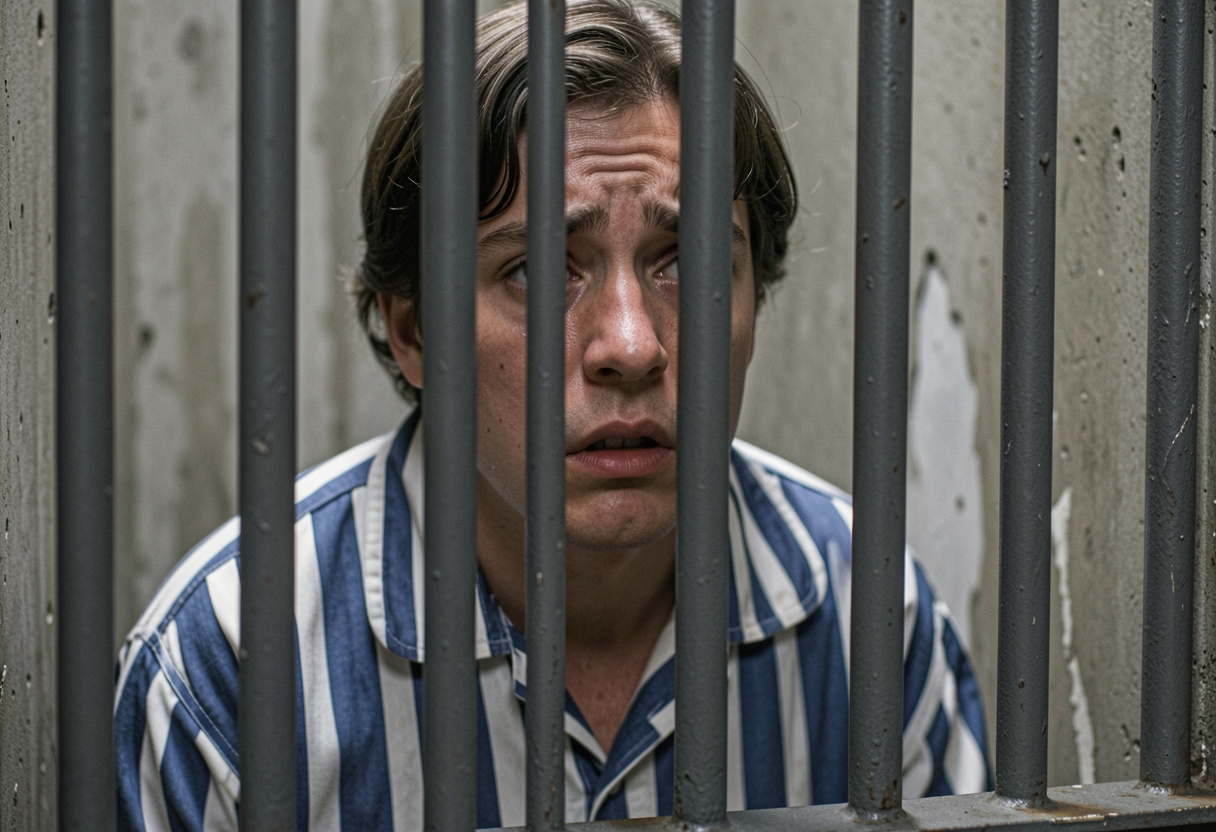
Once inside the mock prison, the prisoners were strip-searched, sprayed with a decontaminant (supposedly to prevent lice), given a uniform with an ID number instead of a name, and had a chain placed around one ankle. Guards were given khaki uniforms, mirrored sunglasses (to prevent eye contact), and wooden batons. They were instructed to maintain order but given no specific training — only told they could not use physical violence.
The rules were simple: three meals a day, three supervised bathroom trips, two visits from a “priest” or “public defender,” and lights out at 10 p.m. The prisoners were to follow all orders. Guards were told they had complete authority but could not harm the prisoners physically.
Within 24 hours, the experiment began to unravel.
The Descent Into Cruelty
On the second day, the prisoners rebelled. They ripped off their ID numbers, barricaded themselves in their cells, and shouted insults at the guards. The guards responded with a fire extinguisher (aimed at the prisoners through the bars) and then devised a counter-strategy.
They split the prisoners into two groups: “good” prisoners and “bad” prisoners. The “good” prisoners were rewarded with a special meal and the return of their mattresses. The “bad” prisoners were punished with push-ups, repeated counting, and solitary confinement.
What happened next shocked even Zimbardo. The guards became more creative — and more sadistic. They forced prisoners to clean toilet bowls with their bare hands. They stripped prisoners naked and made them stand for hours. They denied prisoners the right to sleep by interrupting them with frequent “bed checks.” They used boredom, humiliation, and arbitrary rules to break the prisoners’ will.
One prisoner — Prisoner #8612 — began screaming, crying, and suffering from acute psychological distress after just 36 hours. He was released. Others developed rashes, depression, and uncontrollable rage. A priest was brought in to counsel the prisoners, and he noted that several seemed to have accepted their helplessness completely.
By day four, Zimbardo’s girlfriend (and future wife), Christina Maslach, visited the mock prison. She was horrified by what she saw — prisoners shuffling blindly down the hall, heads down, guards shouting orders with casual cruelty. She told Zimbardo, “It’s terrible what you’re doing to these boys.” That moment, Zimbardo later said, made him realize he had become too involved in his role as “prison superintendent” and forgotten his duty as a scientist.
He ended the experiment on day six — not day 14 as planned.
The Official Conclusions: The Power of the Situation
Zimbardo’s primary conclusion was that the situation — not the personalities of the participants — caused the abuse. He argued that the prison environment alone could make good people act in evil ways. This became known as the “Lucifer Effect”: the transformation of human character when given power without accountability.
In his own words: “Good people can be induced, seduced, and initiated into behaving in evil ways.”
The Stanford Prison Experiment became a staple of psychology textbooks, ethics courses, and management training. It influenced everything from prison reform (highlighting the dangers of dehumanization in real prisons) to military interrogation policies. For decades, it was held up as proof that we all have a dark side waiting to be unleashed.
But then came the critiques.
The Cracks in the Story
In the 2000s and 2010s, investigative journalists and psychologists began re-examining Zimbardo’s study. What they found was alarming.
First, the “random assignment” and “no prior selection” claims were overstated. Some guards later admitted they had tried to act like “tough but fair” guards in the beginning, but they felt pressured by Zimbardo himself to become harsher. The prison superintendent (Zimbardo’s research assistant, David Jaffe) explicitly told guards: “You have to create in the prisoners a sense of boredom, a sense of fear, a sense of powerlessness. They have no power.”
In other words, the guards were coached.
Second, not all guards became brutal. Some were kind — they gave prisoners extra food, let them sleep, and quietly defied the harsh instructions. Zimbardo downplayed their existence in his published accounts.
Third, several prisoners later reported that they were “faking” their breakdowns to get out early. One prisoner, Douglas Korpi (who famously screamed, “I’m burning up inside!” on the video footage), admitted years later that he was acting to some degree because he had a psychology exam coming up and wanted to leave. He also clarified that the guards were not inherently brutal — many were just bored college students playing along.
Fourth, the experiment lacked basic scientific controls. There was no standardized measure of abuse. The “guards” and “prisoners” knew they were being watched and filmed. The demand characteristics — cues that tell participants how to behave — were enormous.
Most damningly, in 2018, a team of psychologists led by Alexander Haslam and Stephen Reicher reanalyzed the available data and concluded that the guards didn’t become cruel because of the situation. Instead, they became cruel because they identified with the experimenter’s goals. In other words, they were acting out a script that Zimbardo had written.
Why Does the Myth Persist?
If the Stanford Prison Experiment was so flawed, why do we still talk about it?
Because it tells a story we desperately want to believe — or perhaps fear is true. The idea that ordinary people, when given absolute power, become monsters is both terrifying and strangely reassuring. Terrifying because it could happen to anyone. Reassuring because it absolves us of individual responsibility: “It’s not me, it’s the situation.”
This narrative has been used to explain the Abu Ghraib prison abuses (where guards tortured Iraqi detainees) and corporate scandals. But when actual psychologists examined Abu Ghraib, they found that the abuses were not spontaneous situational reactions — they were planned, premeditated, and often photographed with glee. Many of the soldiers involved had prior histories of misconduct.
The real lesson of the Stanford Prison Experiment may not be the one Zimbardo intended. It may be this: Science is done by humans, and humans are susceptible to bias, self-deception, and the desire for a dramatic finding. The experiment succeeded not because it revealed a universal truth about human nature, but because it created a compelling narrative that fit the cultural mood of the 1970s — a decade marked by distrust of authority and a fascination with the banality of evil.
What We Should Take Away
So should we throw out the Stanford Prison Experiment entirely?
Not completely. Even its fiercest critics acknowledge that it raised important ethical questions. After this experiment, institutional review boards (IRBs) were created to oversee human subject research. Today, you could never run a study that subjects volunteers to psychological torture — and that’s a good thing.
The experiment also reminds us that roles matter. When you give someone a uniform, a title, and a sense of authority, they may begin to act differently. But the key word is “may,” not “will.” Some people resist. Some people are kind. Some people choose to do the right thing even when the situation encourages cruelty.
Perhaps the most valuable lesson is more personal and more uncomfortable: If you ever find yourself in a position of power over others, ask yourself — not what would the situation do to me — but what am I choosing to do right now?
Because in the end, the Stanford Prison Experiment didn’t prove that we are all puppets of our environment. It proved that some of us, when given permission, will behave in ways we later regret. And that the best safeguard against that is not a better experiment, but a stronger conscience.
Final note: The Stanford Prison Experiment has been replicated several times — and the replications have consistently failed to produce the same extreme results. In fact, in a 2002 BBC replication (also criticized, but for different reasons), the guards were friendly and the prisoners eventually took over the prison. Human behavior, it turns out, is more complex and more hopeful than a basement dungeon in 1971 would have us believe.
메타데이터
- post_id
- 9e4bbf992ba3
- slug
- a-chilling-lesson-about-the-power-of-situations-roles-and-authority-9e4bbf992ba3
- url
- https://medium.com/@generous_celadon_turtle_935/a-chilling-lesson-about-the-power-of-situations-roles-and-authority-9e4bbf992ba3
- canonical_url
- https://medium.com/@generous_celadon_turtle_935/a-chilling-lesson-about-the-power-of-situations-roles-and-authority-9e4bbf992ba3
- author_url
- https://medium.com/@generous_celadon_turtle_935
- status
- ok
- fetched_at
- 2026-06-09 15:37:30