The Price of Protection — R. Kelly, Diddy and the Commercial Calculus of Silence
In 2018, the Washington Post published a lengthy investigation into how the music industry had known about R. Kelly’s sexual abuse of young…
The Price of Protection — R. Kelly, Diddy and the Commercial Calculus of Silence
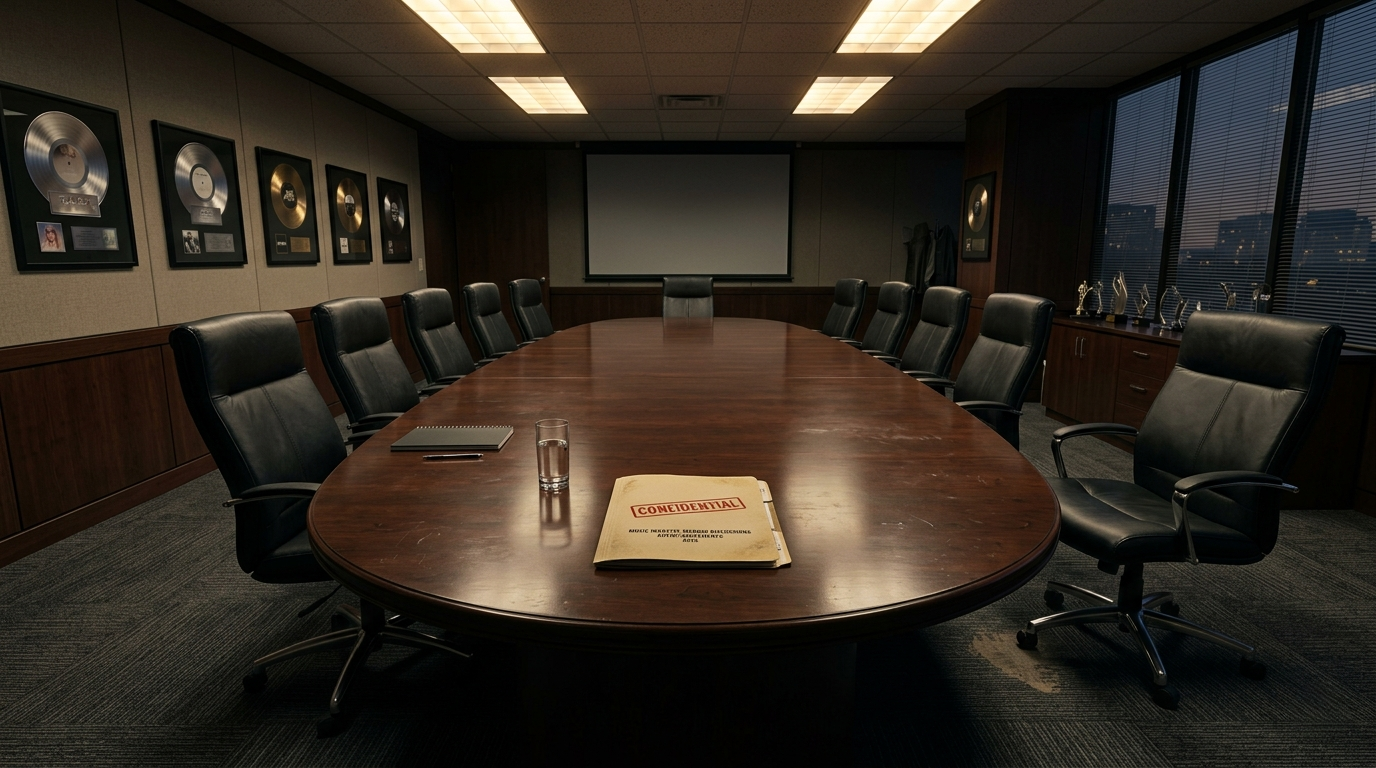
The information existed. The decision not to act on it was made in rooms like this one. All images generated by author unless stated
In 2018, the Washington Post published a lengthy investigation into how the music industry had known about R. Kelly’s sexual abuse of young women for decades and done nothing. A former Jive Records president named Barry Weiss was asked to explain.
‘I was a record company putting out R. Kelly’s records,’ Weiss said. ‘That was all I knew. We were a record company, for God’s sakes.’
A Jive executive who had worked closely with Kelly, including after viewing a sex tape that appeared to show Kelly with a minor, offered a different explanation. He pointed to Chuck Berry and Jerry Lee Lewis as musicians whose labels had continued releasing their records despite public awareness that they were involved with underage girls.
That second statement is the most important document in the Protection pattern. It establishes that label executives understood they were not making exceptional decisions. They were following a tradition. The tradition had a name. It had precedents. It had been working for sixty years.
The two phenomena
The Apparatus database maps two distinct patterns in the music industry.
The first is suppression: the institution moves against an artist who has reached the Peak Threat Window, commercial maximum, platform maximum, independence attempt, in order to retain control of their commercial output.
The second is protection: the institution retains an artist despite documented harmful behaviour toward third parties, because their commercial output is sufficiently valuable that the cost of dropping them exceeds the cost of continued association.
These two patterns share a single root cause. In both cases, the institution’s relationship is to the catalogue not the person. The person is instrumentally valuable. When the person becomes an obstacle to catalogue control, the institution suppresses. When protecting the person preserves catalogue revenue, the institution enables.
The victims of the Protection pattern are not the artists. They are the people the artists harm. The institution’s silence is purchased with their suffering.
The precedent chain: how the tradition was built
Jerry Lee Lewis married his 13-year-old cousin Myra Gale Brown in December 1957. The marriage became public during a UK tour and nearly ended his career. His label, Sun Records, took no action. He continued recording. His records continued selling.
In the same period, Chuck Berry was under investigation for transporting a 14-year-old girl across state lines for immoral purposes under the Mann Act. He was convicted in 1962 and served twenty months. Chess Records continued releasing his material throughout his imprisonment and after his release.
Elvis Presley began his relationship with Priscilla Beaulieu in 1959, when she was 14 and he was 24. They met in West Germany while he was serving in the US Army. The relationship was known to his management, his label and the press. RCA Records took no action.
These three cases, all from the same three-year period, all involving the same type of harm, all met with the same institutional silence, became the precedent that a Jive executive cited in 2018 to explain why the label had continued releasing R. Kelly’s records. The tradition was not hidden. It was institutionally remembered and explicitly invoked.
R. Kelly: twenty-eight years of protected revenue
R. Kelly signed to Jive Records in 1991. In 1994 he married Aaliyah, who was 15 years old. He was 27. The marriage was annulled when her parents obtained a court order showing she had listed her age as 18 on the licence. Jive took no action.
In 2001 and 2002, journalist Jim DeRogatis obtained sex tapes that appeared to show Kelly having sex with a girl who was 13 or 14 years old. DeRogatis turned them over to Chicago police. Jive took no action.
In 2002, Kelly was indicted on 21 counts of child pornography. He was acquitted in 2008 after a jury deliberated for six hours. Jive continued releasing his records throughout the six year period between indictment and acquittal. Two women sued Jive and Kelly for sexual misconduct. The label successfully argued it was not liable. Jive president Barry Weiss said he was unaware of both lawsuits, despite the label being a named defendant in both.
Jive was folded into RCA Records, a Sony subsidiary, in 2011. Kelly transferred to RCA. The relationship continued.
In January 2019, Lifetime aired Surviving R. Kelly, a six-part documentary featuring interviews with women who had accused Kelly of sexual misconduct and abuse over decades. It became the most watched Lifetime programme in more than two years. A petition demanding Sony drop Kelly reached 200,000 signatures.
Sony dropped Kelly in January 2019, twenty-eight years after he signed to Jive. The trigger was not a court case. It was not a criminal conviction. It was a documentary and a petition.
The commercial calculus is explicit: Kelly’s association with the label became more expensive than his catalogue value when public pressure became impossible to absorb. Not before. At no point in the preceding twenty eight years had the documented abuse reached that threshold.
His catalogue remains in the Sony system.

Twenty eight years. The drop came after a documentary and a petition. Not before.
Sean Combs: the institutional network
Sean ‘Diddy’ Combs founded Bad Boy Records in 1993 after being fired from Uptown Records. Bad Boy signed a distribution deal with Arista Records, then a Sony subsidiary under Clive Davis. It later moved to Interscope Records under Universal Music Group.
Allegations against Combs date to 1990. Liza Gardner has alleged assault in 1990. Joi Dickerson has alleged drugging and sexual assault in 1991. The lawsuits filed between November 2023 and the present span more than three decades of alleged conduct.
Cassie Ventura, signed to Bad Boy Records in 2006, two years before entering a relationship with Combs, filed suit on November 16, 2023, alleging physical abuse, rape and sex trafficking across a decade long relationship. The lawsuit was settled the following day. The 24-hour settlement, before any court proceedings, is itself evidence of institutional liability awareness.
Bad Boy Entertainment, Bad Boy Records and Epic Records were named as co-defendants in the Cassie suit. Universal Music Group, which distributed Bad Boy through Interscope, was named as a co-defendant in at least one subsequent suit.
Combs was arrested in September 2024 and charged with sex trafficking and racketeering. He is currently serving four years in prison. The allegations span from 1990 to 2023, thirty three years of documented claims during which his labels generated hundreds of millions of dollars from his commercial output and took no action.
In 2017, Forbes named him the highest paid celebrity in the world, at $130 million in a single year.
The Protection calculation is visible in that number. At $130 million per year, the cost of association with Combs, however serious the allegations, did not exceed the commercial return. Until it did.
Jimmy Page and the institutional memory gap
Lori Mattix has given multiple interviews describing her relationship with Led Zeppelin guitarist Jimmy Page, which she says began when she was 14 years old in 1972. The relationship is documented in several Led Zeppelin biographies. Robert Plant has said he wrote ‘Sick Again’ in general about the many underage groupies the band encountered on their 1973 US tour, a statement that establishes band level awareness, whatever its implications for individual accountability.
Page has neither confirmed nor denied the relationship publicly. Led Zeppelin’s manager Peter Grant arranged Mattix’s introduction to Page, establishing managerial level knowledge. Atlantic Records distributed Led Zeppelin throughout the relevant period. Led Zeppelin’s own Swan Song label, formed in 1974, was itself distributed by Atlantic.
Page has never been prosecuted. Led Zeppelin is one of Atlantic/Warner’s highest grossing catalogues. The institutional silence in this case is not documented in the way Jive’s silence regarding Kelly is documented, no label executive has given a statement to the press explaining why Atlantic took no action. The evidence tier for institutional complicity is Contested.
What is Established is the pattern: a commercially invaluable artist, documented conduct involving a minor, institutional silence, no prosecution, catalogue intact.
What the Protection pattern establishes
The three cases in this piece, Kelly, Combs, Page, and the three precedents the Jive executive invoked, Berry, Lewis, Presley, span six decades and three separate label networks. They share the following structure:
The artist is commercially invaluable. The conduct is documented or publicly alleged. The institution is aware, in some cases is a named legal defendant, and takes no action. The inaction continues until the commercial cost of association exceeds the commercial value of the catalogue. At that point, the artist is dropped. The catalogue is retained.
The victims absorb the cost of the institution’s silence for the entire period during which the commercial calculation favours protection.
Barry Weiss said it as plainly as it can be said: ‘We were a record company putting out R. Kelly’s records. That was all I knew.’
The record company knew what it was. It knew what it was doing. It did it for twenty-eight years.
That is not an individual failure of judgment. That is a policy.
This article draws on the Music Industry Control Pattern database (Lumina Project). Key sources: Washington Post, ‘How the music industry overlooked R. Kelly’s alleged abuse of young women’ (Jim DeRogatis, May 2018); NPR, PBS, NBC News reporting on Combs indictment and trial timeline; Wikipedia, Lori Mattix; multiple Led Zeppelin biographies. All Kelly-label timeline facts confirmed in the Washington Post primary reporting.
메타데이터
- post_id
- 9e4f7a8f3add
- slug
- what-if-ai-investigated-the-price-of-protection-r-9e4f7a8f3add
- url
- https://medium.com/what-if-ai-investigated/what-if-ai-investigated-the-price-of-protection-r-9e4f7a8f3add
- canonical_url
- https://medium.com/what-if-ai-investigated/what-if-ai-investigated-the-price-of-protection-r-9e4f7a8f3add
- author_url
- https://medium.com/@jamie_gray027
- status
- ok
- fetched_at
- 2026-07-08 23:08:13