Why Bramayugam Is a Tale of Class War and Human Rot Masquerading as a Ghost Story
This is not another review of the movie.
Why Bramayugam Is a Tale of Class War and Human Rot Masquerading as a Ghost Story
This is not another review of the movie.
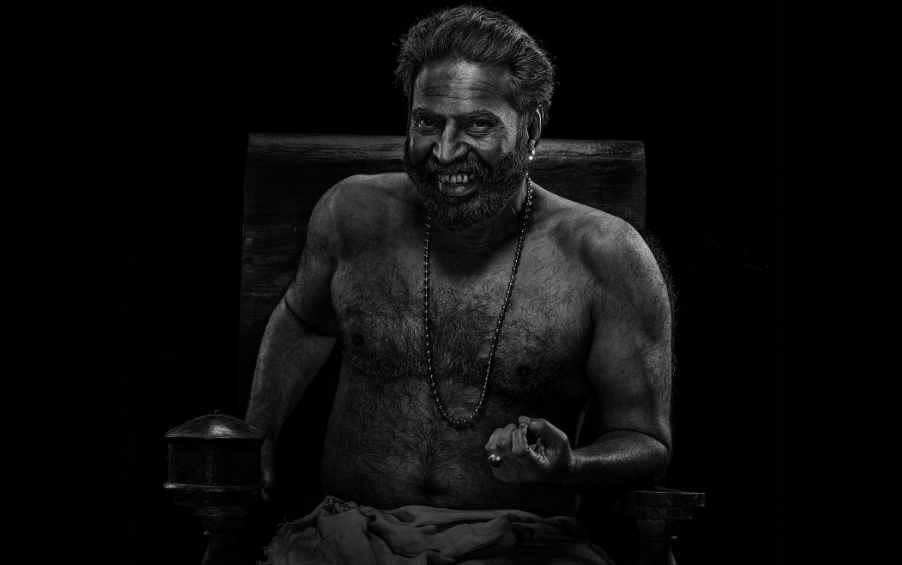
Bramayugam | Image Source: IMDB
Spoilers ahead!
There is a specific kind of dread that settles in when you know the person smiling at you from across the dinner table doesn’t want your company, but your soul. In Rahul Sadasivan’s *Bramayugam*, this dread is both the plot point and the very air the characters breathe.
Every critic who has studied the movie has spent hours dissecting Mammootty’s terrifyingly toothy grin, his evil laughter, and the stark beauty of the monochrome frames that look like a painting. But buried beneath the dirty floorboards of the crumbling Mana (mansion) is a filthier, much more uncomfortable story of class war and human rot.
Democracy of the Shadow
Of course, I must start with the monochrome cinematography. In modern cinema, whenever a director goes black-and-white, it’s usually for nostalgia. Or to set the atmospheric mood. In Bramayugam, it’s a political choice.
In 17th-century Kerala, your clothes and the color of your skin told everyone exactly where you stood in the hierarchy. Had the film been in color, it would have been a loud, vibrant indicator of caste and power. Sadasivan has stripped away the color, making everyone look equally wretched. He has created a visual democracy of decay that begins with the death of hues.
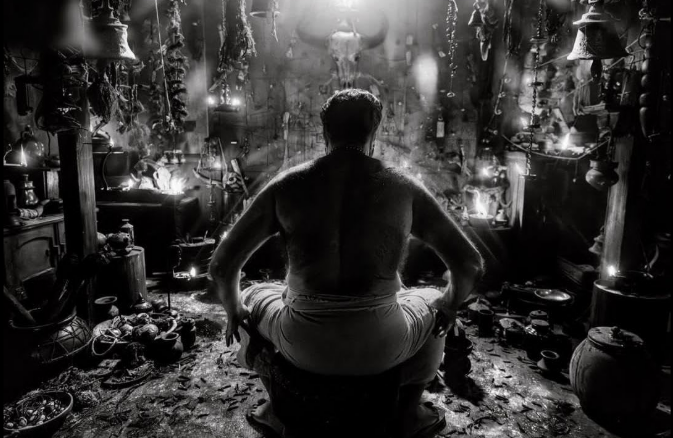
Bramayugam | Monochrome Cinematography | Image Source: IMDB
His use of monochrome is a tactical erasure of inequality. In it, the silk of a Brahmin’s thread, the dirt on a singer’s feet, and the sweat on a cook’s back are the same shades of gray. When you see Kodumon Potti (Mammootty) and the Cook (Sidharth Bharathan) in the same frame, the lighting makes them look like two sides of the same rusted coin.
You can’t look at the mighty Mana and see the golden age of feudalism either, because there is no glitter. It’s not a monument to old-world glory — just a gray tomb of horror, where masters and slaves are tainted by the same shadows. By draining every color, Sadasivan levels the playing field in the most morbid way possible, shifting the focus from the social hierarchy to the grim reality that everything and everyone here is rotting.
A House That Gaslights
The Mana itself is probably the most dishonest character in the film. It’s a theatre of feudal conditioning — of oppression and deceit. It’s an aggressive antagonist that commands fear. If you watch closely, the house feels different in every scene. In the beginning, it’s a sanctuary from the forest. By the middle, it’s a maze. Toward the end, it’s nearly dead, with the rhythmic, metallic scraping of a ladle against a pot its only heartbeat.
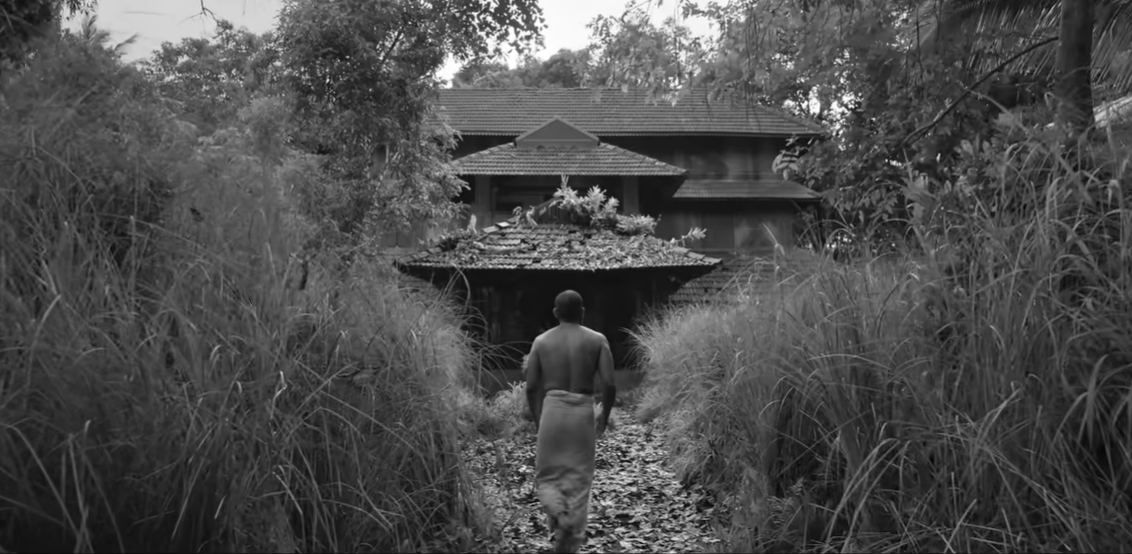
Bramayugam | The Mana | Image Source: Night Shift Studios
Most horror movies use a haunted house as a backdrop, but Bramayugam’s Mana feels like it’s the one meting out the torture. There’s a psychological trick happening here called architectural gaslighting. The walls are forever expanding and contracting, as if they are alive and breathing…and listening.
One moment, the veranda looks endless — like a stage for a grand drama; the next, the ceiling feels like it’s pressing down on Thevan’s (Arjun Ashokan) head like a closing fist. This is exactly how a tyrant works — they make your world feel small so you forget what the outside world looks like, or worse, if there’s even a world outside.
The old, crumbling walls also stand for a system that is falling apart but refuses to die, trapping everyone inside its ruins. The house isn’t decaying because it’s old; it’s decaying because the evil inside it has no interest in maintenance, only in consumption.
The genius of Sadasivan’s direction lies in how he frames this very consumption. In this godforsaken house, eating is never an act of nourishment; it is a display of dominance or a desperate attempt at grounding oneself in a shifting reality.
The characters within it lie trapped by their own aspirations of authority. Thevan’s journey from a folk singer — a man of art — to a creature of mud and blood serves as a metaphor for how such evil aspirations deform the soul.
The Cook and the Politics of the Kitchen
Everyone talks about the evil in Potti, but the Cook is the one who haunts me the most. The former may be the one holding the whip, but the latter keeps the war raging. He’s a fascinating dichotomy, a tragic figure that most people overlook. A bridge between the hunter and the hunted. The ultimate middleman of a corrupt system.
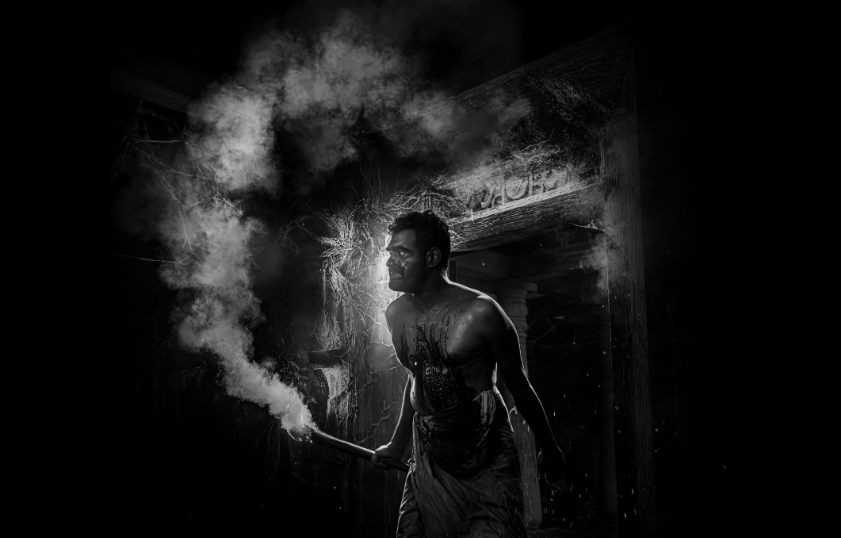
Bramayugam | The Cook | Image Source: IMDB
This is a man who has lived in the shadow of the ungodly for decades. He has traded his freedom to helm the hearth in a cursed house. He knows the master is a monster, but he stays anyway. Perhaps because the kitchen is the only place he feels safe and powerful. Or because he’s forgotten how to be anything else. Or because he is addicted to the hierarchy.
Nothing is filthier than his desperation. His silence is what allows the Chathan to rule. He helps lure others in, proving that a corrupt system needs not just a monster at the top, but also an accomplice to keep the show running. Potti might represent the supernatural apex predator, but he is the one who sustains the horror.
The Cook is also a man whose spirit has been so thoroughly ground into the dirt that he can no longer distinguish service from survival. At the same time, he is fiercely territorial about his workplace and very well-versed in the food politics at play.
In any other movie, food is usually a sign of hospitality. But the Kanji (the gruel) he serves is a weapon of subjugation. It’s the perfect metaphor for the bare minimum. It’s the politics of the kitchen: feed the oppressed just enough, so they don’t die, but keep them weak enough so they don’t rebel.
Sounds of a Dead World
If you close your eyes during Bramayugam, the horror doesn’t go away. It actually gets worse. The sound design is incredibly sparse and quite unnerving because of what isn’t there. A movie set in a forest should be abuzz with the sound of nature — cicadas, birds, crickets, or leaves rustling in the wind, for that matter. But in this film, the forest is silent, and it’s terrifying.
The only sounds we hear are man-made or house-made: the creaking of wood, the clomp of Potti’s footsteps, the thud of his staff, the clatter of dice, and the sound of incessant rain. The film creates a sonic cage and traps you in it. It’s almost as if the very ecosystem around the house has been choked to death under the Chathan’s influence.
The absence of noise is also the presence of dread. It isn’t peaceful; it’s unsettling. It’s an omen. It makes you feel like you’ve stepped out of the real world and entered a dimension where the laws of nature don’t hold, so much so that perhaps even the birds are too scared to sing near this house.
A Dice Game and the Illusion of Control
The Pakida (dice) scenes are the most biting philosophical points of the film. We see Thevan playing for his life, rolling the dice and thinking that if he just gets the right roll, he can win his way out of the Mana. We watch him sweating, praying for a miracle. But that’s Chathan’s trick.
[embed]
The dice game represents the deterministic nihilism of the story. In this gray world ruled by a monster, the game isn’t fair. Thevan thinks he has agency, but he’s playing with someone who owns the dice, the table, and the air they breathe. He is competing with someone who doesn’t play to win money or land; he plays because watching another hope against all odds is a thing that satisfies the evil within him.
The cruelty of the game isn’t that Thevan might lose — it’s that he’s allowed to think he can win. It’s a metaphor for how power works in the real world. We’re told that if we work hard or play the game right, we can succeed. Bramayugam shows us that when the system is rigged, the sense of control over your decisions is just a story the master tells you to keep you seated at the table.
Shifting Identities and Changing Priorities
Horror isn’t just about death; it’s about being erased. The film suggests that the most terrifying thing isn’t the monster in the attic, but the slow erosion of the self. This dread is most potent when the characters realize they’ve forgotten who they were before they entered the Mana.
As the protagonist, Thevan, loses his sense of time and identity. His transition from a human with a name to a mere plaything for the Chathan is the tragedy buried under those floorboards. Bramayugam shows us how easily a person can be broken down until they no longer seek freedom, but only a slightly more comfortable spot in their cage.
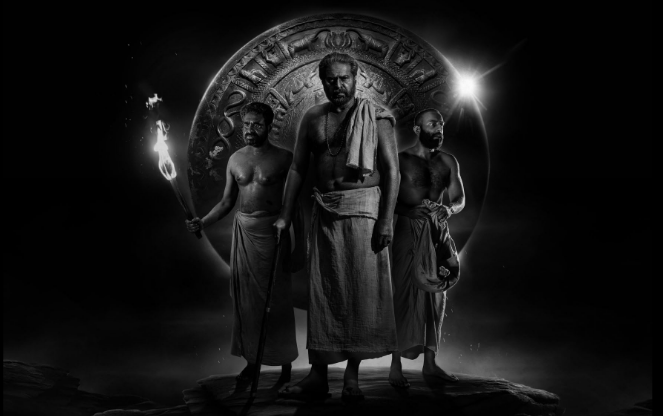
Bramayugam | Shifting Identities and Changing Priorities | Image Source: IMDB
However, as the movie progresses, the characters move from fearing the monster to mimicking the master, just to survive. This proves that the evil’s greatest power isn’t his sorcery, but his ability to make the oppressed fight over the crumbs of his authority. The horror is revealed not through jump-scares, but through the slow, agonizing erosion of dignity, leaving us to wonder if the walls of the Mana are keeping the evil in, or if they are simply reflecting the darkness that’s already there in the human heart.
In the end, Bramayugam posits a chilling question: when you finally kill the monster, do you actually set yourself free, or do you simply become the new occupant of the throne? If you look past the supernatural tropes, this is a film that obsesses with the mechanics of how we trap one another and that power, once gained, inevitably seeks to consume everything beneath it.
The Cycle of Greed
Ultimately, the film refuses to offer the catharsis of a clean escape. By the time the walls of the Mana literally and figuratively crumble, the poison has already leached into the soil. Bramayugam ends with the Portuguese arriving, but their arrival isn’t a respite. It’s only a transition from one form of subjugation to another. It’s the end of one age of madness and the beginning of another (colonialism).
It’s a reminder that where we might see one monster defeated, there will always be another waiting at the door with better weapons and a different flag. It also suggests that the Chathan isn’t a person or a spirit. It’s the lust for power itself, which is a human sickness that still prevails.
This is why I believe Bramayugam is a tale of class war and human rot masquerading as a ghost story. It shows us how the game of power never really ends; only the players change. And whether it’s within an old mansion or a modern office, it is always played. The house might change. Its walls might crumble. But the dice are always loaded, and the “ring” of power eventually finds a new finger to call home.
메타데이터
- post_id
- 9e5259a6ec60
- slug
- why-bramayugam-is-a-tale-of-class-war-and-human-rot-masquerading-as-a-ghost-story-9e5259a6ec60
- url
- https://medium.com/@chayad/why-bramayugam-is-a-tale-of-class-war-and-human-rot-masquerading-as-a-ghost-story-9e5259a6ec60
- canonical_url
- https://medium.com/@chayad/why-bramayugam-is-a-tale-of-class-war-and-human-rot-masquerading-as-a-ghost-story-9e5259a6ec60
- author_url
- https://medium.com/@chayad
- status
- ok
- fetched_at
- 2026-06-11 05:11:55