Generative AI Search: Why Paid Search Isn’t the Same Anymore
Introduction
Generative AI Search: Why Paid Search Isn’t the Same Anymore

Introduction
The digital marketing world is going through one of its biggest changes since search engines first came into play. For a long time, the process was predictable someone typed a query, the search engine showed a list of links and the user clicked on one of them to find answers.
That straightforward journey doesn’t look the same anymore.
With the rise of Large Language Models (LLMs), search has taken a completely new shape. Generative AI Search is no longer just about pointing users toward websites, it’s about delivering answers instantly. Instead of acting as a middleman, search engines are now becoming intelligent systems that understand, process and present information in real time.
For working professionals and students entering the field, the “old way” of managing paid search is becoming less effective by the day. We are moving away from a “blue link” economy toward a conversational interface where the user journey is fragmented and often ends right on the search results page. If you have noticed that your traditional campaigns are yielding different results than they did a year ago, you aren’t imagining it. The fundamental mechanics of user intent and visibility have changed.
How LLMs Redefined “Search”
The traditional Search Engine Results Page (SERP) was designed to be a gateway. Its success was measured by how quickly it could send you away to a relevant website. LLMs like Gemini, GPT-4 and Claude have inverted this logic.
The Rise of Answer Engines
Today, Generative AI Search aims to keep the user engaged within the platform. By utilizing massive datasets, LLMs can now answer complex multi-layered questions such as “What is the best budget-friendly CRM for a team of five that integrates with Shopify?” — without the user ever needing to click a link.
The Impact on Visual Real Estate
In the past, paid ads occupied the “above-the-fold” territory. With the integration of AI Overviews, that prime real estate is now often occupied by a synthesized block of text. This forces paid ads into new, sometimes less prominent positions, or integrates them directly into the AI’s dialogue, making the distinction between “ad” and “answer” increasingly blurred.
SEO vs. GEO: Understanding the New Optimization Playbook
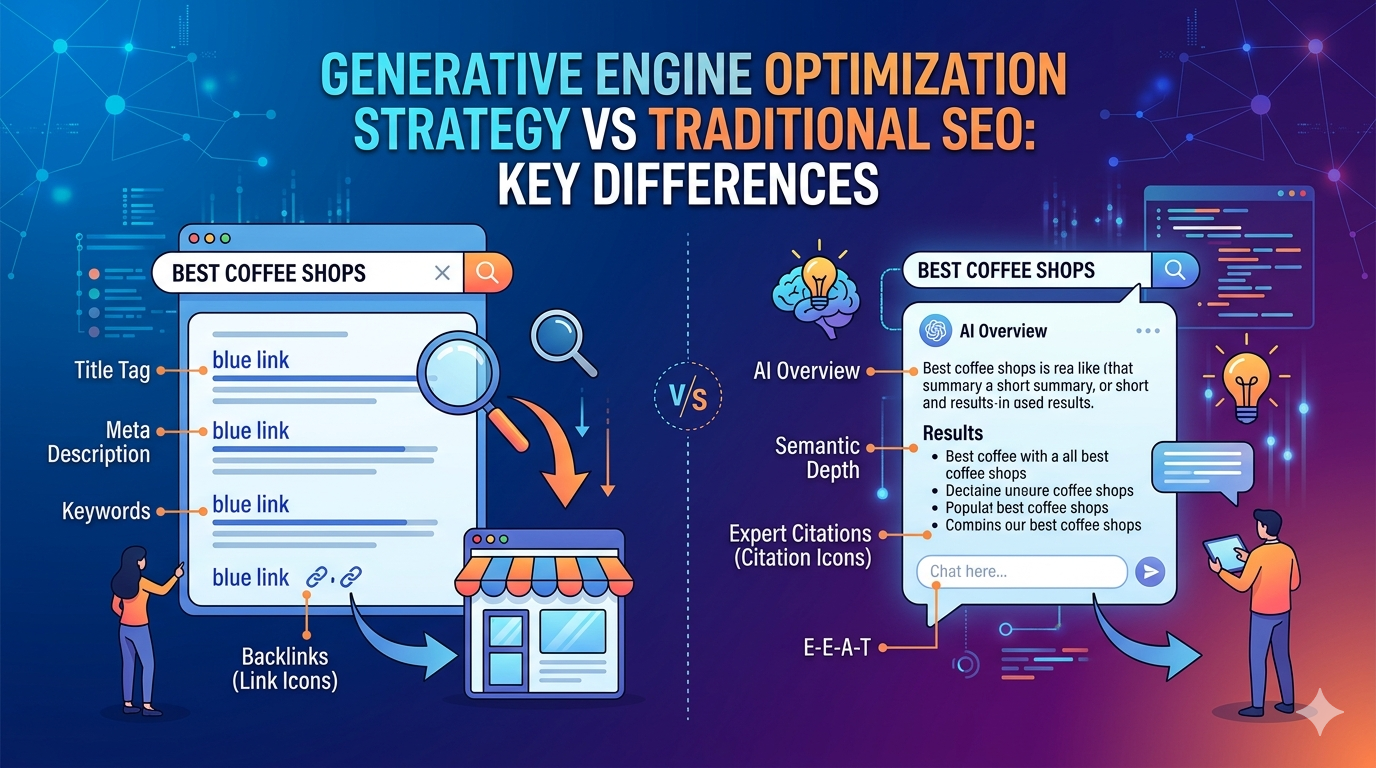
As the technology behind search changes, so must our optimization tactics. While Search Engine Optimization (SEO) remains a foundation, we are seeing the rapid rise of Generative Engine Optimization (GEO).
Traditional SEO Focus
- Ranking Focused: The primary goal is to appear in the top 10 organic results.
- Keyword Centric: Strategies revolve around keyword density, meta tags and backlink profiles.
- Click-Driven: Success is measured by the volume of traffic reaching the landing page.
Generative Engine Optimization (GEO) Focus
- Citation Focused: The goal is to be the source that the AI cites within its generated response.
- Entity Centric: Focuses on establishing your brand as an “authority” or “entity” that the LLM recognizes.
- Context Driven: Prioritizes the directness and factual accuracy of information over traditional keyword placement.
- Technical Literacy: Requires heavy use of Schema markup and structured data to help LLMs parse your content accurately.
While SEO was about winning a beauty contest (visibility), GEO is about winning a debate (being the most credible source).
What is the difference between an AI citation and a search ranking?
The core difference between an AI citation and a search ranking is the format of delivery. A search ranking is your website’s numerical position in a list of links (e.g., Position #3 on Google). An AI citation is a direct reference or link embedded within a synthesized AI response that credits your site for a specific fact, quote, or recommendation.
In the world of **Generative AI Search**, a citation is often more valuable than a ranking because it places your brand directly within the answer the user is reading, rather than as a secondary option listed below the answer.
AI Citation vs. Search Ranking: A New Hierarchy of Authority
In the previous era of search, being #1 was the ultimate goal. In the age of LLMs, you can rank #1 organically and still receive zero traffic if an AI overview answers the user’s query perfectly and cites a different source.
The Psychology of the Citation
When an AI says, “Based on data from Industry Authority X, the market is shifting toward…” it confers a level of institutional trust that a standard link cannot match.
- Authority Signal: A citation acts as a third-party endorsement from the AI itself.
- Fragmented Visibility: AI responses typically cite only 2–4 sources. This creates a “winner-take-all” environment where being #5 or #6 in organic rankings effectively means being invisible.
The Risk of Displacement
For paid search professionals, this means that even a “Top of Page” bid may not guarantee the same engagement it once did. Users are becoming trained to trust the synthesized answer first and the sponsored link second.
How LLMs Affect CTR: The Shift to Zero-Click Searches
One of the most debated topics in digital marketing is how LLMs affect CTR (Click-Through Rate). The impact is not uniform; it depends heavily on the intent of the query.
The Decline in Informational CTR
For simple “what is” or “how to” queries, CTR is seeing a significant decline. If a user asks, “How many calories are in an avocado?” and the AI provides the answer in bold text, there is no functional reason for the user to click on a website.
- Low-Intent Traffic Loss: Brands that rely on high-volume, top-of-funnel informational traffic are seeing their organic and paid click-through rates soften.
The Rise of “High-Value” Clicks
Conversely, for complex research tasks (e.g., “Compare the durability of different roofing materials”), a citation can lead to a much higher quality of traffic.
- Qualified Leads: When a user clicks a link within an AI response, they have already been “pre-sold” on your authority. They aren’t just browsing; they are looking for the deep-dive evidence that supports the AI’s summary.
- Intent Refinement: LLMs help users narrow down their search before they ever visit a site, meaning the visitors you do get are much further along in the conversion funnel.
Real-World Impact: Why Paid Search Isn’t the Same
Paid search used to be a game of bidding on the right words. Now, it’s a game of bidding on the right context.
1. The Dilution of Keyword Match Types
Exact match isn’t quite “exact” anymore. Google’s AI-driven “close variants” mean that your ads are appearing for searches that the engine thinks are related, even if the words don’t match. This is the LLM influence understanding meaning over mechanics.
2. The Rise of Conversational Bidding
Users are no longer typing “best running shoes.” They are typing (or speaking), “What are the best running shoes for someone with flat feet who runs on concrete?” This shift toward natural language means your ad copy needs to be conversational rather than a string of keywords.
Strategic Solutions: How to Win in 2026
To survive the rise of LLMs, marketers must move beyond traditional “set it and forget it” campaign management.
Prioritize “Entity” Building
LLMs rely on a “Knowledge Graph.” You need to ensure your brand is a recognized entity within that graph.
Action: Update your Google Business Profile, ensure your LinkedIn company page is robust and use Organization Schema on your website.
Focus on Original Research and Proprietary Data
AI models are trained on existing data. If your content is just a rewrite of someone else’s blog, the AI has no reason to cite you.
- Action: Publish original case studies, surveys and unique data points. LLMs are programmed to look for “source” information to increase the accuracy of their answers.
Optimize for Voice and Long-Tail Questions
Since Generative AI Search is fundamentally conversational, your content should answer specific questions directly.
Action: Use an H2 or H3 that asks a common industry question and answer it immediately in the following paragraph (40–60 words) to capture the featured snippet and AI citation.
Key Takeaways for the Modern Marketer
- Generative AI Search is shifting the goal from “getting clicks” to “providing the definitive answer.”
- GEO (Generative Engine Optimization) is the essential partner to traditional SEO, focusing on authority and citations.
- The difference between AI citation and search ranking is the difference between being a reference and being a list item.
- While LLMs affect CTR negatively for simple facts, they can improve the quality of traffic for complex, high-intent queries.
- Paid search strategy must pivot toward conversational intent and brand entity authority.
Conclusion
The rise of LLMs doesn’t mean the end of digital marketing; it means the end of “lazy” digital marketing. We can no longer rely on high bidding and basic keywords to drive growth. As **Generative AI Search** becomes the standard, the winners will be the brands that provide the most value, the most data and the most trustworthy answers.
By understanding the nuances of AI citations, the shift toward GEO and the changing nature of CTR, you can position your brand — or your career — at the forefront of this revolution. The search engine is no longer just a tool; it’s an assistant. Make sure you are the one it’s talking about.
FAQs
Q1: Is paid search going away because of AI?
Absolutely not. However, the format of the ads is changing. Expect to see more “sponsored citations” and ads integrated directly into the AI’s conversational flow rather than just a list of links.
Q2: How do I know if my site is being cited by an LLM?
You can use tools like Perplexity or Google Gemini to search for industry-specific queries and see which sources they credit. Additionally, keep an eye on “Search Console” for mentions of AI Overviews.
Q3: Does keyword density still matter for GEO?
Much less than it used to. LLMs understand “semantic meaning.” It is better to cover a topic comprehensively and use related terms (LSI keywords) naturally rather than repeating a single primary keyword.
Q4: Should I block AI bots from crawling my site?
Generally, no. While there are concerns about AI “scraping” content, blocking them ensures you will never be cited in Generative AI Search, which could lead to a massive loss in brand visibility.
Q5: What is the most important E-E-A-T signal for AI?
Authoritativeness and Trustworthiness. Having clear author bios, citations to other reputable sources and a history of accurate, data-driven content are the best ways to signal quality to an LLM.
메타데이터
- post_id
- 9e53ecde3369
- slug
- generative-ai-search-why-paid-search-isnt-the-same-anymore-9e53ecde3369
- url
- https://medium.com/@upkepr/generative-ai-search-why-paid-search-isnt-the-same-anymore-9e53ecde3369
- canonical_url
- https://medium.com/@upkepr/generative-ai-search-why-paid-search-isnt-the-same-anymore-9e53ecde3369
- author_url
- https://medium.com/@upkepr
- status
- ok
- fetched_at
- 2026-06-12 07:40:50