Masculine Performance through the Lens of Mad Men’s Pilot episode.
Set within a 1960s New York advertising department, Matthew Weiner’s pilot of Mad Men presents masculinity through ideals of success…
Masculine Performance through the Lens of Mad Men’s Pilot episode.
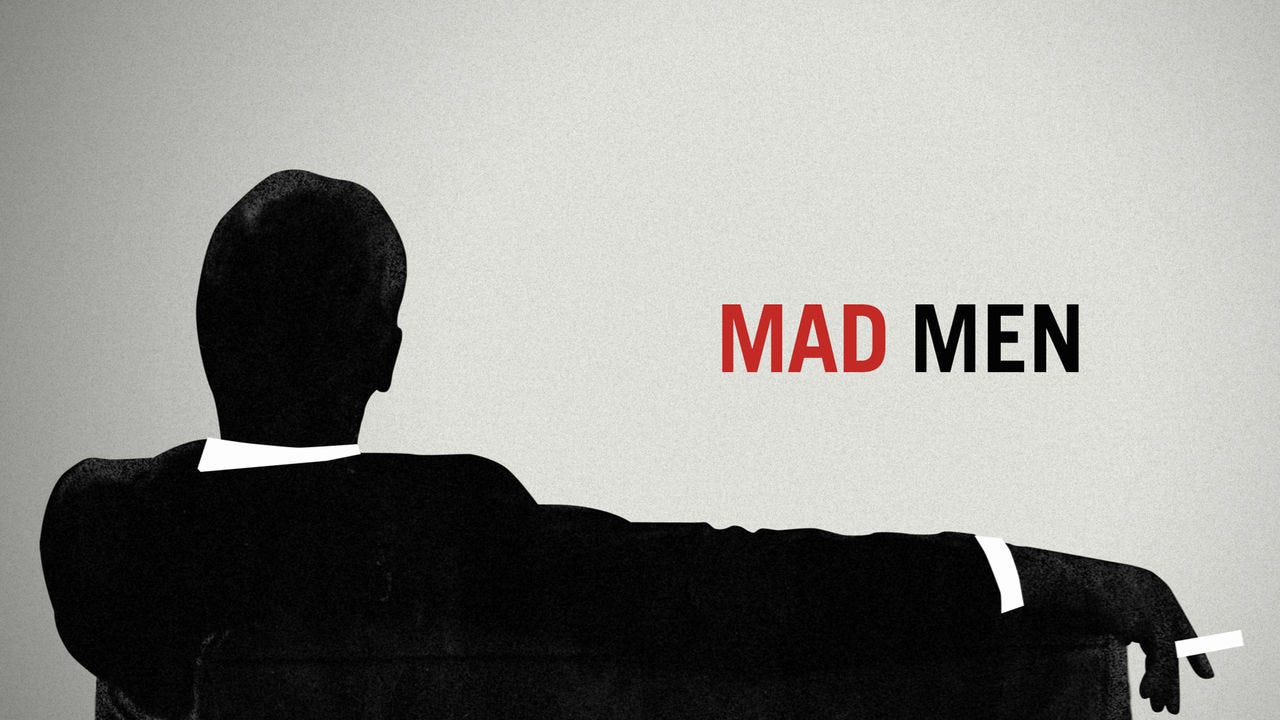
2007 Poster of Weiner’s Mad Men
Set within a 1960s New York advertising department, Matthew Weiner’s pilot of Mad Men presents masculinity through ideals of success, heterosexuality, and authority, revealing this as a performed image rather than something naturally possessed. Focusing on character Don Draper and those around him within the workplace, we see the charade of masculinity being performed in almost every scene, something that must be continually maintained. Adding to the notions of Success and heterosexuality, these characters aim to covey sexual control and professional/social dominance in order to upkeep the idealised impression of the American working man. Using works that analyse masculine performance and ideals, we can use theorists such as Judith Butler and John Beynon to understand reasoning and application within these performances. Situated within a period idealising gender roles, ‘regaining’ post-war prosperity, Weiner’s Mad Men acts as a blueprint for the contemporary American male, with the Advertising office creating the perfect stage.

Sign to Sterlign Cooper Advertising Agency
Existing as a hive of masculinity, the office in which Don Draper and his coworkers inhabit represents an ideal theatre for patriarchal dominance. As the series first moves into the advertising department it takes no time for this toxic masculinity to be presented. As character Ken Cosgrove and his followers’ step into the elevator, they leer towards the new intern, Peggy, whispering predatory statements towards her such as ‘I’m enjoying the view’. Here Cosgrove is not only looking down on Peggy with sexual intent but also playing this role for the men around him, attempting to establish himself higher than his coworkers within the elevator with sexual dominance. The idea of Sexual offense within the office, also pairs with the excessive drinking and smoking committed throughout most scenes, something that represents masculine ideals. Suggesting that ‘Men are not born with masculinity’ John Beynon provokes the idea that these repeated performances of sexual harassment and excessive consumption of alcohol and cigarettes within the workplace, upkeep outdated impressions of 60s masculinity.

Peggy and Cosgrove within Sterlign Cooper’s evelator
One way in which Sterling Cooper, the office, works within the pilot of Mad Men is through its established basis of gender conformity. Explaining this, we see the women of the office stationed at small desks, usually outside of the executive offices in which only the men of Sterling Cooper reside. Within Sterling Cooper, we can use Judith Butler’s identity theory to represent male and even female, though oppressed, repeated gender roles when she suggests ‘an identity is instituted through a stylized repetition of acts’. Using this theory, the advertising office acts as a physical pyramid for repeated gender conformity, with woman being made to dress to please male taste, alongside being at hand to cater to any needs. Looking to how the office presents male performance, on top of controlling the female work area, we can start to develop an idea of leisure and need to passively work. Looking to the female workspace, there is a hectic environment, from the switchboard operators to the executive assistants showing constant movement and expectations completely contrasting the male space. When the camera cuts to Don Draper in his office, we see him laid on the sofa asleep, around the same time Peggy is made to bring him medicine from the chaos outside. Using this scene as an analytical tool we see this idea of a leisure as performance, with the male workers viewing the hustle and bustle of the office to be a ‘woman’s job’, enhancing their own masculinity due to free time; Viewing their staggered business meetings as more important.

Lucky Stripes Business Meeting Preperation
Changing from the public sphere to the domestic, the audience is able to gain the impression of performance deterioration through Don Draper’s wife and child. After having an affair on his wife, sexual control, belittling the Lucky Stripe CEO, patriarchal judgment, Don Draper returns home to morph into the moralistic American male. This idea of change shows that Don Draper does not have a singular format of masculinity, yet presents two different versions depending on surrounding environments, and thus adding evidence to our theory. Transformations in masculine performance like this, reflect Judith Butlers argument that gender is built on repeated actions and repeated environments rather than an innate part of male genealogy. Blending into the domestic sphere, Don Draper does what he knows he can do best, sell an appearance just as he does with Cigarettes at Sterling Cooper, satisfying demands within both his private and public life, ensuring they do not clash.

Betty and Don Draper
Ultimate, Weiner’s pilot of Mad Men presents the idea that American Masculinity is not an inherent characteristic yet exists as an ideal that relies on constant performance based upon expectations and environment. Pairing Sterling Cooper’s, and 60’s America’s, objectification of female workers alongside the ‘executive’ patriarchal hierarchy, this episode suggests that masculinity also exists as a competition, with performances such as Cosgrove’s boosting one’s position. Using theory such as Butler and Beynon, the ways in which masculinity as a performance are revealed, with sexual dominance and professional success being paramount to a man’s image within not only the workplace, but general to aspects of 60’s American patriarchy. Consequently, Mad Men’s pilot challenges the moralistic ideal of the male citizen, yet use’s masculine performances to ‘make a nostalgic recreation of a time and place’, this just happening to be an advertising department within bustling 60s New York City.
This was intially a university mini assignment but found it very intersting and fun to write!!! i was also way too lazy to transfer my references from Word to Medium.
메타데이터
- post_id
- 9e5db1dc2f2e
- slug
- masculine-performance-through-the-lens-of-mad-mens-pilot-episode-9e5db1dc2f2e
- url
- https://medium.com/@harvey12boardman/masculine-performance-through-the-lens-of-mad-mens-pilot-episode-9e5db1dc2f2e
- canonical_url
- https://medium.com/@harvey12boardman/masculine-performance-through-the-lens-of-mad-mens-pilot-episode-9e5db1dc2f2e
- author_url
- https://medium.com/@harvey12boardman
- status
- ok
- fetched_at
- 2026-06-09 15:37:30