The 7 Interview Mistakes That Cost Me Job Offers.
I did not lose opportunities because I lacked technical knowledge. I lost them because I failed to communicate judgment, ownership, and…
The 7 Interview Mistakes That Cost Me Job Offers.
I did not lose opportunities because I lacked technical knowledge. I lost them because I failed to communicate judgment, ownership, and clarity when the pressure started.
Most developers do not fail interviews because they cannot code.
They fail because the interviewer cannot see how they think.
I learned this after walking out of interviews feeling confident, only to receive the same polite rejection a few days later:
“We’ve decided to move forward with another candidate.”
The frustrating part was that I usually knew the technologies. I had built APIs, deployed applications, fixed production bugs, worked with databases, managed servers, and spent late nights debugging problems that tutorials never mention.
But interviews exposed something uncomfortable.
Knowing the answer and communicating engineering maturity are not the same skill.
I was giving technically acceptable answers while accidentally showing weak judgment, unclear ownership, poor communication, and insecurity. The interviewer was not only evaluating whether I knew Node.js, React, Docker, PostgreSQL, or AWS.
They were quietly asking:
Can this person investigate a production issue without panicking?
Can they explain a trade-off without hiding behind buzzwords?
Will they admit uncertainty before making a dangerous change?
Can they work with a team when requirements are unclear?
Will they take ownership when something breaks?
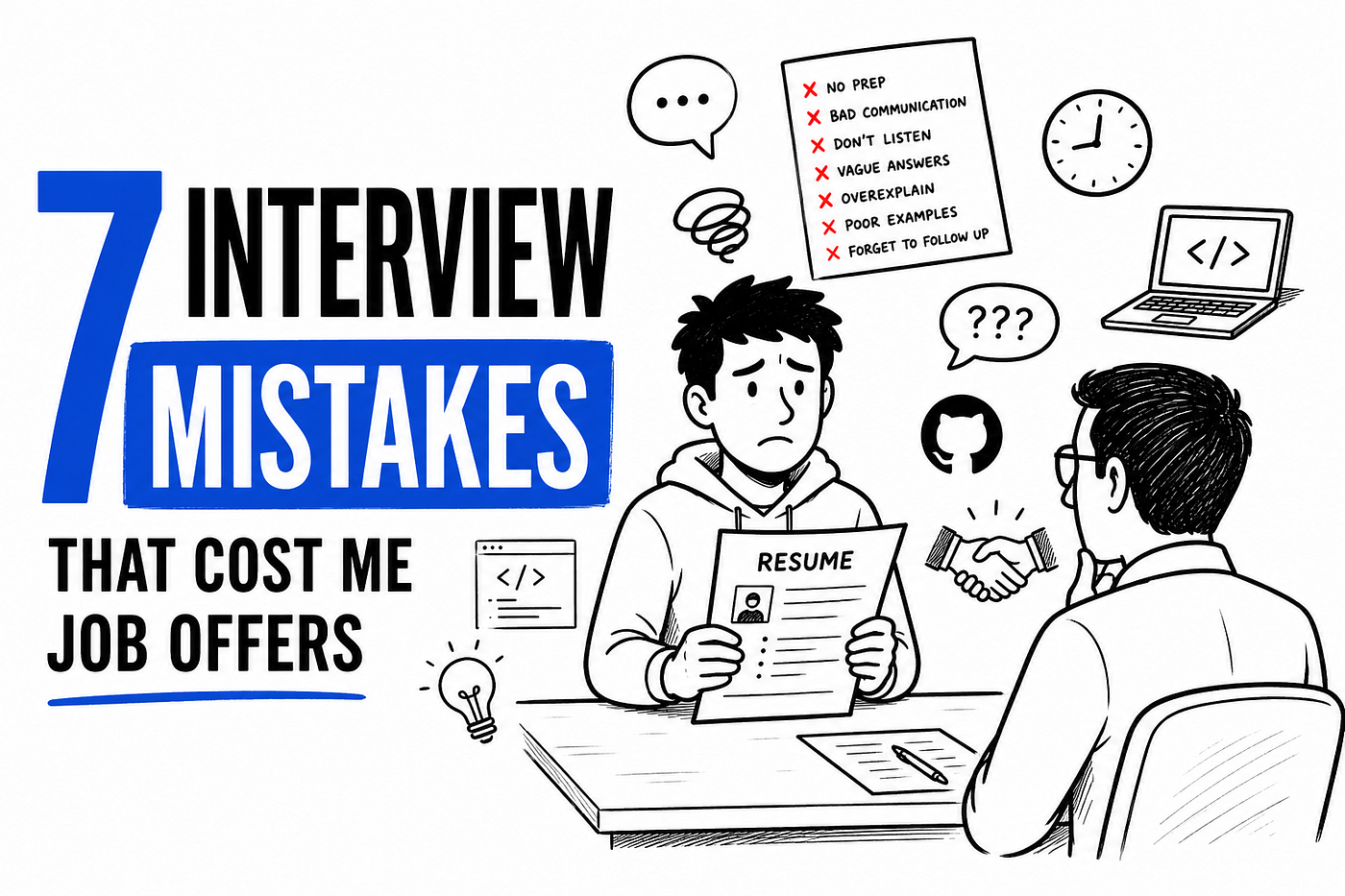
These are the seven mistakes that cost me opportunities, and the lessons I wish I had understood earlier.
Interviews Are Not Knowledge Tests. They Are Risk Assessments
I used to treat technical interviews like university exams.
The interviewer asked a question, and I searched my memory for the most impressive answer. If they mentioned scalability, I talked about microservices. If they mentioned performance, I said Redis. If they asked about deployments, I listed Docker, Nginx, CI/CD, AWS, and monitoring.
I thought showing more knowledge made me look senior.
Often, it made me look dangerous.
Companies are not hiring a collection of keywords. They are hiring someone who will make decisions inside systems where mistakes cost money, time, customer trust, and sleep.
When an interviewer asks, “How would you improve this slow API?” they are not waiting for you to say caching. They want to know whether you first inspect database queries, response size, external services, logs, CPU usage, indexes, and recent deployments.
A developer who immediately adds Redis may sound productive. A stronger engineer asks what is actually slow.
The interview is not asking, “Do you know tools?”
It is asking, “Can we trust your judgment when the answer is unclear?”
Mistake 1: I Answered Before I Understood the Question
One of my worst habits was answering too quickly.
The interviewer would ask:
“How would you design authentication for this application?”
Before they finished explaining the system, I was already talking about JWTs, refresh tokens, guards, cookies, Redis, token rotation, and role-based access control.
The answer sounded technical, but it was built on assumptions.
I had not asked whether the application was web-only or mobile. I did not know whether users needed multiple sessions, social login, forced logout, tenant isolation, or strict compliance requirements. I did not know whether the backend and frontend shared a domain or whether the system needed server-side sessions.
I was solving a system that existed only in my head.
This is exactly how bad architecture enters real products. A developer hears “authentication” and installs the pattern they used last time. Months later, the team discovers that refresh tokens cannot be revoked properly, cookies behave differently across domains, or mobile clients cannot follow the same flow.
A better response begins with clarification:
“Before choosing the authentication approach, I’d like to understand the clients, security requirements, expected session behavior, and whether immediate revocation is required.”
That sentence does not make you look unprepared. It shows that you understand architecture depends on context.
There are moments when an interviewer wants a quick conceptual answer. That is fine. The goal is not to turn every question into a requirements workshop. The goal is to avoid presenting assumptions as facts.
Do not solve the question you expected. Solve the question that was actually asked.
Mistake 2: I Gave Long Answers Instead of Clear Answers
I used to believe that longer answers proved deeper knowledge.
When asked about the Node.js event loop, I would explain the call stack, task queues, microtasks, timers, I/O callbacks, worker threads, and half of the runtime architecture.
Some of it was correct.
Most of it was unnecessary.
By the time I reached the important point, the interviewer had to rescue the conversation and move to the next question. I had turned a focused interview into an uncontrolled lecture.
Long answers also create more opportunities to contradict yourself. You begin with a correct explanation, add unnecessary details, mention an edge case you do not fully understand, and suddenly the interviewer is questioning the weakest sentence in your entire response.
A stronger answer has layers.
Start with the direct response:
“Node.js can handle many concurrent I/O operations efficiently because it does not block the main JavaScript thread while waiting for most network or file operations.”
Then pause.
If the interviewer asks for more depth, explain the event loop, queues, and where CPU-heavy work becomes a problem.
This approach is not about being brief for the sake of being brief. It is about respecting the shape of the question. A two-minute answer to a twenty-second question often communicates poor prioritization.
The same problem appears in real engineering. Some developers send ten-paragraph Slack messages when the team needs one decision, one reason, and one next step.
Clear communication is not reducing knowledge.
It is delivering the right amount of knowledge at the right time.
Answer the question first. Add depth only where it improves the decision.
Mistake 3: I Memorized Definitions but Could Not Explain Trade-Offs
I could define microservices.
I could explain horizontal scaling.
I knew the difference between SQL and NoSQL databases. I could describe Docker, queues, load balancers, caching, indexes, and REST principles.
Then an interviewer would ask:
“Would you use microservices for this product?”
And my answer became weak.
I would repeat the benefits: independent deployment, scalability, fault isolation, and team autonomy. I rarely discussed the cost: network failures, distributed tracing, duplicated infrastructure, deployment complexity, data consistency, local development, and operational overhead.
Definitions show that you studied.
Trade-offs show that you have built things.
A junior answer says PostgreSQL provides strong relational features. A stronger answer explains why PostgreSQL may be safer for transactions, reporting, and structured relationships, while also acknowledging that schema changes, connection limits, and poorly designed queries can create operational problems.
A weak answer says Redis makes the system faster. A stronger one asks whether the data can become stale, how invalidation works, what happens when Redis is unavailable, and whether the database query should be fixed first.
Interviewers are rarely looking for one universally correct technology. They want evidence that you understand every decision creates consequences.
A mature answer often sounds like this:
“For the current scale, I would start with a modular monolith because it is easier to deploy, debug, and maintain. I would separate clear domain boundaries so individual modules can be extracted later if traffic, team ownership, or deployment needs justify it.”
That answer is less fashionable than “microservices.”
It is also more believable.
Do not only explain what a tool can do. Explain what it will cost the team.
Mistake 4: I Pretended to Know Things I Did Not Know
This mistake came from fear.
I thought saying “I don’t know” would immediately disqualify me. So when an interviewer asked about something unfamiliar, I tried to construct an answer from nearby concepts.
Sometimes I survived.
Sometimes I created technical nonsense while watching the interviewer’s expression change.
Developers often believe uncertainty makes them look weak. In reality, confident guessing is much more dangerous.
Imagine a production incident involving failed payment webhooks. One engineer says, “I’m not sure whether the provider retries these events. I’ll confirm before we change the handler.” Another confidently assumes retries do not happen and deploys a quick fix.
The second engineer sounds faster.
They may also charge customers twice.
A good interview response does not stop at “I don’t know.” It shows a path:
“I haven’t implemented that specific AWS service in production. My understanding is that it solves this type of problem, but I would need to verify its delivery guarantees, retry behavior, limits, and pricing before recommending it.”
That answer communicates honesty, partial understanding, and investigation discipline.
You are not expected to know everything. Even senior engineers regularly work outside their strongest areas. What matters is whether you distinguish knowledge from assumption.
There is nuance here. Do not use uncertainty as an escape from every difficult question. Think aloud, connect the problem to what you know, and explain how you would validate the missing parts.
A careful unknown is safer than a confident invention.
Mistake 5: I Started Coding Before Defining the Problem
During coding interviews, I wanted to prove I was fast.
The moment I understood the basic task, I started typing.
I did not confirm input constraints. I ignored invalid values. I did not ask whether duplicates were allowed, whether order mattered, or what should happen when no result existed.
Then the interviewer introduced an edge case, and my solution started collapsing.
This was not a syntax problem. It was a process problem.
The same behavior creates production bugs. A ticket says, “Add pagination to the users endpoint.” A developer immediately adds page and limit, but nobody defines maximum limits, stable sorting, empty pages, invalid parameters, total counts, or what happens when records are inserted between requests.
The endpoint works in a demo.
It becomes unreliable under real usage.
A better coding interview flow is simple:
- Restate the problem.
- Confirm assumptions.
- Walk through one example.
- Discuss the approach.
- Mention time and space complexity.
- Write the solution.
- Test normal and edge cases.
This may feel slower during the first few minutes. It usually makes the complete solution faster because you are not repeatedly repairing misunderstood requirements.
Strong engineers do not race into implementation.
They reduce uncertainty before creating more code.
Five minutes of clarification can prevent twenty minutes of rewriting.
Mistake 6: I Described Projects as Technology Lists
When interviewers asked about my experience, I used to answer like this:
“I built the project using React, Node.js, Express, PostgreSQL, Prisma, Docker, Nginx, AWS, and GitHub Actions.”
That tells them what existed.
It does not tell them what I did.
Many candidates describe projects as stacks because stacks are easy to remember. But interviewers need evidence of ownership. They want to know what problem you solved, what decisions you made, what failed, and what changed because of your work.
A stronger project explanation follows a practical shape:
- What the product did
- What you personally owned
- What constraint made the work difficult
- What decision you made
- What result followed
- What you would improve now
For example:
“I owned the backend deployment and media-processing flow for an application that generated layered mobile wallpapers. The original image processing blocked API requests and created long response times. I separated the processing work from the request lifecycle, stored generated assets in object storage, and tracked the processing status in PostgreSQL. That made failures easier to retry and prevented the API from waiting on CPU-heavy work.”
Now the interviewer can see the problem, ownership, architecture, and result.
Do not exaggerate your role. If you contributed to one module, say so. Honest boundaries make the parts you genuinely owned more credible.
The most impressive project is not always the one with the largest stack.
It is the one you understand deeply enough to explain its failures.
Talk about decisions and consequences, not just libraries and frameworks.
Mistake 7: I Became Defensive When My Answer Was Challenged
An interviewer once questioned an architecture I proposed.
Instead of treating the challenge as collaboration, I treated it as an attack.
I kept defending my original answer even after the interviewer introduced new constraints that made it weaker. I was more interested in protecting my credibility than improving the solution.
That is developer ego in its most expensive form.
In real teams, requirements change. Senior engineers discover missing information. Production traffic behaves differently from estimates. A database design that looked clean during planning becomes painful under reporting workloads.
Strong engineers update their position when the evidence changes.
Weak engineers protect the first idea because admitting a better option feels like losing.
When an interviewer says, “What happens if Redis goes down?” they may not be proving you wrong. They are giving you another constraint.
A good response could be:
“That changes the reliability requirement. I would avoid making Redis the only source of truth, define fallback behavior, and decide whether degraded performance is acceptable during an outage.”
You do not need to abandon every answer as soon as it is challenged. Some design choices deserve a clear defense. But the defense should be based on requirements and evidence, not personal attachment.
The interview is not a debate you must win.
It is a simulation of how you behave when another engineer pushes on your assumptions.
Your ability to revise an answer can be more impressive than getting it perfect immediately.
Good Interviews Are Evidence, Not Performance
The biggest change in my interviews happened when I stopped trying to sound impressive.
I started asking clearer questions.
I gave direct answers before adding depth. I admitted what I did not know. I explained trade-offs instead of repeating benefits. I described real ownership instead of listing technologies. I slowed down before coding and treated challenges as new information.
The interviews became less theatrical.
They also became more honest.
Technical interviews are imperfect. Strong developers still get rejected. Companies make inconsistent decisions, interviewers have biases, and sometimes another candidate simply matches the role more closely.
But many rejections are not caused by missing knowledge.
They happen because our knowledge becomes difficult to trust under pressure.
Good engineering is not knowing every answer immediately. It is understanding the problem, separating facts from assumptions, communicating decisions clearly, and changing direction when reality proves you wrong.
That is what the interviewer is trying to see.
Do not perform intelligence. Show judgment.
Follow me for more honest developer stories and practical engineering lessons.
메타데이터
- post_id
- 9e6b90439d4f
- slug
- the-7-interview-mistakes-that-cost-me-job-offers-9e6b90439d4f
- url
- https://medium.com/skillstuff/the-7-interview-mistakes-that-cost-me-job-offers-9e6b90439d4f
- canonical_url
- https://medium.com/skillstuff/the-7-interview-mistakes-that-cost-me-job-offers-9e6b90439d4f
- author_url
- https://medium.com/@muhammadshakir4152
- status
- ok
- fetched_at
- 2026-07-13 06:23:13