The Impact of the SAVE Act on the Cost of Voting: A Wolf in Sheep’s Clothing?
Introduction: The Present “Cost of Voting” Research
The Impact of the SAVE Act on the Cost of Voting: A Wolf in Sheep’s Clothing?
Introduction: The Present “Cost of Voting” Research
In the U.S., voting comes with costs; voters must commit their personal resources (e.g., time, effort, money) to complete the voting act. Depending in which state voters live, voting can be more or less costly. If, for instance, voters live in AR, TX or MS , voting is more costly, requiring expenditures of greater personal resources to exercise the franchise, than if they live in OR, HI, or WA (see Pomante, 2024, “Cost of Voting Index”). The research on the cost of voting links voting difficulty to voter turnout; such that, as the act of voting becomes more difficult, requiring more personal resources to complete, voter turnout decreases (Pomonte II, et. al, 2023).
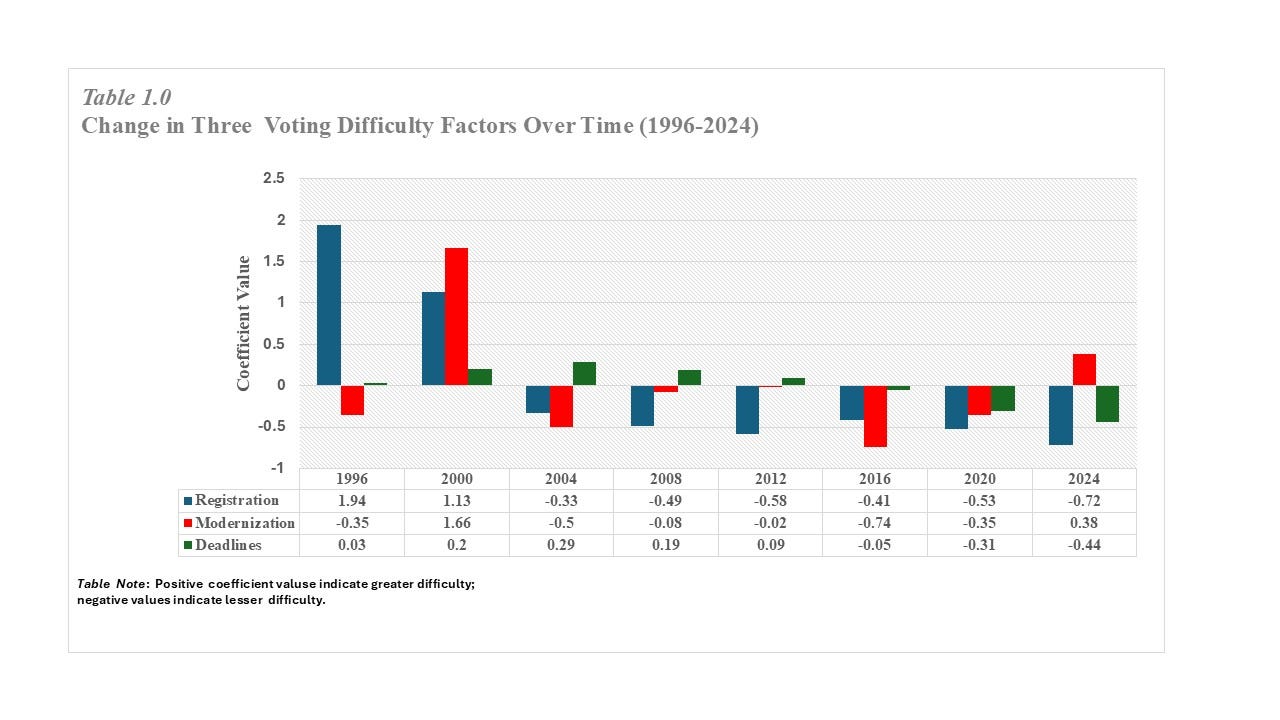
This author’s ongoing empirical research on the “Cost of Voting” (see Baxter, 2026) links three voting difficulty factors (i.e., registration, modernization, and deadlines) to voter turnout. Table 1.0 below shows the manner in which these three factors have changed over the course of eight presidential election cycles (1996–2024).
Baxter, A.G. (2026). Time and Turnout: Linking the Cost of Voting to Voter Turnout. Unpublished Manuscript
Table 1.0 presents a chart of mean values for Registration, Modernization, and Deadlines factors, showing changes in these three measures of voting difficulty across eight U.S. presidential election cycles (1996 to 2024).
Registration Difficulty: The tabular data show that registration difficulty steadily declines over time. At its highest point in 1996, this factor peaks and becomes consistently lower, reaching its lowest level in 2024. This decline indicates a long‑term reduction in registration barriers over time.
Modernization Difficulty: The tabular data further show that modernization barriers follow a similar trend. The modernization factor fluctuates substantially, sharply improving (lower difficulty) in 2000 with mixed and inconsistent changes thereafter. Most likely reflecting the spread of Automatic Voter Registration systems or lack thereof, modernization difficulty increases in 2024, becoming more restrictive.
Deadline Difficulty: Table 1.0 also shows a reversal in deadline difficulty over time, manifesting positive (less restrictive) values through 2012 and turning negative (more restrictive) starting in 2016. Deadline difficulty becomes most restrictive in 2024, a fact that highlights an increasing reliance on time‑based administrative constraints in recent elections and which my research links to voter turnout.
While traditional registration barriers have declined over the past three decades, procedural deadlines have become increasingly restrictive, particularly since 2016. Table 1.0 visually reinforces the central claim that the modern cost of voting is increasingly driven by time‑based constraints rather than access to registration. This implies that requirements that increase the time voters must commit to exercising the franchise is likely to lower voter turnout.
A related area of my larger cost-of-voting study finds that in “more difficult” states wherein voters must register to vote in person, 30 days before the election (e.g., AR, TX, MS), voter turnout is significantly lower than “less difficult” states, those wherein voters can “same-day register” or register electronically or in-person on election day (e.g., WA, OR, HI). Even more compelling for this paper’s purposes, the overall cost of voting research clearly shows that increases in the cost of voting, affect minorities, women, and the poor most, dramatically reducing turnout among these groups.
What would happen to variability in the voting costs between the states if these costs universally rise? The Safeguard American Voter Eligibility (SAVE) Act, H.R. 22 introduced January 3, 2025, is Congressional legistation which if enacted would universally increase the costs of voting, changing voter registration requirments for federal elections. Supporters say the SAVE Act would prevent noncitizens from voting, while critics argue it would make it harder for eligible voters, especially young and first-time voters, to register because of new proof of registration requirements.
My research projects that the SAVE Act’s registration requirement; including passports, original birth certificates, marriage licenses and court documents for people who have name changes, would greatly increase the cost of voting in all fifty states. The states that COVI ranks as the least and most costly states in which to vote (see, Pomante et. al, 2023) would become substantially more difficult for voters to complete the franchise. For instance, voters in OR, HI, and WA, which COVI ranks as the least costly states, have significantly higher turnout than AR, TX, and MS, the costliest states in which to vote. Would a general increase in costs alter these rankings?
Methods: Analyzing the Costs of Documented Proof of Citizenship
Looking at the SAVE Act’s voter registration requirement, namely Documented Proof of Citizenship (DPOC), the standard is basically the same as securing a U.S. passport: To secure a U.S. passport, applicants need to provide documented proof of U.S. citizenship, such as a birth certificate or naturalization certificate; a government-issued ID, such as a driver’s license or state ID. If the applicant’s name has changed, applicants must provide an official name change document, such as a marriage certificate. The amount of time, effort, and money voters must spend to meet the “passport-like” registration requirement would greatly increase, especially for those without passports or ready access to original birth certificates, marriage certificates, Real ID, or other official documents.
Given the parallels between the State Department’s actual passport and the SAVE Act’s proposed DPOC requirements, passport ownership can serve as a useful proxy to project the possible impact the SAVE Act would have on the cost of voting and thereby on voter turnout. This paper proposes to use the costs of meeting U.S. Passport requirements to estimate the SAVE Act’s effects on the cost of voting should it become law.
Results: The Cost of Securing a U.S. Passport
The costs of securing a passport can be broken down in terms of the same demands on personal resources that the cost of voting makes, i.e., time, effort, and money. For a first-time adult applicant (age 16+) in March 2026, the estimated commitment for a U.S. passport book is 6–10 weeks of time, approximately 2–3 hours of active effort, and at least $175–$185 in mandatory costs. These costs breakdown as follows:
1. Time Investment
For a first-time adult applicant (age 16+) in March 2026, the estimated commitment for a U.S. passport book is 6–10 weeks of time. The total “door-to-door” time includes both processing by the U.S. Department of State and mailing periods.
a) Routine Service: 8–10 weeks total (4–6 weeks for processing plus up to 4 weeks for round-trip mailing).b) Expedited Service: 6–7 weeks total (2–3 weeks for processing plus up to 4 weeks for mailing).
c) Best Time to Apply: Late winter through summer is peak season; applying between October and December typically results in faster turnaround.
2. Effort and Tasks
Expect to spend approximately 2 to 3 hours of effort on document preparation and submission.
a) Form Completion: Filling out Form DS-11 is estimated to take about 55–85 minutes.
b) Document Gathering: You must collect original proof of citizenship (e.g., birth certificate) and a valid government-issued ID.
c) In-Person Appointment: First-time applicants must apply in person at an authorized acceptance facility, such as a post office or clerk’s office. This includes travel time and the appointment itself.
3. Financial Cost (2026 Rates): Expect to pay at least $175–$185 in mandatory costs.Fees are split into two mandatory payments that must be paid separately.
Findings: Comparison of the SAVE Act’s Effects in Easiest and Hardest States
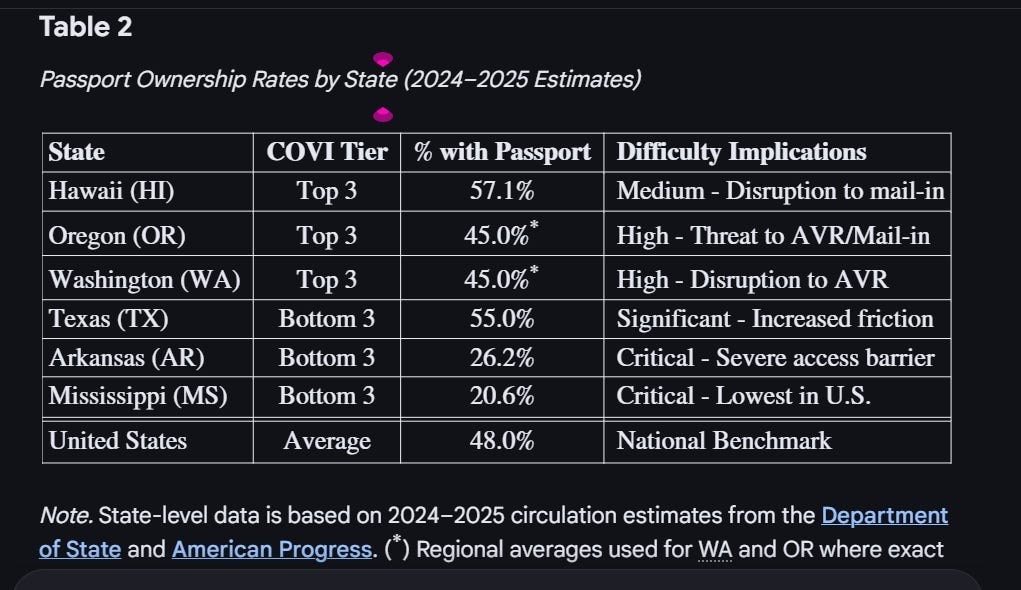
Built on the real costs of meeting the passport requirements as a proxy measure for the cost of voting, Table 2 below shows the percentage of voters in the three easiest and three most difficult of the 50 states who currently have passports (i.e., are qualified to register). The tabular data highlights three types of effects which this study projects the passage of the SAVE Act would induce in the six states:
-
Inversion of Ease: In “high-ease” states like Hawaii, roughly 42.9% of the population lacks the easiest form of DPOC (a passport). Under the SAVE Act, these individuals would lose the ability to register via current mail-in/online channels without an in-person document check, lowering voter turnout.
-
Compounded Barrier: In Mississippi, where nearly 80% of residents do not own a passport, the SAVE Act would likely “cement” its position at the bottom of the Cost of Voting rankings, as the vast majority of new registrants would be forced to navigate the higher-cost hurdle of birth certificate retrieval and in-person verification.
-
Documentation Gap: Nationally, approximately 146 million American citizens do not possess a valid passport, making alternative documentation (and the associated costs) the primary driver of registration difficulty under the SAVE Act legislation. By significantly increasing the cost of voting, the SAVE Act would clearly lower voter turnout.
Discussion: A Wolf Hiding Inside the SAVE Act
Current research on changes in the cost of voting over the course of eight presidential election cycles (e.g., see Baxter, 2026) shows a shift in registration difficulty away from registration access to greater time-based constraints, the very area that the SAVE Act targets with near surgical precision. Halting the steady easing of the difficulty (personal expense) in registering to vote and thus the corresponding increase in voter turnout, the SAVE Act appears as nothing more than a voter suppression strategy, one that would negatively affect minorities, women, and the poor more than other social groups.
Although some mistakenly believe that voting, like driving, is a privilege and thus subject to revocation by the government, voting in the United States is a constitutional right, protected under the 15th, 19th, 24th, and 26th Amendments. The government can neither in fact nor in effect deny citizens their right to vote based on race, sex, failure to pay a poll tax, or age (18 and older). While states can regulate how elections are run, they cannot infringe on citizens’ fundamental right to vote without violating the U.S. Constitution.
Sponsored by Congressional Republicans as a benign voter ID bill, but operating through the mechanism of registration difficulty, the 2025 SAVE Act would effectively disenfranchise minorities, women, and poor voters most, those who tend to vote for Democrat candidates over Republican ones (e.g., see Barber and Holbein, 2022). Thus, the SAVE Act, if it passes into law as it is written, is best viewed fabulistically, that is, as the proverbial “wolf in sheep’s clothing” of which all U.S. citizens ought to beware.
References
Baxter, A.G. (2026). Time and Turnout: Linking the Cost of Voting to Voter Turnout. Unpublished Manuscript
Pomante M. J. II, Schraufnagel, S., & Li, Q. (2023). The Cost of Voting in the American States. Kansas City: University Press of Kansas.
Barber M, Holbein JB. 400 million voting records show profound racial and geographic disparities in voter turnout in the United States. PLoS One. 2022 Jun 8;17(6):e0268134. doi: 10.1371/journal.pone.0268134. Erratum in: PLoS One. 2024 Nov 20;19(11):e0314386. doi: 10.1371/journal.pone.0314386. PMID: 35675350; PMCID: PMC9177044.
Acknowledgement
This study acknowledges the support of CHAT-GPT 4's LLM, assisting with literature search and review and data interpretation. The author is responsible for all form and content elements of this research.
메타데이터
- post_id
- 9e8338fea883
- slug
- the-impact-of-the-save-act-on-the-cost-of-voting-a-wolf-in-sheeps-clothing-9e8338fea883
- url
- https://medium.com/@anthonygbaxter/the-impact-of-the-save-act-on-the-cost-of-voting-a-wolf-in-sheeps-clothing-9e8338fea883
- canonical_url
- https://medium.com/@anthonygbaxter/the-impact-of-the-save-act-on-the-cost-of-voting-a-wolf-in-sheeps-clothing-9e8338fea883
- author_url
- https://medium.com/@anthonygbaxter
- status
- ok
- fetched_at
- 2026-06-09 14:34:10