How to Build a Professional Identity that Travels across Every Platform
At a conference last year, Ryan, a product designer, met someone who would have been a perfect client. The conversation was genuinely good…
How to Build a Professional Identity that Travels across Every Platform
At a conference last year, Ryan, a product designer, met someone who would have been a perfect client. The conversation was genuinely good. They talked for twenty minutes about a shared frustration with how enterprise software gets built, found common ground on more than a few things, and ended with the prospect saying, “You should send me your portfolio.”
Ryan handed over a paper card and waited patiently for a few weeks to get a call.
He didn’t.
Maybe the prospect lost the card, or set it aside and forgot. Even though the connection was real, nothing came of it.
The problem with how most professionals show up
We spend significant time building expertise, accumulating work, developing opinions, and cultivating a professional reputation. Then, when the moment comes to introduce ourselves, in person, online, or somewhere in between, what we hand over rarely reflects any of that.
A LinkedIn profile, a paper business card, an email signature with a phone number, and a website that hasn’t been updated in two years. None of these is wrong on its own. The problem is they aren’t connected.
Every platform reflects a different facet of who you are professionally, and no single introduction brings those facets together. When someone meets you and wants to learn more, they have to assemble the picture themselves.
Most won’t.
What a professional identity actually needs to do
A strong professional identity isn’t just about looking polished. It needs to work for you in every context, consistently and without friction. Here’s what that means in practice:
- It arrives before you’ve had a chance to explain yourself. The person receiving it should understand, within seconds, who you are, what you do, and why that’s relevant to them. Not after scrolling through a website or reading a LinkedIn About section.
- It travels consistently across every context. The version of you that someone meets at a conference should match the version they find online, in an email, or when they pass your name to a colleague. Inconsistency doesn’t just look disorganized; it creates doubt.
- It gives people a clear next step. A professional identity without a call to action is just a profile. Good personal branding guides the other person: book a call, view my work, reach out here, connect on this platform. It does the navigation for them.
Most people have built something that does one of these reasonably well. Very few have built something that does all three.
Why the “scattered presence” problem is getting worse
Professionals are now expected to exist across more surfaces than ever before:
- LinkedIn for career credibility
- A personal website for portfolio depth
- Instagram or X for thought leadership
- Email for direct outreach
- In-person events for warm connection
Each of these requires its own version of your professional identity, maintained independently, updated separately, and siloed from the others.
Professionals with complete and consistent profiles receive significantly more connection requests and are far more likely to be found in search. Yet the consistency gap between someone’s LinkedIn presence and their in-person or email presence is where most professionals fall short. Keeping everything aligned across platforms takes real effort, and most people never quite close it.
The result is a fractured professional identity: impressive in one place, outdated in another, and impossible to hold together across every interaction.
What it looks like to get this right
Professionals who navigate this well tend to share a few habits:
They have a single source of truth. Instead of maintaining ten separate profiles, they anchor everything to one place that’s always current. This may be a card, a profile, or a link that holds everything together. When their role changes, their contact details update, or they launch something new, there’s one place to change it and every surface reflects that update automatically.
They match the medium to the moment. The version of yourself you share in a quick introduction is different from what you share in a formal business context or a creative pitch. But the underlying identity stays the same: the same tone, the same visual language, the same links to the same current work.
The format adapts. The identity doesn’t fragment.
They make it easy to be found and easy to remember. The goal of a professional introduction isn’t just to exchange contact details. It’s to give the other person enough to recall you later, find you easily, and have a reason to reach out. Your introduction has to do more than exist. It has to stick.
The tool that ties it all together
A few years ago, this was genuinely difficult to solve without technical skill or a significant time investment. Today, it’s not.
Digital business cards have become the most practical way for professionals to carry a complete, consistent identity into every introduction.
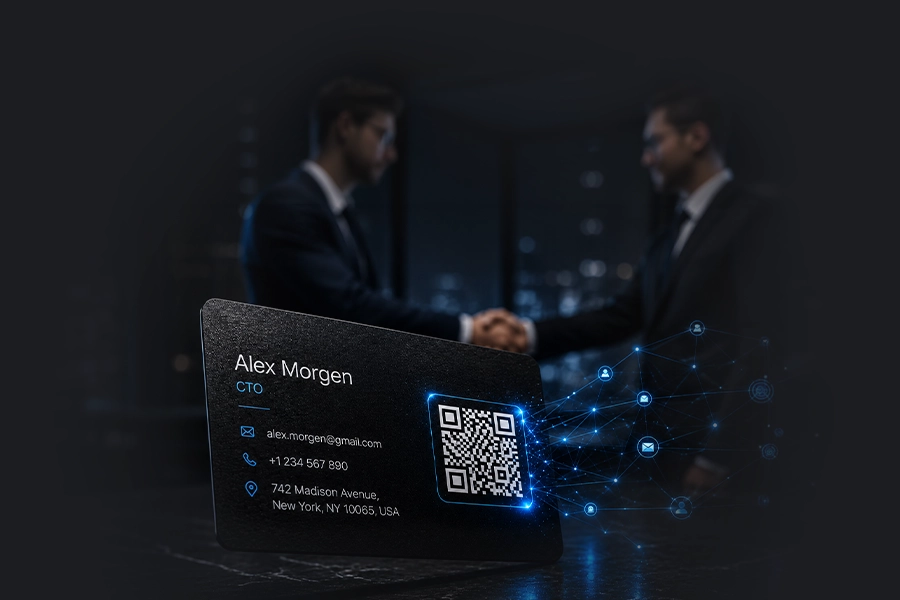
A well-built card brings together your contact details, work, social profiles, calendar, and key links in one place. It’s shareable by QR code, link, NFC tap, or email signature. It’s always current because it lives online, not on paper. And it’s the same card whether someone meets you at an event, finds you through a colleague, or receives your email.
For consultants, salespeople, and independent professionals who introduce themselves for a living, DigitalBusinessCard.Pro is built specifically for this. It gives you a single card that serves as the stable center of your professional identity, no matter where the introduction happens.
It’s not a complicated tool. That’s intentional. A complicated tool would just become another fragment to maintain.
The practical framework: Building an identity that travels
If you’re building or rebuilding your professional presence with portability in mind, anchor to these three principles:
Make one version the master. Pick the single place that is always current and always complete. Every other surface points back to it. Your email signature links to it. Your QR code opens it. Your LinkedIn profile references it. When it changes, everything downstream changes with it.
Lead with relevance, not resume. The first thing someone encounters should tell them why you matter to them: what you solve, what you’re known for, or what you’re currently working on. Not your job history or a list of credentials. Answer the question “why should I keep reading?” before they have a chance to ask it.
Design for the moment after the introduction. The real test of a professional identity isn’t how it looks. It’s what happens next. Does the person save your contact? Book a call? View your work? Visit your site? If your introduction doesn’t create a clear next step, it has done half the job at best.
Closing the loop on Ryan
Ryan eventually solved this by building an introduction that could do more of the work for him. The conversation was always going to be good. What changed was what happened after.
That’s the goal: a professional identity that doesn’t depend on the other person’s memory, their filing habits, or a paper card surviving a jacket pocket. One that travels consistently, completely, and without the friction that used to make great connections so easy to lose.
If you want a practical starting point, Digital Business Card PRO lets you set up a card in minutes, share it anywhere, and keep it current without updating every platform separately. Create your digital business card here.
메타데이터
- post_id
- 9e94c86f76e5
- slug
- how-to-build-a-professional-identity-that-travels-across-every-platform-9e94c86f76e5
- url
- https://medium.com/@amber_001/how-to-build-a-professional-identity-that-travels-across-every-platform-9e94c86f76e5
- canonical_url
- https://medium.com/@amber_001/how-to-build-a-professional-identity-that-travels-across-every-platform-9e94c86f76e5
- author_url
- https://medium.com/@amber_001
- status
- ok
- fetched_at
- 2026-07-17 21:26:36