GPS Monitoring Mandates by Sheriffs: Legal Overreach and the Road to Federal Civil Rights…
What we are seeing in some parts of Mississippi right now should concern every person who believes in the rule of law, because it…
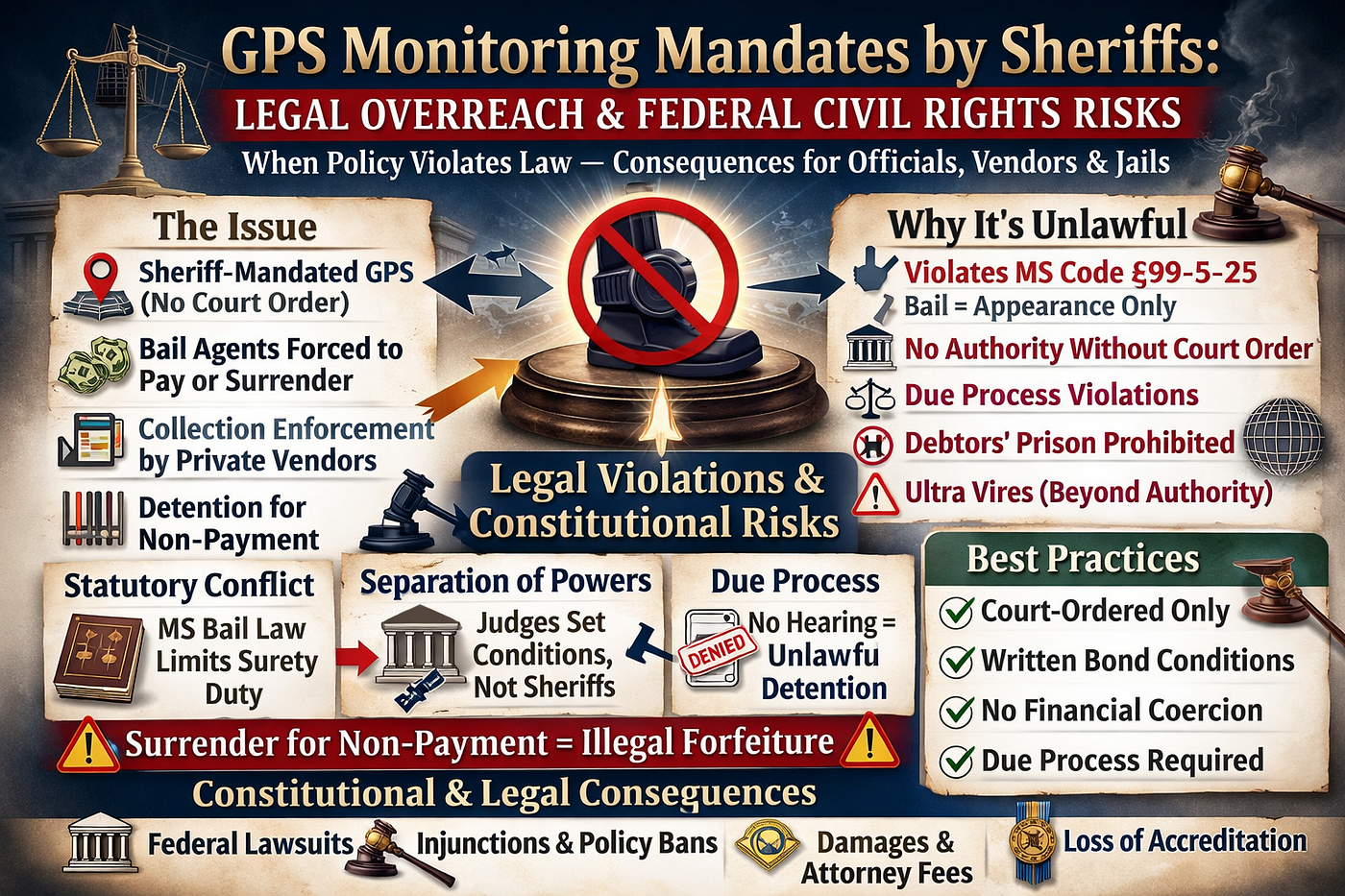
GPS Monitoring Mandates by Sheriffs:
Legal Overreach and the Road to Federal Civil Rights Litigation
What we are seeing in some parts of Mississippi right now should concern every person who believes in the rule of law, because it represents a quiet but very dangerous shift in how pretrial authority is being exercised. A sheriff’s department is attempting to require licensed professional bail agents to assume responsibility for the costs and enforcement of private GPS monitoring programs that are not ordered by a judge, while simultaneously expecting those agents to surrender defendants if a payment dispute arises between the defendant and the vendor. At first glance, this may appear to some as merely an administrative policy decision intended to manage jail populations or reduce supervisory burdens, but when examined through the lens of Mississippi statutory law, criminal procedure rules, and federal constitutional protections, it becomes clear that this approach is not simply questionable policy; it is a path that can lead directly into federal civil rights litigation.
To understand why, one must begin with the most fundamental principle of Mississippi bail law, which is clearly stated in Mississippi Code Section 99–5–25. The statute does not leave room for interpretation or creative expansion of responsibilities. It states plainly that the purpose of bail is to guarantee the defendant’s appearance in court, and that a bail bond shall not be forfeited for any reason other than failure to appear. That single sentence defines the entire legal scope of the surety relationship. A licensed bail agent is not a probation officer, not a supervisory contractor, not a collection agency for private vendors, and certainly not a guarantor of compliance with administrative programs created outside of judicial authority. When a policy attempts to transform a bail bond into something broader — into a mechanism for enforcing private monitoring contracts or guaranteeing payment obligations — it directly conflicts with the controlling statute. In legal terms, that is not merely an overreach; it is an ultra vires act, meaning an exercise of authority beyond what the law permits.
The next critical point involves who has the authority to impose conditions of release in the first place. Under the Mississippi Rules of Criminal Procedure, specifically Rule 8, the power to determine bond conditions belongs exclusively to the court. The rule is designed to protect the separation of powers by ensuring that liberty decisions remain within the judicial branch rather than being delegated to law enforcement administrators. A judge may impose conditions such as travel restrictions, reporting requirements, or even electronic monitoring when authorized by statute, but those conditions must appear in a formal release order. A sheriff’s department cannot independently create new bond conditions through policy, nor can it impose requirements after a court has already set the terms of release. When a GPS device is not ordered by a judge but instead originates from administrative policy, it exists entirely outside the legal framework that governs pretrial release. That distinction is not technical or procedural; it is constitutional.
At the same time, an equally serious constitutional issue arises from the nature of GPS tracking itself, because continuous location monitoring is not merely a supervisory tool; it is a form of electronic surveillance that directly implicates the Fourth Amendment right to privacy. Modern constitutional law recognizes that location-tracking data reveals far more than a person’s physical movements. It creates a detailed and continuous record of where a person sleeps, works, worships, seeks medical care, associates socially, and travels over extended periods of time. The United States Supreme Court has recognized that this type of tracking provides an intimate window into a person’s life and therefore carries heightened constitutional protection.
When electronic monitoring is imposed by a judge as a formal condition of release, the legal framework is clear because the monitoring exists within a judicial order, the scope of supervision is defined by the court, and access to the data is tied to lawful judicial authority. In that circumstance, the defendant is on notice that their movements are subject to monitoring under the authority of the court, and law enforcement access occurs within that judicially established structure. The situation changes entirely when GPS tracking originates from a sheriff’s departmental policy rather than a judicial order, because in that context there has been no judicial finding authorizing electronic surveillance, no written condition of release defining who may access the data, and no procedural safeguards governing how that information may be used.
This distinction is critical because the location data generated by such devices does not become open enforcement information simply because it is collected by a private vendor. The monitoring company may possess the data as part of its contractual service, but possession does not convert that information into public or law-enforcement property. Federal privacy principles and constitutional law both recognize that companies holding sensitive digital information cannot freely disclose detailed personal location records to government actors without lawful judicial process. A departmental policy is not a warrant, not a court order, and not a substitute for constitutional authorization.
Licensed bail agents stand even further outside any lawful data-access framework. Mississippi law limits the role of the surety to guaranteeing court appearance and exercising surrender rights under defined statutory conditions. There is no statute, rule, or legal doctrine that grants bail agents independent authority to monitor or obtain location-tracking data from private vendors. Requiring or expecting sureties to access or act upon such surveillance information would effectively transform them into unsupervised surveillance actors, which is inconsistent with both Mississippi law and established constitutional privacy protections.
Law enforcement access to GPS location data without judicial authorization presents the most serious constitutional risk. Continuous location tracking is treated as highly sensitive information, and government acquisition of that data typically requires judicial process grounded in probable cause. A sheriff’s internal policy cannot create constitutional authority to access protected surveillance information. When law enforcement agencies routinely receive, review, or rely upon vendor-generated GPS data without such judicial safeguards, the practice may be characterized as a warrantless search conducted under color of law.
The fact that the monitoring in this situation is not court-ordered strengthens rather than weakens the privacy protections that apply. Without judicial authorization, there has been no lawful reduction of the defendant’s expectation of privacy in their movements. As a result, any routine sharing of location data between a private vendor and law enforcement agencies may expose all parties involved to constitutional challenges based on unlawful surveillance, improper disclosure of protected personal information, and violations of due process protections.
This is where the situation becomes particularly serious. If a defendant is required to participate in a private GPS program that is not court-ordered, and then faces the threat of surrender or incarceration because of an inability to pay that vendor, the legal character of the situation shifts dramatically. At that point, the issue is no longer about public safety supervision; it becomes a matter of financial coercion tied to liberty. Federal constitutional law has long prohibited what are commonly referred to as modern forms of debtors’ prisons. The United States Supreme Court has made it clear in decisions such as Bearden v. Georgia that a person cannot be incarcerated solely because of an inability to pay financial obligations unless there has been a judicial hearing, a determination of willful refusal to pay, and findings regarding the individual’s ability to do so. When a surrender is triggered by non-payment to a private monitoring company rather than by a failure to appear in court, the legal risk escalates immediately, because it creates the appearance — and potentially the reality — of detention based purely on economic status rather than lawful judicial process.
Another profound concern arises from the forced involvement of bail agents in this arrangement. By requiring sureties to enforce payment compliance or perform surrenders tied to vendor disputes, the policy attempts to impose duties that do not exist under Mississippi law. Bail agents operate under a licensing framework that strictly limits their responsibilities to appearance assurance and lawful surrender under defined statutory conditions. When a governmental entity attempts to compel them to act outside those statutory duties, it places them in an untenable legal position. They are effectively being asked to participate in an enforcement scheme that could later be characterized as an unlawful deprivation of liberty. This is precisely the type of scenario that often leads to federal civil rights litigation under 42 U.S.C. Section 1983, which allows individuals to sue state actors who violate constitutional rights under color of law.
In federal court, cases like this are rarely framed as isolated policy disagreements. Instead, they are analyzed as systemic deprivations of due process, improper delegation of judicial authority, and unlawful financial conditions placed upon pretrial liberty. When government officials implement policies that result in individuals being jailed, surrendered, or threatened with detention due to non-payment of private fees, courts frequently view those actions through the lens of equal protection and due process violations. The involvement of private vendors does not shield public officials from liability; in fact, it often heightens scrutiny because it raises questions about whether liberty decisions are being influenced by financial arrangements rather than legal standards.
There is also a structural constitutional issue embedded within this scenario. The separation of powers doctrine exists to prevent exactly this type of authority shift. The judiciary determines who may be released and under what conditions, while the executive branch, including sheriffs, carries out lawful detention and enforcement functions. When a sheriff’s policy effectively creates new conditions of release or alters existing bond terms without judicial involvement, it blurs that constitutional boundary. Federal courts take such encroachments seriously because they undermine the integrity of the legal system’s checks and balances.
The cumulative effect of these legal conflicts cannot be overstated. What may appear on the surface to be a localized administrative policy carries the potential to trigger significant federal scrutiny. If defendants begin to be surrendered or detained because of unpaid GPS fees that were never judicially ordered, and if bail agents are compelled to participate in that process, it creates a record of actions that could be interpreted as systemic violations of constitutional protections. Civil rights litigation often begins with precisely these types of factual patterns, where well-intentioned policies drift into areas that the law simply does not allow.
At its core, this issue is not about opposition to technology or resistance to supervision tools. Electronic monitoring has a legitimate role when properly authorized and judicially imposed. The real issue is the preservation of legal boundaries and the protection of due process. Bail agents cannot be transformed into enforcement arms of private monitoring companies, and defendants cannot be exposed to detention risks because of financial disputes that fall outside the lawful purpose of bail. When those lines are crossed, the legal consequences do not remain confined to local policy debates; they extend into federal courtrooms, where the focus shifts from administrative intent to constitutional compliance.
This is why the current path is so dangerous. It is not simply a policy disagreement within the bail industry or a procedural matter between local agencies. It is a situation that implicates statutory authority, judicial power, individual liberty, and federal civil rights protections all at once. History shows that when government actors move beyond the limits set by law in matters affecting pretrial liberty, the result is often costly litigation, judicial intervention, and long-term institutional consequences. That is not speculation; it is the predictable outcome when constitutional safeguards are overlooked in the pursuit of administrative convenience.
메타데이터
- post_id
- 9e997eb581f4
- slug
- gps-monitoring-mandates-by-sheriffs-legal-overreach-and-the-road-to-federal-civil-rights-9e997eb581f4
- url
- https://medium.com/@mdmorrison/gps-monitoring-mandates-by-sheriffs-legal-overreach-and-the-road-to-federal-civil-rights-9e997eb581f4
- canonical_url
- https://medium.com/@mdmorrison/gps-monitoring-mandates-by-sheriffs-legal-overreach-and-the-road-to-federal-civil-rights-9e997eb581f4
- author_url
- https://medium.com/@mdmorrison
- status
- ok
- fetched_at
- 2026-07-23 07:41:17