Busy Muay Thai Athletes Get Back Pain for a Specific Reason
By Kru Ben Lee | Muay Thai Coach, Montrait Muay Thai
Busy Muay Thai Athletes Get Back Pain for a Specific Reason
By Kru Ben Lee | Muay Thai Coach, Montrait Muay Thai
I hold a BASc in Mechanical Engineering and an MSc in Biomechanics from the University of Waterloo, and have trained in Muay Thai since 2010. My research on low back injury prevention and Muay Thai performance is published on ResearchGate.
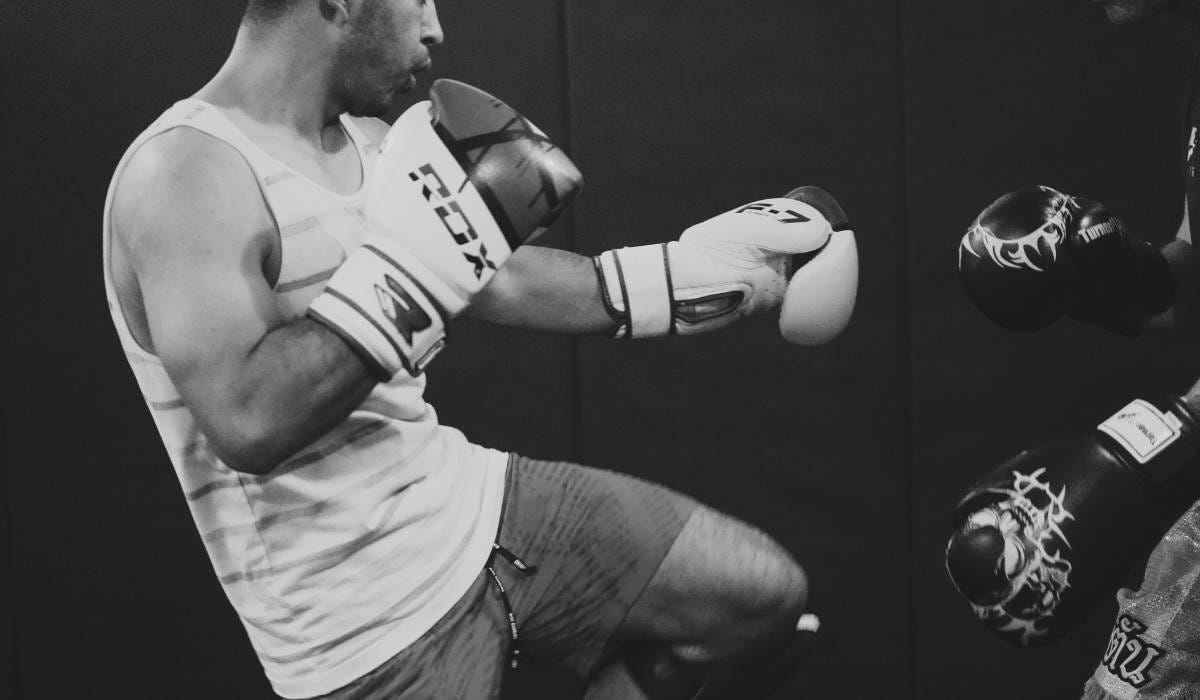
student in training at MMT’s Downtown Toronto location
Somewhere between a full week of solid training and a single hard session, your lower back decided it had enough. Not during a fight. Not after a freak accident. Just a regular round, a familiar kick, and suddenly you are bent forward in the locker room wondering what went wrong.
The frustrating part is not the pain itself. What keeps athletes up at night is the fact that they were training consistently, eating well, and putting in real effort — and the back still gave out. For most busy Muay Thai athletes, that moment triggers a familiar loop: rest, stretch, add some core work from YouTube, feel okay, go back to training hard, and watch it flare up again three weeks later.
That loop has a specific cause. And it is not what most people think.
The Story I Hear Most Often
Over 16 years of training and coaching Muay Thai, a particular story has come up more times than I can count…..
A student gets swamped at work or school.
Sessions drop from four per week to one.
Guilt sets in.
The next chance they get, they go all out to make up for lost time.
A few days later, their back is locked up and bending forward has become a negotiation.
These are not careless athletes. Many of them are professionals in their thirties and forties who treat training seriously, manage their sleep, and understand how their body works better than most. The problem is not discipline or effort. The problem is that high-intensity Muay Thai training, when returned to abruptly, exposes a control gap that already existed before the pain showed up.
Why “Strengthen Your Core” Is Incomplete Advice
The standard prescription for Muay Thai back pain tends to follow a predictable script:
- Brace your core harder during training
- Add planks and anti-rotation exercises to your routine
- Focus on maintaining a neutral spine throughout every movement
None of this is wrong exactly, but it addresses the symptom rather than the mechanism. A neutral spine is a useful concept in a static gym environment. Muay Thai does not take place in a static environment. Every round involves rotation, deceleration, reactive position changes, and repeated force production under fatigue — conditions where rigid bracing is not a realistic strategy.
Muay Thai culture also tends to push athletes toward more volume as the answer to almost every problem. More rounds, more conditioning, more time on the mats. For skill development and mental toughness, that approach has real merit. For resolving a control problem in the lower back, additional volume tends to compound the issue by repeating the same faulty force patterns at higher intensity and greater fatigue.
The Mechanical Reason Your Back Keeps Absorbing Too Much
Every technique in Muay Thai — a teep, a round kick, a knee in the clinch, a lateral check — requires the body to generate and transfer rotational force. The spine does not produce that force. Its job is to manage and distribute it across a coordinated system of joints and muscles. When the system coordinates well, the load spreads across the hips, trunk, and legs as intended.
When one part of the chain is late, stiff, or disengaged, the lower back fills the gap.
A useful way to think about it is a drive shaft in a vehicle. The shaft itself is designed to transmit torque between two well-aligned joints. When those surrounding joints are working properly, the shaft handles the load without issue. The moment one joint loses its timing or positional stability, the shaft absorbs forces it was never built to carry. It does not fail because it is structurally weak. It fails because the system stopped distributing load the way it was supposed to.
Your lower back operates on the same principle.
Where the Breakdown Shows Up in Training
Force in Muay Thai is supposed to travel in a specific sequence:
Ground contact → Hip drive → Trunk rotation → Striking limb
When hip rotation is delayed, when stance control deteriorates under fatigue, or when trunk stiffness and relaxation are poorly timed, the lower back starts compensating for the gaps. The tell-tale signs tend to be subtle at first:
- Tightness concentrated on one side after repeated kicks in that direction
- Back discomfort that appears during clinch rounds but not during pad work
- A back that feels fine through the warm-up but locks up in the final rounds
These patterns are not signals that the back is fragile or damaged. They are signals that the back is doing more than its share of the work.
Three Approaches That Do Not Solve the Problem
Generic Core Conditioning
Planks, dead bugs, and Pallof presses build isolated capacity in controlled conditions. What they do not do is train the nervous system to maintain rotational control when a sparring partner changes the timing of an exchange, when fatigue has been accumulating for forty minutes, or when a kick lands at an unexpected angle. The conditions that produce back pain in Muay Thai are sport-specific. The solution needs to be too.
Stretching and Mobility Work Alone
Targeted hip flexor and thoracic mobility work can temporarily reduce tension and improve range of motion. The limitation is that tissue extensibility is not the same as motor control. A hip that stretches further in isolation does not automatically contribute on time during a round kick under fatigue. Flexibility without coordinated load management tends to leave the same gap in place.
Verbal Technique Cues
Coaching cues like “turn your hips more” or “keep your base wider” carry an implicit assumption: that the athlete’s system is capable of executing that adjustment consistently under load and fatigue. For athletes dealing with a foundational control problem, the system cannot yet do that reliably — and that unreliability is often why the back pain developed in the first place.
Signs the Problem Is Rooted in Your Foundation
Some patterns tend to show up consistently in athletes who have a foundational control issue rather than a structural injury:
- Back pain that surfaces only after multiple rounds of training, not at the start
- A feeling of solidity and control early in a session that deteriorates as the session progresses
- One kick direction that consistently aggravates the back while the other feels fine
- A reliance on hard bracing to feel stable during certain movements
- Strength and conditioning sessions that feel fine while Muay Thai-specific training does not
These are control problems. More effort applied to a control problem does not resolve it.
What the Foundations Program at MMT Is Built to Do
Coaching is not about scaling back the difficulty of training. The goal is to earn the right to train hard by building a system that can handle it.
In a Foundations setting at MMT, the work includes:
- Reducing intensity to observe how force actually transfers through your specific mechanics
- Identifying which joints are not contributing at the right time in your movement patterns
- Rebuilding stance stability, rotational control, and load tolerance in a progressive sequence
- Finding the asymmetries and compensations that group training environments tend to obscure
- Re-testing movement quality under fatigue, not just in fresh and controlled conditions
My role as a Foundations coach is to function as a performance engineer for your movement. We assess fundamental mechanics, identify the patterns connected to your pain, and build a training structure that progressively strengthens the system rather than continuing to expose its gaps.
Foundational training is not a step backward. It is the engineering work that makes everything built on top of it more durable.
Return to Muay Thai After Low Back Pain in Toronto
At Montrait Muay Thai in Toronto, the Foundations Program is built for athletes whose back issues keep resetting their training no matter how much effort they put in. The programming is individual, progressive, and grounded in the same biomechanical framework I apply in my research.
Book a no-sweat consultation call to talk through where you are at and what a path forward could look like. There is no sales pitch and no commitment involved, just an honest conversation about your situation and how the Foundations Program at MMT can help you get back to training without the same pattern repeating itself.
메타데이터
- post_id
- 9e9a090128e2
- slug
- busy-muay-thai-athletes-get-back-pain-for-a-specific-reason-9e9a090128e2
- url
- https://medium.com/@montraitmuaythai/busy-muay-thai-athletes-get-back-pain-for-a-specific-reason-9e9a090128e2
- canonical_url
- https://medium.com/@montraitmuaythai/busy-muay-thai-athletes-get-back-pain-for-a-specific-reason-9e9a090128e2
- author_url
- https://medium.com/@montraitmuaythai
- status
- ok
- fetched_at
- 2026-07-08 01:19:27



