Banff and Jasper: Core Memories for Life
The most awaited trip for us was a visit to the Canadian Rockies. Although we planned this trip in a short period of time, we managed to…
Banff and Jasper: Core Memories for Life
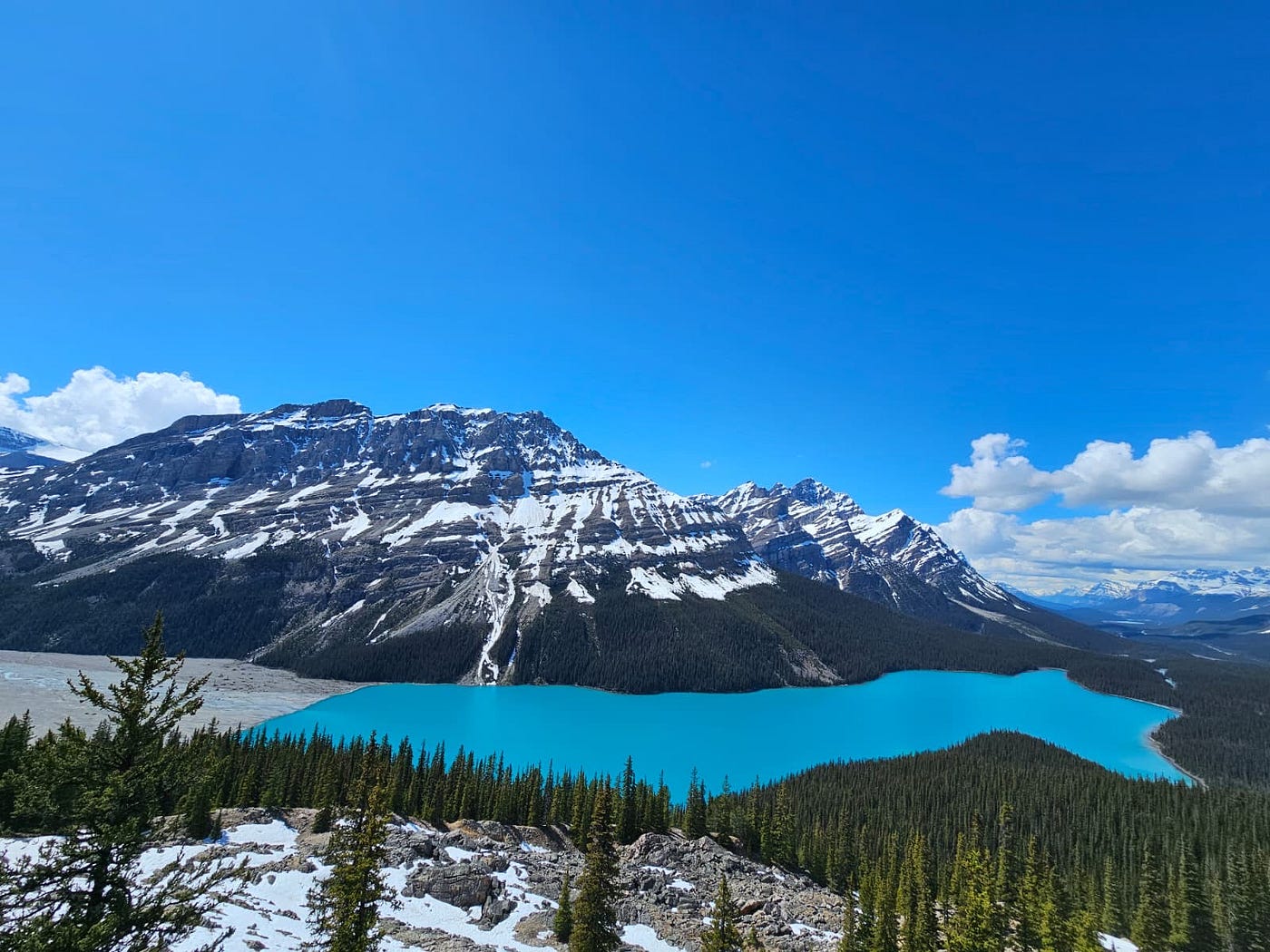
Peyto Lake. All photos by author
The most awaited trip for us was a visit to the Canadian Rockies. Although we planned this trip in a short period of time, we managed to execute it exceptionally well.
Our journey began in Toronto, where we booked our flights to Calgary. We took an afternoon Porter flight from Billy Bishop Airport and landed in Calgary at 4:30 PM local time. We had reserved a rental car — a Hyundai Tucson — through the Turo app, and the car owner was waiting for us outside the airport at the scheduled time. After collecting the car, we hit the roads of Calgary.
We made a quick pit stop at one of our cousins’ homes and then headed straight towards the mountains. Our stay was booked at WorldMark Resorts in Canmore, about an hour’s drive from Calgary. However, heavy rain accompanied us that evening, so we drove cautiously while hoping and praying for good weather in the days ahead to fully enjoy Banff.
Adventure Begins
The next morning was cloudy, but thankfully there was no rain. We continued to hope for better weather as our trip progressed.
We started the day by visiting Surprise Corner, a viewpoint offering a stunning view of the Banff Springs Hotel surrounded by majestic mountains. Surprisingly, this hidden gem remains unknown to many visitors. From there, we took a short trail to Bow Falls, which is located very close to the viewpoint. The cloudy weather added a magical charm to the scenery, creating calm and soothing views that we thoroughly enjoyed.
We had packed some food, which we quickly ate inside the car before heading to downtown Banff. We parked our vehicle in the free public parking lot next to the train station. The downtown area is just a five-minute walk from there. We explored the local shops, purchased a few souvenirs, and captured photographs of the beautiful town nestled among the mountains.
After spending some time in downtown, we drove to Johnston Canyon. The canyon is truly breathtaking. There are two main trails — the Lower Falls Trail and the Upper Falls Trail. We chose the Lower Falls Trail and walked for about 20 minutes to witness the beauty of the canyon and its waterfalls.
Later, we drove back to a gas station near the train station to refuel before heading to Vermilion Lakes, located just a short distance from downtown Banff. After a brief stop at the lakes, our next destination was the Mount Norquay Viewpoint. This viewpoint offers a panoramic view of downtown Banff and is one of the most beautiful spots to appreciate how a town can exist in perfect harmony with the surrounding mountains.
We then made our way to the famous Lake Minnewanka. Due to the cloudy weather, the lake wasn’t at its most photogenic, but that did not take away from the experience. We enjoyed every moment of our visit there.
Nearby lies another lake that is absolutely worth visiting — Two Jack Lake. Two iconic red chairs are placed along the shoreline, enhancing the beauty of the lake and providing a perfect place to sit and admire the scenery.
With that, we had covered all the places we had planned for the day and headed back to our accommodation. Since our stay included a kitchenette, we prepared some Maggi noodles and called it a night. There was something especially comforting about enjoying a hot bowl of Maggi after a long day of exploring the Canadian Rockies.
The Big Day
We woke up at 3:30 AM, checked out of our hotel by 4:45 AM, and headed straight towards Lake Louise. Since we had purchased our Parks Canada shuttle tickets for the 6:30 AM time slot, we drove to the Park and Ride location, parked our car, checked in to collect our tickets, and boarded the shuttle to the world-famous Lake Louise.
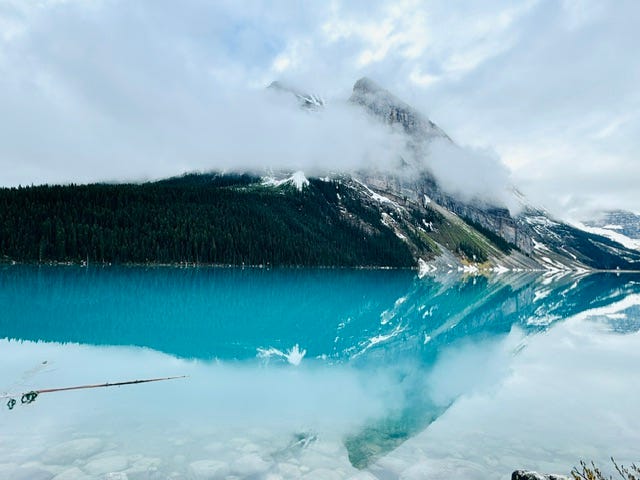
Lake Louise . All photos by author
I couldn’t control my excitement during the 15-minute ride to the lake. The moment we arrived, the turquoise waters of Lake Louise took our breath away. We couldn’t stop staring at this magnificent creation of nature. The vibrant blue waters, surrounded by towering mountains, looked almost unreal.
We decided to take the Fairview Lookout Trail, a 2-kilometre hike that offers a stunning elevated view of the lake. The trail itself was a memorable experience. As we walked through the quiet forest, parts of the path were still covered in ice, adding a touch of adventure to the journey. When we finally reached the viewpoint, we were rewarded with a spectacular panoramic view of the lake and the historic hotel overlooking it.
We stood there wondering, “How can water be this blue?” The sight was so mesmerizing that it felt impossible to look away. Even today, those views remain etched in my memory. We captured a few photographs to preserve the moment before making our way back down to the shoreline.
Once back at the lake, we spent some time walking along the waterfront, admiring the beauty of Lake Louise from every angle. No matter where we stood, the scenery seemed straight out of a postcard.
Next, we boarded the shuttle to Moraine Lake. Parks Canada operates shuttle buses every 15 minutes between Lake Louise and Moraine Lake, making the journey very convenient. The ride took about 25 minutes, and upon arrival, we were greeted by a view that somehow managed to surpass our already high expectations.
Moraine Lake was on an entirely different level. Surrounded by majestic mountains on all sides, the lake looked like a masterpiece painted by nature itself. We immediately headed towards the famous Rockpile Trail. Every step offered another incredible perspective of the lake and the surrounding peaks. We simply couldn’t take our eyes off the scenery.

Moraine Lake
Neither of us had ever witnessed such breathtaking natural beauty in our lives. We spent a considerable amount of time there, climbing the rocks to the top of the viewpoint and then slowly making our way down. At one point, we sat quietly on the rocks, saying very little and simply soaking in the beauty around us. It was one of those rare moments where words felt unnecessary.
Eventually, it was time to leave. We walked back to the shuttle station and boarded the bus to the Park and Ride lot, where our car was waiting.
From there, we continued our journey towards Emerald Lake in Yoho National Park, British Columbia. Crossing into British Columbia felt special — we could proudly say that our trip had now taken us into another province as well.
Emerald Lake was yet another gem of the Canadian Rockies. The lake’s vibrant green waters lived up to its name, and we could see people canoeing peacefully across its surface. The surrounding mountains reflected beautifully in the water, creating a picture-perfect scene. We spent some time enjoying the peaceful atmosphere before heading to our next destination.
A short drive away was the Natural Bridge, a fascinating geological formation where powerful waters rush through a narrow rock channel. Over thousands of years, the force of the water has carved the rocks into a natural bridge-like structure. Watching the water thunder beneath the rock formations was both exciting and mesmerizing.
After visiting the Natural Bridge, we began what would become one of the highlights of our entire trip — the drive along the world-famous Icefields Parkway. Often regarded as one of the most scenic drives in the world, this stretch of road promised endless mountain views, glaciers, waterfalls, and unforgettable landscapes. Little did we know that the journey ahead would leave us speechless at every turn.
We had read beforehand that there would be very limited cellular network coverage and very few gas stations along the route. To avoid any issues, we filled up our gas tank and downloaded offline maps before starting the drive.
Our first stop along the parkway was Bow Lake. One of the best things about this lake is that it requires no hiking. The stunning turquoise waters can be enjoyed right from the roadside. We spent about five to ten minutes soaking in the beauty of the lake before continuing our journey.
Our next destination was the famous Peyto Lake, known for its unique bear-shaped outline when viewed from above. As we arrived at the parking lot, we noticed large piles of snow still covering the area. We began the short but steep hike towards the viewpoint. At the entrance, a lady who was returning from the trail handed me a thick tree branch that she had been using as a hiking stick. I thanked her and accepted it, wondering why she felt the need to pass it on.
As we continued climbing, I quickly found out why. The trail was far from easy. Much of the path was covered in packed snow, and people were slipping and sliding their way up and down the hill. We carefully made our way upward, occasionally losing our footing. At one point, I even fell into the snow while trying to climb. Despite the challenges, the experience itself was fun and memorable.
The moment we reached the viewpoint, every bit of effort felt worthwhile.
From the top, we could see a narrow stream of brilliant blue water flowing into the iconic bear-shaped lake. The surrounding landscape was breathtaking — towering mountains with snow-covered peaks, dense pine forests, and endless wilderness stretching in every direction. It was one of the most beautiful sights we had ever witnessed.
Interestingly, we also learned the science behind Peyto Lake’s stunning color. The lake receives water from the Peyto Glacier. As the glacier slowly moves, it grinds the rocks beneath it into an extremely fine powder known as “rock flour.” Meltwater carries this rock flour into the lake, where the particles remain suspended because they are so lightweight.
When sunlight reaches the water, the longer wavelengths of light — such as red, orange, and yellow — are absorbed. The shorter wavelengths, primarily blue and green, are reflected back. The suspended rock flour further influences the way light scatters, giving the lake its mesmerizing turquoise-blue appearance. The amount of rock flour present can even affect whether the water appears more blue or more green.
After spending time admiring the view and learning about the lake’s fascinating geology, we carefully made our way back down the snowy and slippery trail and continued our drive towards Mistaya Canyon.
The drive itself deserves a special mention. Snow-covered mountains lined both sides of the road, while the Bow River and Athabasca River flowed alongside us through the valleys. Every few minutes, we found ourselves wanting to stop the car just to admire the scenery. It felt as though we were driving through a postcard.
Our next stop was Mistaya Canyon. From the parking lot, it was about a 20-minute walk to reach the canyon. The hike was pleasant, and the reward at the end was spectacular. Powerful water rushed through the narrow rock formations, carving its path through the canyon with incredible force.
The views were magnificent. Watching the water push relentlessly through the rocks was mesmerizing. It almost seemed as if the water was emerging directly from the mountains themselves. I sat quietly for a few moments, closed my eyes, and simply listened to the sound of nature. It was one of the most peaceful and soothing experiences of the entire trip.
After taking a few photographs, we continued our journey to Sunwapta Falls. The falls were located just a minute’s walk from the parking lot, making them easily accessible. Despite the short walk, the view was impressive. The rushing water appeared so powerful that it looked as though it was slowly dissolving the rocks beneath it in order to create its own path.

Sunwapta falls
From there, we headed to Athabasca Falls, another spectacular waterfall along the Icefields Parkway. Although not the tallest waterfall, the sheer force and volume of water crashing through the narrow canyon made it an unforgettable sight. The power of nature was on full display.
As evening approached, we continued driving towards Jasper. Once we reached the town area, we filled up our gas tank and then headed straight to our accommodation, Hinton Lodge in Hinton.
After checking into the hotel, we were delighted to discover an Indian restaurant nearby called Tandoori Kona. After a long day of hiking, sightseeing, and driving through some of the most beautiful landscapes we had ever seen, a delicious Indian dinner was exactly what we needed.
With full stomachs and hearts filled with unforgettable memories from the Icefields Parkway, we called it a night and looked forward to what Jasper had in store for us the next day.
Let’s Explore Jasper
The next morning, we enjoyed the complimentary breakfast at the hotel before setting out to explore Jasper National Park.
Our first destination was Medicine Lake. The lake was calm, peaceful, and incredibly beautiful. As we arrived, we noticed signs informing visitors that a female eagle was incubating her eggs nearby while the male eagle was out searching for food and protecting the nest. Curious and excited, we spent some time scanning the area with our cameras. Eventually, we spotted the nest and, to our delight, saw a majestic white-headed eagle sitting firmly in place. It was a special wildlife moment that made the visit even more memorable.
From Medicine Lake, we continued our drive to Maligne Lake. While the drive itself was scenic, it was also heartbreaking. For long stretches of the road, all we could see were the remains of trees that had been burned during the devastating Jasper wildfires of 2024. The landscape that was once covered in greenery had been transformed into miles of blackened trunks and charred forests. It was a sobering reminder of the power of nature and the impact of wildfires on these beautiful landscapes.
As we reached Maligne Lake, however, the scenery changed dramatically. Before us stood a vast, tranquil lake surrounded by snow-capped mountains. The water shimmered in shades of blue and green, creating a picture-perfect setting.
We took a leisurely 1.5-kilometre trail along the shoreline to a viewpoint that offered a closer look at the lake. The peaceful atmosphere, the reflections on the water, and the mountains in the distance made it one of the most beautiful places we had visited during the trip. Sometimes, there are no words that can truly describe a place — you simply have to stand there and experience it for yourself.
Our next stop was Beauvert Lake. To reach the viewpoint, we followed a short trail of about one kilometre. The area was much less crowded, which made it feel even more secluded and peaceful.

Lake Beauvert
As my husband and I walked along the trail, we found ourselves discussing wildlife safety. Since we did not have bear spray with us, we joked about making noise while walking, hoping to avoid any surprise encounters with bears. Fortunately, we noticed another couple walking about 200 metres ahead of us, which made us feel a little more comfortable.
Just a few moments later, something unexpected happened.
Out of nowhere, a large cow elk came running from behind us and passed right by. Within seconds, it stopped only about 100 metres away and turned to look directly at us.
I froze.
For a moment, I was speechless. My heart started racing, and I instinctively grabbed my husband’s hand. We slowly stepped backward without saying a word, unsure of what the elk might do next.
Thankfully, after staring at us for a few moments, it calmly walked ahead and eventually disappeared into the woods.
Only then did we begin to breathe normally again.
Once our nerves settled, we continued towards the lake. As we approached the shoreline, another incredible sight awaited us. Right beside the lake was a beautifully maintained golf course. The combination of the bright blue sky, the crystal-clear lake displaying different shades of blue, the lush green grass, and the surrounding mountains created a scene that almost felt unreal.
We stood there wondering how a place could possibly be so beautiful.
After spending some time enjoying the scenery and taking photographs, we returned to our car and began driving back along the Icefields Parkway towards one of the most anticipated experiences of our trip — the Columbia Icefield.
The Columbia Icefield offers visitors a unique opportunity to step onto the Athabasca Glacier, one of the most accessible glaciers in North America. Upon arrival, we purchased a combo ticket that included both the glacier adventure and the Skywalk experience.
The adventure began with a standard shuttle bus that carried approximately 56 passengers to a transfer point. There, we boarded a massive Ice Explorer vehicle. The machine was unlike anything we had ever seen before. Its enormous wheels stood nearly five feet tall, making it look more like a vehicle designed for another planet than for Earth.
We climbed aboard, fastened our seat belts, and began our journey towards the glacier.
As we descended the steep terrain, our driver shared fascinating information about the history of the glacier, how it had changed over the years, and how rapidly it was retreating. He also mentioned that the Ice Explorer we were riding in was 28 years old and had cost approximately 1.4 million dollars when it was built.
After navigating some of the steepest grades we had ever experienced in a vehicle, we finally arrived at the glacier.
Standing on nearly 400 feet of ancient ice was an incredible feeling. Small streams of glacial meltwater flowed around the edges, creating an unforgettable landscape. My husband and I had fun touching the ice and even drinking some of the pure glacier water. It felt surreal to be standing on something that had existed for thousands of years.

Athabasca Glaciers
Of course, we couldn’t leave without capturing the moment, so we stopped for photographs to preserve the memory forever.
After spending about half an hour on the glacier, we were asked to return to the Ice Explorer. We were then transported back to the shuttle bus, which took us to the second part of the experience — the Columbia Icefield Skywalk.
The Skywalk was an adventure in itself. Built high above the valley floor, the glass-floored platform extends out over the edge of a cliff, offering breathtaking views of the landscape below. As we carefully walked across the transparent floor, we could see a river flowing beneath us while mountains rose all around in the distance.
For a few moments, it truly felt as though we were standing on top of the world.
After enjoying this remarkable experience, we returned to our car and began the drive back to Hinton. The journey back gave us time to reflect on everything we had seen that day — from wildlife encounters and pristine lakes to glaciers and mountain vistas.
Back in Hinton, we enjoyed a satisfying dinner and rested well, ending another unforgettable day in the Canadian Rockies.
Final Day
As usual, we started our day with the complimentary breakfast at the hotel. However, this morning felt different. There was a sense of heaviness knowing that it was our final day in the Canadian Rockies. The mountains, lakes, glaciers, and unforgettable experiences had become a part of us over the past few days, and it was difficult to accept that our journey was coming to an end.
We began driving back towards Banff through the Icefields Parkway, retracing what had become one of our favorite routes of the entire trip. Even though we had already driven this road once, the views felt just as spectacular the second time. Every mountain, glacier, and river seemed to offer a new perspective.
On our way, we stopped at Pyramid Lake, another peaceful and picturesque lake that features a small island at its center. The calm waters, reflections, and surrounding mountain scenery created a perfect setting for a few final photographs. We spent some time enjoying the tranquil atmosphere before continuing our journey.
As we drove along the Icefields Parkway, we experienced what felt like the perfect ending to our wildlife adventures.
We spotted a black bear.
From a safe distance, we pulled over and watched the bear peacefully feeding on the mountainside. Seeing such a magnificent animal in its natural habitat was both exciting and humbling. It felt as though the Rockies were giving us one last memorable gift before saying goodbye.
We continued our drive, soaking in every moment of what is undoubtedly one of the most beautiful road trips one can experience in a lifetime. The Icefields Parkway had exceeded every expectation we had before the trip and had become one of the highlights of our entire journey.
Once we reached Banff, we parked our car, filled up the gas tank, and took one final walk through downtown. We visited a few shops and purchased some souvenirs to take home — small reminders of the incredible places we had explored and the memories we had created.
Soon, it was time to leave the mountains behind and head back to Calgary. Before our flight, we spent a few hours with my colleagues and my husband’s cousin, which was a wonderful way to wrap up the trip. As the evening approached, we made our way to the airport and boarded our flight back to Toronto.
As the plane took off, I couldn’t help but reflect on everything we had experienced over the past few days — the turquoise waters of Lake Louise, the breathtaking beauty of Moraine Lake, the endless scenery along the Icefields Parkway, the glaciers, waterfalls, wildlife encounters, and the peaceful moments spent surrounded by nature.
This trip was more than just a vacation. It was one of the most relaxing, refreshing, and fulfilling journeys we have ever taken. The Canadian Rockies gave us moments of awe, adventure, peace, and gratitude.
The trip may have come to an end, but the memories certainly have not.
Banff and Jasper left our hearts full of peace and gave us countless core memories that we will cherish for a lifetime.
[embed]Write for True Travel Tales Submission Guidelinesmedium.com
메타데이터
- post_id
- 9ea0917c9ef7
- slug
- banff-and-jasper-core-memories-for-life-9ea0917c9ef7
- url
- https://medium.com/true-travel-tales/banff-and-jasper-core-memories-for-life-9ea0917c9ef7
- canonical_url
- https://medium.com/true-travel-tales/banff-and-jasper-core-memories-for-life-9ea0917c9ef7
- author_url
- https://medium.com/@dheekshayogananda
- status
- ok
- fetched_at
- 2026-07-10 03:02:36