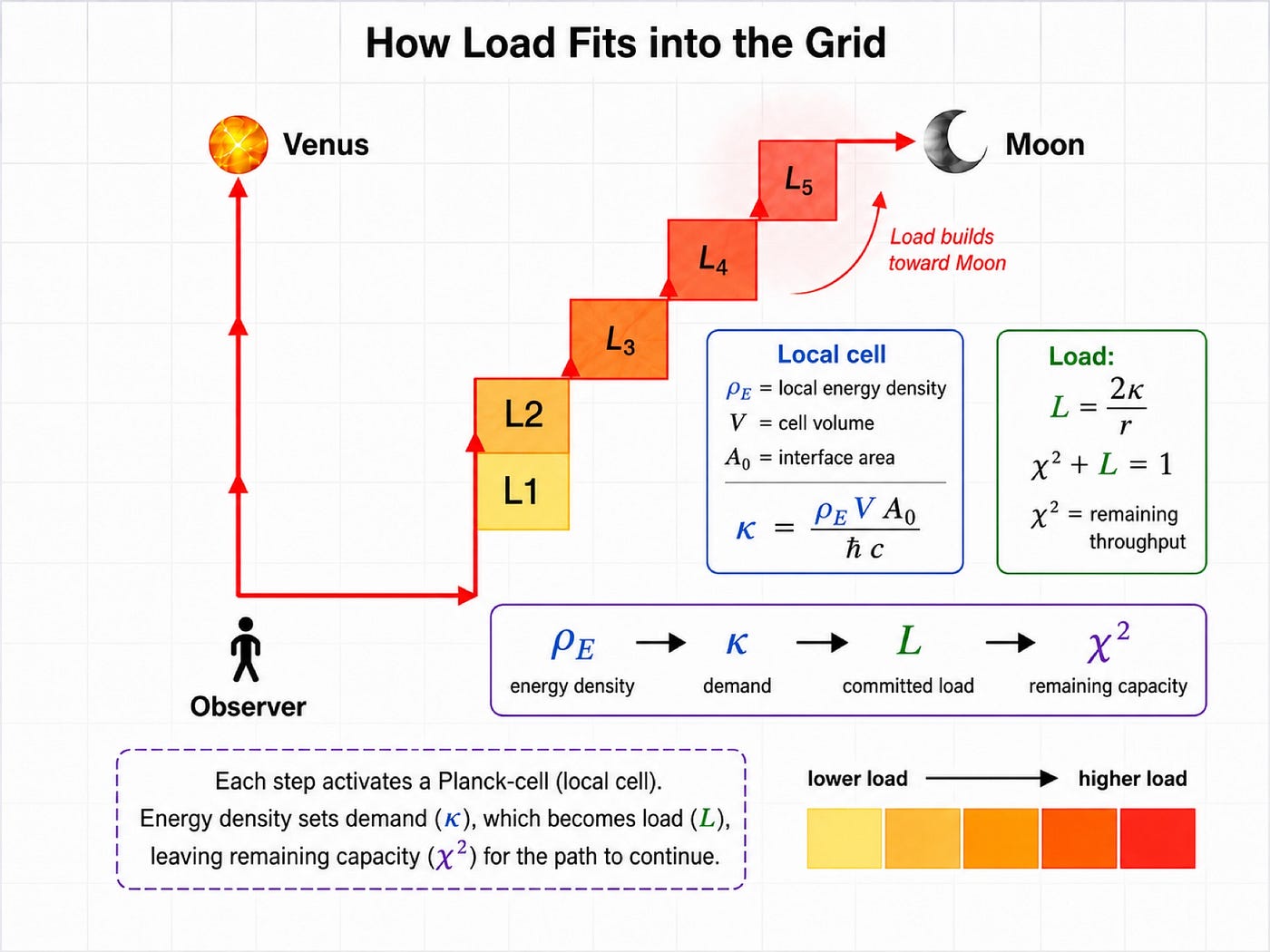
The Unruh Effect from Ghidan Capacity Conservation
Acceleration Load, Bloch-Sphere Throughput Rotation, and Computational Friction in the Ghidan 1/0 Bit – Qubit Framework
The Unruh Effect from Ghidan Capacity Conservation
Acceleration Load, Bloch-Sphere Throughput Rotation, and Computational Friction in the Ghidan 1/0 Bit – Qubit Framework

Ghidan Quantum Dynamics Laboratory
Melbourne, Australia
The Unruh effect predicts that a uniformly accelerated observer perceives the inertial vacuum as a thermal bath with temperature T_U = ℏa/(2πck_B), where a is proper acceleration, ℏ is the reduced Planck constant, c is the speed of light, and k_B is Boltzmann’s constant. In conventional quantum field theory, this result is obtained through Rindler quantization, Bogoliubov transformations, or detector-response analysis. This paper reconstructs the Unruh temperature within the Ghidan 1/0 Bit – Qubit framework, where physical propagation is governed by the capacity conservation identity χ² + L = 1. Here χ represents available informational throughput and L represents committed load. Using the Ghidan update-speed relation v = χ²c, uniform acceleration is interpreted as a finite update-depth condition rather than as a geometric primitive. A uniformly accelerated observer exhausts the available causal update budget over the acceleration depth r_a = c²/a. The associated acceleration load is defined by the Ghidan load-ratio rule L_a = ℓ_P/r_a = a/a_P, where ℓ_P is the Planck length and a_P = c²/ℓ_P is the Planck acceleration. On the Ghidan Bloch Sphere, this becomes L_a = sin²θ_a and χ_a = cosθ_a. The thermal scale follows from the finite-depth quantum energy E_a = ℏc/r_a. Applying the circular normalization 2π gives k_B T_U = ℏc/(2πr_a), and therefore T_U = ℏa/(2πck_B). Equivalently, since T_P = ℏc/(k_Bℓ_P), the result becomes T_U = T_P L_a/(2π). Thus, the Unruh temperature is reconstructed as the Planck temperature weighted by acceleration-induced load. The Unruh effect is interpreted as computational friction: the thermal signature of acceleration-induced informational access loss.
- Introduction
The Unruh effect is one of the most important results connecting acceleration, quantum fields, horizons, and thermality. It states that a uniformly accelerated observer moving through the inertial vacuum detects a thermal bath, even though an inertial observer detects no particles. The associated temperature is:
T_U = ℏa/(2πck_B)
In the standard interpretation, the accelerated observer has access only to a restricted region of spacetime, usually described through Rindler coordinates. The observer’s vacuum mode decomposition differs from that of an inertial observer, and the detector response becomes thermal.
The Ghidan 1/0 Bit – Qubit framework approaches the same phenomenon from a different starting point. Instead of beginning with Rindler geometry, it begins with the conservation of informational capacity:
χ² + L = 1
where χ ∈ [0,1] is the available throughput fraction and L ∈ [0,1] is the committed load fraction. The corresponding Ghidan update-speed relation is:
v = χ²c
Thus, propagation speed is not treated as an independent primitive. It is the visible expression of remaining available update capacity.
This paper argues that the Unruh temperature can be reconstructed from this capacity structure. The central route is:
acceleration → finite update-depth → acceleration load → Bloch-sphere rotation → finite-depth quantum energy → thermal response
The result is not presented as a replacement for the full quantum-field-theoretic detector derivation. Rather, it is a Ghidan-framework reconstruction of the Unruh temperature scale and an informational reinterpretation of the acceleration horizon.
- Standard Unruh Effect
The standard Unruh temperature is:
T_U = ℏa/(2πck_B)
or equivalently:
k_B T_U = ℏa/(2πc)
The standard thermal occupation number is:
⟨n(ω)⟩ = 1/(e^(2πωc/a) − 1)
This corresponds to a Bose – Einstein spectrum. In conventional treatments, the factor 2π arises from the periodicity of Euclidean Rindler time or from the analytic structure of field modes in the accelerated frame.
The conventional route is:
uniform acceleration → Rindler wedge → causal horizon → thermal detector response
The Ghidan route preserves the final temperature but changes the ontology:
uniform acceleration → finite update-depth → inaccessible information load → throughput suppression → thermal computational friction
- Core Ghidan Capacity Law
The foundational identity is:
χ² + L = 1
where:
χ = available informational throughput
L = committed load
The associated update-speed law is:
v = χ²c
Therefore:
χ² = v/c
and:
L = 1 − χ² = 1 − v/c
The three basic limits are:
Full-throughput limit:
χ = 1
L = 0
v = c
Partial-load limit:
0 < χ < 1
0 < L < 1
0 < v < c
Horizon/load-saturation limit:
χ = 0
L = 1
v = 0
In this framework, a horizon is defined operationally as the condition where the available update velocity relative to the observer vanishes:
v = χ²c → 0
Therefore:
χ → 0
L → 1
This allows horizon-like behavior to be reconstructed from capacity conservation rather than assumed as a metric boundary.
- The Ghidan Bloch Sphere
The Ghidan Bloch Sphere represents the capacity law geometrically.
Define:
χ = cosθ
√L = sinθ
Therefore:
χ² = cos²θ
L = sin²θ
and:
cos²θ + sin²θ = 1
The physically relevant interval is the first quadrant:
0 ≤ θ ≤ π/2
At θ = 0:
χ = 1
L = 0
This is full throughput.
At θ = π/2:
χ = 0
L = 1
This is full load, or horizon saturation.
Acceleration can therefore be represented as a rotation of the observer’s vacuum-access state on the Ghidan Bloch Sphere. Increasing acceleration rotates the state away from the χ-axis and toward the load axis.
- Acceleration as Finite Update-Depth
In the standard language, uniform acceleration introduces a Rindler horizon at the characteristic scale:
r_a = c²/a
In the Ghidan framework, this scale is reinterpreted without taking Rindler geometry as primitive.
Start from the operational update-budget condition:
a r_a = c²
This says that constant acceleration exhausts one light-speed update budget over the characteristic distance r_a. Solving gives:
r_a = c²/a
Thus, the same scale normally identified as the Rindler horizon distance emerges as an acceleration update-depth.
The interpretation is:
higher acceleration → shorter accessible update-depth
lower acceleration → deeper accessible update region
At a → 0:
r_a → ∞
The observer has full vacuum access.
At very large a:
r_a shrinks
The observer loses access to more of the vacuum update structure.
- Acceleration Load
The Ghidan framework treats ℓ_P as the primitive update length of the informational substrate. The dimensionless acceleration load is defined as the ratio between this primitive update length and the acceleration update-depth:
L_a = ℓ_P/r_a
Substitute:
r_a = c²/a
Then:
L_a = ℓ_P/(c²/a)
L_a = ℓ_Pa/c²
Define the Planck acceleration:
a_P = c²/ℓ_P
Then:
L_a = a/a_P
This does not claim that a_P is a primitive of mainstream quantum field theory. Rather, a_P is the Ghidan normalization scale: the acceleration at which the update-depth r_a equals one Planck length.
At ordinary acceleration:
a ≪ a_P
therefore:
L_a ≪ 1
At Planck acceleration:
a = a_P
therefore:
L_a = 1
and:
χ_a = 0
So Planck acceleration corresponds to full acceleration-load saturation.
- Bloch-Sphere Acceleration Rotation
Insert L_a into the Ghidan conservation law:
χ_a² + L_a = 1
Since:
L_a = a/a_P
we obtain:
χ_a² = 1 − a/a_P
and:
χ_a = √(1 − a/a_P)
Using the Bloch representation:
χ_a = cosθ_a
L_a = sin²θ_a
Therefore:
sin²θ_a = a/a_P
and:
θ_a = arcsin√(a/a_P)
This provides the acceleration-to-Bloch-angle mapping.
At a = 0:
θ_a = 0
χ_a = 1
L_a = 0
At a = a_P:
θ_a = π/2
χ_a = 0
L_a = 1
Thus, acceleration is interpreted as a rotation of the observer’s state from available throughput into committed load.
- Thermal Scale from Acceleration Update-Depth
The key improvement in this updated derivation is that the thermal scale is not introduced as a free postulate.
The acceleration update-depth is:
r_a = c²/a
The finite-depth quantum energy associated with this causal-access scale is:
E_a = ℏc/r_a
Substitute r_a = c²/a:
E_a = ℏc/(c²/a)
E_a = ℏa/c
The thermal response associated with a circular update cycle carries the angular normalization 2π:
k_B T_U = E_a/(2π)
Therefore:
k_B T_U = ℏa/(2πc)
and:
T_U = ℏa/(2πck_B)
This exactly reproduces the Unruh temperature.
This is the stronger route:
r_a = c²/a
E_a = ℏc/r_a
k_B T_U = E_a/(2π)
T_U = ℏa/(2πck_B)
The temperature is therefore reconstructed from the acceleration update-depth and the finite-depth quantum energy scale.
- Planck-Load Form of the Same Result
Now express the same result in Ghidan load variables.
The Planck temperature may be written as:
T_P = ℏc/(k_Bℓ_P)
This is equivalent to the standard Planck temperature:
T_P = √(ℏc⁵/(Gk_B²))
because:
ℓ_P = √(ℏG/c³)
Therefore:
ℏc/(k_Bℓ_P) = √(ℏc⁵/(Gk_B²))
The ℓ_P form is preferred in the Ghidan framework because ℓ_P is treated as the primitive update length.
Since:
L_a = ℓ_P/r_a
we have:
T_P L_a = [ℏc/(k_Bℓ_P)] [ℓ_P/r_a]
Therefore:
T_P L_a = ℏc/(k_Br_a)
Apply the same 2π circular normalization:
T_U = T_P L_a/(2π)
Substitute:
L_a = a/a_P
Then:
T_U = T_P(a/a_P)/(2π)
Using:
T_P = ℏc/(k_Bℓ_P)
and:
a_P = c²/ℓ_P
we obtain:
T_U = [ℏc/(k_Bℓ_P)] [aℓ_P/c²]/(2π)
Cancel ℓ_P:
T_U = ℏa/(2πck_B)
Thus:
T_U = T_P L_a/(2π)
is not merely reverse-engineered. It is the Planck-normalized version of:
k_B T_U = ℏc/(2πr_a)
- Compact Ghidan Derivation
The full derivation can be written compactly as follows:
χ² + L = 1
v = χ²c
Uniform acceleration defines the update-depth:
a r_a = c²
therefore:
r_a = c²/a
Define acceleration load:
L_a = ℓ_P/r_a
therefore:
L_a = ℓ_Pa/c²
Since:
a_P = c²/ℓ_P
we obtain:
L_a = a/a_P
Insert into capacity conservation:
χ_a² + L_a = 1
therefore:
χ_a² = 1 − a/a_P
On the Ghidan Bloch Sphere:
χ_a = cosθ_a
L_a = sin²θ_a
therefore:
sin²θ_a = a/a_P
The finite-depth quantum energy is:
E_a = ℏc/r_a
The thermal response is:
k_B T_U = E_a/(2π)
therefore:
T_U = ℏc/(2πk_Br_a)
Substitute r_a = c²/a:
T_U = ℏa/(2πck_B)
Equivalently:
T_U = T_P L_a/(2π)
or:
T_U = T_P sin²θ_a/(2π)
or:
T_U = T_P(1 − χ_a²)/(2π)
These are the Ghidan Bloch-Sphere forms of the Unruh temperature.
- Computational Friction Interpretation
In the Ghidan framework, the Unruh effect is interpreted as computational friction.
An inertial observer has:
χ = 1
L = 0
v = c
The observer has full access to the vacuum update structure.
A uniformly accelerated observer has:
r_a = c²/a
This finite update-depth limits the observer’s accessible vacuum information. The inaccessible fraction becomes acceleration load:
L_a = ℓ_P/r_a
The available throughput becomes:
χ_a² = 1 − L_a
The detector does not directly observe the inaccessible update region. Instead, it registers the unresolved finite-depth energy scale as heat:
k_B T_U = ℏc/(2πr_a)
Thus:
Unruh heat = finite-depth unresolved update energy
or:
Unruh heat = acceleration-induced computational friction
This does not deny the standard detector result. It reinterprets its origin as a consequence of acceleration-induced loss of informational access.
- Relation to Rindler Horizons
The standard route is:
Rindler geometry → horizon → Euclidean periodicity → thermal response
The Ghidan route is:
χ² + L = 1
v = χ²c
a r_a = c²
L_a = ℓ_P/r_a
E_a = ℏc/r_a
k_B T_U = E_a/(2π)
The two routes share the same physical scale:
r_a = c²/a
The difference is interpretive and foundational.
In the standard route, r_a is associated with the Rindler horizon scale.
In the Ghidan route, r_a is the acceleration update-depth: the finite causal-access depth over which the observer’s acceleration exhausts the available light-speed update budget.
Therefore, the Rindler horizon is not rejected. It is reinterpreted as an emergent acceleration-throughput boundary.
The horizon condition becomes:
χ → 0
L → 1
v = χ²c → 0
- Origin of the 2π Factor
In standard treatments, the 2π factor arises from Euclidean Rindler periodicity or from the analytic structure of accelerated-frame field modes.
In the Ghidan framework, the same factor is interpreted as the circular normalization of the update cycle. The Ghidan Bloch representation is angular:
χ = cosθ
√L = sinθ
L = sin²θ
and the thermal response is normalized over a full circular phase/update cycle:
2π
Thus:
k_B T_U = E_a/(2π)
or:
T_U = T_P L_a/(2π)
The 2π factor is therefore not arbitrary. It is the angular normalization connecting finite-depth energy to thermal response.
- Relation to Hawking Radiation
The Unruh effect and Hawking radiation are structurally related. In standard physics, the Hawking temperature of a black hole is associated with surface gravity at the horizon, while the Unruh temperature is associated with proper acceleration.
The Ghidan framework expresses both through load.
For acceleration:
L_a = a/a_P
T_U = T_P L_a/(2π)
For gravitational load:
L_g = 2κ/r
where:
κ = GM/c²
At a Schwarzschild horizon:
r = 2κ
therefore:
L_g = 1
and:
χ = 0
Thus:
Unruh effect = partial acceleration load
Hawking horizon = gravitational load saturation
Both satisfy:
χ² + L = 1
The difference lies in the source of L.
Acceleration source:
L = L_a = ℓ_P/r_a = a/a_P
Mass-gravity source:
L = L_g = 2κ/r
In both cases, thermal behavior is associated with finite access, horizon structure, and throughput suppression.
- κ-Route Interpretation
In the broader Ghidan framework, κ is the source-demand bridge.
For gravitational systems:
κ = GM/c²
and:
L_g = 2κ/r
For acceleration, the relevant depth is:
r_a = c²/a
The load is:
L_a = ℓ_P/r_a
This can be read as a primitive κ-like route:
L_a = κ_P/r_a
where:
κ_P = ℓ_P
for the elementary Planck update route.
This does not mean that acceleration is mass-sourced in the same way as gravity. Rather, it means both gravity and acceleration can be expressed as dimensionless load ratios.
Gravity:
load = source-demand length / radial access depth
Acceleration:
load = primitive update length / acceleration access depth
Both enter the same conservation identity:
χ² + L = 1
- Numerical Examples
The Unruh temperature is:
T_U = ℏa/(2πck_B)
Using the coefficient:
T_U ≈ 4.05 × 10⁻²¹ a K
where a is in m/s².
16.1 Earth Gravity Equivalent
For:
a = 9.81 m/s²
we obtain:
T_U ≈ 3.98 × 10⁻²⁰ K
This is far below detectability in ordinary conditions.
16.2 Acceleration Required for 1 K
Set:
T_U = 1 K
Then:
a = 2πck_B/ℏ
Numerically:
a ≈ 2.47 × 10²⁰ m/s²
This is approximately:
2.5 × 10¹⁹ g
where:
g ≈ 9.81 m/s²
16.3 Extreme Acceleration
For:
a = 10²⁶ m/s²
we obtain:
T_U ≈ 4.05 × 10⁵ K
This illustrates why direct detection is difficult: everyday accelerations produce essentially zero observable Unruh temperature, while detectable temperatures require enormous accelerations.
- Physical Meaning of T_U = T_P L_a/(2π)
The central Ghidan identity is:
T_U = T_P L_a/(2π)
This means:
Unruh temperature = Planck temperature × acceleration-load fraction ÷ circular normalization
Because:
L_a = a/a_P
we also have:
T_U/T_P = L_a/(2π)
Therefore:
L_a = 2πT_U/T_P
and:
χ_a² = 1 − 2πT_U/T_P
Temperature becomes an observable proxy for throughput loss.
The Unruh effect therefore measures how much of the vacuum update structure has become inaccessible to the accelerated observer.
In this sense:
thermal response = load visibility
The detector sees heat because it cannot resolve the full update structure.
- Comparison with Mainstream Interpretation
The mainstream account may be summarized as:
-
The Minkowski vacuum is observer-dependent in particle content.
-
- Uniformly accelerated observers use accelerated-frame modes.
-
- The inertial vacuum appears thermal to them.
-
- The temperature is T_U = ℏa/(2πck_B).
-
. The Ghidan account is:
-
- The vacuum is modeled as a finite informational update substrate.
-
- Uniform acceleration defines finite update-depth r_a = c²/a.
-
- The inaccessible update fraction becomes acceleration load L_a = ℓ_P/r_a.
-
- Throughput is reduced by χ_a² + L_a = 1.
-
- The finite-depth quantum energy is E_a = ℏc/r_a.
-
- Circular normalization gives k_B T_U = E_a/(2π).
-
- Therefore T_U = ℏa/(2πck_B).
-
. The standard result is preserved. The ontology changes.
-
. Mainstream language:
-
. thermal bath from accelerated detector response
-
. Ghidan language:
-
. computational friction from acceleration-induced informational load
-
Limitations and Status of the Reconstruction
This paper does not claim to replace the full quantum-field-theoretic derivation of the Unruh effect. The conventional detector-response derivation remains the established route to the full Bose – Einstein spectrum and mode structure.
The present work reconstructs the Unruh temperature scale within the Ghidan framework.
Several elements should be clearly distinguished.
First, the Planck acceleration:
a_P = c²/ℓ_P
is not a standard primitive of mainstream quantum field theory. It is introduced here as a Ghidan normalization scale: the acceleration at which the update-depth r_a = c²/a shrinks to one Planck length.
Second, the load relation:
L_a = ℓ_P/r_a
is a Ghidan load-ratio rule. It is structurally analogous to the gravitational relation L_g = 2κ/r, but it is applied to acceleration-induced causal-access depth rather than mass-sourced curvature.
Third, the formula:
T_U = T_P L_a/(2π)
should not be treated as a free postulate. It follows from:
E_a = ℏc/r_a
and:
k_B T_U = E_a/(2π)
combined with:
L_a = ℓ_P/r_a
and:
T_P = ℏc/(k_Bℓ_P)
Fourth, this paper reconstructs the correct temperature scale but does not yet derive the full detector response function, Bogoliubov coefficients, or Bose – Einstein spectrum directly from Ghidan cube microdynamics. That remains future work.
Therefore, the strongest claim is:
The Ghidan framework reconstructs the Unruh temperature from acceleration update-depth, finite-depth quantum energy, capacity load, and Bloch-sphere throughput rotation.
A more cautious statement is:
The Ghidan framework provides a capacity-geometric reinterpretation of the Unruh effect that reproduces the standard temperature formula.
- Predictions and Future Work
Because the leading result reproduces the standard Unruh temperature, ordinary leading-order predictions agree with conventional quantum field theory:
T_U = ℏa/(2πck_B)
However, the Ghidan framework suggests several directions for future investigation.
20.1 Near-Planck Acceleration Saturation
Since:
χ_a² = 1 − a/a_P
the framework predicts that as a approaches a_P:
χ_a → 0
and:
L_a → 1
This suggests a saturation regime where the acceleration-induced thermal response cannot grow indefinitely without entering full load saturation.
20.2 Detector Response from Cube Microdynamics
The next theoretical step is to derive the Bose – Einstein factor:
⟨n(ω)⟩ = 1/(e^(2πωc/a) − 1)
directly from Ghidan cube update states.
This would upgrade the current reconstruction from a temperature-scale derivation to a full detector-spectrum derivation.
20.3 Horizon Equivalence
Acceleration horizons and gravitational horizons should be expressible through the same throughput condition:
χ → 0
L → 1
v = χ²c → 0
This suggests a unified load-based classification of Unruh, Hawking, and analogue-horizon effects.
20.4 Analogue Systems
In analogue systems with effective propagation speed c_eff and effective update length ℓ_eff, the corresponding Ghidan-style temperature scale would become:
T_eff = ℏc_eff L_eff/(2πk_Bℓ_eff)
where:
L_eff = ℓ_eff/r_eff
This may provide a route to testing the capacity-load interpretation in condensed matter, optical, or quantum-simulation systems.
- Discussion
The key conceptual shift is that acceleration is treated not merely as motion through spacetime, but as a demand on the observer’s access to the informational substrate.
An inertial observer has full throughput:
χ = 1
A uniformly accelerated observer has finite update-depth:
r_a = c²/a
The finite-depth energy scale is:
E_a = ℏc/r_a
The corresponding load is:
L_a = ℓ_P/r_a
The detector response is:
k_B T_U = E_a/(2π)
Thus, acceleration creates a mismatch between the observer’s update frame and the underlying vacuum update substrate. The detector registers this mismatch as heat.
The Unruh effect becomes:
the thermal visibility of inaccessible information
or:
the heat of lost throughput
This interpretation fits naturally with the broader Ghidan framework, in which gravitational time dilation, horizons, load saturation, quantum normalization, and thermodynamic response are all expressed through transformations of χ and L.
- Conclusion
This paper reconstructed the Unruh temperature within the Ghidan 1/0 Bit – Qubit framework.
Starting from:
χ² + L = 1
and:
v = χ²c
uniform acceleration defines an update-depth:
r_a = c²/a
The corresponding acceleration load is:
L_a = ℓ_P/r_a = a/a_P
where:
a_P = c²/ℓ_P
On the Ghidan Bloch Sphere:
χ_a = cosθ_a
and:
L_a = sin²θ_a
so:
sin²θ_a = a/a_P
The finite-depth quantum energy is:
E_a = ℏc/r_a
Applying circular normalization:
k_B T_U = E_a/(2π)
therefore:
T_U = ℏc/(2πk_Br_a)
Substituting:
r_a = c²/a
gives:
T_U = ℏa/(2πck_B)
Equivalently:
T_U = T_P L_a/(2π)
with:
T_P = ℏc/(k_Bℓ_P)
Thus:
T_U = T_P(a/a_P)/(2π)
or:
T_U = T_P sin²θ_a/(2π)
or:
T_U = T_P(1 − χ_a²)/(2π)
The Unruh effect is therefore reconstructed as the thermal signature of acceleration-induced informational load.
In the Ghidan interpretation, acceleration does not create particles from nothing. It restricts access to the vacuum update substrate. The resulting unresolved finite-depth energy appears as heat.
This is computational friction.
Core Result
T_U = T_P L_a/(2π)
with:
L_a = a/a_P
therefore:
T_U = T_P(a/a_P)/(2π)
Using:
T_P = ℏc/(k_Bℓ_P)
and:
a_P = c²/ℓ_P
we obtain:
T_U = ℏa/(2πck_B)
Therefore:
Unruh temperature = Planck temperature × acceleration-load fraction ÷ 2π
or:
T_U = T_P(1 − χ_a²)/(2π)
or:
T_U = T_P sin²θ_a/(2π)
This is the Ghidan Bloch-Sphere form of the Unruh effect.
References
- Fulling, S. A. “Nonuniqueness of Canonical Field Quantization in Riemannian Space-Time.” Physical Review D, 1973.
-
- Davies, P. C. W. “Scalar Production in Schwarzschild and Rindler Metrics.” Journal of Physics A, 1975.
-
- Unruh, W. G. “Notes on Black-Hole Evaporation.” Physical Review D, 1976.
-
- Rindler, W. “Kruskal Space and the Uniformly Accelerated Frame.” American Journal of Physics, 1966.
-
- Hawking, S. W. “Particle Creation by Black Holes.” Communications in Mathematical Physics, 1975.
-
- Crispino, L. C. B., Higuchi, A., and Matsas, G. E. A. “The Unruh Effect and Its Applications.” Reviews of Modern Physics, 2008.
-
- Ghidan, F. “Capacity Conservation as the Primitive of Gravity: A Scalar, Tensor-Free Derivation of Gravitational Time Dilation, Flat Rotation Curves, and the Holographic Principle from χ² + L = 1.” Ghidan Quantum Dynamics Laboratory, 2026.
-
- Ghidan, F. “Quantum Mechanics and Gravity from Conserved Informational Throughput.” Ghidan Quantum Dynamics Laboratory, 2026.
-
- Ghidan, F. “The Ghidan Bloch Sphere Method: Capacity Conservation, Load Geometry, and Emergent Gravitational Structure.” Ghidan Quantum Dynamics Laboratory, 2026.
메타데이터
- post_id
- 9eb2dbcb8167
- slug
- the-unruh-effect-from-ghidan-capacity-conservation-9eb2dbcb8167
- url
- https://medium.com/@fghidan/the-unruh-effect-from-ghidan-capacity-conservation-9eb2dbcb8167
- canonical_url
- https://medium.com/@fghidan/the-unruh-effect-from-ghidan-capacity-conservation-9eb2dbcb8167
- author_url
- https://medium.com/@fghidan
- status
- ok
- fetched_at
- 2026-06-13 16:00:06