AI Overviews & Your Business: How to Rank in Pakistan’s Generative Search
The Death of the “Ten Blue Links”
AI Overviews & Your Business: How to Rank in Pakistan’s Generative Search
The Death of the “Ten Blue Links”
The digital landscape in Pakistan has undergone a seismic shift, one that has rendered the traditional search experience — that familiar list of “ten blue links” — a relic of a bygone era. For over two decades, search engine optimization (SEO) was a straightforward game: identify a keyword, build a page around it, acquire some backlinks, and hope to rank on the first page of Google. Users would then click, evaluate, and navigate. That era of passive browsing has come to an abrupt end. We have entered the age of Generative AI, where the search engine is no longer a librarian, but a consultant that provides the answer before you even have to visit a website.
The AI Revolution in Pakistan
In Pakistan, the adoption of generative search has been rapid and transformative. From bustling markets in Karachi to tech hubs in Lahore and Islamabad, users are increasingly turning to AI-integrated search engines not just to find websites, but to receive immediate, synthesized solutions. When a user in Pakistan searches for “best internet service provider in Lahore” or “how to register a business in Pakistan,” they are no longer met with a disorganized list of web pages. Instead, they are presented with a Google AI Overview — a concise, AI-generated summary that aggregates information from various sources to provide a direct answer.
This is not just a cosmetic update to the search results page (SERP); it is a fundamental change in the digital funnel. The Pakistani consumer, known for being pragmatic and time-conscious, has embraced this change because it offers convenience. Why click through three different websites to compare prices for a digital service when an AI summary can provide a comparative table, key benefits, and even direct contact links instantly? For the Pakistani business owner, this means that your website is no longer the destination it is now part of the raw data that feeds the AI. If your content is not structured, accurate, and authoritative, you are simply not part of the conversation.
The “Trusted Answer” Goal: Becoming the Source Material
If your website is no longer the destination, what is your new objective? In 2026, the primary goal of every small business in Pakistan is to become the “Trusted Answer.” You are competing to be the source material that the AI cites when it generates its summaries. This requires a complete pivot in your SEO strategy. Instead of optimizing for clicks, you are now optimizing for authority and clarity.
To be the “Trusted Answer,” your business must meet the standards of E-E-A-T (Experience, Expertise, Authoritativeness, and Trustworthiness). When an AI model processes a query about, for example, “web development services in Karachi,” it scans the web for the most reliable information. It looks for websites that have clear, structured data, consistent business information, and a track record of being the definitive source for that topic. If your business provides the most comprehensive, accurate, and structured data on a subject, the AI is far more likely to synthesize your information into the top-tier summary, potentially placing your brand name or a link to your service directly in front of the user.
This transition is complex, technical, and requires a proactive approach. It involves rethinking how you structure your business data, how you answer customer questions, and how you establish your digital reputation across the country. It is not something that can be achieved through traditional keyword spamming or outdated backlink tactics. It requires a sophisticated integration of technical SEO, high-quality content, and local authority-building that aligns with the way AI models “think.” This is exactly how we help our partners navigate this complex shift; to see how we facilitate this transformation, you can explore our Local, national, and global SEO service.
Why the Traditional Funnel is Failing
The traditional digital funnel — Attraction, Interest, Decision, Action — relied heavily on the “click” as the bridging mechanism between stages. In a world of generative search, the “click” is often skipped. This is known as “zero-click” search. If a user gets the answer they need from the AI summary, they may never visit your website. While this sounds alarming, it is actually an opportunity for those who understand how to be the “Trusted Answer.”
When an AI model cites your business as the authoritative source for a query, it builds implicit brand trust, even without a click. If a user in Islamabad researches “reliable accounting firms” and the AI summary highlights your firm as a leading expert, you have gained authority in the eyes of that user before they ever interacted with your brand. The “Trusted Answer” goal is about establishing brand presence at the top of the information chain.
Furthermore, being the “Trusted Answer” actually improves your chances of capturing the “high-intent” clicks that do remain. When a user is satisfied with the AI summary, they are more likely to click on the source links provided if those links clearly lead to the specific solution mentioned. By becoming the source of the summary, you essentially pre-qualify the traffic that lands on your site. These visitors are not just “browsers”; they are individuals who have been introduced to your brand as a trusted authority, making them significantly more likely to convert into customers.
The Imperative for Pakistani SMEs
For small and medium-sized enterprises (SMEs) across Pakistan, this shift is an equalizer. Large corporations with massive advertising budgets can no longer rely solely on paid-for dominance in the search results. An AI model is programmed to find the best answer, not just the one with the biggest budget. A local business in a specific neighborhood in Lahore, if they have superior, highly structured, and locally relevant content, can absolutely outrank a massive, generalized corporate site in an AI summary.
This democratization of search visibility is the greatest opportunity for growth we have seen in the last decade. It forces businesses to focus on what actually matters: providing value to the customer. When you focus on creating the best, most helpful, and most accurate content for your audience in Pakistan, you are naturally aligning yourself with the needs of the AI models.
To achieve this, you need a strategy that encompasses everything from your technical infrastructure ensuring your site is fast, secure, and understandable to AI crawlers to your content strategy, which must be deeply rooted in the specific needs and intent of your local customers. It is a fundamental shift from “marketing” to “authoritative positioning.”
In the chapters that follow, we will break down exactly how you can implement this strategy. We will explore how to structure your business data using schema markup, how to create content that answers the specific, spoken questions of your local customers, and how to maintain the local authority that makes your business the “Trusted Answer” in every city in Pakistan. The era of the “ten blue links” is over; the era of the “Trusted Answer” has begun. Whether you are operating in the heart of Karachi, the suburbs of Lahore, or the developing commercial zones of Islamabad, your digital future depends on your ability to become the authority that the AI trusts.
Deep Dive: The Mechanics of AI Synthesis
To truly grasp why you must become the “Trusted Answer,” we must look at how AI models actually synthesize information. When a user enters a query into a modern search interface, the AI system doesn’t just scan the web for the keyword. It initiates a three-step process:
- Intent Recognition: The AI categorizes the user’s query into informational, transactional, or navigational categories. In the Pakistani context, a query like “best biryani place near me” is highly transactional and context-dependent. The AI uses the user’s real-time location, the time of day, and historical popularity signals to determine the most relevant local entities.
- Contextual Retrieval: The system retrieves information from a multitude of sources — websites, social media, reviews, and directories. This is where your local SEO efforts are tested. Does your business show up consistently across these platforms? Is your business address verified? Are your service offerings clearly defined?
- Generative Synthesis: This is the most crucial part. The AI takes the retrieved information and synthesizes it into a direct, reader-friendly response. It weights information based on authority. If your business has a long-standing history of positive reviews, verified contact information, and highly accurate service pages, you have a much higher weight in the AI’s synthesis process.
For Pakistani businesses, this means that “reputation” is now a hard data point. In the past, a high-quality website was enough to fool a basic search algorithm. Today, the AI looks for “cross-platform validation.” It checks if the information on your website matches your business listing on Google Maps, your LinkedIn profile, and your presence in local directories. If there is a mismatch, the AI sees it as a trust-negative signal. This is why NAP (Name, Address, Phone) consistency is no longer just a technical recommendation; it is an existential business requirement.
The Psychological Impact of AI Overviews
We must also consider the psychological shift in the user. When a Pakistani user relies on an AI summary, they are placing their trust in the AI to “filter” the web for them. This creates a powerful brand-perception phenomenon. If the AI consistently points to your business as the solution for a specific need, you are not just a service provider; you become a preferred partner in the user’s mind.
This brand positioning is particularly effective in Pakistan, where word-of-mouth and personal recommendations are the traditional drivers of business success. AI Overviews act as a digital form of word-of-mouth. When the AI says, “The top-rated web development firm in Karachi based on project history and local reviews is X,” it is effectively providing a professional, data-backed recommendation. This is an incredibly powerful conversion tool.
Building Resilience in a Changing Search Environment
As an SME in Pakistan, you might wonder how you can compete when search engines change their algorithms so frequently. The answer is to build a “resilient” digital presence. A resilient presence is one that is not tied to a single platform or a single SEO “trick.”
Instead, it is tied to the fundamental elements of your business that are universally recognized as high-quality:
- Operational Clarity: Clearly articulated services, transparent pricing, and simple ways to contact you.
- Local Relevance: Evidence that you are deeply embedded in your local market through local partnerships, participation in community events, and a focus on localized customer pain points.
- Trust Signals: A consistent stream of verified customer reviews, professional certifications, and clear business identity markers.
These are the elements that AI models value. They are the components of E-E-A-T that remain constant regardless of how the search algorithm changes. By focusing your SEO efforts on building this resilient foundation, you are not just optimizing for the AI of 2026; you are building a digital business that will be prepared for whatever comes in 2027, 2028, and beyond.
The death of the “ten blue links” is a wake-up call. It is a signal to stop playing the SEO “game” and start building a digital presence that is objectively authoritative and fundamentally helpful. For businesses that take this to heart, the reward is not just higher rankings; it is a higher level of trust, a more efficient customer funnel, and a sustainable competitive advantage in the Pakistani market.
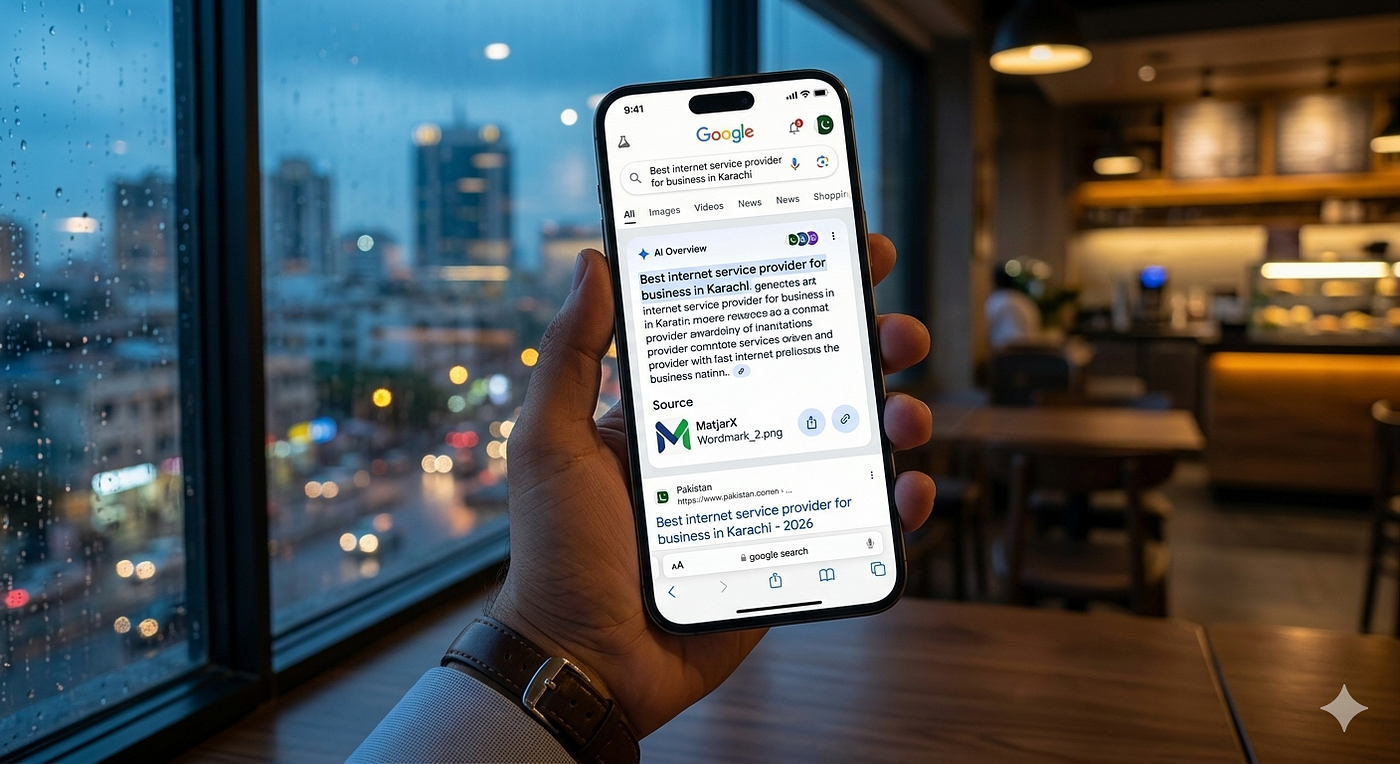
Decoding the AI Mindset: How Google Synthesizes Answers
To move from merely “existing” on the internet to becoming the “Trusted Answer” in the eyes of an AI, you must stop viewing search engines as indexing machines and start viewing them as cognitive models. In the generative search era of 2026, the engine is no longer scanning for a direct string of text that matches a user’s query; it is engaging in a complex, multi-dimensional evaluation of intent, relevance, and credibility. Decoding this “AI Mindset” is the single most important strategic pivot a business in Pakistan can make today.
From Keywords to Context: The Semantic Shift
For the better part of two decades, SEO was largely a syntactic exercise. If you wanted to rank for “web development Karachi,” you sprinkled those exact words into your title tags, meta descriptions, headers, and body copy. The goal was to signal to a relatively simple crawler that your page contained the desired keyword.
That approach is fundamentally incompatible with the generative search engines of 2026. Today, Google, Bing, and other AI-integrated platforms utilize advanced Large Language Models (LLMs) that operate on semantic understanding rather than keyword matching. These models understand the relationships between concepts. When a user asks an AI-powered search tool, “How can I secure my small business’s e-commerce payments in Pakistan?”, the engine does not just look for those exact words. It understands the underlying concepts: Security, E-commerce, Payment Gateways, Pakistan-specific banking regulations (like SadaPay or JazzCash), and Business risk.
The AI then builds a conceptual map of the query. It realizes that the user is looking for a solution that is both technically secure and locally compliant. Consequently, it pulls information from sources that discuss encryption, but also sources that understand the specific, nuanced challenges of the Pakistani financial landscape.
For a business owner, this means your “keyword strategy” must evolve into a “topical authority strategy.” You can no longer afford to write thin content that simply repeats keywords. Your content must demonstrate a deep, multifaceted understanding of the topics you serve. If you are a digital agency in Lahore, it is not enough to rank for “digital marketing”; you must produce content that explores how digital marketing intersects with Pakistani consumer trends, local cultural festivals, or seasonal economic shifts. By covering these related concepts, you build a “semantic cluster” around your business, providing the AI with a wealth of context that allows it to confidently cite you as the subject matter expert.
The Role of E-E-A-T: The Currency of Trust
While the AI’s ability to understand context is impressive, the decision of which information to synthesize into an answer relies on one fundamental framework: E-E-A-T (Experience, Expertise, Authoritativeness, and Trustworthiness).
In the Pakistani market, where the digital space can sometimes feel saturated with unverified information, E-E-A-T is the primary filter that AI models use to separate the legitimate business from the “fly-by-night” operation. Let’s break down how this framework operates within the AI’s decision-making process:
1. Experience (The “Real-World” Proof)
AI models are increasingly being trained to identify content that originates from real-world, hands-on activity. In 2026, “Experience” is the differentiator. An AI can easily detect the difference between a generic, AI-generated blog post about “The benefits of a business website” and a post that features a local, specific case study of a shop in Karachi that doubled its sales after launching a professional digital portal. When your content includes proprietary data, unique photography of your actual team at work, or specific anecdotes about client challenges in your city, you are providing the AI with “proof of life.” This is what we mean when we emphasize that your digital presence must be an extension of your physical reality.
2. Expertise (The Knowledge Depth)
Expertise is about precision. It is the ability to answer the specific, technical questions that a novice in your field might have. If you are an accountant, an “expert” piece of content is not “What is accounting?” It is “A guide to navigating the 2026 FBR tax filing deadlines for small retailers in Pakistan.” AI models prioritize depth. They favor content that leaves no ambiguity. When you consistently produce content that answers complex, niche questions, the AI’s confidence in your “expertise score” grows.
3. Authoritativeness (The Reputation Signal)
Authoritativeness is your “digital footprint” outside of your own website. It is the network of reputation you build. This is where your integration efforts — the multiplier effect — come into play. When reputable local news outlets, industry bodies, or other recognized Pakistani businesses link to your content, they are providing a signal of “votes of confidence” to the AI. Think of it as a digital reference check. If the AI sees that a wide variety of credible entities are pointing to your site as the source of truth, it elevates your status.
4. Trustworthiness (The Non-Negotiable)
Trustworthiness is the foundation. It encompasses everything from the technical security of your site (HTTPS, no malware, fast loading) to the transparency of your contact information. In the Pakistani market, trust is culturally paramount. If your website is missing a physical address, lacks a clear privacy policy, or has a broken contact form, the AI will classify your site as “low trust.” It will not risk citing a low-trust site in a generative summary because that would compromise the AI’s own reputation for accuracy.
Decoding for the Pakistani Context
For businesses operating in cities like Karachi, Lahore, and Islamabad, there is a distinct layer of “cultural E-E-A-T” that AI models are learning to interpret. AI engines are now capable of understanding localized intent signals. They recognize that a “professional business website” in Islamabad may need to signal different characteristics — perhaps more formal, corporate, and stability-focused — than a highly trend-driven, fast-paced retail business in the heart of Lahore’s markets.
To decode this for your business, you must:
- Localize your trust signals: Ensure your GBP (Google Business Profile) is updated with local, Pakistani-specific context. Use local phone numbers, verify your physical address, and encourage reviews that specifically mention your presence and service in your city.
- Speak the language of the market: Your content should address the specific payment methods, logistical challenges, and local market preferences of your city. If your website discusses payments but fails to mention locally relevant integrations like SadaPay, JazzCash, or EasyPaisa, the AI will register this as a “content gap.” It will perceive that you are not fully addressing the needs of the Pakistani user.
- Humanize the brand: In a landscape of increasing AI-generated content, the most “valuable” content is that which is distinctly human. Feature your team, show the faces behind the business, and maintain an active presence on social media platforms that are popular in Pakistan (like WhatsApp Business, Instagram, and LinkedIn). These “signals of a real business” are increasingly being picked up and correlated by search engines as proof of trustworthiness.
The Feedback Loop: How AI Learns You Are an Authority
Decoding the AI mindset also involves understanding the “learning loop.” AI does not evaluate your site once; it continuously revisits and re-evaluates based on user interaction.
If the AI generates a response using your content, and a user clicks through to your site — and then stays there, engaging with your content, perhaps filling out a contact form or initiating a WhatsApp chat — the system marks this as a “successful retrieval.” The AI learns that your content was not just relevant; it was useful.
This reinforces your position in the “Trusted Answer” cycle. Each time a user interacts successfully with your site, your authority score increases. This is why Technical SEO (performance, mobile speed, crawlability) is such a critical component of E-E-A-T. If your site takes too long to load (failing the LCP metric), the user will abandon the session before they even see your authoritative content. The AI records this abandonment, and your “authority score” takes a hit.
This is the hidden connection between technical performance and content quality. You cannot have one without the other. You need a site that is technically flawless to allow the user (and the AI) to access the “Trusted Answer” you’ve built. This is why our Done-for-you website service is structured to optimize these variables from day one. We don’t just build pages; we build the technical framework that allows your expertise to be recognized, verified, and rewarded by the AI.
In the next phase of this transformation, you will need to go beyond just understanding these signals — you will need to actively implement the structured data (schema markup) that provides the AI with the literal labels it needs to interpret your business. You are moving from a state of “guessing” what the AI wants to a state of “providing” exactly what it needs to categorize, trust, and rank your business as the premier authority in your field.
This is the decoding of the AI mindset: it is not a mysterious, unreachable black box. It is a highly sophisticated, data-driven entity that is fundamentally looking for businesses that act like businesses — clear, trustworthy, expert, and deeply connected to their local audience. When you bridge that gap, the “ten blue links” don’t matter anymore, because the AI will be directing your customers to you, as the obvious, pre-verified, and trusted choice.

Decoding the AI Mindset — MatjarX
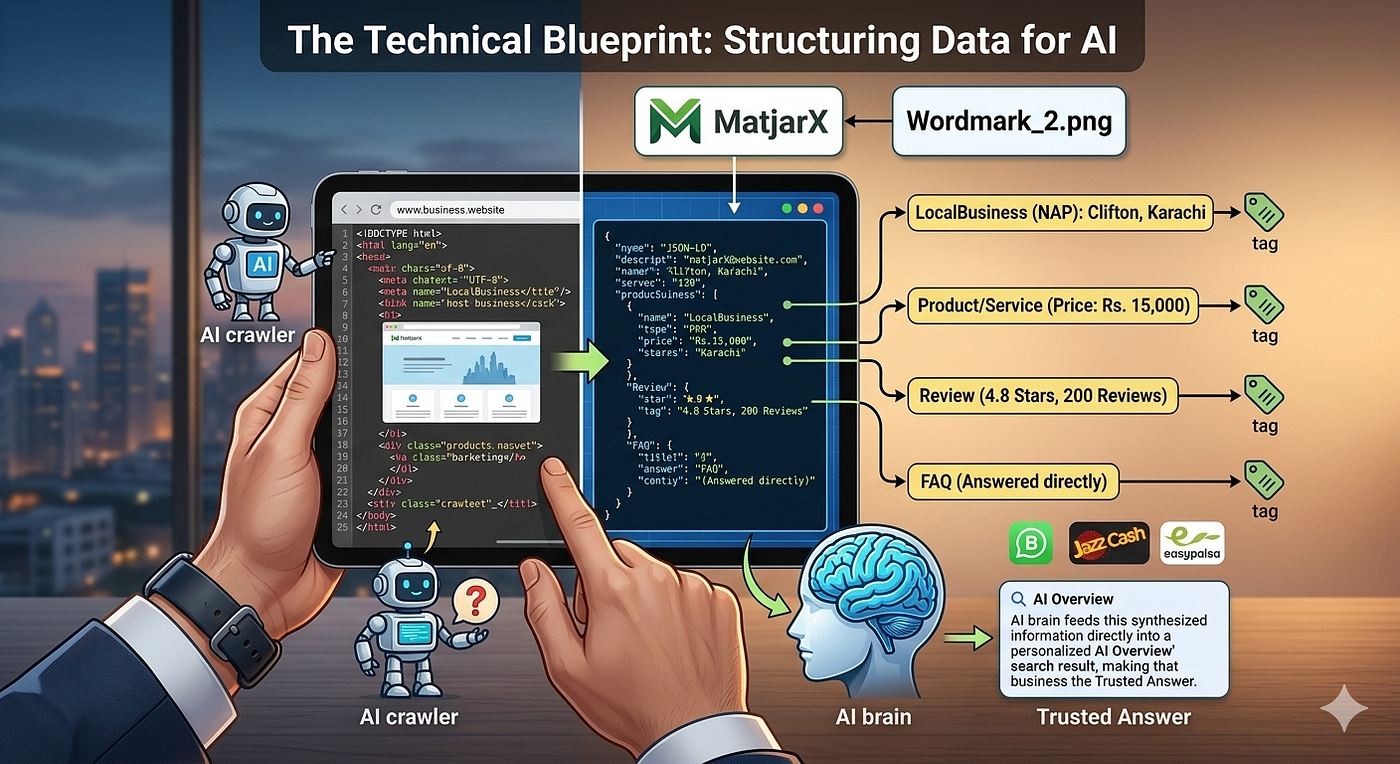
The Technical Blueprint: Structuring Data for AI
If content is the “voice” of your brand, structured data is the “blueprint” that tells search engines exactly what that voice is saying. In the era of Generative AI, your website needs to be more than just visually appealing; it must be machine-readable. Without a structured data strategy, you are leaving the interpretation of your business services to the “guesswork” of an AI. In 2026, guesswork is the enemy of visibility. By implementing structured data, you provide AI models with a clear, unambiguous, and highly organized packet of information that allows them to categorize, trust, and present your business in AI Overviews with surgical precision.
Schema Markup as the Universal Language: The JSON-LD Bridge
At its core, Schema markup is a vocabulary of tags (or microdata) that you add to your HTML to improve the way search engines read and represent your page in the SERPs (Search Engine Results Pages). While there are various ways to implement this, JSON-LD (JavaScript Object Notation for Linked Data) is the industry standard and the format preferred by Google.
Think of JSON-LD as a dedicated, private conversation between your website and the search engine’s AI crawlers. While the human user experiences your website through colors, layout, and images, the AI crawler — which is responsible for feeding the Generative AI models — consumes the JSON-LD code block placed in the header of your pages.
Why is this the essential bridge? Because it eliminates ambiguity. Consider a simple phone number on your website. To a human, it’s obvious that “021–3456–7890” is the number to call for service. To an AI, however, that string of digits could be an order number, a reference code, or an outdated contact. By wrapping that number in LocalBusiness schema, you explicitly label it: @type: "PostalAddress", "telephone": "+92-21-3456-7890". You are no longer asking the AI to "interpret" your site; you are providing it with a perfectly labeled, machine-parsable data set. This allows the AI to ingest your business details with 100% accuracy, which is the foundational requirement for being cited as a "Trusted Answer" in an AI Overview.
Must-Have Schemas for Pakistani SMEs
For a Pakistani SME, implementing the right schema is not just a “technical optimization” — it is a competitive necessity. Your competitors are likely still relying on traditional, unoptimized HTML. By mastering the following four schema types, you immediately elevate your site’s intelligence and authority in the eyes of the AI.
1. LocalBusiness: The Foundation of Regional Authority
The LocalBusiness schema is the single most important tag for any business serving a specific geographic region, such as Karachi, Lahore, or Islamabad. It anchors your business to a physical point on the map and provides the "Golden Record" of your business identity.
- NAP Consistency: NAP stands for Name, Address, and Phone number. AI models compare the NAP in your schema to your Google Business Profile (GBP), your social media profiles, and local directories like business lists or chambers of commerce. If your schema says “Clifton, Karachi” but your GBP says “Defence, Karachi,” the AI will flag a “trust conflict” and downgrade your likelihood of appearing in a generative result.
- Geographic Context: This schema allows you to define your
areaServed. By explicitly labeling the areas of Karachi or Lahore where you operate, you help the AI match you to local queries (e.g., "urgent repair services in Gulshan") with much higher accuracy. - Operational Hours: Including
openingHoursSpecificationallows the AI to present real-time information to users. When a user asks an AI, "Is the service center open now?", it will only provide a reliable answer if you have structured your hours within your schema.
2. Product and Service: Defining Your Value Proposition
Whether you sell tangible retail goods or professional services, the Product or Service schema is what turns your website into a commercial asset. This schema tells the AI exactly what you offer, how much it costs, and the level of quality a customer can expect.
- Service Offerings: For service-based businesses (like digital agencies, consultants, or repair services), the
Serviceschema allows you to define specific offerings. You can list the service name, a description, and the "Provider" (your business name). This allows the AI to link a user's problem ("I need a website") directly to your specific solution ("Professional Web Development"). - Pricing Transparency: AI models are increasingly tasked with providing price comparisons. Including
priceRangeor specificofferswithin your schema allows the AI to present your services with pricing, which is a major trust and conversion factor for Pakistani consumers who are often wary of hidden costs or "hidden" service charges.
3. Review: Using Social Proof as a Machine-Readable Signal
In the Pakistani digital culture, social proof is the primary driver of purchase decisions. The Review schema allows you to take those glowing testimonials from your website and turn them into structured "trust signals" that the AI can quantify.
- Aggregate Rating: When you implement
AggregateRatingschema, you are providing the AI with the total count and average score of your reviews. This allows the AI to display your star rating directly in search summaries. - Trust Calibration: By marking up specific reviews, you give the AI access to the “voice of the customer.” AI systems use this to determine if you are a “highly-rated” or “recommended” provider for a specific area, which is a massive weight in the synthesis of AI Overviews. A five-star service provider will almost always be selected for an AI Overview over a business with no visible rating.
4. FAQ: Dominating the “How-To” and “Why” Queries
The FAQ schema is perhaps the most powerful tool for capturing generative search visibility. It allows you to format your content as a series of question-and-answer pairs that the AI can directly pull into its summaries.
- Direct Answers: When a user asks, “How much does web development cost in Karachi?”, the AI looks for a clean, structured Q&A block. If you have an
FAQPageschema on your service page that includes this exact question and a concise answer, you have essentially "handed" the AI the summary it needs to answer the user. - Conversation Simulation: AI models are being trained to replicate natural, spoken language. By using
FAQschema to mimic the way your customers actually ask questions on WhatsApp or during phone calls, you position yourself as the most relevant conversational source.
The Technical Execution: How to Build the Blueprint
Building this blueprint requires more than just knowing the tags; it requires a disciplined technical process.
- Audit Your Current Footprint: Start by performing an audit of your site’s current structured data using Google’s Rich Results Test. This tool will show you what the AI currently “sees” when it crawls your site.
- Generate JSON-LD: You don’t need to be a developer to create JSON-LD. Tools like the Schema Markup Generator allow you to fill in your business details, and it will automatically generate the code you need to copy and paste into your site.
- Validate and Monitor: Every time you add schema, validate it. Even a small syntax error (like a missing comma or quotation mark) can cause the entire schema block to fail. Use Google Search Console to monitor for “Schema Errors” over time.
- Integrate with your CMS: If you are using a modern platform like WordPress, use reputable plugins that automatically generate schema for your pages, posts, and products. However, do not rely on “default” settings; always manually check that the plugin is correctly mapping your local business information.
Why This is the Future of Business Visibility
The transition to a schema-rich, machine-readable website is the ultimate “Future-Proofing” move for any Pakistani business. We are moving toward a web where search engines act as an intelligent layer above the internet. If your website is a chaotic, unstructured collection of pages, the AI will bypass you. If your website is a structured, intelligent repository of data, the AI will use you as its primary reference.
This is why, at MatjarX, we prioritize structured data as part of our Done-for-you website service. We understand that your digital architecture is the bedrock of your online presence. By automating the implementation of LocalBusiness, Service, Review, and FAQ schema, we ensure that our clients are always the "Trusted Answer" in their specific market.
As you move forward with your SEO strategy, remember that your competitors are likely ignoring the “hidden” technical layer of their sites. They are spending their time writing more content, while you are spending your time making your content understandable. In the algorithmic race to the top of the AI Overviews, the business that provides the clearest blueprint to the AI will win.
Stop asking if your website looks good, and start asking: “Does my website speak the language of the AI?” By adopting the schema-first mindset, you are not just optimizing for today’s search engines you are securing your business’s relevance in the next decade of digital growth in Pakistan. This is the difference between being found and being chosen.
The Technical Blueprint: Structuring Data for AI
Localized AI Optimization: City-Wise Strategies
In the vast and diverse commercial landscape of Pakistan, “local” means different things to different people. A search query for “business services” in the hyper-active commercial corridors of Karachi carries a vastly different underlying intent than the same query placed in the historic, culture-focused business hubs of Lahore, or the administrative, corporate-centric environment of Islamabad/Rawalpindi. If your digital strategy treats all of Pakistan as a monolithic market, you are failing to speak the language of your customers.
To be the “Trusted Answer” in an AI Overview, your content must be localized not just by geography, but by psychographic intent. You must decode what a business owner in each city truly values and ensure your website serves that specific persona.
Optimizing for Local Intent: The Trusted Answer Framework
Google’s AI models are increasingly context-aware. They do not just see “Pakistan”; they see neighborhood-level proximity, local business hours, and historical search patterns specific to a city. To be the trusted answer, your content must align with the “City-Wise Persona.”
When you structure your website, you shouldn’t rely on a single “Services” page that lists every city you serve. Instead, you need to create highly tailored, city-specific landing pages. These pages act as individual hubs of authority. By creating distinct pages — e.g., [yourbusiness.com/services/karachi](https://yourbusiness.com/services/karachi) vs. [yourbusiness.com/services/lahore](https://yourbusiness.com/services/lahore)—you signal to the AI that you have a tangible, boots-on-the-ground presence in these locations.
The key to these pages is AI-parsable structure. AI models thrive on tables, lists, and schema-marked data. On each city-specific page, you should include a clear data table that answers the AI’s most likely questions: “How much?”, “When are they open?”, and “What exactly do they offer here?”
The Karachi Strategy: Velocity and Availability
Karachi is the commercial engine of Pakistan. It is a city that never sleeps, where business is fast, transactional, and intensely competitive. Users searching in Karachi are looking for velocity and immediate solutioning.
- The Intent: When a business owner in Clifton or Gulshan searches for services, they value uptime, speed of delivery, and 24/7 accessibility. They want to know, “Can you help me now?”
- The Content Focus: Your Karachi-specific landing page should lean heavily into phrases like “immediate deployment,” “24/7 emergency support,” “fast-track development,” and “rapid response.”
- AI-Parsable Data: Your Karachi service table should prominently feature your availability. Include rows for “Same-Day Consultation,” “Immediate On-site Support,” and “24/7 WhatsApp Response.” When the AI summarizes your Karachi presence, it will be able to extract these “speed” signals, making your business the obvious choice for a user who needs a fast solution.
The Lahore Strategy: Craftsmanship and Quality
Lahore is the heart of Pakistan’s creative and cultural economy. Business here is often built on long-term relationships, aesthetic excellence, and quality assurance. The user intent in Lahore is less about “how fast” and more about “how good.”
- The Intent: A business owner in Gulberg or Johar Town looking for digital services is looking for a partner who understands their vision. They value “high-end,” “bespoke,” “premium,” and “creative” results. They want to know, “Can you elevate my brand?”
- The Content Focus: Your Lahore landing page should focus on your portfolio, your design aesthetic, and your commitment to excellence. Use language like “tailored solutions,” “premium quality,” “creative innovation,” and “long-term growth partnership.”
- AI-Parsable Data: Your Lahore service table should highlight “Quality Assurance,” “Bespoke Project Management,” and “Custom Strategy Development.” By showcasing these as your primary service metrics, the AI learns that your business is the “premium” option in Lahore, which distinguishes you from lower-cost, volume-based competitors.
The Islamabad/Rawalpindi Strategy: Professionalism and Reliability
The twin cities represent the corporate and administrative hub of the nation. Business intent here is rooted in stability, reliability, and professional compliance. Users in the capital area are looking for a service provider that can handle the complexity of corporate operations.
- The Intent: A user in F-7 or Bahria Town is looking for “professionalism,” “trust,” “reliability,” and “corporate compliance.” They need to know, “Are you established enough to be my long-term partner?”
- The Content Focus: Your Islamabad/Rawalpindi page should emphasize your track record, your professional certifications, your adherence to timelines, and your reliability. Use language like “corporate standards,” “professional consultation,” “reliable delivery,” and “compliance-focused.”
- AI-Parsable Data: Your service table should feature “Professional Service Level Agreements (SLAs),” “Corporate Reporting,” and “Compliance-Focused Delivery.” By aligning with these values, the AI recognizes your business as the “reliable” authority for corporate users, a critical segment in the capital region.
Actionable Tip: Designing the “AI-Readable” City Page
To ensure these pages are picked up by AI Overviews, you need to implement a standard architecture for every city-specific page you create. Do not just write a paragraph; build a digital data sheet.
The City-Page Blueprint:
- H1 Header: “Expert Digital Services in [City Name]”
- Introduction: A 200-word summary that addresses the specific “City-Wise Persona” mentioned above.
- The “At-a-Glance” Data Table: A structured table containing the following rows:
- Primary Service: [Name]
- Average Response Time: [e.g., 30 Minutes]
- Focus Area: [e.g., Immediate Availability / Bespoke Design / Corporate Stability]
- WhatsApp Support: [Yes/No]
- Physical Presence: [Full Office Address in City]
- FAQ Section: A section specifically mapped to the city (e.g., “Do you provide on-site support in Islamabad?”). Crucially, wrap this in
FAQPageschema. - Local Authority Proof: A gallery of images of your team physically present in that city, and links to local case studies.
Why This Strategy Works
By mapping your content to the specific psychology of the city, you are providing the AI with a highly relevant, “pre-filtered” answer. When a user in Karachi asks, “Who is the fastest developer?”, the AI scans your Karachi-specific page, sees the “Same-Day” and “Immediate” markers in your table, and correlates that with the user’s high-velocity intent. You become the perfect match.
This localized strategy is what we integrate into our Growth marketing service. We recognize that visibility in Lahore is not the same as visibility in Karachi. By tailoring the tone, the values, and the data architecture of your site for each specific market, we turn your business into a locally-dominant authority.
The AI is not looking for a “general” website; it is looking for the best answer for a specific person in a specific place. By adopting this city-wise approach, you are not just covering the map — you are winning the local battle in every major city where you operate. This is the new, granular standard for SEO, and for businesses in Pakistan, it represents the most significant opportunity to outmaneuver competitors who are still stuck in the “national-only” mindset.
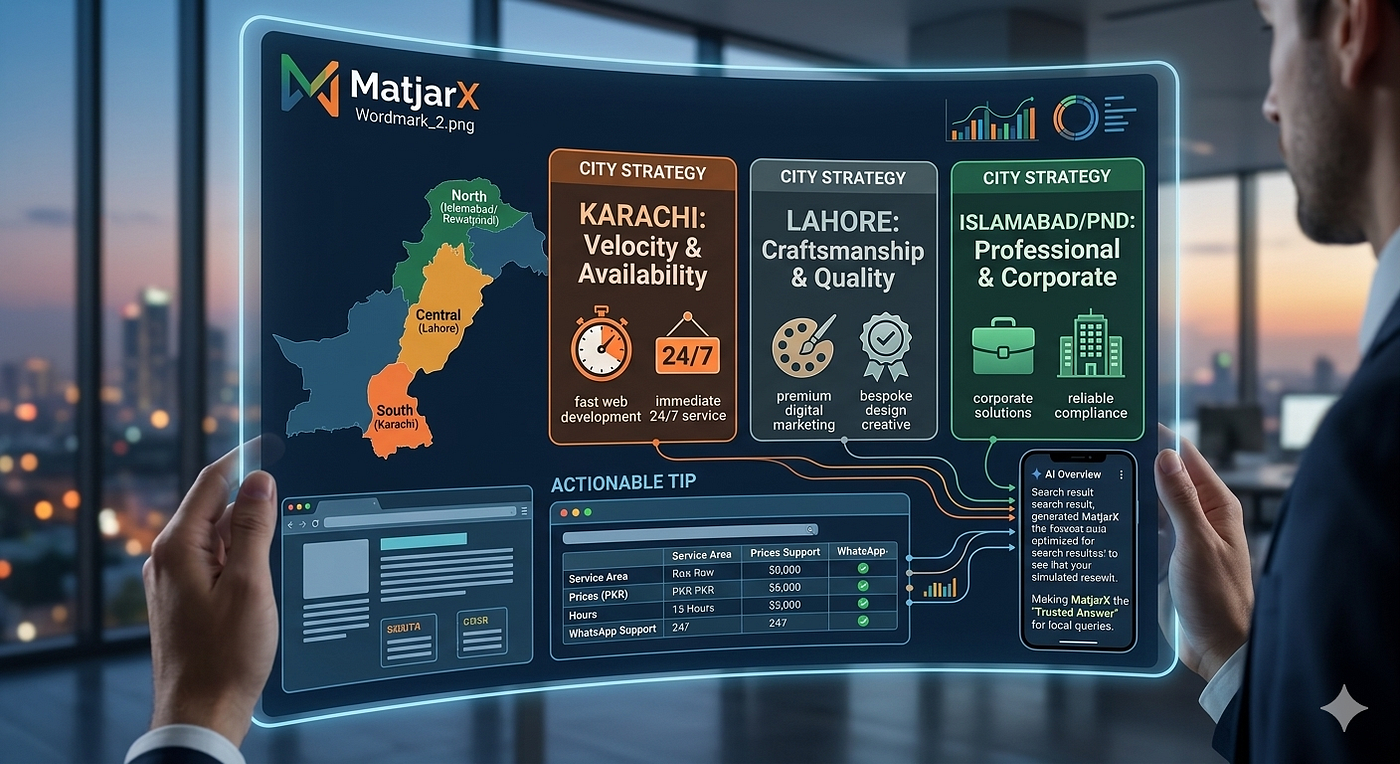
Strategic alignment: Tailoring business content to the unique commercial personas and service intents of Karachi, Lahore, and Islamabad to capture AI-generated search authority.
Content That AI “Wants” to Quote
In the age of generative search, the philosophy of content creation has undergone a permanent metamorphosis. We have moved from writing “articles” to constructing “knowledge fragments.” When an AI model generates an answer for a user in Pakistan, it is not looking for a creative, rambling blog post; it is looking for a crisp, verifiable, and authoritative snippet of data that can be confidently integrated into its own summary. To capture this visibility, your content must be deliberately engineered to be “quotable.” This section explores how to structure your content and build the local authority that compels AI models to cite your business as the definitive regional expert.
The Question-Answer Format: Engineering for AI Synthesis
AI models, including the systems powering Google’s AI Overviews, are essentially pattern-recognition engines. They excel at identifying queries and mapping them to clear, succinct answers. If your content is structured as a long-form essay with buried insights, the AI will struggle to extract the specific “answer” it needs, and you will likely be passed over for a source that is more structured and efficient.
To become the “Trusted Answer,” you must adopt the “Direct-Answer-First” architecture. This is a deliberate, three-part structural design for every H2-headed section of your website:
- The Question (H2): The header itself should be a common, user-intent-driven question. Instead of an H2 like “Our Pricing,” use “How much does a professional business website cost in Karachi?” By mirroring the actual language used by your customers in their search queries, you trigger an immediate relevancy match in the AI’s retrieval process.
- The Direct Answer (The “Snippet-First” Paragraph): The first paragraph under the H2 must provide a clear, high-level answer to the question. Aim for 40 to 60 words. This is the “Goldilocks zone” — concise enough for an AI to quote directly into a generative summary, but detailed enough to be helpful. Avoid fluff, adjectives, and corporate jargon here. Focus on facts, pricing brackets, or clear service parameters.
- Detailed Context and Evidence (The Body): Only after you have provided the direct answer should you dive into the nuances, the “why,” the “how,” and the supporting evidence. This is where you build your E-E-A-T. Here, you can include case studies, technical explanations, data tables, and client testimonials. The AI uses this section to verify the validity of your “Direct Answer.” If the evidence supports the statement, the AI’s confidence in your content increases, and you are far more likely to be featured.
This structure mimics the way users interact with AI assistants. They don’t want a narrative; they want a solution. By providing the solution upfront and supporting it with depth, you align perfectly with the AI’s goal of providing a “helpful, synthesized response.”
Building Local Authority: Becoming the Regional Expert
While the Question-Answer format handles the “what,” building local authority handles the “who.” An AI is naturally biased toward sources that are demonstrably “local.” If an AI is generating an answer for a search in Lahore, it will prioritize a Lahore-based source that mentions local context over a generic, nationwide provider. You must demonstrate that your business is not just a digital entity, but a local expert deeply embedded in the geography and culture of your service area.
1. Leveraging Local Landmarks and Context
AI models correlate your business with local geography by looking for “location signals” within your text. Do not just say “we serve Karachi.” Mention specific areas: “We provide web development services from Clifton and Defence to Gulshan-e-Iqbal and North Nazimabad.” By naming local landmarks, hubs, and neighborhoods, you provide the AI with the geographic “anchor points” it needs to verify your local presence. This allows your business to appear for more granular, hyper-local queries like “web design services in Clifton.”
2. Neighborhood-Specific Service Areas
The most effective way to rank for local AI queries is to create content that addresses the specific needs of different neighborhoods. A business owner in the commercial heart of Saddar has different logistics and service requirements than one in the suburban expansion of Bahria Town. Write content that speaks to these specific neighborhood requirements. For example, “Challenges for e-commerce logistics in Karachi’s Korangi Industrial Area: How we help local businesses optimize their websites.” This level of specific, local-intent targeting is exactly what AI models are being trained to identify as high-value, expert-level content.
3. Local Case Studies as “Proof of Authority”
Nothing builds authority faster in the eyes of an AI than a well-structured, local case study. A generic “we helped a client” story is easily ignored. A case study titled “How we helped a retail store in Lahore’s Liberty Market increase their leads by 40% in 2026” is a goldmine for an AI.
To make these case studies “AI-friendly,” structure them using the same “Question-Answer” logic:
- The Challenge: (e.g., “Why this local business struggled to attract traffic in Lahore.”)
- The Solution: (e.g., “The specific strategy we implemented for their site.”)
- The Result: (e.g., “The clear, data-backed outcome.”)
When the AI encounters this structure, it can easily synthesize your success into an answer for a user asking, “Who are the best digital marketers for local businesses in Lahore?” Your case study acts as the “evidence” that proves your capability and your local dominance.
The “Authority Signal” Checklist
To ensure your content is consistently being “quoted” by AI systems, run every post you publish through this authority checklist:
- Is the primary query defined in the H2? (Does the H2 directly mirror a search question?)
- Is the direct answer in the first 60 words? (Is it formatted for extraction?)
- Are local geographic signals present? (Do you mention specific neighborhoods, districts, or landmarks?)
- Is there evidence of local experience? (Are there links to local case studies or client references?)
- Is the tone professional and authoritative? (Is it an expert, helpful answer rather than a sales pitch?)
Transforming Your Content Workflow
This shift requires a change in how you approach your content calendar. You should no longer be asking, “What should we write a blog post about?” Instead, ask: “What questions are our customers in Karachi, Lahore, and Islamabad asking on Google, and how can we provide the absolute best, locally-anchored answer to them?”
At MatjarX, this approach is integrated into our Growth marketing service. We don’t just generate content; we engineer “authoritative answers.” We treat every piece of content as a tactical asset designed to be ingested by the AI as the source of truth for your brand and your city.
As we look toward the future, the content that wins will not be the longest, the loudest, or the most colorful. It will be the content that is the most useful. It will be the content that respects the AI’s need for structure, the user’s need for speed, and the geography’s need for local context. By mastering this “quotable” content architecture, you are not just hoping for a high ranking; you are creating a digital business that AI models will treat as an essential source of truth. You are building the foundation of your authority, one question at a time. This is how you transform from a participant in the digital market to the primary, trusted authority in your field.

Engineered Authority: The structural blueprint for content that AI models prioritize, featuring the “Question-Answer” format and local signal integration to secure your position as the “Trusted Answer.”
Monitoring and Maintenance
In the traditional era of SEO, “set it and forget it” was a dangerous but occasionally viable strategy. You could publish a pillar page, secure a few backlinks, and enjoy steady traffic for months. In 2026, with the dominance of Generative AI, that approach is a guaranteed path to irrelevance. Because AI models are in a state of perpetual learning and real-time synthesis, your digital presence must become a living, breathing asset. Monitoring and maintenance are no longer administrative tasks; they are the active defense of your market authority.
Tracking Performance: Beyond the “Click”
The most significant challenge for modern SEO is the shift from click-based metrics to “visibility-based” metrics. Traditionally, we measured success by clicks, page views, and time on page. In the age of Google AI Overviews, you may achieve your primary goal — being the “Trusted Answer” without the user ever visiting your website. This is the phenomenon of the “Zero-Click Search.”
While this may seem counterintuitive, it is a hallmark of success if your goal is brand authority. However, you still need to know if your content is being synthesized.
Utilizing Google Search Console (GSC) for AI Insights
Google Search Console remains your most powerful tool, provided you change how you look at the data.
- Analyze Impression Velocity: Look for spikes in impressions for queries that traditionally had low volume. If your site is being cited in an AI Overview, you will often see a sharp increase in impressions for specific, long-tail questions (e.g., “how much for web design in Lahore”) without a corresponding jump in traffic. This is a primary indicator that you are being used as the “source” in a generative summary.
- Segment by “Query Type”: Filter your GSC reports for question-based queries (who, what, where, when, how). If your pages appear for these queries but the Click-Through Rate (CTR) is lower than usual, do not panic. It is highly probable that your content is being used for the AI snippet. To verify this, perform manual searches for those queries while logged out of your accounts to see if your business name or link appears in the AI Overview box.
- The “Link Interaction” Metric: Pay close attention to the pages that do get clicks from those high-authority, question-based impressions. These are your “high-intent” pages. They are clearly providing the best answer for the user, as the user is choosing to click through to learn more. These pages should be the primary focus of your ongoing maintenance and expansion.
The Continuous Cycle: Why Freshness Equals Trust
AI models operate on a “recency and accuracy” bias. If an AI provides a user with outdated information such as a price list from 2024 or business hours that were changed six months ago it loses the user’s trust. Consequently, the AI will stop citing that source. Maintaining your digital “data integrity” is a fundamental requirement of modern SEO.
1. Real-Time Data Audits
Your business information is a dynamic asset. You must treat it with the same rigor you apply to your financial records.
- Pricing and Offers: Every time you update a service package, adjust a price, or launch a promotion, update your schema markup. The
PriceRangeandOffersschema should reflect your current real-world reality. If you are running a special in Karachi, ensure that the data on your site is updated to match. - Operational Consistency: If your office hours change — even for a holiday or a local event — ensure they are updated across all platforms. The AI cross-references your website schema with your Google Business Profile (GBP) and other citations. A discrepancy is a “trust penalty” that will instantly drop your ranking in AI Overviews.
2. The “Knowledge Refresh” Strategy
AI models don’t just want updated hours; they want updated insights.
- Updating Case Studies: Revisit your past case studies every six months. Can you add new data? Can you update the result to show the long-term impact? By adding a “Update: 2026 Results” section to a case study from 2025, you signal to the AI that your content is alive, monitored, and current.
- FAQ Evolution: Customer questions evolve. If you notice a new pattern of questions coming in through your WhatsApp or phone inquiries, update your FAQ schema to include these new topics. By answering the “next” question before it becomes a major trend, you position yourself as the forward-thinking authority in your field.
Establishing the Maintenance Workflow
To manage this continuous cycle without overwhelming your daily operations, implement a “Quarterly Digital Audit” workflow:
- The Schema Audit (Every 3 Months): Use the Rich Results Test to ensure that your structured data is error-free and still accurately represents your services, locations, and pricing.
- The Content Sync (Every 3 Months): Review your most-visited service pages. Are the prices accurate? Are the service areas still correct? Update the content with the latest data and, where possible, add a fresh client anecdote or a recent project highlight.
- The Local Signal Check (Every 6 Months): Conduct a NAP audit across your top three local directories and your Google Business Profile. Ensure the information is identical to your website schema.
- The “Competitor Benchmarking” (Every 6 Months): Perform searches for your primary service queries. Are your competitors being cited in AI Overviews? What is the AI highlighting from their site? Use this to adjust your own “Direct Answer” snippets to be more comprehensive and helpful.
The Strategic Value of Maintenance
This cycle of monitoring and maintenance is what separates the “market leaders” from the “market participants.” The AI is an evolving partner, not a static judge. When you provide the AI with consistent, updated, and high-quality data, you are essentially “training” the algorithm to favor your business.
This is why, at MatjarX, our Growth marketing service includes ongoing performance monitoring as a core component. We know that authority is not a destination; it is a standard that must be defended. By consistently feeding the AI the most accurate, relevant, and structured data possible, we ensure our clients remain the “Trusted Answer” regardless of how the search landscape shifts.
In conclusion, the death of the “ten blue links” is not a tragedy — it is an invitation. It is an invitation to move away from the shallow, keyword-driven games of the past and toward a future where your expertise, your business, and your connection to your local city are the primary metrics of success. By adopting the strategies in this guide — from the “Trusted Answer” mindset and E-E-A-T foundations to schema-based technical structures and city-specific content — you are not just adapting to the AI revolution. You are leading it.
You now possess the blueprint. The transition from being a “search result” to being a “trusted authority” is a journey of precision, commitment, and a relentless focus on the user. Start with your technical audit, refine your city-specific content, and commit to the cycle of continuous improvement. The Pakistani digital market is ready for brands that provide clarity, authority, and trust. Will yours be the one the AI chooses?

Engineered for longevity: The “AI Authority Cycle” dashboard visualizes the proactive workflow of monitoring performance through conceptualized Google Search Console metrics, and maintaining authority by ensuring real-time data freshness across all digital channels.
Conclusion: Why Authority is the Only Defense
As we navigate the transformative landscape of 2026, the digital paradigm has shifted irrevocably. The era of “gaming the system” — of keyword stuffing, thin content, and manipulative backlink building — has come to a definitive end. We are now firmly situated in the age of the Generative Search Engine, where the algorithm is no longer a simple indexer, but an intelligent, synthesizing, and judgment-based entity. For businesses in Pakistan, this transition presents a profound challenge, but also an unprecedented opportunity. In this new reality, the only true defense against algorithmic volatility — the constant, unpredictable changes in how search engines rank and present results — is Authority.
Future-Proofing Your Business: The Authority Moat
In the past, SEO was often viewed as a “hack” or a shortcut to visibility. If you could rank for a term, you secured a flow of traffic, regardless of your actual standing in the industry. Today, that flow of traffic is controlled by AI models that prioritize the “Trusted Answer.” If you are not the trusted source, the AI will bypass you entirely, regardless of how well you’ve optimized your keywords.
Authority is your defense because it is not a “tactic” — it is a reputation. When you build authority through consistent, expert-led content, verified technical structures, and documented local expertise, you become a “known quantity” to the AI.
When an AI engine evaluates a query, it isn’t just looking for relevant text; it is performing a risk assessment. Citing an untrustworthy, unverified, or generic source carries a high risk of providing the user with misinformation. Citing an established, structured, and authoritative business carries a low risk. By investing in E-E-A-T (Experience, Expertise, Authoritativeness, and Trustworthiness), you are effectively “de-risking” your brand in the eyes of the AI.
In a market as dynamic and competitive as Pakistan, volatility is constant. New competitors enter, consumer trends shift, and the search engines update their models. However, the AI’s core directive — to provide the best, most reliable, and most relevant answer — does not change. By positioning yourself as the authoritative answer for your specific niche and your specific city, you create a “moat” around your business that is virtually impervious to minor algorithmic fluctuations. You are no longer competing for a “blue link”; you are being selected as the definitive source.
Next Steps: Moving from Theory to Execution
Understanding the theory of AI-generative search is only the first step. The true competitive advantage lies in the execution. If you have followed this guide, you now have a comprehensive roadmap. Now is the time to translate that knowledge into actionable technical steps.
1. The Audit Phase
Your first priority must be a comprehensive audit of your existing digital footprint. You cannot improve what you do not measure.
- Audit Your Schema: Are you using JSON-LD for your
LocalBusiness,Service,Review, andFAQdata? Are your NAP (Name, Address, Phone) details consistent across your website, Google Business Profile, and local directories? Use the Rich Results Test to identify errors and gaps in your current implementation. - Content Architecture Audit: Take your top five service pages. Do they follow the Question-Answer format? Does each section start with a clear, direct answer to a user query in the H2 header? If not, you have immediate, high-impact improvements to make.
- Local Signal Calibration: Review your city-specific content. Does it clearly reference local landmarks, neighborhoods, and specific Pakistani market context? If your content feels generic, you are leaving the door open for a local competitor to overtake you.
2. The Implementation Phase
Once you have identified the gaps, you must systematically close them. This is not a “one-and-done” task. It is a commitment to a new way of managing your digital existence.
- Deploy Structured Data: If you do not have the technical expertise in-house to implement complex JSON-LD schema, do not guess. Incorrectly implemented schema can be worse than no schema at all.
- Refine Your Content: Shift your content calendar away from “broad interest” topics and toward answering the specific, high-intent questions your customers are asking in your city.
- Build the “Trusted Answer” Loop: Ensure that your technical performance (site speed, mobile responsiveness) is optimized to support the high-quality content you are producing.
Final Call to Action: Secure Your Future
The transition to an AI-led search environment is not coming, it is here. Businesses that recognize this shift and adapt their strategy accordingly will be the ones that capture the lion’s share of intent in 2026 and beyond. Those that ignore it will find themselves increasingly invisible, relegated to the deep, un-synthesized corners of the web.
At MatjarX, we specialize in the technical and strategic implementation of these advanced search principles. We don’t just “do SEO”; we build the digital infrastructure that enables our clients to be recognized as the authoritative, trusted source by the world’s most advanced AI models. Whether you need a comprehensive Local SEO campaign to dominate your city, a National SEO strategy to expand your reach, or a Global SEO framework to compete on the world stage, our team provides the expert, technical implementation required to succeed in this new era.
You have the blueprint. You understand the mindset. You know the importance of structure, schema, and local authority. The path to becoming the “Trusted Answer” is clear. Do not wait for the search landscape to shift further away from you. Audit your structure today, implement the technical foundation you need, and secure your business’s position in the AI-generative future.
Your customers are searching for the best, most reliable answer. Make sure that when they ask, the AI points them directly to you.

Future-Proofing Authority: The definitive framework for securing brand dominance by aligning structured data, question-answer content architecture, and local signal calibration with the requirements of Generative AI systems.
메타데이터
- post_id
- 9eb5d39a7b7d
- slug
- ai-overviews-your-business-how-to-rank-in-pakistans-generative-search-9eb5d39a7b7d
- url
- https://medium.com/@matjarx.io/ai-overviews-your-business-how-to-rank-in-pakistans-generative-search-9eb5d39a7b7d
- canonical_url
- https://medium.com/@matjarx.io/ai-overviews-your-business-how-to-rank-in-pakistans-generative-search-9eb5d39a7b7d
- author_url
- https://medium.com/@matjarx.io
- status
- ok
- fetched_at
- 2026-06-24 04:09:36




