Pull Starts Where Everyone Stops Looking
More Than Inventory Management
Pull Starts Where Everyone Stops Looking
More Than Inventory Management
Many people explain Pull as a way to reduce inventory.
They’re right.
Pull does reduce inventory. In fact, Just-in-Time is built upon it.
But inventory is where the story begins, not where it ends.
The Supermarket That Changed Manufacturing
To understand Pull, you don’t need to visit a Toyota factory.
Just visit your local supermarket.
I see it almost every time I shop.
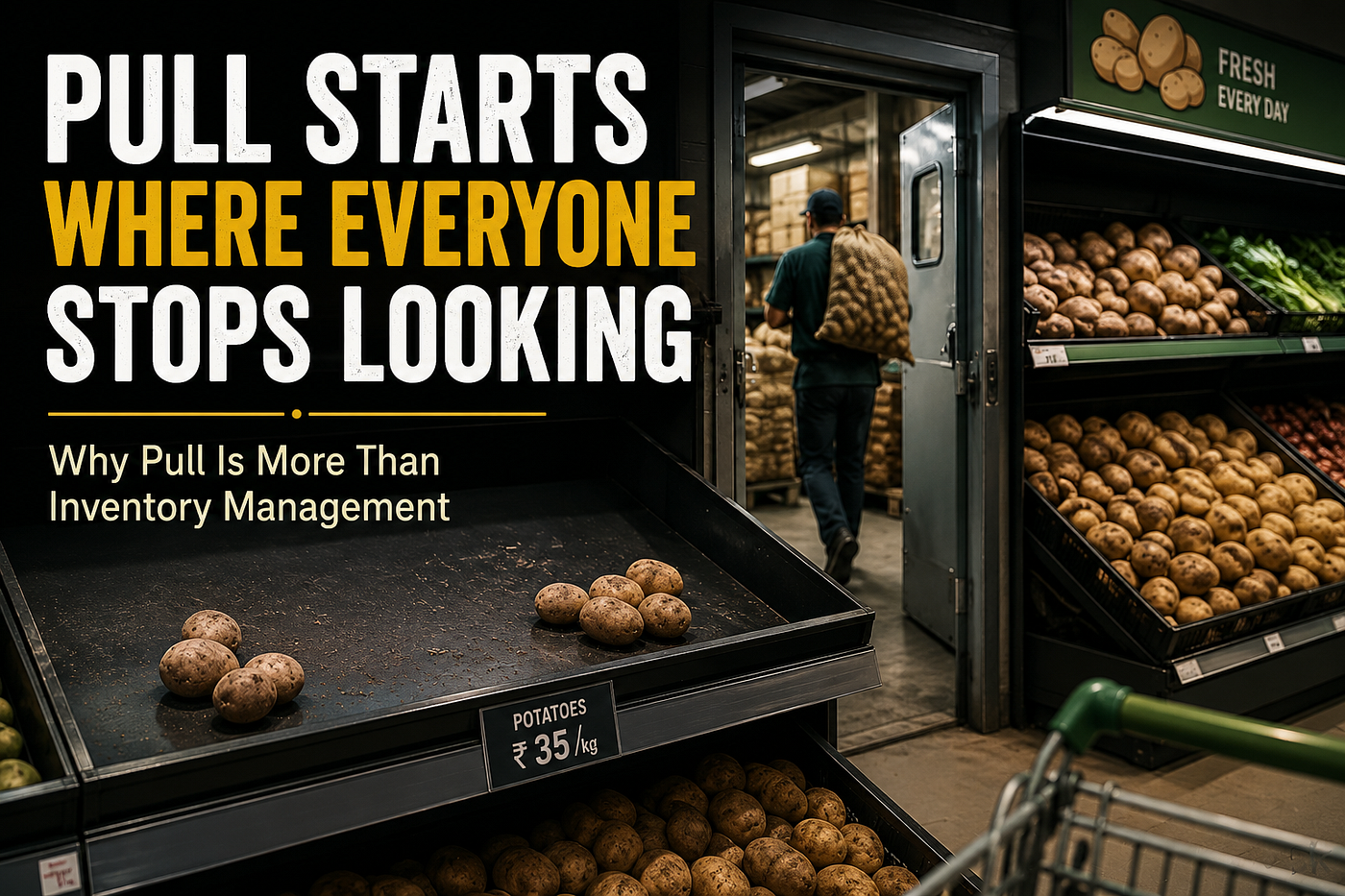
A customer picks up the last few potatoes from the display.
A few minutes later, an employee appears through a small door behind the shelves carrying another sack. The potatoes are replenished almost instantly. Behind the storefront sits a small warehouse that customers never see.
Nothing extraordinary is happening.
Yet this simple act inspired one of the most influential ideas in modern manufacturing.
Taiichi Ohno famously observed American supermarkets during his visit to the United States. What fascinated him wasn’t the shelves. It was the sequence.
Customers removed products.
Only then were the shelves replenished.
Replenishment happened because something had been consumed — not because someone had forecast it.
That observation became the foundation of Pull.
When Consumption Became Information
Most explanations stop there and conclude that Pull reduces inventory.
It certainly does.
But inventory was never the real innovation.
The innovation was that consumption became information.
An empty space on a shelf isn’t a problem.
It’s a signal.
That signal tells a worker to replenish the shelf from the small warehouse behind the store. As inventory in the back room declines, another signal is sent to the distribution centre. The distribution centre replenishes from the supplier. The supplier replenishes from the producer.
One customer purchasing a bag of potatoes can trigger a chain of replenishment stretching all the way back through the supply network.
Consumption has created the signal.
The entire system responds.
This is the foundation of Just-in-Time thinking.
Just-in-Time doesn’t mean having no inventory.
Every supermarket has inventory.
Every factory has inventory.
The question isn’t whether inventory exists.
The question is how much inventory stands between consumption and replenishment.
The larger that buffer becomes, the longer the system continues responding to yesterday’s demand instead of today’s.
Pull keeps that distance as small as practical.
As demand changes, replenishment changes.
As demand slows, replenishment slows.
As demand stops, replenishment stops.
Demand — not forecasts — drives the system.
From Supermarkets to the Factory Floor
Years later, I found myself applying the same principle in a completely different setting.
As a Vendor Development Manager at Maruti Suzuki, India’s largest automobile manufacturer, our objective wasn’t simply to reduce inventory. We worked with suppliers to deliver smaller quantities more frequently, synchronizing deliveries with the rate at which the assembly line actually consumed parts.
Smaller lots reduced inventory, but that wasn’t their greatest benefit.
They allowed the supply chain to respond faster to changing demand.
Quality problems surfaced sooner.
Production issues became visible earlier.
Adjustments could be made before thousands of defective or unwanted components accumulated in warehouses.
Small batches weren’t an efficiency trick.
They were an information system.
The Same Principle Beyond Manufacturing
The same principle applies far beyond manufacturing.
Software teams often begin work because a roadmap says they should.
Product teams build features because budgets have been approved.
Organizations commit months before evidence has had a chance to emerge.
That’s Push.
Pull asks a different question.
What evidence tells us this work should begin now?
Whether it’s a supermarket shelf, an automobile assembly line, or a software backlog, the principle remains the same.
Don’t let forecasts replace evidence.
Let consumption create the signal.
Respond to demand.
Pull begins with inventory.
But it grows into something much more powerful.
It becomes a way of building systems that respond to demand instead of forecasts.
Originally published at https://www.linkedin.com.
메타데이터
- post_id
- 9eb690f0695a
- slug
- pull-starts-where-everyone-stops-looking-9eb690f0695a
- url
- https://medium.com/@dumandal1998/pull-starts-where-everyone-stops-looking-9eb690f0695a
- canonical_url
- https://medium.com/@dumandal1998/pull-starts-where-everyone-stops-looking-9eb690f0695a
- author_url
- https://medium.com/@dumandal1998
- status
- ok
- fetched_at
- 2026-08-02 02:13:39