Multi-Step Reasoning — Breaking Down Complex Tasks
Day 19 — AIpril : From Prompt to Production
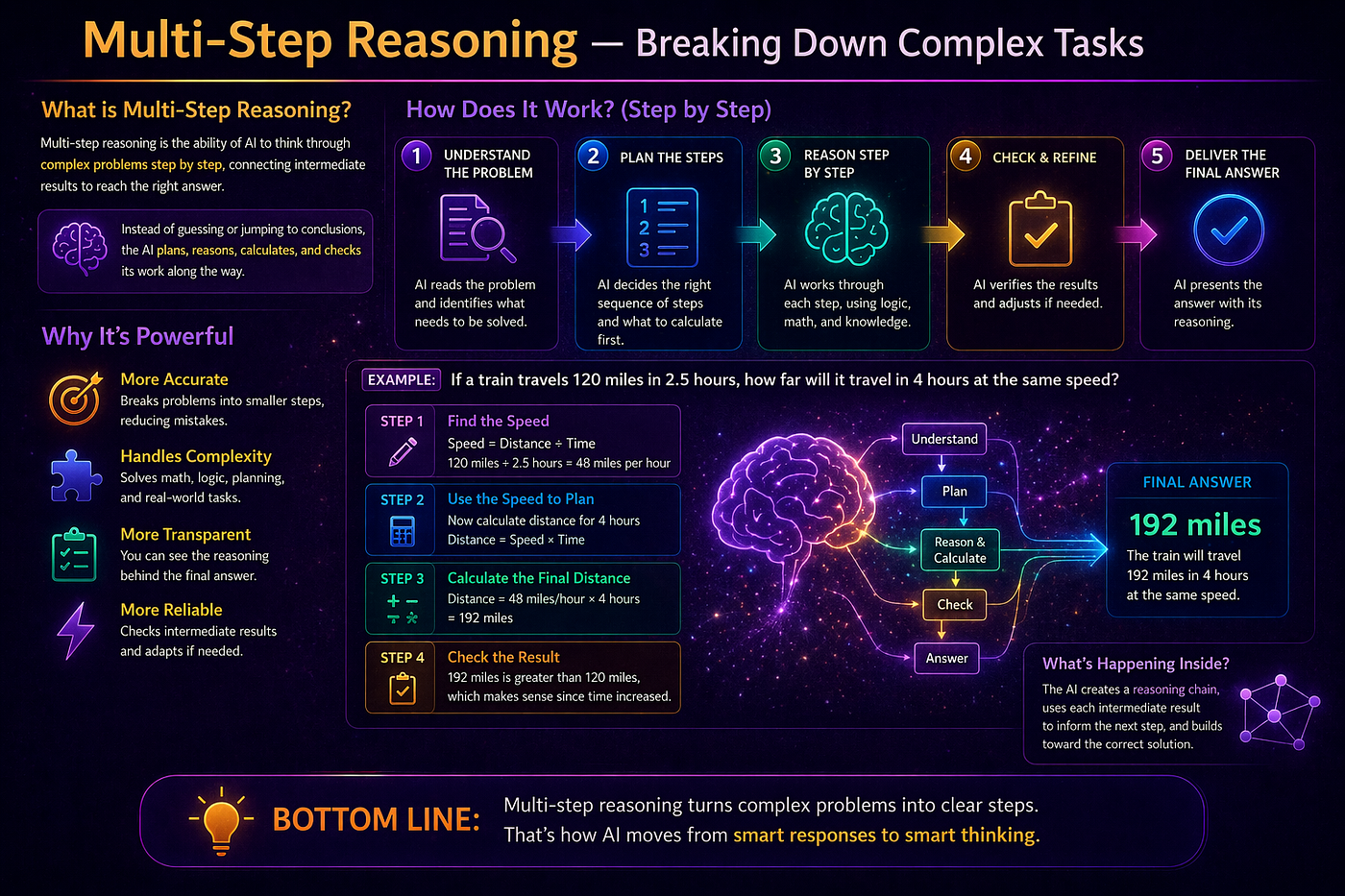
Multi-Step Reasoning — Breaking Down Complex Tasks
Day 19 — AIpril : From Prompt to Production
So far, we’ve seen:
- tool calling enables action
- function calling enables structure
But there’s another challenge:
Some problems are too complex to solve in a single step.
They require:
- decomposition
- intermediate thinking
- step-by-step execution
This is where multi-step reasoning comes in.
Step 1: The Limitation of Single-Step Thinking
LLMs generate responses token by token. For simple tasks, this works well. But for complex tasks like:
- system design
- planning
- debugging
A single-pass response often leads to:
- incomplete answers
- logical errors
- hallucinations
Step 2: What Is Multi-Step Reasoning?
Multi-step reasoning is:
Breaking a complex problem into smaller, manageable steps and solving them sequentially
Instead of:
“Solve everything at once”
We:
“Solve step by step”
Step 3: Simple Example
User asks:
“Design a URL shortener”
Single-step output:
- vague
- incomplete
Multi-step approach:
- Define requirements
- Design architecture
- Explain components
- Consider scaling
This leads to: “structured and complete answers”
Step 4: Why It Works
Breaking problems down helps:
- reduce cognitive load
- improve clarity
- guide the model’s predictions
It aligns with how the model works:
predicting the next step based on context
Step 5: Chain-of-Thought (Conceptually)
One common idea is:
Encourage the model to reason step by step
Instead of jumping to the answer, it:
- explores intermediate steps
- builds toward a conclusion
This improves:
- accuracy
- logical consistency
Step 6: Explicit vs Implicit Reasoning
Explicit
You ask the model to:
- “Explain step by step”
Implicit
System enforces:
- structured decomposition internally
Both approaches aim to: “guide reasoning”
Step 7: Decomposition Patterns
Common ways to break tasks:
Sequential
- Step 1 → Step 2 → Step 3
Divide and conquer
- Split into independent parts
Iterative refinement
- generate → review → improve
Planning + execution
- plan steps first
- then execute
Step 8: Multi-Step Reasoning in Systems
In production systems, reasoning is often:
- controlled via workflows
- combined with tool calls
- validated at each step
Example:
- Step 1: understand query
- Step 2: retrieve data
- Step 3: process data
- Step 4: generate answer
Step 9: Benefits
Multi-step reasoning improves:
- accuracy
- completeness
- explainability
- reliability
Especially for:
- complex queries
- technical tasks
Step 10: Challenges
Longer latency
More steps = more time
Higher cost
More tokens used
Error propagation
Mistakes in early steps affect later ones
Step 11: Controlling Reasoning
Good systems:
- limit unnecessary steps
- validate intermediate outputs
- combine reasoning with tools
The goal is:
efficient and correct reasoning
Step 12: From Answers to Thinking Systems
Without multi-step reasoning:
AI gives answers
With multi-step reasoning:
AI follows a process
This is a key shift toward:
- intelligent systems
- agent-like behavior
The Reasoning Layer
Problem → Decompose → Solve Steps → Combine Results → Final AnswerThis layer enables:
- structured thinking
- complex problem solving
Why This Matters
Once you understand multi-step reasoning:
- You stop asking vague, complex questions
- You design systems that guide reasoning
- You improve output quality significantly
And most importantly:
You move from expecting answers to designing processes that produce answers.
What’s Next
Next, we add control and safety: “Guardrails — Controlling AI Behavior in Production”
Because reasoning alone is not enough. It must be controlled.
AIpril Series Thought
Complex problems are not solved in one step. They are solved through a sequence of decisions. And that sequence is what defines intelligence!!!
메타데이터
- post_id
- 9ebca3077936
- slug
- multi-step-reasoning-breaking-down-complex-tasks-9ebca3077936
- url
- https://medium.com/@arvita-writes/multi-step-reasoning-breaking-down-complex-tasks-9ebca3077936
- canonical_url
- https://medium.com/@arvita-writes/multi-step-reasoning-breaking-down-complex-tasks-9ebca3077936
- author_url
- https://medium.com/@arvita-writes
- status
- ok
- fetched_at
- 2026-07-15 01:13:07






