Spicy Topic #1: Should Press & Journalism Come Under IFCE?
Starting a new series with something medium spicy. Thoughts for and against why press and journalism should be under freedom of…
Spicy Topic #1: Should Press & Journalism Come Under IFCE?
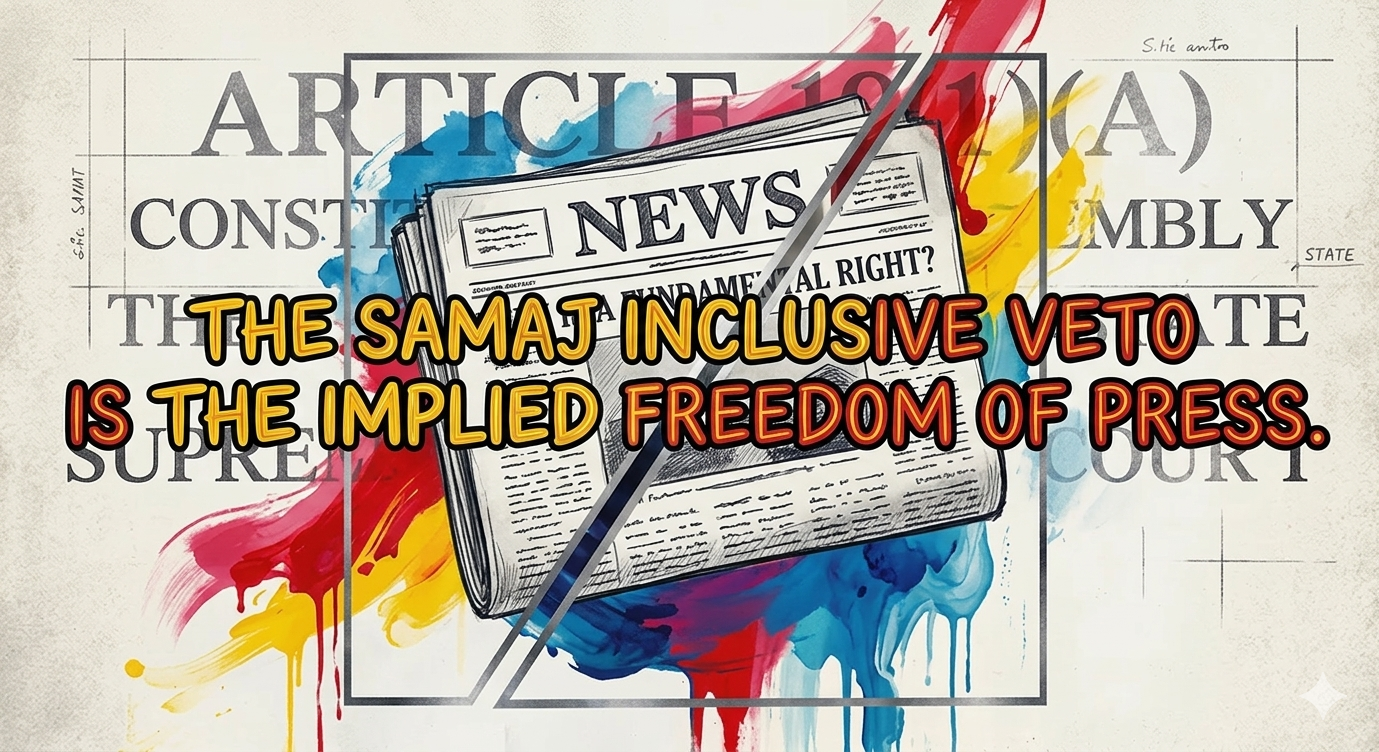
Starting a new series with something medium spicy. Thoughts for and against why press and journalism should be under freedom of communication and expression (IFCE).
Indian Freedom of Communication and Expression (IFCE) is easy to comprehend when it applies to individuals vis-a-vis the state? But what about media houses and journalists? This post argues from both sides strongly (and hopefully, steelmanly enough) before providing some context and further thoughts.
Before proceeding, some definitions are in order: by press, I refer to profit-seeking and non-profit-seeking organizations that collect, report and deliver material of a news- and opinion-friendly nature to the Indian public. They are regulated by multiple acts and bodies, cutting across print (newspapers and magazines), television (news channels) and online (YouTube channels; digital news sites, e-paper). What makes this complicated (and interesting) is there’s a broader principle of journalism itself, which can be independently done without oversight (or what we call citizen journalists). Do these count as well in this ambit or can they be considered normal applications of IFCE?
Why Should Press, Media and Journalism Not Come Under IFCE?
- The easiest answer for this is it’s not explicitly mentioned in the Constitution of India. The Constituent Assembly members argued vociferously on many things and the end outcome (the Constitution we adopted in 1951) doesn’t give it a separate right or even as part of Article 19(1)(a). This is not an omission due to incompetence or forgetfulness. We can ascertain that it wasn’t important enough to be included in the Constitution.
- You could argue that press and media as a fourth pillar is important enough to keep the whole checks and balances thing going. Without them, how would we citizens know about the excesses of the executive, the parliament or even the judiciary (considered as a check on the other two branches)? That sounds good until you realize that sanctioning it as part of the Fundamental Rights or part of IFCE would mean giving media house owners power to exploit their pulpit for money or due consideration. Undue influence is exercised by those with money on politicians and bureaucrats and even the judiciary. Media houses may not have money but with a fundamental right, they will have clout. One they can use to arm-twist the other three pillars into doing their bid. After all, as an up-and-coming politician, would you now challenge a media house in any court if their existence and right to report is protected by a Fundamental Right? Impunity without restraint brings about corruption and misuse. With regular IFCE, the people can exercise it either individually or groups with short-term goals. Further exploitation isn’t possible.
- The last reason is to consider that today (and even back then), the line between a media house and journalist could be vague. Think about the YouTube spouting random conspiracies about ex-politicians or even serving ministers. They can claim it as news until complaints are raised and then reverse course, claiming it was just opinion. IFCE can strengthen even the worst claims, engendering public morale and cohesion. At the very least, libel and slander can stem the tide. But giving that person the right to free press as an individual journalist, without institutional safeguards, training or consequences, is dangerous. It becomes a free-for-all where all objectivity and rigor for fair and unbiased and well-researched news goes away. Think about the landscape of the internet since the 2010s. All that misinformation and disinformation without even such a right existing. Imagine how worse it can get with that cushioning extremists and conflict entrepreneurs, bullshitters and plain liars to coach their “takes” as facts. That’s the loophole a distinct right to press or as an inclusion to IFCE provides; the easiest magnet for bad actors, especially in an attention-oriented and post-truth society such as ours.
Why Should Press, Media and Journalism Come Under IFCE?
- Being an IFCE-proponent means managing differing interest groups. One of the most prominent is the media. In a way, it concentrates the idea of free speech into a distinct entity. Through content that is communicated or expressed, it can bring to light hidden monstrosities or mundane matters that everyone needs to know. For those eager to keep things hidden, they can go to any lengths. That way, having it expressed explicitly under Article 19(1)(a) would be helpful, since it means these media houses can now stand up to their challengers, whoever it may be. Since reasonable restrictions exist, those can be used against the media house if it steps out of line. Such a right doesn’t give them the freedom to post unverified news, gossip or damaging information due to ulterior motives. This balance allows them to pursue Satyamev Jayate in its truest sense.
- If you go back to the Constituent Assembly debates, in a way, the press is already covered under IFCE. Ambedkar himself argued against adding it explicitly, stating that freedom of speech extended to that of the press. This is aided by the Supreme Court reading into that verdict as part of Thappar v. State of Madras (1950), Sakal Papers v. Union of India (1962), Bennett Coleman & Co. v. Union of India (1972), State of U.P. v. Raj Narain (1975) and Prabhu Dutt v. Union of India (1981) judgments. The end result is three-fold:
- The press is a vehicle for exchanging ideas and facilitating public discussion. This allows average citizens to make informed decisions.
- The press complements the “right to know” and “right to information”, two other positive rights the Supreme Court claimed was necessary to make India a well-functioning democracy.
- The press is allowed to operate without fear of constraint by the state in any form.
- Normally, rights fare better when individualized and focused. The right to life, as a fundamental right, would be stronger than the right to life and liberty. However, in this case, having the right to press inside IFCE strengthens both and prevents the overreach of any. Take for example, if the freedom of the press was enshrined distinctly in the Constitution. At what stage would it be triggered? If it is an established media house, recognized by requisite bodies and the state? That could lead to disparities where existing media houses would prevent entry, as would the state, to control the flow of information and preserve their oligopoly and arrangement. But if everyone has the right to IFCE, then suddenly it doesn’t matter if you’re legally recognized as a media house or not. The freedom of press automatically applies, and with it the reasonable restrictions that apply as part of article 19(1)(a). It is a great equalizer that way, allowing a sole YouTuber (for example) to investigate claims about sand mining in a tribal village as no big media house is interested or having the funds needed for the investigation. This is especially valuable and precious in a Constitution that otherwise provides special rights to certain groups. It prevents misuse by the state against media houses of all sizes and from companies exploiting media houses or even media houses going after the lone reporters. The inclusivity creates a balancing rope that all, despite their size and power, must tip-toe on with equal care.
Now comes the time for the Hegelian synthesis (in the crude sense of the term). Given my pro-IFCE leaning, it’s easy to see that I want the press, media and journalism to get substantial freedoms enshrined in the Constitution. However, while others may feel it needs to be strongly worded into Article 19(1)(a) as a distinct term, or even “better”, be a fundamental right onto itself, I think that’s going too far. The Supreme Court and the Constituent Assembly interpreted it correctly, that the freedom press is a part of the IFCE. Think of it like how the members, when debating the Constitution, didn’t want to explicitly put secularism into the Preamble or any of the Articles. Their argument was that the character of Indian society was very much so already. The inclusion in the 42nd amendment (along with socialism) did a disservice by making it explicit, thereby inviting polarizing debates that last till today. Hence, you see the presence of a “secularist, socialist” left and a “Hindutvadi, capitalist” right (though each side is more closer to each other than the other thinks).
I propose the same thing for the freedom of the press. The uniqueness of India is not that it is a civilization alone or a civilizational state or just a nation-state. Rather it is a state held back, maintained and pushed forward by the samaj. Everything else (from the bazaar or the sarkaar), no matter how strong, only works at its whim. And for a samaj-heavy nation, inclusivity that is implied, is best. This allows changing interpretations as seasons go by. Now, I’m not pedantic about this. Ambedkar argued that it was this samaj-heavy tilt that led to Indians being where they are. And you can argue that every government (and associated ideology) with its machinery has seen the samaj as an enemy (in many cases rightfully so) to justify carrying out its will. If it wasn’t for the new state, we would have never gotten a right to vote for all citizens of India regardless of caste, class, religion, gender, and so on.
In many ways, the state’s heavy-handedness helped India progress. As today, the market’s thoroughness, competitive zeal and obsessiveness with unlocking customer quantity and quality. But scratch past their incredible successes and you broadly see the society accepting of the same.
- It was the SCs, STs, women, and OBCs who wanted the vote even if dominant sections robbed them of their voices and choices.
- It was the advent of foreign travel and comparative internet discourse that awakened in India the desire for everything the rest of the world had (not to mention the balance of payment crisis that forced India to reform and immediately elevated many people).
But the minute you have a section directly affected, almost to a moral core (farmers, bureaucrats, women, etc.), then see how the sarkari and vyapari power collapses.
I advent the same for IFCE and the media. Making things explicit will only benefit those out the door and ahead of the curve. They will convince the legislature to pass acts confirming who is or isn’t allowed to be called “press”. That will isolate many start-ups and single contributors. The Supreme Court will find it hard to strike down since the legislature has, in its purview, to define this, unless the right to press [as a standalone right or explicitly called out in 19(1)(a)] defines it stringently enough. But by having it implicitly understood as part of Article 19(1)(a), it democratizes it, allowing no unfair playing field, helping any combination of media houses (new, old, small, big, etc.) operate the way they would like.
The issue, then, becomes one of implementation and standardization and regularization, ending with normalization.
Until next time!
메타데이터
- post_id
- 9eca5495c6db
- slug
- spicy-topic-1-should-press-journalism-come-under-ifce-9eca5495c6db
- url
- https://medium.com/@bharath.madhusoodanan/spicy-topic-1-should-press-journalism-come-under-ifce-9eca5495c6db
- canonical_url
- https://medium.com/@bharath.madhusoodanan/spicy-topic-1-should-press-journalism-come-under-ifce-9eca5495c6db
- author_url
- https://medium.com/@bharath.madhusoodanan
- status
- ok
- fetched_at
- 2026-08-11 13:37:14