The Rising Cost of Being an AI-Powered Developer
There’s a strange irony sitting at the center of modern software development. Personally, since Ruby on Rails came out, this is the moment…
The Rising Cost of Being an AI-Powered Developer
There’s a strange irony sitting at the center of modern software development. Personally, since Ruby on Rails came out, this is the moment in my career where I’ve felt the most productive and had the most fun. At the same time, I’ve never paid more for the privilege.
I’ve been writing software professionally for almost 20 years. When I got started, the barrier to entry was remarkably low. My first tech stack was LAMP. To write PHP + MySQL you could get away with a fairly inexpensive computer, a text editor, and an internet connection. Everything else (the language, the framework, the database, the deployment tools) was both libre and *gratis.*
Not “free tier” free. Actually free.
Open source had won, and the whole ecosystem reflected it.
Want to learn Ruby on Rails? Download it. Need a database? MySQL (pre Oracle), right there. Version control? Git. Hosting for your side project? Heroku (pre Salesfore) free tier, or a cheap Linode VPS. Editor? Vim, Emacs, Notepad++, take your pick. The entire pipeline from idea to deployed application cost you close to nothing.
That world shaped a generation of developers, myself included. We tinkered. We broke things on weekends. We built projects nobody asked for, just to see if we could. The open source community wasn’t just a resource. It was a culture. You could show up with nothing but enthusiasm and leave with real skills. And for a long time, that kept getting better. New languages, new frameworks, new hosting options, and almost all of it stayed free.
The New Stack Has a Subscription Model
Fast forward to today, and the developer experience looks radically different. AI-powered tools have genuinely transformed how we work. I use them daily, and I won’t pretend otherwise: they’re incredible. Having a coding agent that can scaffold a feature, catch bugs, or help me think through architecture decisions in real time has made me meaningfully faster.
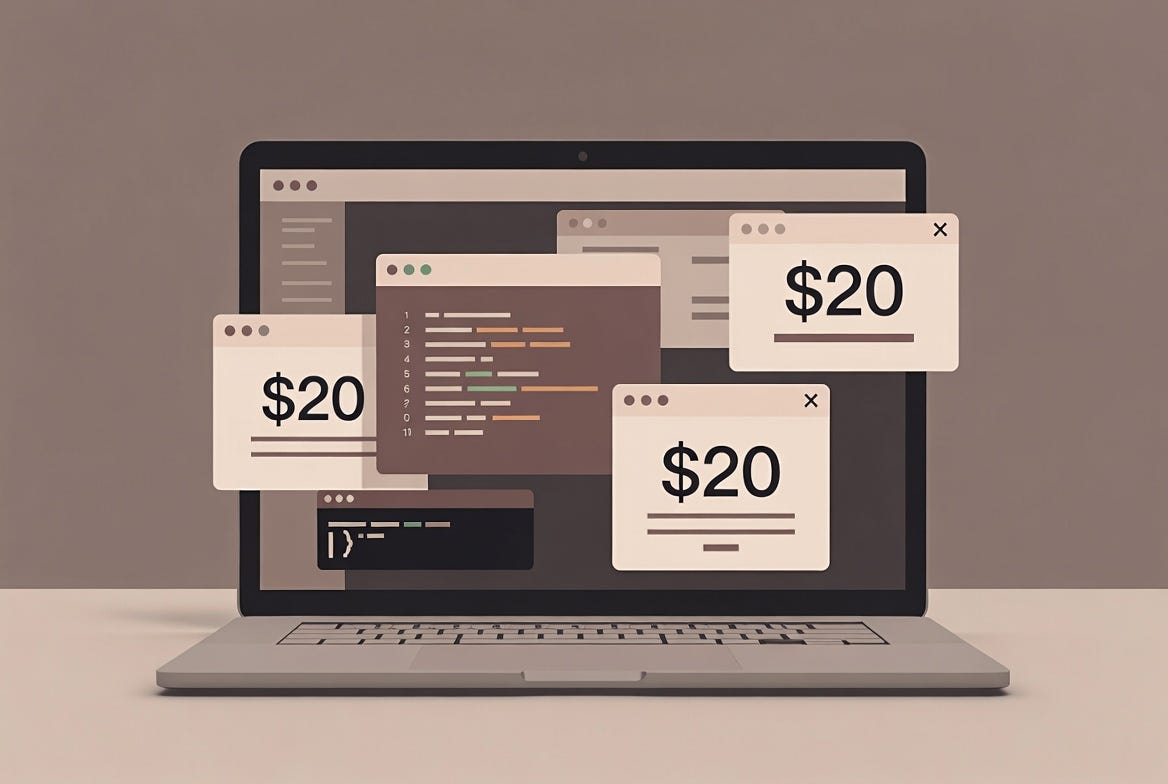
As of this writing, the first paid tier of either of the two major LLM providers is $20/month, but of course you’ll soon run out and quickly find yourself paying $100/month for the next tier, then $200/month for the one after that, until you find yourself creating multiple accounts just so you can Ralph Wiggum to the max. AI-powered editor? $20. Want to experiment with RAG and vector search? Pinecone’s Standard plan starts at $50/month. Warp, an AI-powered terminal (because even the damn terminal costs money now!), is $18. And that’s before any usage-based API charges for embeddings, inference, or token overages. A developer who wants access to the best available tools can easily spend $100+ per month before writing a single line of business logic.
None of these are unreasonable prices individually. But collectively, they represent something new: a recurring cost of entry to the craft that simply didn’t exist before.
What This Means for the Next Generation
This is where it gets personal for me. I spent years teaching: building courses, running local Coding Dojos, mentoring junior developers. And the thing that made that work was accessibility. I could tell someone, “All you need is a laptop. Everything else is free. Let’s go.”
I’m not sure that’s true anymore. Or rather, it’s technically true (you can still write code with free tools) but the gap between the free experience and the AI-augmented experience is growing fast.
A junior developer working without AI assistance is operating at a fundamentally different speed than one who has it. And in a job market that’s already tough, that gap matters.
Think about what it’s like to be a new developer today. You’re told the industry is competitive. You’re told AI is changing everything. You’re told we’re moments away from the one-person unicorn. You’re watching senior developers pair with agents that autocomplete entire projects. And when you sit down to build your first project, you’re faced with a choice: invest in tools you might not be able to afford, or fall behind before you’ve even started.
That’s a different on-ramp than the one I had. The open source ethos said, “Come as you are.” The AI tooling era says, “Subscribe to keep up.”
I Don’t Have a Clean Answer
I’m by no means against these tools. I use them quite heavily. I benefit from them. The productivity gains are real, and the companies building them deserve to charge for their work. This isn’t a call to make everything free.
But I think it’s worth pausing to notice what’s shifting. The culture of software development, in particular open source, was built on the idea that the tools belong to everyone. That you could go from zero to capable without a credit card. That tinkering was free.
We’re moving into a world where the best tools are behind paywalls, where staying current means staying subscribed, and where the distance between the haves and have-nots in our industry isn’t just about talent. It’s about tooling budgets.
If you’ve been in this industry for a while, that might feel like a small shift. If you’re just getting started, it might feel like the door is a little harder to open than you were told it would be.
I think that’s worth talking about.
메타데이터
- post_id
- 9ee359148dba
- slug
- the-rising-cost-of-being-an-ai-powered-developer-9ee359148dba
- url
- https://medium.com/@caike/the-rising-cost-of-being-an-ai-powered-developer-9ee359148dba
- canonical_url
- https://medium.com/@caike/the-rising-cost-of-being-an-ai-powered-developer-9ee359148dba
- author_url
- https://medium.com/@caike
- status
- ok
- fetched_at
- 2026-08-12 00:14:20






