Plenary Snapshot: Resisting Erasure, Building Trust, and Cultivating Safety and Equity in Archives
This is an edited transcript of my portions of the plenary panel, “Resisting Erasure, Building Trust, and Cultivating Safety and Equity in…
Plenary Snapshot: Resisting Erasure, Building Trust, and Cultivating Safety and Equity in Archives
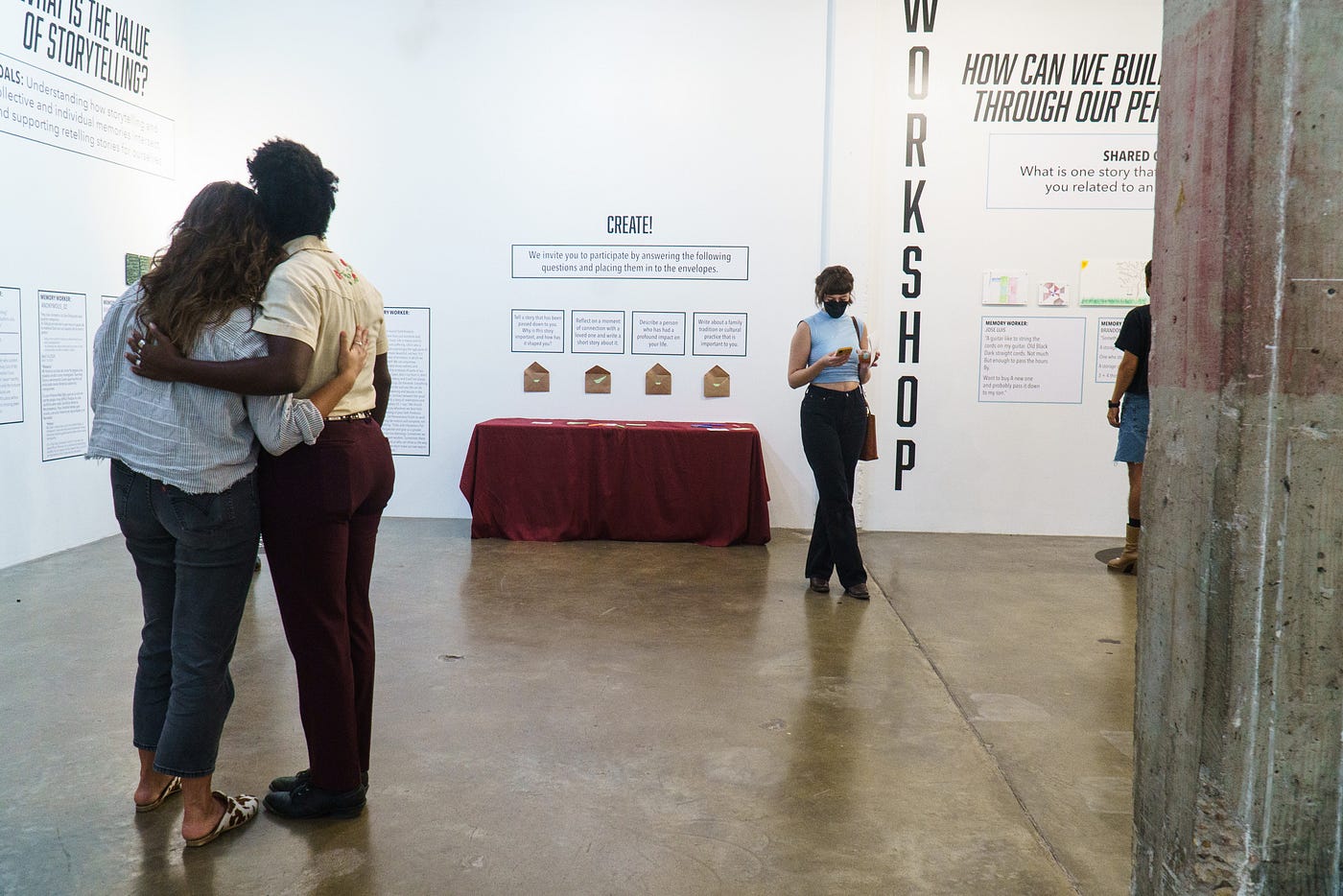
After Violence Project’s 2024 “Archives is a Sacred Word” interactive exhibit in Austin, Texas
This is an edited transcript of my portions of the plenary panel, “Resisting Erasure, Building Trust, and Cultivating Safety and Equity in Archives” at the 2025 Society of American Archivists annual conference in Anaheim, California. My co-panelists were Dr. Thuy Vo Dang and Dr. Krystal Tribbett.
Can you share strategic areas of work that your organization is moving towards during this time of funding precarity and political backlashes?
Let’s be honest, the world we’re living in today is different than the one we were living in a year ago.
So, like a lot of community-based archives, our work and strategy has shifted, necessarily. I’ll give two examples. First, we’re spending a lot of time and resources really trying to understand and mitigate the risks and threats to our work, to our staff, to our organization, and, above all, to the communities that we serve. We’re really trying to recognize the wide range of risks and threats to our work. We started hosting monthly risk and protection meetings where we’ve invited community archives practitioners and others working in a wide range of areas with the focus of trying to prevent the erasure of people, our cultures and histories, our stories, and our archives. So that’s been a drastic shift for us in the last year or so.
Second, we recognize that After Violence Project and the Community Archives Collaborative will play a very unique role in expanding the capacity, infrastructure, and sustainability of community-based archives. Community-based archives are still not nearly as well-resourced or funded as institutional archives. We’re getting there. We’re making progress. AVP is unique in that we have full-time staff where many community archives are run by volunteers or part-time staff. We’re recognizing that increasingly community-based archives and other independent collecting organizations are going to play a huge role in making sure that we can archive and preserve long-term materials that are truly under threat of erasure. So, those are two ways that we’re trying to continue to meet the moment.
Can you reflect on what has worked well and what are ongoing challenges with partnerships or collaborations between academic institutions and independent archives?
While it’s true that universities and institutions can continue to provide cover and provide resources to community archives, it really has now become a two-way dynamic. The arrangement where community archives were so reliant on universities and institutions, that dynamic was shifting even before the election. What’s happened since then is now increasingly universities and large institutions are coming to small community archives like AVP for guidance and for advice. That’s a fascinating trend, and it points to the reason why funders must seriously bolster the capacity of independent community archives.
As I say every opportunity I can: we need ten Mellon Foundations to support and bolster community archives so that we can truly build out their infrastructure and sustainability. We can no longer rely on university archives and institutions for digitization, metadata, and long-term storage. I think we have to really think through the logistics to make this happen now. Mellon has done a really fantastic job of getting the momentum going through their grant program for community archives. That’s fantastic. We got that grant in 2020, which allowed us to build an independent digital repository and allowed us to move away from our partnership with UT Austin. UT Austin terminated their entire DEI staff recently, so it was good to be able to move away from that partnership.
I was just telling Krystal [Tribbett] I didn’t realize universities were actually putting university archival collections under scrutiny at such a scale. I think that that’s going to happen more and more.
There’s always been challenges with partnerships between community archives and universities. There’s also been successes. One point that my colleague Hannah Whalen made yesterday, which is a really good one, is that now’s not the time to throw our hands up and say, ‘Okay, universities are under attack, so we can just let them fight their battle. These partnerships don’t work, so we’re just going to give up on them. We’ll just do our thing.’ There are people who take that position. I’m not one of them. Now’s the time to find where there are opportunities for solidarity with our allies working within institutions and figure out a way that we can work together and fight and resist together.
That’s going to be a focus for me moving forward. Not to focus so much on all of the barriers and challenges, which will always be there because these are well-resourced, massive bureaucracies where it takes eight months to get payment for for the work that community members do. Community archives are grassroots, community-led, community-controlled, and very under-resourced. We have to try to find ways that we can work together because the archivists and librarians we work with at institutions get it. They get it. The problems start when you climb up that power ladder.
The Community Archives Collaborative partnership with C-CAP [Community-Centered Archival Practice at UC Irvine] is a really good example of a successful partnership. The work that we’ve done at AVP with Michelle Caswell and the UCLA Community Archives Lab is another good example. It’s important to continue to build these partnerships that work really well and are really effective.
What are other ongoing and new challenges you are currently facing?
I can mention two different kinds of challenges that we’re facing right now. One is that, oftentimes community archives do so much more than archiving and activation (such as creating documentary films, exhibits, and educational resources). There are other responsibilities to the communities we serve that often have nothing to do with archiving. Let me give one example. We got really tired of just documenting the experiences of the loved ones of people who had been executed, the very unique grief this very underserved population deals with everyday. It’s a very unique experience to have a loved one pursued and executed by the state, a process that usually takes 15 to 20 years. So we did something about it. We created a program to be responsive to the archive and to train mental health clinicians to be better prepared to welcome these families and loved ones into their care. And it’s a wildly successful program. We think it’s the only one in the country, and there’s a huge demand. And now we’re working to connect family members with clinicians.
Through our strategic planning we realized that we also really need to expand our capacity for rapid response work. We’re recognizing that, yes, this work should move slowly and thoughtfully and there are times when we have to move very quickly. And so, for example, we are thinking through how we can be a resource for people to responsibly document and archive protest materials. At AVP, we talk often about the archives being the nucleus of our work. That’s true. But we’re being pulled in all these other directions because we also know that we have a responsibility to the communities we serve.
The second challenge is funding. We have a lot of work to do to educate funders about what community archives are. Not only how they’re different from institutional archives, but how the are necessary. Foundations are quick to give several millions of dollars to Harvard, UCLA, UT Austin, and other large institutions but community archives are often forced to “legitimize” our work. So, there’s a lot of work to do to educate funders. For example, there’s a funder collaborative that put out a report recently and it talks about the intergenerational components of narrative change, how it’s a long-term prospect, how it takes a lot of time, and so on. But there’s no mention whatsoever of archives. There’s no mention whatsoever of preservation. There’s a true lack of understanding among funders, outside of Mellon and some federal funders that are currently, as we know, no longer there as a resource for us. How do we work together to educate funders and bring them into this space so that they truly know how these two types of archives are both very important but serve different functions?
Community archives have proven that we can do the work. We’ve proven that we can earn the trust of the communities we serve. We’ve proven that we can do safe and ethical documentation and archiving practices. Now we need funders to recognize that we can do it and start moving significant resources to community archives. They’ve been very comfortable doing this for universities for generations. The community archives grant from Mellon allowed us to to scale up our infrastructure, our practice, and our staffing so that we could prove that we could do it. And now we’ve done it. Now we have to go out and make the legitimate case that we have to start moving tens and hundreds of millions of dollars into the community archives space so that we can build the infrastructure for community archives all across the U.S.
메타데이터
- post_id
- 9ee98f46c95e
- slug
- plenary-snapshot-resisting-erasure-building-trust-and-cultivating-safety-and-equity-in-archives-9ee98f46c95e
- url
- https://medium.com/community-archives/plenary-snapshot-resisting-erasure-building-trust-and-cultivating-safety-and-equity-in-archives-9ee98f46c95e
- canonical_url
- https://medium.com/community-archives/plenary-snapshot-resisting-erasure-building-trust-and-cultivating-safety-and-equity-in-archives-9ee98f46c95e
- author_url
- https://medium.com/@gabe_51250
- status
- ok
- fetched_at
- 2026-06-14 11:28:49