I Wrote 80 Prompts to Run My Solo Business. Here Are the 5 I Use Every Single Day.
The five prompts that handle the work that comes back every week. Cold outreach, positioning, product launches, project proposals, and…
I Wrote 80 Prompts to Run My Solo Business. Here Are the 5 I Use Every Single Day.
The five prompts that handle the work that comes back every week. Cold outreach, positioning, product launches, project proposals, and turning long writing into a single LinkedIn post.
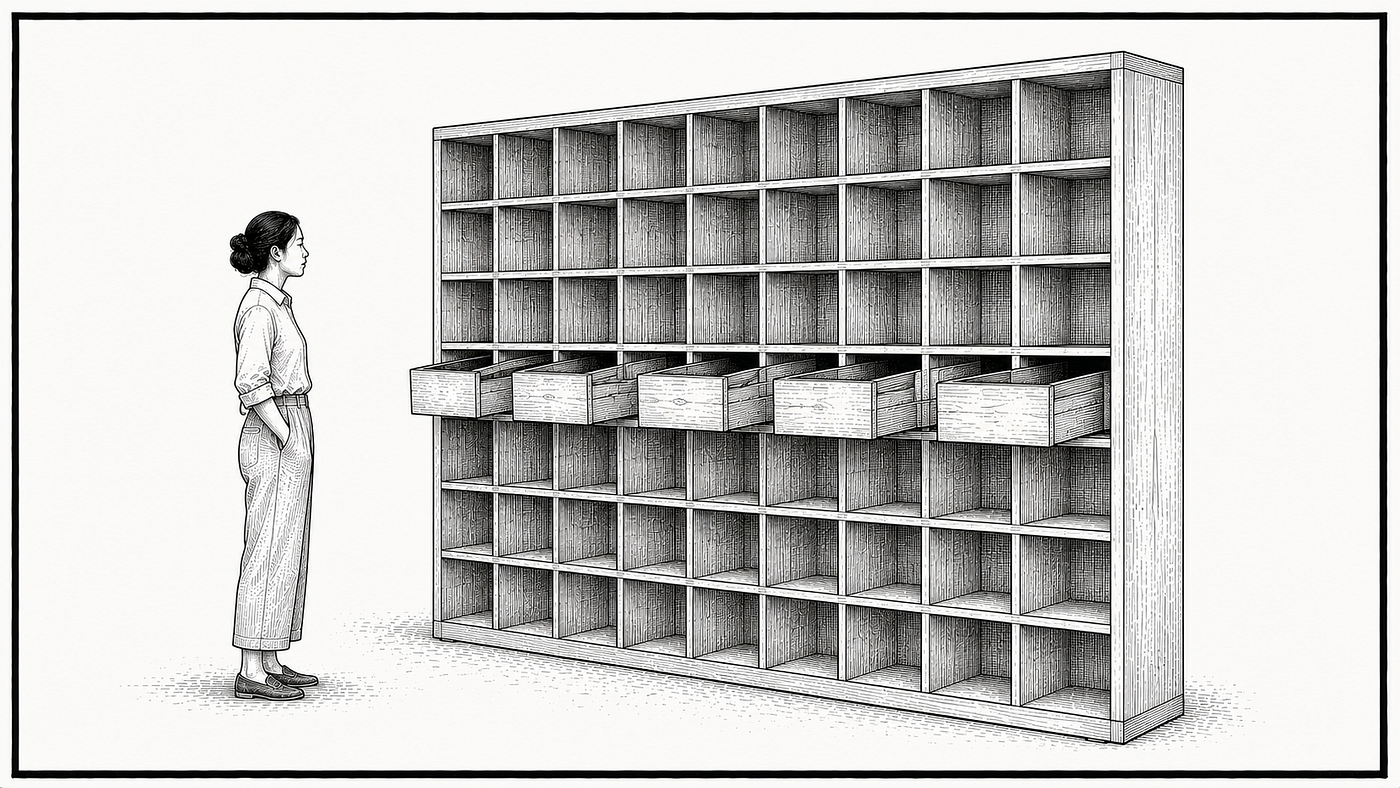
Eighty compartments built over time. Five of them get pulled out every week.
A year ago, I noticed I was typing the same kind of message to ChatGPT or Claude every week. A slightly different version of a cold email. A slightly different version of a positioning paragraph. A slightly different version of a launch description. Each time, I rewrote the prompt from memory, which usually made it slightly worse than the last time. The work the AI was doing was the same, and the prompt I was using to get there kept drifting.
The fix was to write the prompts once, get them right, and keep them in a file I could reuse. Over the next few months, I built up a library of eighty prompts across the categories that show up in a one-person business. Cold outreach, pricing and positioning, product launches, client communication, content repurposing, proposals, follow-ups, reviews, and briefs. Each one was shaped by what worked and what did not when I ran it on real work.
This week, I went back through the library and counted which prompts I actually use most often. Five came back as the prompts I run more or less every week. Here they are, verbatim, with a short example of what each one produces and why each one earned a permanent slot in the working set. These work with ChatGPT, Claude, or any major model. There is no special tool required.
1. Cold Outreach, The First Touch Email
When to use: First contact with a prospect who has never heard of you. The prompt is built to produce a reply, not just an open, which is the part most cold email advice skips.
I am a [YOUR SERVICE — e.g. freelance copywriter, brand designer, web developer] who works with [TARGET CLIENT TYPE — e.g. early-stage SaaS founders, e-commerce brands, local service businesses]. I am emailing [DESCRIBE THE RECIPIENT — e.g. the founder of a software company whose onboarding emails I reviewed and found three specific gaps]. You are an experienced B2B copywriter who writes short, direct cold emails that get replies without sounding like templates. Write a cold email under 120 words. Open with one specific, genuine observation about their business or work. Briefly state what I do and why it is relevant to what I observed. End with a single low-friction question as the call to action — not “do you have 30 minutes?” but something they can answer in one sentence. Return plain text only, no subject line, no commentary before or after the email. Tone: direct, specific, and human. No filler openers. No “I hope this finds you well.”
A short version of what it produced last week, for a freelance copywriter writing to a SaaS founder:
“I went through your onboarding sequence as a new signup last week. Three things stood out. Your welcome email leads with the feature tour instead of the outcome. Your day-three email asks for a review before the user has had time to use the product. Your day-seven email goes silent on next steps. I write onboarding copy for early-stage SaaS founders, and these are the exact gaps I usually rewrite first. Worth a five-minute trade of notes on which of the three you would address first?”
Why it earns the slot: every cold email I write now has a specific observation, a clear relevance link, and a low-friction question. The prompt forces those three things every time.
2. Pricing and Positioning, The Positioning Statement
When to use: Before writing any other copy. This is the internal foundation on which everything else builds.
My product or service is [DESCRIBE WHAT IT IS — e.g. a freelance brand design service, a SaaS tool for restaurant owners, a coaching program for first-time managers]. My target customer is [DESCRIBE THEM SPECIFICALLY — e.g. independent restaurant owners with fewer than 5 locations, B2B SaaS founders who are past product-market fit, managers in their first 90 days]. The problem I solve is [SPECIFIC PROBLEM]. My key differentiator is [WHAT MAKES YOU DIFFERENT — e.g. the only option built specifically for this segment, a faster result than alternatives, a proprietary method]. You are a positioning strategist who has worked with SaaS companies and independent consultants. Write three positioning statements using this structure: “For [customer], [product/service] is the [category] that [key benefit] because [reason to believe].” Write one that leads with the benefit, one that leads with the differentiator, and one that leads with the customer type. Return only the three statements, numbered, no commentary. Tone: plain and precise. No jargon.
A short version of what it produced for a SaaS tool serving independent restaurants:
“1. For independent restaurant owners, MenuPulse is the menu management tool that updates every digital channel at once, because one source of truth eliminates the Wednesday afternoon scramble to fix the website, the delivery apps, and the daily specials. 2. For independent restaurant owners, MenuPulse is the menu management tool built specifically for independents with fewer than five locations, because the enterprise tools are over-built and the consumer tools cannot handle real menu structure. 3. For independent restaurant owners with fewer than five locations, MenuPulse is the menu management tool that puts the owner back in control of their channels in one workflow.”
Why it earns the slot: positioning shifts every six months. Having a prompt that produces three crisp variants in one call means I can stress-test the positioning in five minutes instead of an afternoon.
3. Product Launch, The Product Hunt Listing
When to use: Launching on Product Hunt and you need a tagline, description, and first comment that earn upvotes. The prompt is designed to produce all three in a single call, in the order Product Hunt requests.
My product is [DESCRIBE IN ONE SENTENCE]. It is for [TARGET CUSTOMER]. The main problem it solves is [SPECIFIC PROBLEM]. The key differentiator is [WHAT MAKES IT DIFFERENT]. You are a direct response copywriter who has helped products launch successfully on Product Hunt. Write three things: (1) a tagline under 60 characters that states what the product does in plain language — no slogans, no questions; (2) a product description of 3–4 sentences that states the problem, the solution, and who it’s for — no jargon, no hype; (3) a maker’s first comment of 4–5 sentences that tells the story behind the product — why you built it, who it’s for, and what you want feedback on. Return all three, clearly labeled. Tone: direct, honest, and human. No “excited to announce.” No “revolutionizing.”
A short version of what it produced for a fictional launch:
“Tagline: A directory of vetted AI tools, curated for solo builders. Description: Most solopreneurs waste a week sorting through hundreds of AI tools to find a few that actually fit a one-person business. This is a curated directory of what works, organized by category, with honest one-line takes. Built for solo founders, freelancers, and indie operators who would rather build than research. Maker’s comment: I built the directory because I lost a week sorting through tools after a friend asked me what I would recommend. Every page is something I would tell that friend in plain language. I am looking for feedback on which categories feel underbuilt and which tools you would expect to see that are not on the list yet.”
Why it earns the slot: launches are high-stakes copy that I do once or twice a quarter. Having a prompt that handles the three pieces in one pass means I am not rewriting the same launch from scratch every time.
4. Client Communication, The Project Proposal
When to use: A prospect has expressed interest, and you need to send a proposal that is clear, professional, and easy to say yes to. The structure assumes the client has already had an initial conversation and wants the details on paper.
I am a [YOUR SERVICE — e.g. freelance web designer, brand strategist, copywriter]. I am writing a proposal for [CLIENT NAME or TYPE] to [DESCRIBE THE PROJECT]. The scope of work includes: [LIST THE MAIN DELIVERABLES]. The timeline is [TIMEFRAME]. The price is [YOUR RATE OR TOTAL COST]. One reason I am the right person for this: [SPECIFIC CREDENTIAL OR RELEVANT EXPERIENCE]. You are a business copywriter who writes project proposals that are clear and persuasive without being padded. Write a proposal of 4–6 paragraphs. Paragraph 1: Restate the client’s goal in your own words to show you understand it. Paragraph 2: Describe your approach. Paragraph 3: list deliverables and timeline. Paragraph 4: state the price and what it includes. Paragraph 5: brief statement of fit. Paragraph 6 (optional): clear next step. Return only the proposal body, no subject line. Tone: direct, professional, and confident. No “I would be honored.” No padding.
A short version of what it produced for a freelance web designer proposing to a local accounting firm:
“You want a new website that signals trust to small business clients, loads fast on mobile, and lets your team update content without involving a developer. My approach is to build a five-page site on a calm, professional template, with a content management system you can actually use. The deliverables include the five pages, a hosted preview link by week two, and final delivery by week four. The price is $4,800, which includes design, build, content management training, and thirty days of post-launch revisions. I have built sites for two other accounting firms in the past year, and both said the training piece was what they valued most. If this matches what you are looking for, the next step is a one-hour discovery call this week.”
Why it earns the slot: proposals are where freelance work gets won or lost. Having a prompt that produces a clean, structured draft means I can review and edit rather than start from scratch.
5. Content Repurposing, Blog Post to LinkedIn Post
When to use: You have a blog post or article and want to turn the key idea into a LinkedIn post that stands on its own. The post has to work for a reader who never clicks through to the original.
Here is a blog post or article I have written: [PASTE YOUR CONTENT or DESCRIBE THE KEY POINTS]. My target audience on LinkedIn is [DESCRIBE THEM — e.g. solopreneurs, early-stage founders, freelance designers]. The most valuable insight or takeaway from this piece is [DESCRIBE IT — or write “identify it yourself”]. You are a LinkedIn copywriter who turns long-form content into standalone posts that earn engagement without feeling like link-bait. Write a LinkedIn post of 150–200 words. Open with the most compelling insight or hook — not “I wrote a new article.” Build the key argument or story in 2–3 short paragraphs. End with a question or observation that invites a comment. Include the article link at the bottom, not in the body. Return only the post. Tone: direct, personal, and specific. No excessive line breaks are used as a hook technique. No “link in bio.”
A short version of what it produced for a blog post on solo builders:
“Most solo builders are not stuck because of laziness. They are stuck because no one has shown them how to think about their business as a layered system. The default mental model is an inbox. The inbox empties, then refills. The operator does the work, and the work does not do itself. A one-person business that runs cleanly has three layers: data sources, agents, and an interface. Build them in that order, and the work the business should be doing for itself stops landing on your calendar. The hours you get back are not for more building. They are for the work only you can do. What part of your week is the work the business should be doing for itself?”
Why it earns the slot: every long-form piece I write gets a LinkedIn version. Having a prompt that pulls the post out of the long form in one call is the difference between repurposing every piece and repurposing none.

Five reusable templates, each one shaped for a different recurring job.
Why these five
The reason these five are in the working set is that each handles a job that recurs weekly or on a per-project basis. Cold outreach happens every week. Positioning gets revisited every quarter. Launches happen every few months. Proposals happen every time interest comes in. LinkedIn posts happen every time a long-form piece ships. Together, the five prompts cover most of the writing a solo operator does in a typical month, without me having to think about the structure from scratch each time.
The other seventy-five prompts in the library are for the work that comes up less often. Reviews, briefs, follow-ups, year-end reflections, customer interview guides. Useful when they show up, less often than the five above. The library exists so that when one of those moments arrives, the prompt is already written and tested.
Thanks for reading, now go build something fun.
Eddie
P.S. The full set of eighty prompts is the AI Prompt Bundle at https://e2larsen.gumroad.com/l/ai-prompt-bundle. It costs $49 for the whole bundle. Individual category packs are also available at $15 each if you only need one or two categories, but the bundle is the better deal if you write across more than two of these jobs in a typical month.
메타데이터
- post_id
- 9f410dcd9efc
- slug
- i-wrote-80-prompts-to-run-my-solo-business-here-are-the-5-i-use-every-single-day-9f410dcd9efc
- url
- https://medium.com/@e2larsen/i-wrote-80-prompts-to-run-my-solo-business-here-are-the-5-i-use-every-single-day-9f410dcd9efc
- canonical_url
- https://medium.com/@e2larsen/i-wrote-80-prompts-to-run-my-solo-business-here-are-the-5-i-use-every-single-day-9f410dcd9efc
- author_url
- https://medium.com/@e2larsen
- status
- ok
- fetched_at
- 2026-06-20 20:29:01




