Systemic Falsifiability: What Would Actually Disprove SignalRupture
SignalRupture – Limitation Paper II
Systemic Falsifiability: What Would Actually Disprove SignalRupture
SignalRupture – Limitation Paper II
Reading Orientation
This paper defines the conditions under which the SignalRupture (SR) paradigm can be meaningfully challenged. While SR cannot be validated or invalidated through local, bounded, or dataset‑level measurements, it is not epistemically closed. SR is systemically falsifiable: it can be challenged only by evidence that contradicts its structural dynamics across multiple institutions over time.
SR operates at the system layer, but it is not insulated from reality. It is constrained by the large‑scale, cross‑domain patterns that emerge under conditions of rising complexity. This paper formalizes the criteria for systemic falsifiability and clarifies the difference between local contradiction (expected under drift) and structural deviation (which would challenge SR’s generative architecture).
-
Introduction: The Need for Systemic Falsifiability
-
SR is a system‑layer paradigm describing how governance systems behave under rising complexity, drift, and capacity strain. Its core contribution is the identification of a recurring structural dynamic:
-
drift → buffer extraction → visibility threshold → compensatory infrastructure → downward regulation
-
This sequence is not a rigid timeline but a structural pattern that recurs under sustained complexity.
-
Because SR models generative conditions rather than local outputs, it cannot be disproven by isolated counterexamples. However, SR is not unfalsifiable. It is constrained by the patterns that must emerge across systems if its structural claims are correct.
-
Local Contradiction vs. Structural Deviation
2.1 Local Contradiction Is Expected
Under drift, institutions fragment. Fragmentation produces:
inconsistent outcomes
contradictory datasets
uneven adoption timelines
divergent performance
These are not evidence against SR.
They are expected outputs of system‑layer dynamics.
2.2 Structural Deviation Is the Relevant Standard
To challenge SR, one must demonstrate that its structural dynamics fail to emerge across systems under sustained complexity.
The relevant question is not:
“Does a counterexample exist?”
but:
“Do the expected system‑level patterns fail to appear at scale over time?”
This is the correct altitude for critique.
- The SR Structural Dynamics
SR predicts that under rising complexity, institutions will tend to exhibit:
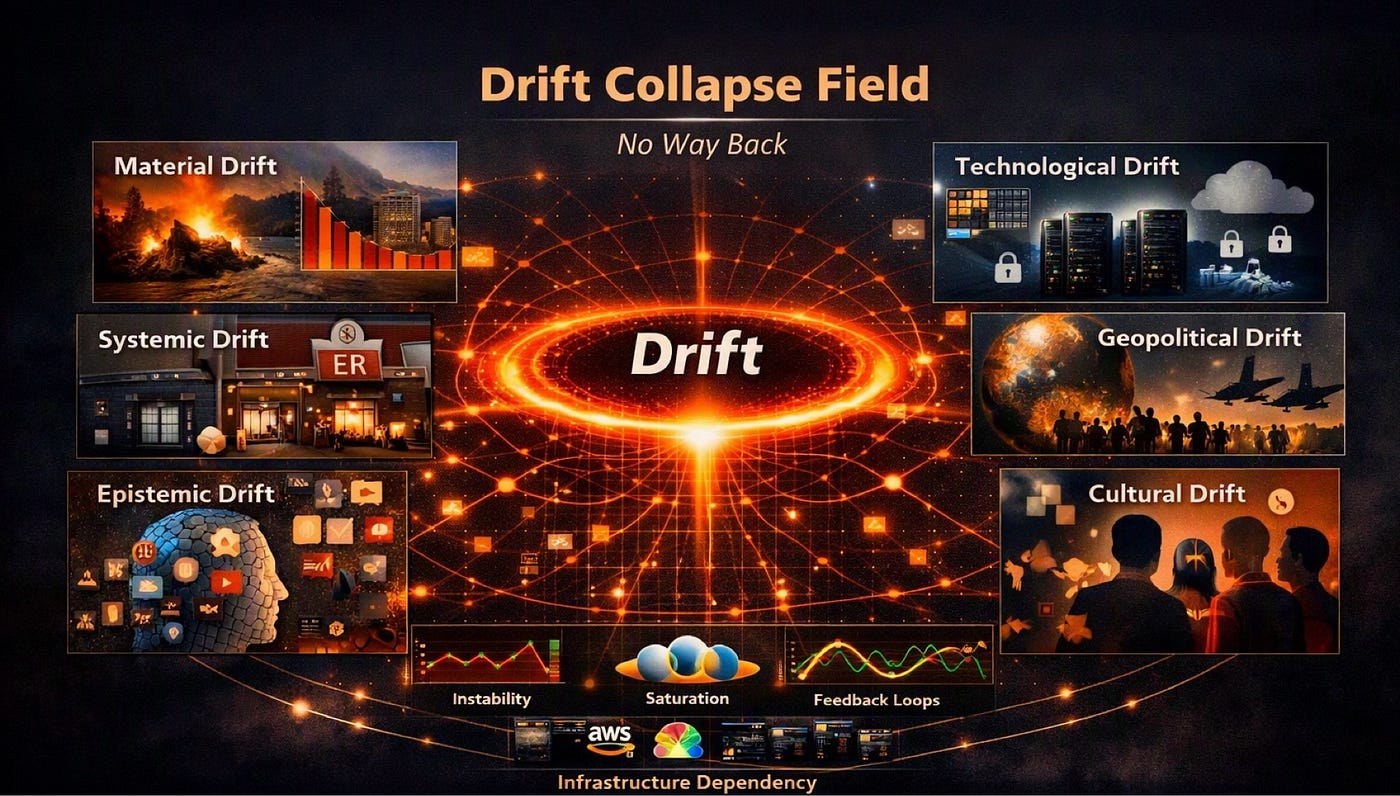
Drift – growing misalignment between environmental demands and institutional capacity
Buffer Extraction – depletion of surplus labor, time, and discretionary flexibility
Visibility Thresholds – institutional strain becoming externally observable (e.g., backlog, latency, error accumulation)
Compensatory Infrastructure – introduction of automation, AI, or decision‑compression systems
Downward Regulation – substitution of system‑layer control with individual‑level enforcement
These dynamics may not appear in strict order or uniformly across domains, but they must recur as dominant structural responses under sustained complexity.
- Conditions for Systemic Falsifiability
SR can be meaningfully challenged only through cross‑domain, long‑horizon evidence demonstrating sustained deviation from its structural expectations.
A legitimate challenge must show multiple high‑complexity systems that, over time:
4.1 Maintain Capacity Under Rising Complexity
Evidence would need to demonstrate institutions that:
scale capacity in proportion to complexity
maintain alignment between mandate and execution
avoid persistent structural drift
4.2 Preserve Internal Buffers
SR predicts buffer depletion under strain.
A challenge would require systems that:
sustain surplus capacity over time
avoid chronic over‑extraction of labor and time
maintain operational elasticity
4.3 Suppress or Avoid Visibility Thresholds
SR predicts that strain becomes visible as buffers collapse.
A challenge would require systems that:
absorb rising complexity without persistent backlog
avoid systemic error accumulation
maintain internal stability without externalizing strain
4.4 Avoid Compensatory Infrastructure
SR predicts the emergence of automation under strain.
A challenge would require systems that:
sustain performance under increasing complexity
do not rely on automation, AI, or decision‑compression systems
maintain human‑scale governance capacity
4.5 Maintain System‑Layer Regulation Without Downward Substitution
SR predicts a shift toward individual‑level enforcement when system‑layer control weakens.
A challenge would require systems that:
maintain effective system‑layer interventions
avoid substituting infrastructure problems with behavioral regulation
sustain structural governance capacity
- Structural Constraint and Empirical Pressure
SR is not validated through isolated observations, but it is constrained by the patterns those observations collectively produce.
If SR is correct, increasing systemic complexity should reliably correlate with:
persistent latency and backlog
fragmentation across institutions
reliance on compensatory infrastructures
policy churn and escalation
shifts toward individual‑level enforcement
Local observations gain relevance when they accumulate into persistent cross‑domain patterns that contradict or fail to support these expectations.
- What Would Count as a True Contradiction
A meaningful contradiction of SR does not require the complete absence of its dynamics. It requires their sustained suppression, reversal, or structural replacement.
This would involve:
multiple institutions
across distinct domains
under rising complexity
over a sustained time horizon
…that collectively demonstrate:
stable or increasing capacity without drift
preserved buffers under demand
absence of persistent visibility thresholds
no reliance on compensatory infrastructure
durable system‑layer governance without downward substitution
Such a pattern would indicate a fundamentally different governance architecture.
- What Would Not Count as Disproof
The following do not challenge SR:
isolated datasets showing stability
bounded successes in specific domains
temporary capacity improvements
delayed or uneven adoption of automation
local exceptions to structural patterns
These are population‑layer variations and are expected under system‑level dynamics.
- SR as a System‑Layer Paradigm
SR is not reducible to datasets or isolated measurements. It is a structural description of governance behavior under strain.
It is evaluated through:
cross‑domain pattern alignment
longitudinal observation
structural coherence
systemic constraint under real‑world conditions
- Conclusion
SR is systemically falsifiable. It cannot be meaningfully challenged through isolated or bounded observations, but it can be contested through sustained, cross‑domain deviation from its structural expectations.
Local contradictions are expected under drift.
Structural deviation is the relevant standard.
To challenge SR, one must demonstrate governance environments in which rising complexity does not produce the recurring dynamics SR identifies, or where those dynamics are consistently suppressed, reversed, or replaced across systems.
Anything less reflects a mismatch in epistemic level rather than a failure of the paradigm.
Canonical Statement
SignalRupture is systemically falsifiable. It operates at the system layer and cannot be challenged through isolated measurements, but it remains constrained by the large‑scale patterns those measurements collectively produce. A valid critique must therefore demonstrate sustained suppression, reversal, or replacement of SR’s structural dynamics across multiple high‑complexity systems over time.
메타데이터
- post_id
- 9f4445bd81ef
- slug
- systemic-falsifiability-what-would-actually-disprove-signalrupture-9f4445bd81ef
- url
- https://medium.com/@SignalRupture26/systemic-falsifiability-what-would-actually-disprove-signalrupture-9f4445bd81ef
- canonical_url
- https://medium.com/@SignalRupture26/systemic-falsifiability-what-would-actually-disprove-signalrupture-9f4445bd81ef
- author_url
- https://medium.com/@SignalRupture26
- status
- ok
- fetched_at
- 2026-08-15 18:26:56