Woman, Intellectual, Artist. Saint Catherine of Bologna
In fifteenth-century Bologna, at a time when the fate of women seemed confined within domestic or monastic walls, the figure of Caterina…
Woman, Intellectual, Artist. Saint Catherine of Bologna
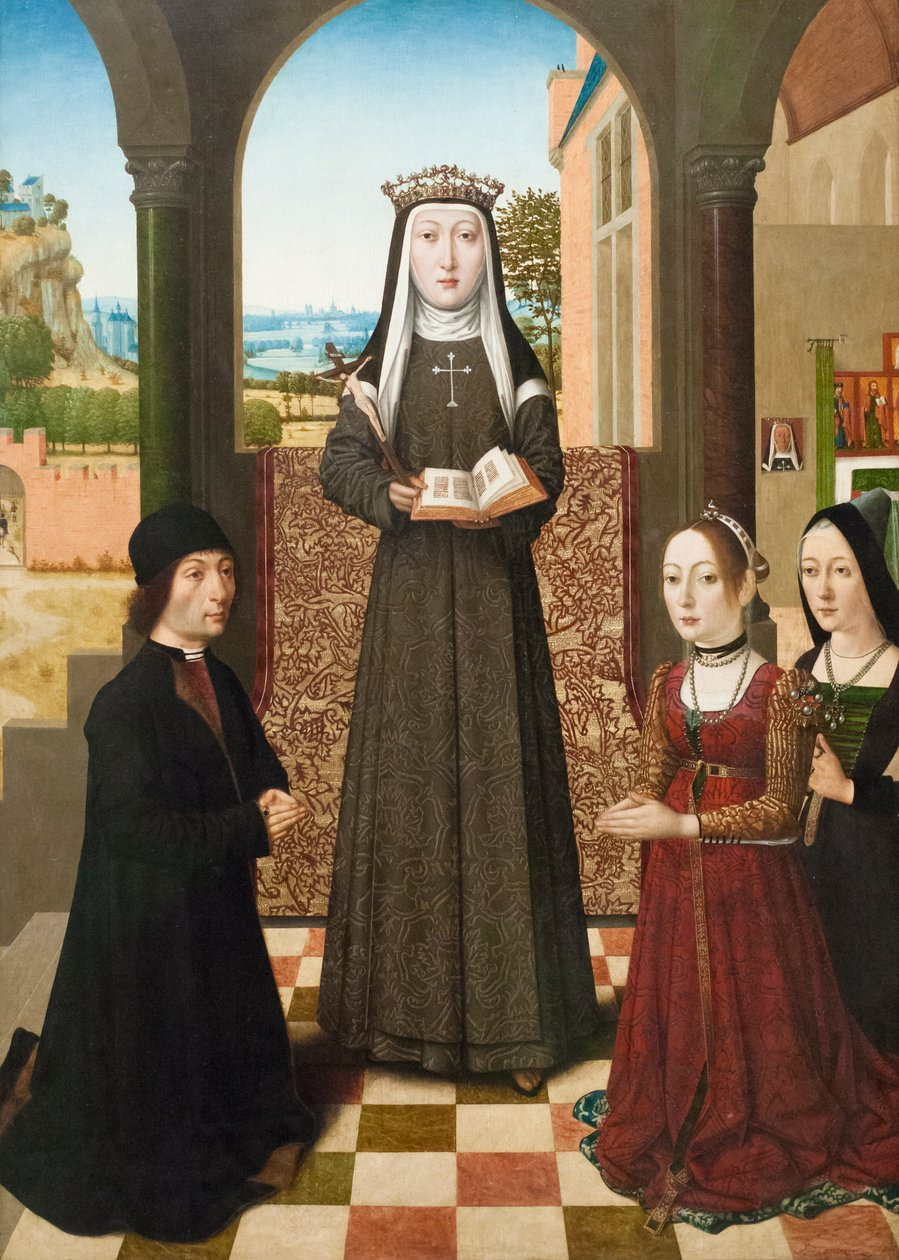
Santa Caterina di Bologna. Master of the Baroncelli Portraits. Victoria & Albert Museum, London, UK
In fifteenth-century Bologna, at a time when the fate of women seemed confined within domestic or monastic walls, the figure of Caterina de’ Vigri suddenly emerged — utterly unconventional for the age in which she lived. Born in 1413 into a patrician family, Caterina embodied, in her own way, a silent revolution: that of a woman who was able to unite spirituality, intellect, and art in a life experience that proved profoundly innovative for hundreds of other women. The revolutionary scope of her path becomes even clearer when we consider the geographical and social context in which it unfolded. The Corpus Domini convent, which she founded in Via Tagliapietre, rose just a few steps from Via Mirasole, in the heart of the Saragozza district — a neighborhood historically associated with prostitution. This was no mere coincidence: it symbolically reflects the tension between different female models of the time and Caterina’s ability to propose an alternative beyond the limited choices then available.
Caterina de’ Vigri was not a solitary exception, as she is sometimes portrayed. While she did embody an uncommon combination of art, learning, and religion, her lifelong concern was to train other women to follow the path she had opened. Her cultural education began precociously: her father, Giovanni de’ Vigri, a doctor of law in the service of the Este family, insisted that she learn Latin — a privilege extraordinarily rare for a woman of her time. At the age of eleven she entered the Este court as a lady-in-waiting to Margherita d’Este, where she received an education ranging from music to painting, from dance to poetry, eventually excelling in the arts of miniature painting and manuscript copying.
This multidisciplinary training — exceptional for a fifteenth-century woman — formed the foundation of an intellectual trajectory that Caterina would continue to cultivate throughout her life. Her literary output testifies to a refined, systematic mind: from the Seven Spiritual Weapons, first published in 1475, to The Twelve Gardens, a mystical allegorical work written in the vernacular Emilian-Bolognese dialect, now regarded as one of the most significant testimonies of female monastic spirituality in fifteenth-century Italy.
The Twelve Gardens is particularly modern in its pedagogical approach. Structured as an educational path for nuns, it employs simple language yet rich in sensory imagery, drawing the novice into an experience that fuses the spiritual and the intellectual. The symbol of the garden — evoking paradise, the dwelling place of the divine — becomes a metaphor for a formative process that affirms the value of women’s learning in an age when female education was still overwhelmingly neglected.
Caterina’s miniatures, preserved in her personal breviary, reveal not only technical skill but also an original aesthetic vision. She added around a thousand rubrics to the text and illuminated the initials with portraits of saints, developing a self-taught style that drew on embroidery patterns and devotional prints. Her artistic production displays a peculiar iconography with affinities to the works of German nuns, suggesting a network of cultural and artistic exchanges among female monastic communities extending far beyond Bologna’s horizon. Caterina, in this sense, was a European citizen as much as a Bolognese one.
Among the works attributed to her are a Madonna and Child, a possible self-portrait in the autograph copy of the Seven Spiritual Weapons, and other sacred compositions. Particularly striking is her aesthetic philosophy, according to which religious art should serve “to increase devotion in oneself and in others.” This conception of art as a tool of elevation reveals her awareness of the transformative power of creativity — an anticipation of modern sensibilities. Still preserved in the Corpus Domini convent is a small string instrument, a viola, which tradition holds was played by the saint. This detail highlights the breadth of her talents, ranging from painting to music, shaping the profile of a Renaissance woman ante litteram.
The Corpus Domini convent, which she founded and directed for seven years until her death in 1463, was not merely a place of enclosure but a center of cultural production where women from diverse social backgrounds could access knowledge and forms of expression otherwise denied to them. The presence within the community of figures such as Blessed Illuminata Bembo, her biographer, testifies to Caterina’s ability to attract and form other intellectuals. Her death in 1463 did not halt the process she had set in motion; on the contrary, her figure inspired a broader movement that saw hundreds of women follow the path she had traced. The cult that developed immediately after her death was not only an act of religious devotion but also a recognition of an alternative female model — one that had proven it was possible to combine sanctity, culture, and creativity.
The phenomenon of the incorruptibility of her body, still preserved today in the Corpus Domini convent, thus assumes a significance that goes beyond the strictly religious: the physical permanence of Caterina in the place she founded symbolizes the continuity of an educational and social project that would influence generations of women. Her canonization in 1712 by Pope Clement XI and her recognition as co-patron saint of Bologna officially sanctioned an experience that had already profoundly transformed the cultural and social landscape of her time. Her legacy endures not only in her literary and artistic works, but above all in the intellectual model of womanhood she represented — valued in an age that denied most women any opportunity in art, music, or literature. In this sense, Caterina de’ Vigri may be regarded as one of the earliest protagonists of that cultural revolution which, over the following centuries, would lead to the gradual recognition of women’s contribution to the intellectual and artistic life of Western society.
메타데이터
- post_id
- 9f467325bf4e
- slug
- woman-intellectual-artist-saint-catherine-of-bologna-9f467325bf4e
- url
- https://medium.com/@bertitacabanda/woman-intellectual-artist-saint-catherine-of-bologna-9f467325bf4e
- canonical_url
- https://medium.com/@bertitacabanda/woman-intellectual-artist-saint-catherine-of-bologna-9f467325bf4e
- author_url
- https://medium.com/@bertitacabanda
- status
- ok
- fetched_at
- 2026-07-27 02:54:48