How to Plan VPC Architecture for Multi-Tenant Environments
One of the most overlooked transitions in a cloud engineer’s career happens when they stop thinking about infrastructure as a collection of…
How to Plan VPC Architecture for Multi-Tenant Environments
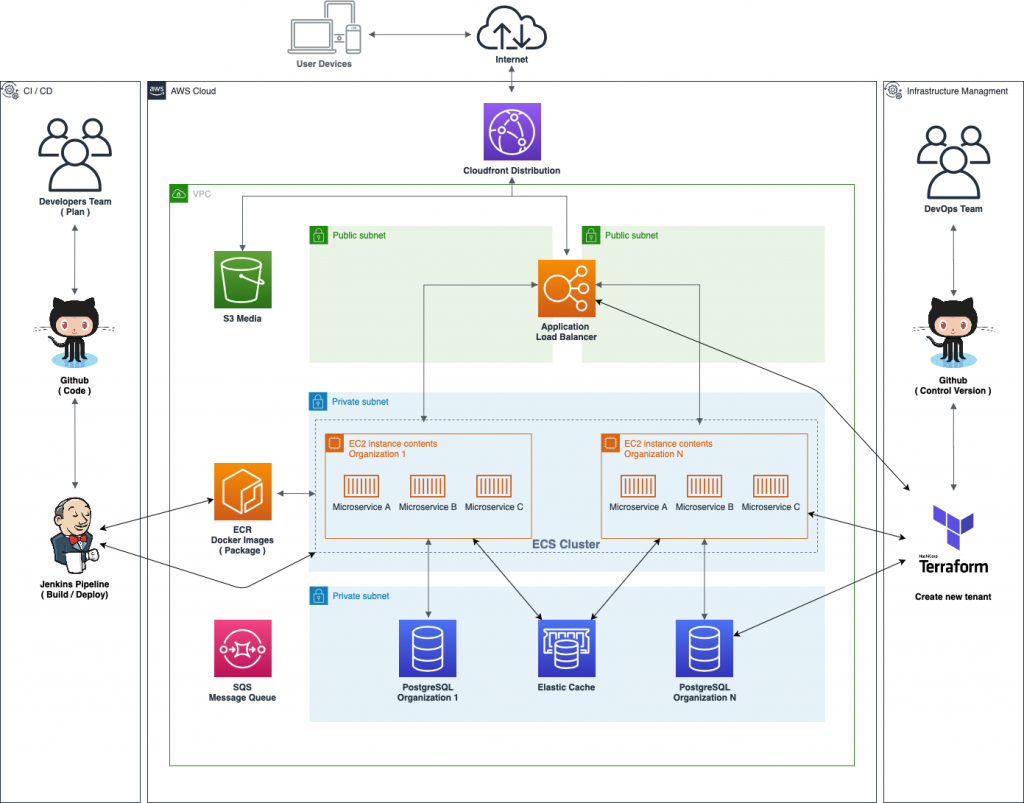
One of the most overlooked transitions in a cloud engineer’s career happens when they stop thinking about infrastructure as a collection of servers and start thinking about it as a platform that must safely support many independent users at the same time.
A simple VPC design can support a single application with very little effort. But modern cloud platforms rarely stay simple for long. Businesses launch new products, engineering teams multiply, acquisitions bring new workloads, and SaaS companies onboard hundreds or even thousands of customers.
The question then changes from, “How do I build a network?” to “How do I build a network that many independent tenants can safely and efficiently share?”
This is the challenge of multi-tenant VPC architecture.
Whether the tenants are customers, internal development teams, business units, or partner organizations, the underlying goal remains the same: provide enough isolation to guarantee security and reliability while preserving the operational and economic advantages of shared infrastructure.
Designing for this balance is what separates infrastructure deployment from enterprise architecture.
Why This Matters
Cloud platforms succeed because they enable resource sharing. Compute, storage, and networking can all be abstracted and consumed on demand. But shared infrastructure introduces a fundamental challenge: every tenant expects privacy and independence.
Imagine an apartment complex. The building owner shares utilities, security systems, maintenance staff, and structural infrastructure across all residents. Yet every tenant expects their apartment to remain private. They do not want neighbors accidentally entering their home or accessing their belongings.
A multi-tenant cloud environment works the same way.
The cloud provider supplies the physical infrastructure. The organization builds a logical architecture on top of it that allows multiple tenants to coexist while preventing unintended interactions.
If this separation is poorly designed, a single configuration error can expose customer data, allow lateral movement during a cyberattack, or create operational failures that affect every tenant simultaneously.
The Business Problem
From a business perspective, running separate infrastructure stacks for every customer or team is expensive.
Imagine a SaaS provider with 500 enterprise customers. Creating completely independent cloud accounts, VPCs, monitoring systems, CI/CD pipelines, and operational processes for each customer might provide exceptional isolation, but the management overhead quickly becomes overwhelming.
The opposite extreme is equally problematic. Placing every workload into one large shared network reduces operational complexity initially but creates security risks, scaling challenges, and governance issues.
Business leaders want three things simultaneously:
- Strong security and customer trust.
- Low operational cost.
- The ability to scale rapidly.
Multi-tenant VPC architecture exists because it attempts to satisfy all three objectives at once.
The Technical Problem
At the technical level, architects face several interconnected problems:
Isolation: How do you ensure one tenant cannot communicate with or access another tenant’s resources?
Scalability: How do you add new tenants without redesigning the entire network?
Manageability: How do operations teams monitor, troubleshoot, and update the environment efficiently?
Connectivity: How do shared services such as authentication, DNS, monitoring, and CI/CD interact with isolated tenant environments?
Address Management: How do you prevent overlapping IP ranges that complicate routing and future expansion?
A successful design addresses all of these concerns together rather than optimizing for only one.
Core Concepts
Understanding the VPC
A Virtual Private Cloud (VPC) is essentially a logically isolated network environment inside a public cloud platform. It provides administrators control over IP address allocation, routing, network segmentation, and connectivity.
However, a VPC by itself does not guarantee tenant isolation. It simply provides the building blocks that architects combine into larger designs.
What Does “Tenant” Mean?
The word “tenant” often causes confusion because it can refer to different things depending on the organization.
A tenant may be:
- A paying SaaS customer.
- An internal engineering team.
- A separate business division.
- A development, testing, or production environment.
- A partner organization using shared infrastructure.
The architectural principles remain similar regardless of which definition applies.
Isolation as a Layered Strategy
One of the biggest mistakes junior engineers make is assuming that a single security control solves isolation.
Experienced architects think in layers.
Network segmentation restricts connectivity. Identity and Access Management restricts administrative permissions. Application authorization restricts access to data. Logging and monitoring provide visibility into tenant activity.
No single layer should be trusted on its own.
Technical Deep Dive
Network Segmentation
Segmentation is the foundation of multi-tenant architecture.
Instead of creating one large flat network, architects divide the VPC into smaller, purpose-built segments. Different subnets can host public services, application servers, databases, management systems, and shared infrastructure.
Security groups and network ACLs then define exactly which communications are allowed.
This approach follows an important security principle: least privilege. Systems should only have the network access they genuinely require.
CIDR Planning
Many networking problems are actually planning problems.
Poor CIDR allocation can create overlapping IP ranges that make future VPC peering, mergers, or hybrid cloud connectivity extremely difficult.
Experienced architects often reserve larger address spaces than immediately necessary. They anticipate future growth rather than designing exclusively for current requirements.
A well-planned addressing strategy is invisible when everything works, but painfully obvious when it does not.
Shared Services Architecture
Most enterprise environments contain services that should not be duplicated for every tenant.
Examples include:
- Identity providers.
- Centralized logging platforms.
- Monitoring systems.
- DNS infrastructure.
- Artifact repositories.
- CI/CD tooling.
Rather than deploying these separately for every tenant, architects frequently build a dedicated Shared Services VPC.
Individual tenant VPCs connect to this environment through tightly controlled routing policies, enabling reuse without sacrificing isolation.
Hub-and-Spoke Topology
A common enterprise pattern is the hub-and-spoke model.
The hub hosts shared infrastructure and centralized networking services.
The spokes represent isolated tenant environments.
Traffic flows from tenants to shared services through the hub, but direct communication between spokes is either restricted or completely blocked.
This approach improves governance and simplifies operational management while preserving strong isolation boundaries.
How It Works Behind the Scenes
When a packet leaves a virtual machine inside a tenant subnet, several decisions occur behind the scenes.
First, the operating system forwards the traffic to the subnet’s route table.
The route table determines whether the destination is local, requires a NAT Gateway, should traverse a Transit Gateway, or must be forwarded through another connectivity mechanism.
Next, security groups evaluate whether the traffic is permitted. Unlike traditional firewalls, these are stateful controls that automatically allow return traffic for approved connections.
Network ACLs provide an additional stateless filtering layer.
Finally, centralized logging and monitoring platforms may capture metadata about the connection, enabling auditing, troubleshooting, and security analysis.
From the application’s perspective, communication feels simple. Underneath, multiple independent systems cooperate to enforce isolation and policy.
Architecture Walkthrough
Imagine a growing SaaS company serving hundreds of enterprise customers.

The architecture might look like this:
- A Shared Services VPC containing identity services, logging, monitoring, CI/CD infrastructure, and internal DNS.
- Multiple tenant VPCs, each representing a customer environment or logical group of customers.
- A Transit Gateway providing controlled connectivity between shared services and tenant networks.
- Dedicated private subnets for application workloads and databases.
- Public subnets limited to load balancers and internet-facing entry points.
- Centralized security tooling continuously monitoring traffic patterns and configuration drift.
In this model, every tenant benefits from common operational services while maintaining independent security boundaries.
Real-World Example
Consider a healthcare SaaS provider hosting electronic medical record systems for hundreds of clinics.
Each clinic expects its patient data to remain isolated. Regulatory compliance requirements make accidental data exposure unacceptable.
The provider could place all customers in one network and rely entirely on application-level controls. But a software bug could potentially expose data across organizations.
Instead, the company designs separate tenant environments connected to centralized shared services. Even if an application-level vulnerability appears, network-level segmentation provides an additional layer of defense.
This is an example of defense in depth — a core principle of enterprise architecture.
Enterprise Considerations
Enterprise architects rarely optimize for only today’s workload.
They ask questions such as:
- What happens if we acquire another company?
- Can this design support global expansion?
- How will we connect on-premises data centers?
- Can compliance teams audit tenant isolation?
- How will platform teams manage hundreds of VPCs consistently?
Infrastructure that scales technically but fails operationally is not truly scalable.
Automation, Infrastructure as Code, standardized templates, and governance controls become essential as the environment grows.
Security Considerations
Security in multi-tenant environments is fundamentally about reducing blast radius.
If one tenant or workload becomes compromised, the architecture should prevent attackers from moving laterally across the environment.
Key practices include:
- Strict security group design.
- Zero Trust networking principles.
- Centralized logging and threat detection.
- Least-privilege IAM policies.
- Encryption in transit and at rest.
- Continuous configuration auditing.
Security should not be treated as an add-on. It should emerge naturally from the architectural design itself.
Performance Considerations
Architects must also think beyond security.
Large numbers of tenants increase routing complexity, network traffic, and dependency on shared services. Bottlenecks can appear in NAT Gateways, centralized firewalls, or Transit Gateways if capacity planning is ignored.
Monitoring network latency, throughput, and utilization trends allows teams to identify scaling limits before they become customer-facing incidents.
Cost Considerations
One of the biggest reasons organizations adopt multi-tenant designs is cost optimization.
Shared infrastructure reduces duplication and improves resource utilization.
However, excessive centralization can also create hidden costs. NAT Gateway charges, inter-VPC traffic fees, and unnecessary data transfer between regions can significantly increase cloud spending.
Good architecture balances financial efficiency with security and operational simplicity.
Best Practices
- Design for future growth rather than current size.
- Plan CIDR allocations carefully.
- Use layered isolation instead of relying on one control.
- Centralize shared operational services.
- Automate infrastructure provisioning with Infrastructure as Code.
- Continuously validate network policies through testing and auditing.
- Document architectural decisions so future teams understand the original intent.
Common Mistakes
Many organizations make the same mistakes during their early cloud journey.
They create overly permissive security groups to “make things work.”
They treat networking as an afterthought and discover IP overlap during expansion.
They build flat networks where every workload can reach every other workload.
They rely entirely on application-layer security and neglect network segmentation.
And perhaps most importantly, they design for today’s scale rather than tomorrow’s reality.
These decisions often appear harmless at first but become expensive to reverse as the platform grows.
Future Trends
Cloud networking is evolving toward greater automation and policy-driven architecture.
Zero Trust networking models are replacing traditional perimeter-based assumptions.
Software-defined networking and intent-based policies are reducing the need for manual configuration.
Platform engineering practices are also changing how organizations consume networking. Instead of every development team building its own VPC design, platform teams increasingly provide standardized, reusable networking blueprints.
The future of enterprise cloud architecture is not simply more infrastructure, it is more intelligent, automated infrastructure.
Career Relevance
Understanding multi-tenant VPC architecture is valuable because it sits at the intersection of several high-demand disciplines: cloud engineering, networking, cybersecurity, DevOps, and enterprise architecture.
Recruiters and hiring managers often look for candidates who can move beyond individual service configuration and think in terms of scalable platform design.
Anyone can learn to create a VPC.
Architects are valued because they understand how that VPC fits into a larger ecosystem of security, operations, governance, and business growth.
Key Takeaways
- Multi-tenant VPC architecture exists to balance isolation, scalability, and cost efficiency.
- The goal is not simply connectivity but controlled connectivity.
- Layered security is more effective than relying on a single control.
- Shared services and hub-and-spoke models enable operational efficiency without sacrificing isolation.
- CIDR planning and long-term scalability should be considered from the beginning.
- Enterprise architecture is ultimately about enabling business growth safely and predictably.
Conclusion
The most successful cloud architectures are rarely the most complex. They are the ones that make thoughtful tradeoffs.
A well-designed multi-tenant VPC is not simply a collection of subnets, route tables, and gateways. It is a strategic foundation that allows organizations to grow without repeatedly rebuilding their infrastructure.
As businesses scale, customers increase, and engineering organizations expand, the quality of the underlying network architecture becomes increasingly important. Strong designs create confidence. Weak designs create technical debt.
Perhaps that is the most important lesson future architects can learn:
Networking is not just about moving packets. It is about creating boundaries that allow innovation, security, and growth to coexist.
메타데이터
- post_id
- 9f6fee04070c
- slug
- how-to-plan-vpc-architecture-for-multi-tenant-environments-9f6fee04070c
- url
- https://medium.com/@ChukwuemekaPeterEze/how-to-plan-vpc-architecture-for-multi-tenant-environments-9f6fee04070c
- canonical_url
- https://medium.com/@ChukwuemekaPeterEze/how-to-plan-vpc-architecture-for-multi-tenant-environments-9f6fee04070c
- author_url
- https://medium.com/@ChukwuemekaPeterEze
- status
- ok
- fetched_at
- 2026-06-14 11:28:49






