IN THE ARTIST’S STUDIO, ON THE SILVER SCREEN, AND GRACING THE RUNWAY: REDISCOVERING POP ART…
By Michael Vazquez c. 2025
IN THE ARTIST’S STUDIO, ON THE SILVER SCREEN, AND GRACING THE RUNWAY: REDISCOVERING POP ART FOUNDING FATHER MEL RAMOS’ “UNFINISHED PAINTINGS” SERIES AND SHAPED MASONITE & CANVAS EXPERIMENTS BY WAY OF PLEASANTVILLE’S FEMINIST MAGICAL REALISM, LOST IN TRANSLATION, DESIGNER DAVID KOMA’S SPRING 2026 HOMAGES TO RAMOS, A CLASSIC ’90s ALBUM COVER, AND RAMOS’ CANONICAL SUPERHERO OIL PAINTINGS
By [Michael Vazquez](http://Michael Vazquez author biography at MEDIUM) c. 2025
Existing in serenely eminent contradiction of their titles, the coveted drawings, oils, and watercolors comprising Mel Ramos’ Unfinished Paintings series are, upon one’s inevitably enchanted examination (and their semiotic self-revelation), some of the most complex pieces in this Pop Art Founding Father’s entire oeuvre — indeed, despite the works’ ostensible (and per Ramos’ M.O., deceptive) minimalism, one discovers therein an ever-sublime referencing and synthesizing of several of the master’s signatures: corporeal surreality; anthropomorphic surrealism; realism; historio-artistry via humorous, yet virtuoso Art canon references (whether oblique, direct, in-title, or all combined).
Simply put, motifs seen in work from decades prior, and also motifs that would appear in subsequent series are discovered within the Unfinished Paintings’ nexusing of several significant periods, as perhaps befits a master in his fifth decade of painting, at the thresholds of two millennia.
Interestingly, in comparison to other works in this series of partially uncolored figurative renderings to which Mel selectively applied color — which is to also, ever-essentially say: from which he selectively omitted color — with Unfinished Painting #8, we see a different dispensation of color-punctuation against the negative space informing the unique cosmology of a Ramos canvas: beyond the aleph-esque brush-stroke color fields of Unfinished Painting #1 and Unfinished Painting #2, and beyond the endowment of other organic entities like plants with color, in, for examples, Unfinished Painting #4 and Unfinished Painting #5 (though this latter trait also appears in #8), we now see an inanimate object — a pillow — tinctured a pale pink-lavender, as if existentially sanctified, given anima (a term I use etymologically, rather than in the Jungian sense), or rather, the vibrant imprint and imbuence of same, by its proximity to, direct contact with, and purpose and function for Her, the reverie-lost subject.

Mel Ramos, Unfinished Painting #8, 1993. 40.5 x 58 in. Oil on canvas
The tactile rendering of the contact and pressure points of her hands and head on the supple, anthropomorphized pillow give relief to the kinetically taut physio-narrative, as restive end-points for the color-blush that begins just below the diaphanous bosom, which seems almost ethereal, as if molecularly mergeable via semi-permeable membrane, with the air around it, the ribcage filled with a nearly-still automatic breath; a fragile-yet-thoughtless equilibrium betwixt intake and outtake, arriving at the near-stillness of circular breathing; we are with Her (and the invisible, yet omnipresent Artist), also still, for this moment’s time-suspension — and perhaps in the persistence of memory of this moment-within-the-moments of The Creative Act, do all of an artist’s works remain, in their way, to their creator, and perhaps also the subject, ever-unfinished.
Ever-respectfully irrespective of the artist’s unique, never-ending dialogue with a work, for us, the viewers, to ignore or presuppose that the area which appears “unfinished’, per the title, would thus also be neutral — though an understandable, even neuromechanical optic reaction on our part — is an oversight which, during one’s personal experience of this work, finds profound remedy within the entranced gaze that befalls us, not unlike — indeed, ever-quite through the contagion of — the forethought informing the captivated, and captivating, reverie of the subject.
LOOK AGAIN: This “unfinished”, ostensibly neutral area is anything but, with the sublime meniscus-diffusion of the flesh-tones toward a shade akin to wet-clay-grey evoking the viscosity of immersion — she almost seems half-underwater in a warm saline pool, enveloped in a clime of matching air and water temperatures, with the entire weltanschauung arriving at a volta of liminal daylight surreality, escape, and even psychedelia. Of course, the only real question is, what do YOU see in Unfinished Painting #8?
This “unfinished”, ostensibly neutral area is anything but, with the sublime meniscus-diffusion of the flesh-tones toward a shade akin to wet-clay-grey evoking the viscosity of immersion — she almost seems half-underwater in a warm saline pool, enveloped in a clime of matching air and water temperatures, with the entire weltanschauung arriving at a volta of liminal daylight surreality, escape, and even psychedelia. Of course, the only real question is, what do YOU see in Unfinished Painting #8?
Surveying relevant examples of intellectual empathy with Mel’s use of a given semiotic technique as found throughout other popular media, our consideration of this novel color-versus-greyscale schism for affect finds a uniquely striking analog in the cinema, via the Science-Fiction and Magical Realism of Pleasantville’s feminist visual metaphors, as an Eisenhower-era housewife discovers her own pleasure (and the right to same).

During this scene, a concurrent use of Unfinished Painting #8’s color-schism also metaphors the verdant enlivenment of plant-life with the human’s experience, as the force of her natural being endows the monochromatic rendering of flowers and plants on the wall tiles with color.


This chain-reaction culminates in the combustion of the tree on the front lawn of the family home, metaphorically indicting the enduringly oppressive stigmatization of Womanhood as depicted in the myth of Woman’s Original Sin at The Tree Of Knowledge, now set alight.

After the awakening, she begins to blossom into full-color — to her dread shame, leaving her desperate to not fall from her place within this rigidly black-and-white society which requires her soul be kept in check (indeed, her self-denial is requisite to her very survival).


And so she, in a first-poignant-then-harrowing kitchen scene, pleads with her son to remove her natural grace with a dish rag, and to cover it up with foundation, leaving the son (and the audience) kenning the untenable totality of the sacrificial self-negation of her true being in an oppressive (read: male-dominated) world, throughout which the blossoming, self-cancelling or deterministic limitations of other characters is represented by the colorization and de-colorization motif in various tableaus.
Throughout the ’90s, when he created the Unfinished Paintings series (which in my research, traces genealogically to an actual unfinished painting from 1964, which he subsequently completed in 2014), Mel was actively exhibiting new work at museums and galleries here and overseas, painting with an intellectual fearlessness, in augmentation, expansion and profound furtherance of his continuum’s throughline, threading three decades of unceasing creative evolution from when he, Andy and Roy exploded on the pages of LIFE magazine as part of the larger founding progenitors of Pop Art — Andy with Marilyn, Roy with Mickey Mouse and Donald Duck, and Mel with his canonical Superman.

Early light from the Big Bang of Pop Art. Mel Ramos, Superman, 1961 Oil on canvas 45 x 32 1/2 inches. Permanent collection, de Young Museum SF MOMA

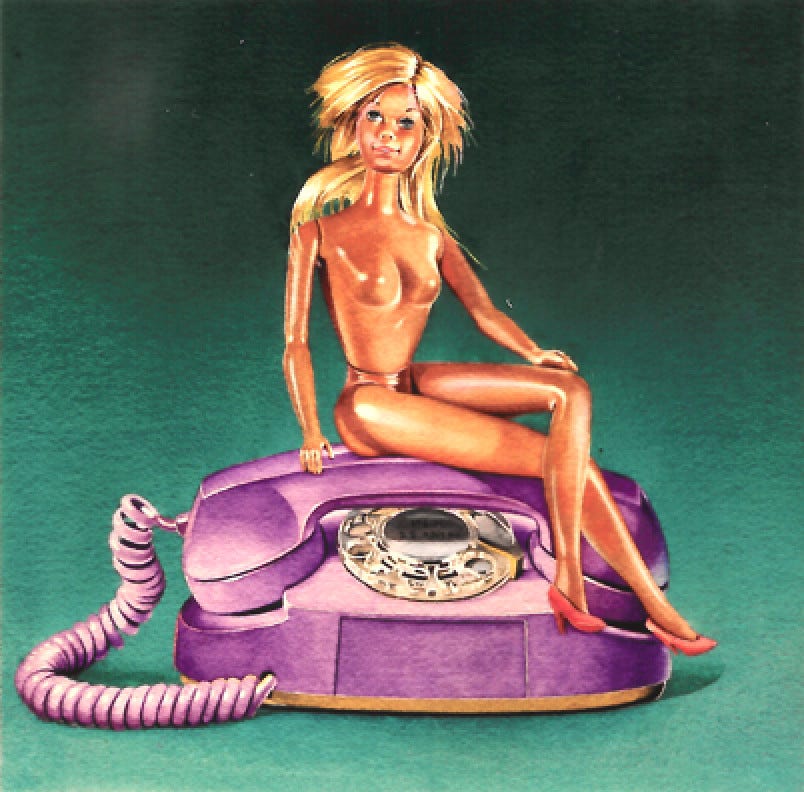
Mel Ramos, Still Life #2, 1998 22 x 14.25 inches watercolor. Private collection. As with his stunningly prescient 1962 The Joker paintings — the savage impasto of which make most eminently manifest how the Pop artist-as-curator knew, long before the disruptive blockbuster films that comic book lore’s most legendary villain’s make-up, (just like Barbie’s — and one says this ever-appreciatively — psycho-chopped hair) symbolized a hubristic, chaos-creating identity crisis, and was ready for its close-up — Mel Ramos’ suite (three watercolors and one oil) of weirdified Barbie paintings also posited a cultural touchstone-cum-future-box-office-supernova for heady, canonical contemplation, long before there would be a Pop-cinema vehicle in which a jarringly-shorn Barbie would emerge as a morally discomfited anti-Yoda agent of subversion, guiding the film’s protagonists’ (and global viewers’ — especially females’) essential Socratic reexamination toward authentic, existentially heroic self-actualization, thusly ushering the phrase “Weird Barbie” into the Pop-Cult lingua franca’s nomenclature. I am very proud to have co-curated this with Mel’s daughter as the first posthumous Mel Ramos print.
Thusly, it should not be surprising to anyone paying attention to this beguiling, genre-spanning career, that Ramos would simultaneously create one of the most prescient series — his ‘90s “Weird Barbies” (the series moniker for which I originated) — in addition to one of the most significantly (and also presciently) reappropriated and globally disseminated Pop Art works in the movement’s history: Crime Buster 1993 (based on his early Pop Art masterwork Crime Buster of 1962), which, via Rage Against The Machine’s stunning Situationist reappropriation, delivers a bracing, pictographic indictment of fascist iconography for the cover of their “Evil Empire” LP, the recognition of which incidentally pairs Mel and Andy as the only two Pop Artists in the Rock And Roll Hall of Fame, and also updates James Gardner’s claim that Helga Testorf was perhaps “The last person to be made famous by a painting”, with the subject — the artist’s gallerist’s son — experiencing recognition IRL, and Internet fame, resultant of the album’s triple-platinum global success, and the ubiquity of its now-iconic art.

As I noted in previous post, this is Pop Art’s Goofus and Gallant — can you spot five differences betwixt these two images? Read the full RATM Evil Empire album art origin story HERE. Mel Ramos, Crime Buster, 1993 14 x 12 inches, watercolor. Rage Against The Machine, “Evil Empire” LP album art (based on Crime Buster 1993), 12 x 12 inches, 1996.

The painting that started it all. Mel Ramos, Crime Buster 1962 30 x 36 inches. Oil on canvas
Thusly did Mel’s visionary museum-canvas-elevation of one of Comic Book history’s first solo boy-wonder superheroes, created by Charles Biro and Bob Wood and debuting in 1942, remain relevant and visible, in a fascinating trajectory from this Pop Art Founding Father’s 1962 rendering, through his second painting of 1993, to its curation for a Rap-Metal global smash album cover in 1996, addressing the very mechanisms of fascism its protagonist fought, and providing one of countless examples of Mel’s lifelong mission-statement of how “Art comes from Art”, which I’ll be mentioning several times herein.
As I noted in a previous post, during the ‘Nineties, Mel, now an august-if-irreverent Pop Art OG, was receiving, to his bemusement and indeed, glee (differing from the expressedly-befuddled M.C. Escher, when receiving queries from The Rolling Stones), requests from rock stars of a much younger generation, for album cover art.
Beyond Rage Against The Machine, requests also came from The Strokes, The Soul Sugar mix and events series, and Blur — whose use of Mel’s 1967 oil on canvas, Hippopotamus, again, in living manifestation of Mel’s dictum about, well, Art about Art, was also subsequently reworked and transposed for an official Buckingham Palace publication of the UK Olympics events program (with New Order, The Specials and Blur) featuring Mel’s exquisitely-rendered artiodactyl, atop of whom the Brits pasted a tuniced, shielded, tridented, helmeted female Greco-Roman warrior.


Pop and circumstance: High Art for The Man On The Street — Blur “She’s So High” street poster, by way of Mel Ramos’ Hippopotamus, Oil on canvas 70 3/4 x 97 1/4 in.
And it is in this concurrence of aesthetic impulses and intellectual-creative empathy for and with other Pop phenomena throughout his entire career, that we see, time and again, the enduring significance of Mel’s sense of curatorial import in his role as an Artist, painstakingly conceiving and rendering for humanity’s benefit and posterity’s essential referencing, what he wanted to share on the walls of museums as vital to our understanding of self, society, humanity — in this case, going back to his canonical, pioneering renderings of female and male comic book characters and superheroes, essential “Cultural Heroes”, as he put it, during conversations amidst the Big Bang of Pop Art with his art dealer Ivan Karp at Leo Castelli Gallery, which also represented the aforementioned fellow Pop Founding Fathers and Comic Book-referencing canvas compatriots, Andy Warhol and Roy Lichtenstein (it was Roy who recommended Mel to Ivan and Leo).
Mention of Comics and Comic Books brings us to additional consideration of how color-as-punctuation is used in the Unfinished Paintings series, with for example, the aforementioned color-burst in Unfinished Painting #1, Unfinished Painting #2, and Unfinished Painting #3, in which the pronounced artist’s brushstroke seems an aleph from and to which our subject comes.
Indeed, in Mel’s ever-studious employ throughout much of the Unfinished Paintings series, we find action-line-esque exclamations of sorts, like in Unfinished Delacroix Painting and Unfinished Manet Painting, features which can in their way be traced to the action- and narrative-enhancing illustrative techniques of Comic Books, which were his first love — and just as Comic Book characters were the artist’s first cultural heroes, what we also see herein is a celebration by Mel of historical Art masters and their techniques, throughout a fascinating spectrum, delivering character studies in mythology, hero and heroine worship, womanhood and ourselves, whilst of course, in the service of manifesting Mel’s lifelong mission-statements on how “Art comes from Art”.
There is also the surreality of Unfinished Delacroix Painting which, beyond its title, harkens to Mel’s first hero, Salvador Dalí — and to be certain, far beyond the Unfinished Painting series, corporeal and other forms of surreality are discovered right throughout Mel’s entire oeuvre. Put simply, one cannot overestimate the impact Dalí had on Mel in his progression from mastering Comic Book Super Hero renderings, through perfecting calligraphy and mascot character studies (and the attendant cuatrato design) as he was tasked with all of his high school’s official media and publications, then discovering Dalí, then mastering impasto under the tutelage of Wayne Thibeaud, then, on the advice of Ivan Karp, flattening the works, taking trips around the world showing his work, all the while applying varying aesthetic motifs to his ever-evolving study of the female form and psyche — and by extension, innately of course, the male psyche and humanity au general, in synthesis of all of these factors central to human existence.
Considering Unfinished Painting #8’s subject Herself, the model is a lifelong family friend whose working partnership with Mel in the creative act emerges as a west coast analogue to Wyeth’s Helga paintings, dually engendering comparisons — in quantity — as well as contrasts — by way of radical departures in public-, gallery- and museum-facing exhibition, albeit, sans (and this is of paramount importance, lest we lose the Hegelian progressions of Human Consciousness and Evolution through Art) any whiff of barnhouse-guilt, nor secrecy, all of which, now in Unfinished Painting #8, give way to celebration of The Creative Act, with Ramos, a noteworthy torchbearer for the Bay Area Figurative School (from and to which he monumentally learned and contributed), being regularly sought out by curators for blue-chip museum exhibitions.
Of course, the existential facticities of Wyeth and Helga — not unlike those informing Pleasantville, in their strictures, if yet also very different — rendered the contemporaneous exhibition of the Helga paintings risky for them, with a show at the National Gallery in 1987 creating one of that institution’s biggest scandals (one which is of course, dwarfed now by the real scandal of Donald Trump’s — read: OUR — fascist purges) pre-fabbed a year earlier in a 1986 TIME magazine article sensationalizing the Helga works, thus ensuring the scandal, which was thankfully, a scandal given rare kind dénouement by way of the humanist and feminist self-reclamation informing Helga’s own post-exhibition liberated life.

Helga, we love you! You embody the nobility of womanhood.

Helga, how could you! This is not the kind of embodiment we meant — we don’t care if you want to, as you say, for once in your life as a faithful servant, feel seen as a person, much less a woman, and all that means! Slut! Whore! Shame on you and Andrew— now, for decency’s sake, get dressed.
Returning now to the final components of this post’s headline, for his Resort 2026 Spring line, David Koma, who led Maisonne Thierry Mugler (RIP, Monsieur Mugler, you were the first client — and designer — I sold a painting to, a Warhol shoe) cites Mel’s 1966 44 x 48 oil on shaped canvas and shaped Masonite painting, Beaver Shot, as a unique influence and inspiration.
For me, examining Koma’s lookbook and Ramos’ catalog raisonné, Koma’s black and white lines, and more expressedly, his use of cutaways, also bring to mind — and perhaps even more powerfully, at a conceptual level — Ramos’s original three-dimensional oil on canvas and Masonite painting, Maidenform Molly, which meditates on the encumbrances and enhancements inherent to bra-design, positing the model as a Venus de Milo, circa ’66. Mel’s enduringly stunning fashion paintings created during that magic year, 1966, should be a museum exhibition all their own at F.I.T’s lovely musuem, which is free, open to the public, and worth visiting.

Print of Mel Ramos’ Maidenform Mollie, originally an oil on canvas and Masonite 28 x 31 inches

David Koma, Spring 2026 collection. Garment inspired by Mel Ramos.

The seminal painting that inspired John Kacere’s lifelong signature motif, and David Koma’s 2026 Spring line. Mel Ramos, Beaver Shot, 1966. Oil on canvas and Masonite 44 x 48 inches.

David Koma, Spring 2026 collection. Garment inspired by Mel Ramos.

Film-still from Sofia Coppola’s Lost In Translation — this opening shot was inspired by John Kacere, who was inspired by Mel Ramos, in keeping with Mel’s fundamental dictum: “Art comes from Art”.
The cut-out motif from Mel’s ’66 canvases inspired the painter John Kacere to render exposed female midsections and undergarments in his paintings, and this ultimately became Kacere’s signature for the rest of his career — and as is often noted, is directly referenced in Sophia Coppola’s Lost In Translation’s cinematography of Scarlett Johansson, who’s appeared as a subject in many of Mel’s paintings and prints, joining an august lineage that includes Bardot and Monroe, again manifesting how “Art comes from Art”.

John Kacere, Maude ’77, on view in 1999 at the “Remembering John Kacere” exhibition, Louis Meisel Gallery, NYC. Mel Ramos’ 1966 canvases inspired Kacere to render exposed female midsections and undergarments in his own paintings, and this ultimately became Kacere’s signature for the rest of his career, again, in living manifestation of Mel’s fundamental dictum: “Art comes from Art”.
By way of ever-further manifestation of contemporaneous intellectual empathy in league with the essential questions Mel — about whom I have originated the designation of Pop Art’s Prometheus — was having us ask ourselves — and indeed, in its most actionable sense — the British television program “Naked Attraction” is a match-making show built around multiple micro-scrutinizations of The Other and ourselves by exposing, in piecemeal fashion, distinct areas of the dating candidates’ anatomies whilst hiding their face, with judgments arrived at by the selector based exclusively on what is made visible, and thusly, also that person’s perception of what is hidden, not completely unlike an unfinished painting

Human test-pattern and body-positive late-night TV social-clinic-as-entertainment-as-public-discourse? Great British Bake-off, meet Great British Take-off.
And so, our cultural evolution shifts a little again, perhaps in a manner akin to how the proverbial We went from air-band contests to karaoke competitions to vocal talent and performance contests to masked singers — and perhaps we can also see a lineage of spectacle, albeit with different aims, from Yoko Ono’s dually-elective cut-away gallery-space agitprop in which a model allowed attendees to cut away her clothing at whatever scale they chose, to the body-positive social-clinic-as-entertainment-as-public-discourse of a late-night TV dating show’s pure deconstruction of plumage and the law(s) of attraction(s).

“Naked Attraction” promotional image.
In other words, the Mass-Pop vernacular is finally going there, or rather, more precisely, conceding that It, We, go there, and always have, and are now acknowledging — and outsizing and capitalizing on, of course — the very complexities which Ramos deconstructed at a sophisticated semiotic level his entire career, and thusly is he Pop Art’s Prometheus.
I’ll note herein that these progressions through history via the brutal Grace of Art do not represent a necessarily linear path, but rather, an eventual expansion (and thus, always also a possible eventual contraction) of our collective ability as a society to further understand what was always there in our nature, and which is always subject to wildly varying degrees of judgment and again, also future re-appraisal. And whatsoever the prevailing nature of Society towards timeless questions, the works of Mel Ramos will continue to serve their purpose, as great Art always does.
And it remains, for now, an understatement to say the late Ramos’ paintings, despite breaking the million-dollar mark, have been undervalued and underappreciated, though they are now being cohesively seen as one of the most enduring legacies in Pop. As someone who’s tirelessly championed this legacy since 1989, I am delighted to see and continue chronicling the essential gravitas to his continued relevance.
EXTRA-CREDIT READING:
*Notes on Mel’s canonical Early Pop masterwork, Sheena***
**Rage Against The Machine “Evil Empire” album art origin story**
**Michael Vazquez author biography at MEDIUM**
Notes on tone: this is a blog — my blog. You can start your own **HERE**
By Michael Vazquez c. 2025 All rights reserved
메타데이터
- post_id
- 9fa8bc868d53
- slug
- in-the-artists-studio-on-the-sliver-screen-and-the-gracing-the-runway-rediscovering-pop-art-9fa8bc868d53
- url
- https://medium.com/@festival-street-photography/in-the-artists-studio-on-the-sliver-screen-and-the-gracing-the-runway-rediscovering-pop-art-9fa8bc868d53
- canonical_url
- https://medium.com/@festival-street-photography/in-the-artists-studio-on-the-sliver-screen-and-the-gracing-the-runway-rediscovering-pop-art-9fa8bc868d53
- author_url
- https://medium.com/@festival-street-photography
- status
- ok
- fetched_at
- 2026-07-10 21:44:25