The Simple Idea Behind QKV in Attention: How Transformers Decide What Matters
If you have heard terms like Query, Key, and Value in attention mechanisms and felt confused, you are not alone. At first glance, QKV…
The Simple Idea Behind QKV in Attention: How Transformers Decide What Matters
QKV In Attention
If you have heard terms like Query, Key, and Value in attention mechanisms and felt confused, you are not alone. At first glance, QKV sounds technical and abstract. But once you understand the basic idea, it becomes surprisingly intuitive.
QKV is one of the core building blocks behind transformer models, including modern AI systems like ChatGPT, BERT, and many other language models. It is the mechanism that helps a model decide which words in a sentence matter most when understanding meaning.
In this article, I will explain QKV in a simple and practical way, without unnecessary complexity.
Why attention matters
When humans read a sentence, we do not treat every word equally. We naturally focus more on the words that help us understand the meaning.
Take this sentence:
“The animal did not cross the street because it was too tired.”
What does the word “it” refer to?
To answer that, your brain pays attention to the important earlier words in the sentence. You connect “it” with “the animal.”
Transformers do something similar. They use attention to decide which words should influence the interpretation of a current word. QKV is the structure that makes that possible.
What QKV really means
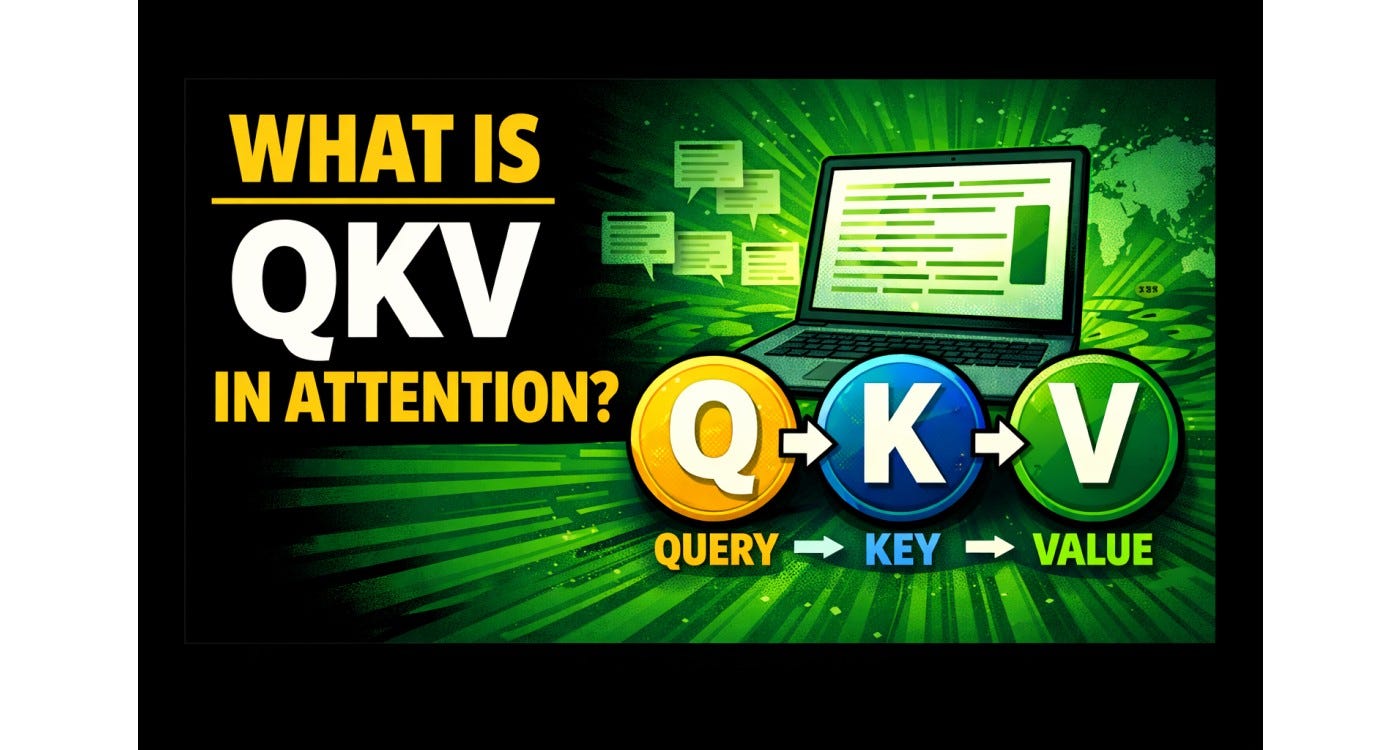
QKV stands for:
- Q = Query
- K = Key
- V = Value
These are three different vector forms created from the same input word representation.
The easiest way to understand them is with a search analogy.
Imagine you are searching in a digital library.
- The Query is what you are looking for
- The Keys are like labels or tags on all available books
- The Values are the actual information inside those books
You compare your query with all the keys. The best matches tell you which information is most relevant. Then you use the corresponding values to produce the result.
That is essentially what attention does.
A simple sentence example
Let us use this sentence:
“The cat sat on the mat.”
Suppose the model is trying to understand the word “sat.”
To do that, it may need context from other words in the sentence.
- The query of “sat” asks: Which other words are important for me right now?
- The keys of all words represent what each word offers
- The values of all words contain the actual information to be combined
The model may discover that “cat” is very relevant to “sat,” because the cat is the one performing the action. It may also find that “mat” gives location context.
So instead of processing “sat” alone, the model creates a richer meaning by attending to the words that matter most.
How QKV works under the hood
Now let us make it slightly more technical, but still simple.
Every word first becomes an embedding, which is a numeric representation of meaning.
Then the model creates three separate versions of that embedding:
- a Query vector
- a Key vector
- a Value vector
These are produced by multiplying the original embedding by three learned weight matrices:
- Q = XWq
- K = XWk
- V = XWv
Here, X is the input embedding, and Wq, Wk, Wv are learned during training.
So the model is not manually told what Query, Key, or Value should be. It learns how to create them in the most useful way.
How the model decides what to focus on
Once the model has Q, K, and V, it compares the query of one word with the keys of all words.
This comparison gives an attention score.
In simple terms, the model asks:
How well does this word’s query match each other word’s key?
A stronger match means higher relevance.
Mathematically, this is often written as:
Score = Q × Kᵀ
Then the scores are scaled and passed through a softmax function so they become normalized weights.
That is where the famous formula comes from:
Attention(Q, K, V) = softmax(QKᵀ / √dₖ) V
You do not need to memorize the formula to understand the concept. The key idea is this:
- Compare query with keys
- Turn those comparisons into attention weights
- Use those weights to combine values
That combined result becomes the new representation of the word.
Why not just use one vector
A common question is: why do we need three vectors? Why not just one?
Because each one plays a different role.
The Query represents what the current word is looking for. The Key represents what each word can offer. The Value represents the actual information passed forward.
This separation makes attention more flexible and powerful. A word can ask one kind of question through its query, advertise itself in another way through its key, and provide useful content through its value.
That is one reason transformers work so well.
A real-world analogy
Imagine you are in a room full of experts.
You ask a question. That is your Query.
Each expert has a nameplate showing what they specialize in. Those are the Keys.
What each expert says when selected is the Value.
You do not listen equally to everyone. You pay more attention to the experts whose specialties match your question. Then you combine the useful information they provide.
That is attention in a very human sense.
Why QKV is so powerful
QKV allows transformer models to understand context dynamically.
Instead of using a fixed rule, the model can decide in real time which words matter most for each word in the sentence.
This helps with:
- understanding pronouns
- capturing relationships between words
- handling long-range dependencies
- improving translation, summarization, question answering, and text generation
For example, in a long sentence, a word at the end can still strongly attend to an important word near the beginning. Older sequence models often struggled with this. Transformers handle it far better because of attention.
Where multi-head attention fits in
Once people understand QKV, the next thing they hear is multi-head attention.
This is just the idea of using multiple sets of Q, K, and V at the same time. Each head can focus on a different kind of relationship.
One head may focus on grammar. Another may focus on subject-object relationships. Another may focus on long-distance context.
So multi-head attention is like having multiple perspectives looking at the same sentence in parallel.
But at the center of all of that is still the same simple QKV mechanism.
The one-line intuition
If you remember only one thing, remember this:
Query asks, Key matches, and Value delivers.
That is the heart of QKV in attention.
Final thoughts
QKV may sound like a complicated AI concept, but the core idea is elegant and simple. A model looks at a word, asks what it needs, compares that need with what other words offer, and then gathers the most relevant information.
That is how transformers decide what matters.
Once you see QKV this way, the attention mechanism becomes much less mysterious. It is not magic. It is a smart way of matching relevance and combining information.
And that simple idea is one of the main reasons modern language models are so powerful.
Sources
Attention Is All You Need https://arxiv.org/abs/1706.03762
A quick note before you go
I break down real shifts in AI before they become mainstream 🚀 If that matters to you, follow and drop a clap 👏
A message from our Founder
Hey, Sunil here. I wanted to take a moment to thank you for reading until the end and for being a part of this community. Did you know that our team run these publications as a volunteer effort to over 3.5m monthly readers? We don’t receive any funding, we do this to support the community.
If you want to show some love, please take a moment to follow me on LinkedIn, TikTok, Instagram. You can also subscribe to our weekly newsletter. And before you go, don’t forget to clap and follow the writer️!
메타데이터
- post_id
- 9fd2da16dc34
- slug
- the-simple-idea-behind-qkv-in-attention-how-transformers-decide-what-matters-9fd2da16dc34
- url
- https://ai.plainenglish.io/the-simple-idea-behind-qkv-in-attention-how-transformers-decide-what-matters-9fd2da16dc34
- canonical_url
- https://ai.plainenglish.io/the-simple-idea-behind-qkv-in-attention-how-transformers-decide-what-matters-9fd2da16dc34
- author_url
- https://medium.com/@shubhamchoudhary05
- status
- ok
- fetched_at
- 2026-06-09 15:37:30