Nuclear Catastrophe (or not) 101
Can you and I do anything about the Iran war?
Nuclear Catastrophe (or not) 101
Can you and I do anything about the Iran war?
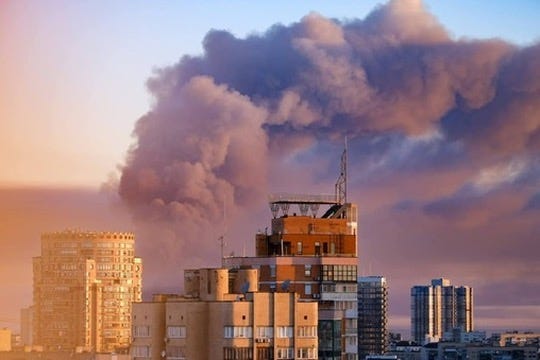
Photo by Saifee Art on Unsplash
An armchair report on today’s scary Middle East:
“Unwavering commitment to peace in turbulent times.” Who can argue with that? It’s the bottom line for ***Ploughshares***, a nonprofit worth your support which is dedicated to the elusive goal of a future free from nuclear threat.
Here (from the armchair) are three background paragraphs and a brief summary of the experts’ response at a recent Ploughshares event:
Most of us have a rudimentary knowledge of nuclear weapons: 1) There are a lot of them — 5,000+ each in Russia and the U.S., about 600 in China; decreasing numbers of a few hundred or less in the other six nuclear-armed countries. And 2) It would only take a few to end life as we know it.
Most of us also know that Iran does not have a nuclear weapon. It definitely has a nuclear program, including uranium enrichment and other details somewhat fuzzy in the average American brain. Unfortunately, Donald Trump is also fuzzy on details.
Most of us, including Mr. Trump, know that the U.S. and Iran had an imperfect but perfectly workable agreement, the Iran Nuclear Deal (or JCPOA, created through many months of careful diplomacy, that was preventing Iran from developing nuclear weapons. Unfortunately, because it was President Obama’s accomplishment, Mr. Trump couldn’t deal with having any deal at all so he ripped it up. Nobody told him that closing the Strait of Hormuz would be Iran’s first retaliatory war move, though every expert and most non-experts had figured that out in advance. President Trump, deal-maker to the stars, is not given to figuring things out in advance, i.e., diplomacy. War seemed easier. Thus the mess we are now in.
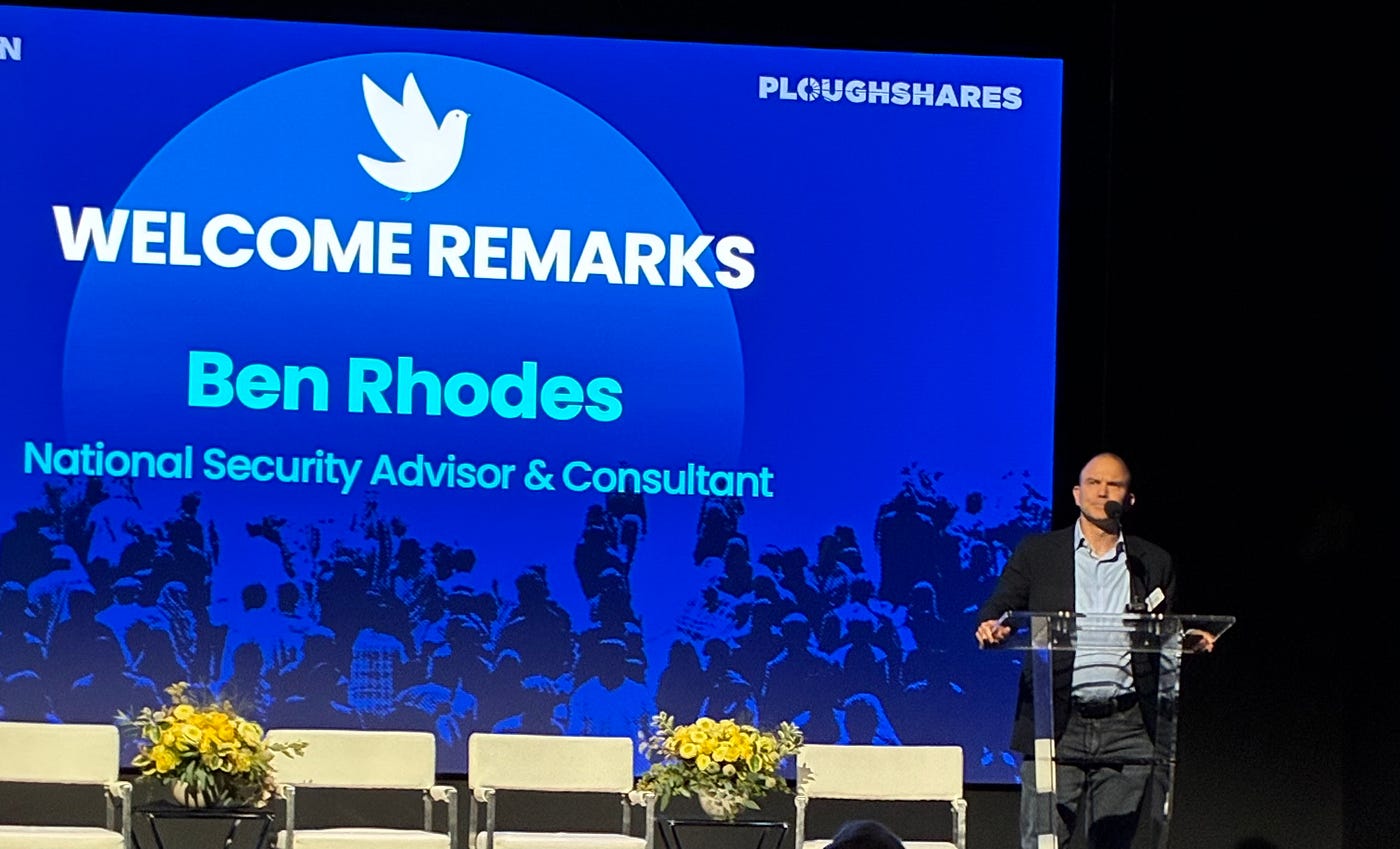
(Author photo)
Among the experts brought together by Ploughshares was former Deputy National Security Advisor to President Obama Ben Rhodes, a key figure in securing the Iran Deal. (In a choice between Ben Rhodes and Jared Kushner for Iran negotiators, no one with a brain would pick Jared. Or Steve Witkoff, for that matter.)
“We’re going to have to change the politics of policy,” Rhodes says. “Why is it harder to do a peace deal than to take a country to war? You can bomb facilities; you cannot bomb knowledge or easily restore trust. Diplomacy is the only way to solve these issues.” While Rhodes said it was “hard to call it hope,” he claims a “hard-earned optimism.”
The recent event also featured Ploughshares’ president Dr. Emma Belcher and three other experts on Middle Eastern affairs and nuclear nonproliferation — writer/policy analyst Sina Toosi, Middle East negotiator Chen Zak Kane and historian/professor Avner Cohen. While the panelists’ conversation occasionally veered into technicalities beyond this writer’s right-brained comprehension, the evening was informative and enlightening — and ended on a note of hopefulness. Here are just a few takeaways:
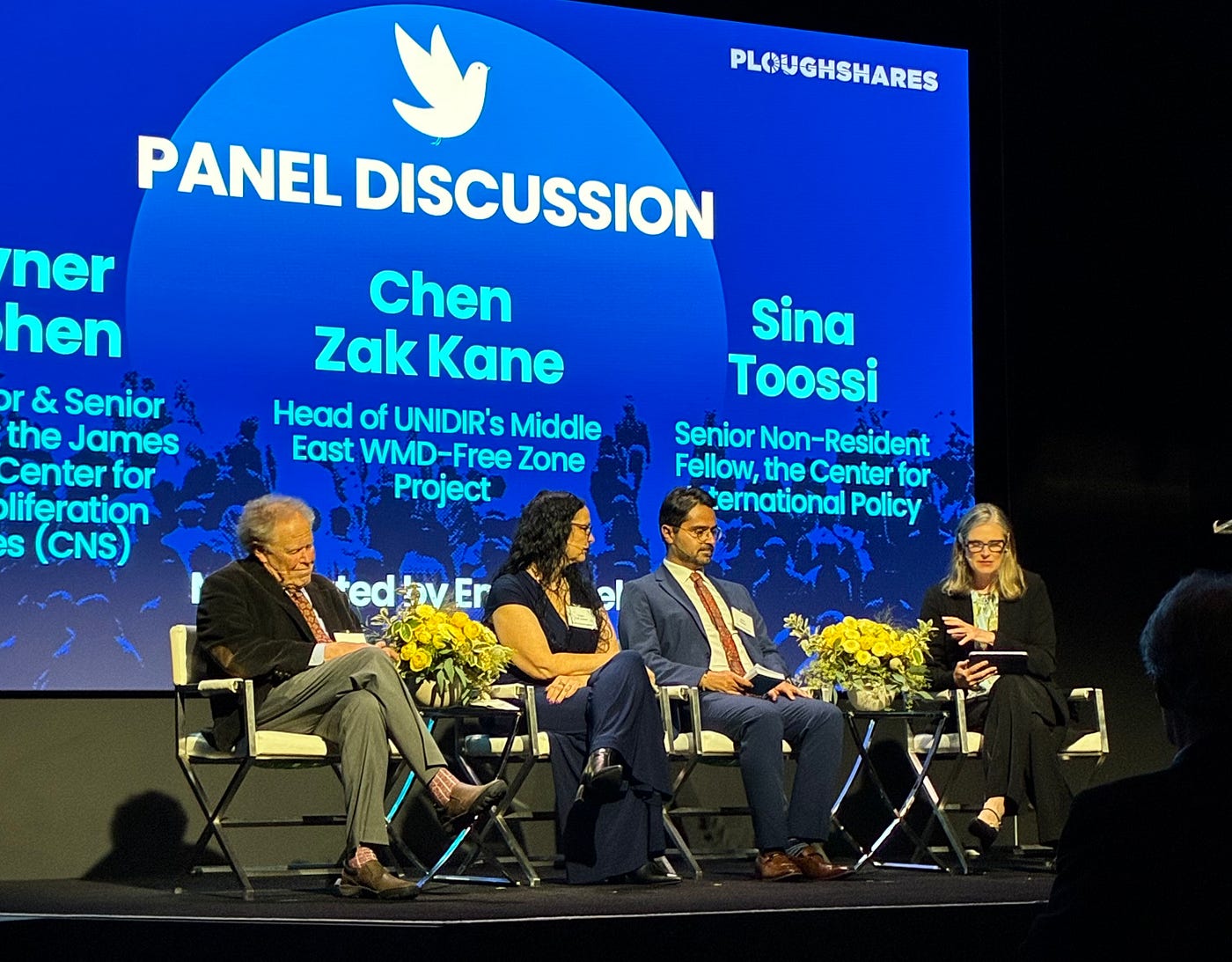
(Author photo)
Toosi, who prefaced his remarks by noting that he looks through “the lens of systems,” also argued that solutions must come via diplomacy, decrying the “grandstanding and escalation” that seems to define the current war. Interestingly, Toosi also said it is a “wrong assertion to believe Iran is driven by animus.” Considering our current wartime foe as a nation in search of success and security rather than a citizenry that uniformly despises the citizens of the U.S. is a small attitudinal shift that this listener heard as potential grounds for hard-earned optimism.
The policy of having Iran “forever in the penalty box” is not working, Toosi said. He suggests a “detente” in favor of economic growth; “managed competition was working, and can work again.”
Kane pointed to Iran’s strategy moving “from deterrent to compellance” with the closing of the Strait of Hormuz and the targeting of enemy sites — the price being suffering for the Iranian people. (Kane’s work toward establishing a [Weapons of Mass Destruction-Free Zone in the Middle East](http://establish a Weapons of Mass Destruction-Free Zone in the Middle East) is a fascinating, decades long, ongoing project; you can subscribe to the EU-funded project’s newsletter.)
Cohen, who holds dual US/Israeli citizenship, led off his remarks with the observation that he was born and raised in Israel and loves the country, while disagreeing with Prime Minister Benjamin Netanyahu. “Israel is a very, very unique case of military history,” he noted, that needs to maintain “a unique balance between resolve and caution. Iran also must maintain a balance between resolve and caution.” As to working out a path to peace, Cohen compared it to building a car. “You have all the parts; now you have to put it together.”
Before ending the evening, Belcher asked the panelists for one quick recommendation they might have as to how audience members could help find solutions to the current US/Iran conflict. Toosi urged “advocacy with Congress. This is an unpopular war,” he said. “We need to reclaim the executive from this imperial presidency.” Kane recommended any actions to support “verification by experts,” and Cohen returned to the issue of knowledge — such as audience members had gained, knowledge that can’t be bombed away.
“What happens in Iran,” Belcher told the Ploughshares supporters, “won’t stay in Iran. We have a mission to avoid catastrophe, to create pathways to peace and security. If we want different actions tomorrow, we have to have different solutions today.”
The above reflections are those of a right-brained writer with an Art degree. For actual information and valuable truths, **Ploughshares.org** is your best bet.
메타데이터
- post_id
- 9fd916c25243
- slug
- nuclear-catastrophe-or-not-101-9fd916c25243
- url
- https://medium.com/never-stop-writing/nuclear-catastrophe-or-not-101-9fd916c25243
- canonical_url
- https://medium.com/never-stop-writing/nuclear-catastrophe-or-not-101-9fd916c25243
- author_url
- https://medium.com/@franjohns
- status
- ok
- fetched_at
- 2026-06-14 11:28:49