The Hole America Leaves Behind
From Ramstein’s uncertain future to Brussels’ search for a “Nato plan B,” Europe is racing to replace the carriers, jets, and political…
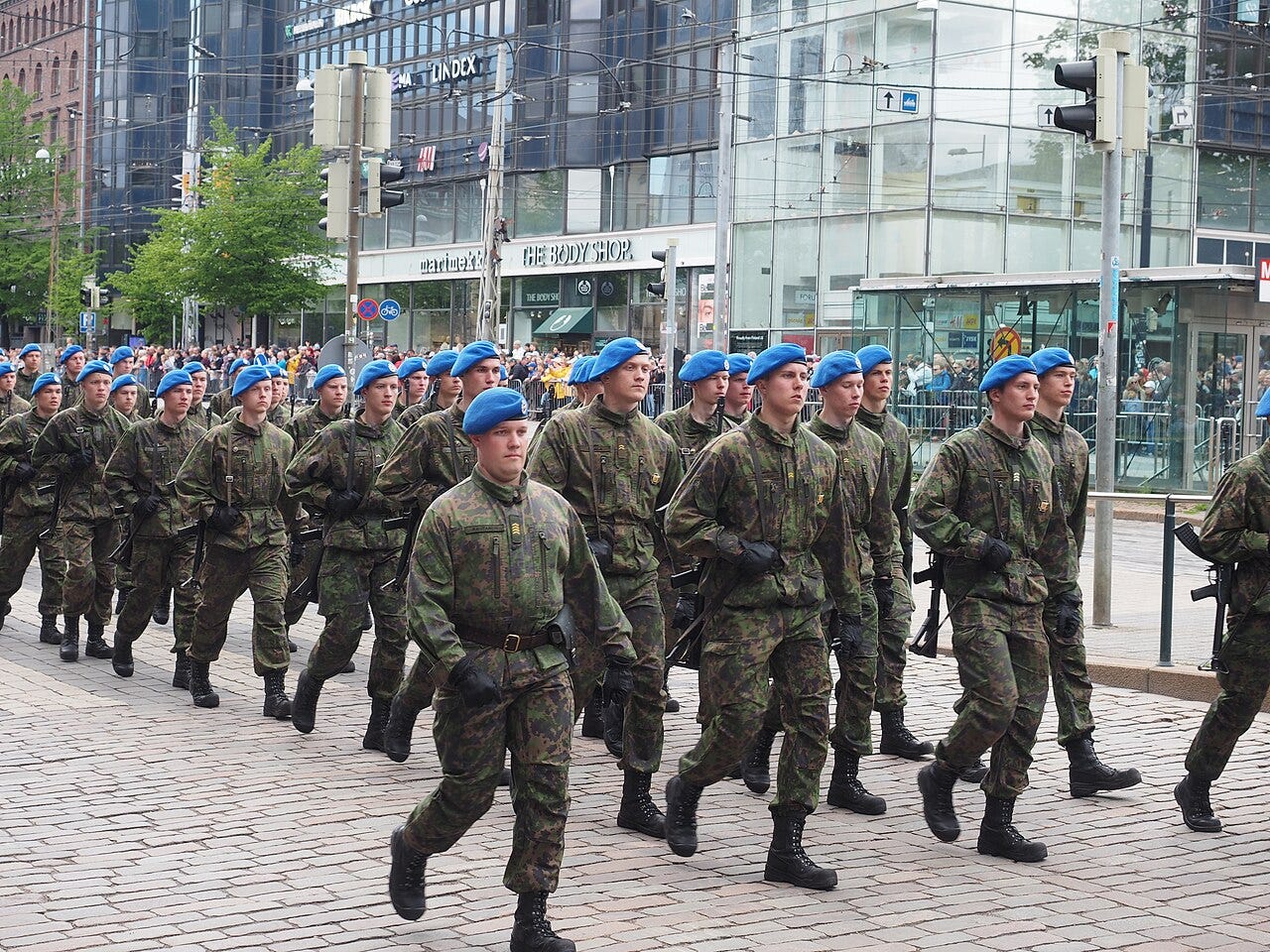
Soldiers with blue berets marching at Flag Day of Finnish Defence Forces 2022
The Hole America Leaves Behind
From Ramstein’s uncertain future to Brussels’ search for a “Nato plan B,” Europe is racing to replace the carriers, jets, and political leadership Washington is quietly withdrawing
Across Europe this summer, a single anxiety threads through boardrooms, defense ministries, and military training grounds alike: the United States is pulling back, and the continent is scrambling to figure out what comes next.
The signs are everywhere — from a centuries-old Finnish institution training its civilian elite for war, to Brussels technocrats sketching blueprints for a defense union that could function without Washington, to German towns bracing for the economic shock of American troop withdrawals, to NATO’s own secretary general insisting, almost too insistently, that the alliance still has teeth.
In Finland, the anxiety has a long history and a well-worn institutional response.
For 65 years, the country has run its National Defense Course, a program that pulls together bankers, generals, politicians, and museum directors and immerses them for three to four weeks in classified briefings, military drills, and simulated national emergencies.
Participants sleep in barracks, eat rations, and are sometimes flown in military aircraft escorted by fighter jets. The point is not military training in the conventional sense — most participants will never fire a weapon in anger — but something closer to civic preparation: teaching the people who will run banks, ministries, and media companies during a crisis how to think under pressure, with incomplete information and enormous stakes.
The program traces back to the Cold War, when Finland, sitting uneasily beside the Soviet Union, needed a way to prepare its elite for the possibility of confrontation between superpowers spilling onto its territory. In those early years, organizers were careful even in their language, referring only to a vague “green East” and “yellow West” rather than naming the Soviet Union directly, reflecting the country’s policy of strict non-alignment. That changed after the USSR collapsed in 1991 and Finland joined the European Union four years later. Briefings began naming nations explicitly, and the scope broadened from conventional military threats to hybrid warfare, including cyberattacks sponsored by states and acts of sabotage against undersea cables.
What was once a niche national curiosity has become something other governments are studying closely. Britain’s 2025 Strategic Defense Review pointed to the need for a comparable program, describing this kind of training as central to surviving in the current threat environment. Polish officials have asked for guidance on building something similar, and German President Frank-Walter Steinmeier requested a briefing on the Finnish model during a visit in May. Finnish President Alexander Stubb has embraced the attention, noting bluntly that other countries are coming to learn from Finland’s approach because the country understands it needs to be ready for the worst.
The centerpiece of the course is a large-scale crisis simulation, in which participants are split into groups representing institutions like the prime minister’s office, the foreign ministry, the defense ministry, and the finance ministry, and forced to negotiate wartime trade-offs together. Bank executives have described drawing directly on lessons from these simulations during real emergencies — one senior official at the Bank of Finland said the “crisis-planning mindset” instilled by the course shaped the central bank’s response during the early days of the COVID-19 pandemic, when authorities moved quickly to stabilize corporate funding as private markets froze. Before Russia’s annexation of Crimea in 2014, many graduates reportedly found the war-game scenarios somewhat exaggerated or implausible. That skepticism has evaporated since Russia’s full-scale invasion of Ukraine, as the line between rehearsed catastrophe and lived reality has blurred. In one striking case, an opposition party leader playing the role of prime minister in this year’s simulation was pulled out mid-exercise to take a real call about discussions in Brussels concerning Donald Trump’s interest in Greenland — the scenario and the headlines briefly merging into one.
Selection for the course is itself a study in elite signaling: candidates cannot apply, are proposed through a multi-stage process, and the surest way to be passed over is to be seen actively seeking an invitation. The roughly fifty-strong cohorts that emerge each cycle form tight, lasting networks, reinforced by reunions and a broader alumni association that hosts security-policy conferences with NATO officials and foreign military commanders. Women now make up around 40 percent of each class, and business executives roughly a third — a marked shift from earlier decades, reflecting how dependent the state has become on the private sector to keep critical infrastructure running during emergencies. There is even discussion of inviting social-media influencers into future cohorts, on the logic that younger generations no longer get their information from newspapers.
Confidence in this model of preparedness runs deep among ordinary Finns, a notable contrast to the skepticism and disunity visible elsewhere in Europe. Surveys suggest roughly 80 percent of the population expressed strong confidence in the country’s defense policy management last year, a degree of public trust that has allowed the program to expand its scope from traditional military planning to encompass nearly every sector — energy, finance, logistics, telecommunications — on the theory that a modern adversary will not confine an attack to the front line but will instead try to unravel an entire society at once.
That theory of “total defense” sits at the heart of a much larger debate now playing out in Brussels, where European officials are trying to work out what continental security looks like if the American security umbrella keeps folding inward. The EU’s first-ever defense commissioner, the former Lithuanian prime minister Andrius Kubilius, has emerged as one of the most outspoken voices arguing that Europe needs an entirely new decision-making structure — something he describes alternately as a European Defence Union or a European Security Council — to fill the gap left by a retreating United States.
The backdrop to this push is a steady drumbeat of warnings from Washington. The Pentagon has already withdrawn an aircraft carrier, support ships, refueling aircraft, and dozens of fighter jets from the pool of resources available to NATO’s European members, and U.S. Defense Secretary Pete Hegseth has told allies in Brussels to expect further reductions. For Kubilius, the challenge is not simply replacing the hardware the Americans are taking away but building what he calls institutional readiness — figuring out how Europeans organize themselves and act with more unity when no single power is automatically expected to lead.
His proposed European Security Council would notionally extend beyond the EU’s own membership, drawing in Britain, Norway, and eventually a fully integrated Ukraine, and would be anchored by the bloc’s largest military powers — the UK, France, Germany, Poland, Italy, and Spain — sitting as permanent members, with smaller states rotating through additional seats in a structure modeled loosely on the UN Security Council. Whether this new body would require its own military headquarters, separate from NATO’s existing infrastructure, is already a point of disagreement among European officials; Kubilius himself has suggested the more realistic path is a more thoroughly “Europeanized” version of NATO’s existing headquarters rather than building something from scratch.
Not everyone agrees that new institutions are even the right answer. Norway’s foreign minister, Espen Barth Eide, has pushed back against the idea that regional groupings should distract from NATO itself, arguing instead that existing frameworks — the UK-led Joint Expeditionary Force, the Nordic-Baltic Eight, the so-called Bucharest Nine — should be used to thicken European cooperation inside NATO rather than as substitutes for it. He has framed Europe’s renewed defense spending not as an effort to free the continent from American involvement but as a way of making European partners more relevant and useful to Washington, particularly by investing in the unglamorous “enablers” — satellite intelligence, heavy-lift aircraft, command-and-control systems — that the United States currently provides almost by default.
Underlying all of this is a legal question that has taken on new urgency: what, exactly, can the EU’s own mutual-defense clause actually guarantee. Article 42.7 of the EU treaties obliges member states to assist a fellow member facing armed aggression, and some officials — including Germany’s chancellor — have floated extending it as a security guarantee for a postwar Ukraine awaiting full EU membership. But the clause has only been invoked once, by France after the 2015 Paris terror attacks, and mostly to request help with redeploying troops rather than anything resembling collective military defense. Former NATO leadership and Swedish officials who were involved in that country’s own accession process have been blunt that the EU clause is considerably weaker than NATO’s Article 5 and was never designed, nor capable, of substituting for it. The general consensus seems to be that Sweden would not have bothered joining NATO at all if Article 42.7 had offered anything close to equivalent protection.
Behind the institutional wrangling is a more basic industrial problem: even if Europe agreed tomorrow on a single chain of command, it still could not produce enough weapons to defend itself or sustain Ukraine at scale. More than four years into the war, European manufacturing has not expanded fast enough, and Kubilius has pointed to the contrast between Russian and European output of cruise missiles, suggesting Russia’s production last year ran into the thousands while Europe’s stayed in the low hundreds. He has urged European industry to take a lesson from Ukraine’s own wartime arms sector, which has prioritized fast, low-cost, “good enough” production over the kind of bespoke, expensive systems traditionally favored by national defense champions — pointing to Ukraine’s domestically produced long-range cruise missile as a model worth emulating.
Executives in the defense-startup world argue the old procurement model, built around lengthy negotiations between national militaries and a handful of established contractors that might take the better part of a decade to deliver a finished system, is no longer adequate. Smaller, newer firms working on faster timelines should be allowed to drive innovation, with established manufacturers brought in later to scale up production once a design proves itself, according to this view. Industry figures broadly agree they don’t set the pace of innovation themselves — that governments and the urgency of actual conflict do, and that Ukraine’s fight for survival has forced an unusually rapid pace of military innovation that European industry, accustomed to peacetime bureaucracy, has struggled to match. Even companies producing basic but essential materials, like one Swedish firm opening only the EU’s second factory for military-grade explosives, describe being slowed by permitting processes that have not adapted to the supposed wartime urgency political leaders keep invoking.
The deeper question hanging over all of this, as one senior European defense official put it, is less about hardware than about whether Russia would ever conclude that NATO is sufficiently disunited, or insufficiently backed by Washington, to make an attack on alliance territory seem like a viable gamble. Much of Europe’s defense planning at the moment is really an attempt to make sure that calculation never looks attractive to Moscow — which means demonstrating unity and capability even while internal European debates about command structures, legal guarantees, and industrial policy remain visibly unresolved.
NATO’s own leadership, for its part, has tried to project confidence rather than anxiety. Secretary General Mark Rutte, speaking in Washington ahead of next month’s summit in Ankara, said allies are set to announce tens of billions of dollars in new defense-related contracts at the gathering, alongside renewed commitments to the spending target — 5 percent of GDP by 2035 — that members agreed to last year. Rutte argued that the alliance is in the early stages of what he called a defense industrial revolution, one that would support hundreds of thousands of jobs while also addressing the fragmented, inefficient state of European defense manufacturing and the bureaucratic friction that has slowed similar efforts in Washington. He framed the summit’s overall message as a direct warning to Russian President Vladimir Putin, saying the Russian leader should understand that the alliance is prepared to act on, not merely announce, its commitments, and cautioning against any provocation. Ukrainian President Volodymyr Zelenskiy is expected to attend the summit as well, with NATO reaffirming its support for Kyiv more than four years into its war against Russian occupation forces, and Rutte stressing that the security of NATO members and Ukraine cannot be separated from one another.
That message of resolve, however, runs up against a much more granular and local set of anxieties in Germany, where American military bases have long been both a strategic asset and an economic lifeline for surrounding regions. Around 35,000 to 39,000 American troops are currently stationed at roughly twenty installations across the country, a presence rooted in the postwar occupation period and cemented during the Cold War, when West Germany became one of Washington’s most important strategic partners. Most of these bases sit in the south and southwest of the country, with Ramstein Air Base standing out as the most significant — both a logistics and personnel hub and the headquarters of U.S. Air Forces in Europe, as well as the transit point for wounded soldiers from conflicts in the Middle East, given its proximity to the largest American military hospital outside the United States. Other German installations serve as the backbone for U.S. and NATO strategy across Europe and Africa, including a major training center in Bavaria that hosts thousands of NATO troops annually, and an air base in Rhineland-Palatinate widely believed, though never officially confirmed, to be the last remaining site for American nuclear weapons on German soil.
The number of U.S. troops stationed in Germany has been declining for decades, but President Trump is now pushing for further reductions, a move that appears at least partly tied to friction with German Chancellor Friedrich Merz, who has criticized Washington for lacking a coherent strategy in its conflict with Iran. The prospect of further American drawdowns has unsettled many German regions that depend heavily on the bases economically: the United States spends billions of dollars annually maintaining them, more than 10,000 Germans are directly employed by the American military, and more than 70,000 jobs in total are estimated to depend on that presence in some way.
Taken together, these threads describe a continent caught between two unfinished processes.
One is institutional and slow-moving — the attempt, championed by figures like Kubilius, to design new European structures capable of decision-making and collective defense without assuming permanent American backing, set against skepticism from officials like Eide and Billström who doubt either the EU’s legal tools or its existing procurement model are up to the task.
The other is cultural and generational — the kind of quiet, long-term civic preparation Finland has spent six decades building through its National Defense Course, designed not to replace NATO or the United States but to ensure that a society’s leaders, across business, government, and the military, know how to function and cooperate the moment a crisis actually arrives.
NATO’s own leadership insists the alliance remains capable of swift, well-funded action, pointing to the upcoming Ankara summit as proof. Yet the steady erosion of the American presence in Germany, the unresolved debate over what a European-only defense structure would even look like, and the lagging pace of European arms production all suggest that the continent’s actual readiness still lags well behind its rhetoric.
Whether Europe can close that gap — institutionally, industrially, and psychologically — before its assumptions are tested may be the central question of this decade’s security politics, and it is one that figures from Brussels commissioners to Helsinki bank executives to small-town German mayors are all, in their own ways, now being forced to confront.
Sources and Further Readings
[embed]
메타데이터
- post_id
- 9fdb7436a332
- slug
- the-hole-america-leaves-behind-9fdb7436a332
- url
- https://medium.com/the-geopolitics-report/the-hole-america-leaves-behind-9fdb7436a332
- canonical_url
- https://medium.com/the-geopolitics-report/the-hole-america-leaves-behind-9fdb7436a332
- author_url
- https://medium.com/@jens_sorensen_geopol.
- status
- ok
- fetched_at
- 2026-07-09 05:26:43