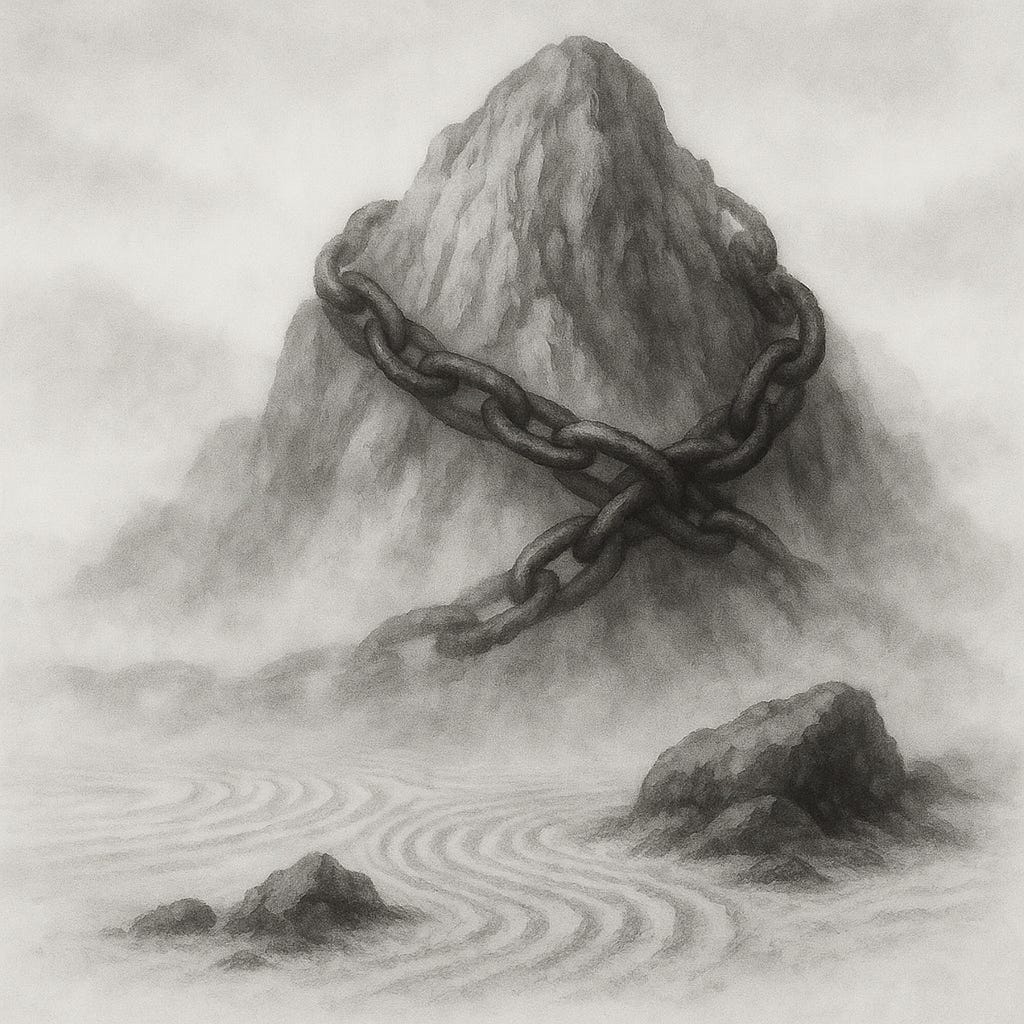
George Washington Warns Across the Centuries
The Platonic Strongman and the Soul of Democracy
George Washington Warns Across the Centuries
The Platonic Strongman and the Soul of Democracy

A Machine that Cannot Run of Itself
I. The Architect’s Warning: A Republic Built on Fear of Itself
The American Republic was not built on hope. It was built on a cold-eyed, historically literate study of failure.
The Founders were men of the Enlightenment, steeped in classical history, and they understood that republics die. They had read Polybius, Livy, and Thucydides. They knew Plato’s diagnosis in The Republic — that democracy carries within it the seed of its own destruction. Plato described, with clinical precision, how the democratic temperament — its love of freedom, its tolerance of license, its suspicion of authority — gradually erodes the discipline a republic requires. The democratic man becomes incapable of distinguishing liberty from license, and when the chaos that follows becomes intolerable, the exhausted people reach for a strongman. The tyrant does not seize power; he is handed it. He rises “as a champion of the people,” Plato wrote, and once he has “tasted blood,” he does not stop.[1]
This was the nightmare that haunted the Constitutional Convention of 1787 and echoes through The Federalist Papers. James Madison, who understood faction the way a physician understands infection, wrote in Federalist №10 that “the instability, injustice, and confusion introduced into the public councils” by faction have “in truth been the mortal diseases under which popular governments have everywhere perished.”[2] His prescription was structural: an extended republic whose competing interests would cancel one another out, where — as he wrote in Federalist №51 — “ambition must be made to counteract ambition.”[3] The machinery of checks and balances was designed not because the Founders trusted power, but precisely because they did not.
But even Madison knew that machinery requires operators who believe in the machine. And it was George Washington who, at the end of his public life, named the fuel the machine could not run without: public virtue.
Washington’s Farewell Address of 1796 is not a valedictory. It is a warning letter to a civilization he feared was already drifting toward self-destruction. On the question of national unity, he was almost desperate in his urgency:
The unity of government which constitutes you one people is also now dear to you. It is justly so, for it is a main pillar in the edifice of your real independence… it is of infinite moment that you should properly estimate the immense value of your national union to your collective and individual happiness; that you should cherish a cordial, habitual, and immovable attachment to it… watching for its preservation with jealous anxiety; discountenancing whatever may suggest even a suspicion that it can in any event be abandoned.[4]
His warning was not abstract. He had watched, from the center of the republic’s formation, the “spirit of party” take hold. And he named it plainly as an existential threat:
Let me now take a more comprehensive view, and warn you in the most solemn manner against the baneful effects of the spirit of party generally. This spirit, unfortunately, is inseparable from our nature, having its root in the strongest passions of the human mind… but, in those of the popular form, it is seen in its greatest rankness, and is truly their worst enemy.[4]
The mechanism of collapse he described tracks almost perfectly with Plato: faction produces disorder, disorder produces exhaustion, and exhaustion produces the tyrant.
The disorders and miseries which result gradually incline the minds of men to seek security and repose in the absolute power of an individual; and sooner or later the chief of some prevailing faction… turns this disposition to the purposes of his own elevation, on the ruins of public liberty.[4]
Then, in a phrase that deserves to be carved above every civic door in America, he named what stands between a free republic and this fate: not the courts, not the Congress, not the Constitution itself, but something prior to all of them. He called it unity, or “fraternal affection.” The spirit of party, he wrote, is “a fire not to be quenched” — it “demands a uniform vigilance to prevent its bursting into a flame, lest, instead of warming, it should consume.”[7]
Washington was not naive about human nature. He was not asking the people for sainthood. He was asking for enough — enough shared commitment to the idea of self-government, enough willingness to place country above faction, enough basic capacity for a common truth — to allow the institutional machinery to do its work. That minimal threshold of civic virtue, that tripwire of conscience, is what every subsequent crisis has either honored or abandoned.
II. The Liturgy of Union: Three Presidents at the Abyss
What Washington prescribed, his successors periodically performed. In the moments when the republic teetered most visibly, American presidents have reached back to what might be called a liturgy of union — a ritual invocation of the fraternal bond Washington said was the republic’s only real foundation.
Thomas Jefferson performed it first, and under the most improbable of circumstances. The election of 1800 was, by any measure, a catastrophe in the making: a bitterly contested outcome, Federalists certain that a Republican victory meant Jacobin revolution, Republicans equally convinced that Federalism was creeping monarchy. It was the first real test of whether power could change hands peacefully. Jefferson’s answer, in his First Inaugural Address, was to refuse the terms of the conflict:
…[E]very difference of opinion is not a difference of principle. We have called by different names brethren of the same principle. We are all Republicans, we are all Federalists.[5]
The genius of that sentence is not its accuracy — it was not literally true — but its aspiration. Jefferson was naming a principle he chose to make real by naming it: that beneath the factional strife lay a shared commitment to republican government itself. He was betting that the act of assertion could conjure the unity it described.
Abraham Lincoln made the same bet, under infinitely grimmer conditions, in March of 1861. Seven states had already seceded. The Confederacy was being organized. Fort Sumter would fall in five weeks. And Lincoln stood at the Capitol and spoke — with full knowledge that he was almost certainly too late — directly to the secessionists themselves, and to every Southerner who had not yet made up their mind, and to a Northern public that needed to understand what was actually at stake:
We are not enemies, but friends. We must not be enemies. Though passion may have strained it must not break our bonds of affection. The mystic chords of memory, stretching from every battlefield and patriot grave to every living heart and hearthstone all over this broad land, will yet swell the chorus of the Union, when again touched, as surely they will be, by the better angels of our nature.[6]
The appeal failed. Four years of catastrophic war followed. But Lincoln’s Second Inaugural — delivered after those four years had consumed 600,000 lives — shows him returning to the same moral posture, without bitterness and without triumphalism. Both sides, he said, had deprecated war. One would make war rather than let the nation survive; the other would accept war rather than let it perish. And the war came. The liturgy of union, in Lincoln’s hands, was never naïve optimism. He performed it knowing it might not work, because the attempt itself was a civic and moral obligation regardless of outcome. That is what makes it liturgy rather than mere rhetoric.
A century later, Ronald Reagan inherited a nation demoralized by stagflation, the Iran hostage crisis, and a decade of institutional betrayal that I will address shortly. He understood the liturgy and performed it with genuine feeling. His First Inaugural offered not policy but dignity — a reminder to ordinary Americans that they were the heroes of the national story:
How can we love our country and not love our countrymen; and loving them, reach out a hand when they fall, heal them when they’re sick, and provide opportunity to make them self-sufficient so they will be equal in fact and not just in theory?[7]
That question is the liturgy in its purest form. It is Washington’s “fraternal affection” translated into the idiom of the twentieth century. Whatever one thinks of what followed Reagan’s inauguration, the question itself remains unanswerable — and it has not been asked, in anything resembling good faith, from the steps of the Capitol in some time.
III. The Decade That Broke the Republic’s Heart
To understand why the institutional safeguards held in the 1970s — and why they are failing in our own time — one must understand what the 1960s did to the American civic imagination.
The decade began with a kind of redemptive possibility. A young president promised a “New Frontier.” The Civil Rights Movement, through extraordinary moral courage and strategic genius, was forcing the nation to confront the monstrous contradiction at its heart: that a republic founded on the proposition that all men are created equal had institutionalized the subjugation of an entire race of its citizens for nearly two centuries. The movement’s greatest leaders — King above all — framed their struggle not as a rejection of the American promise but as its fulfillment, demanding that the republic make good on its founding documents.
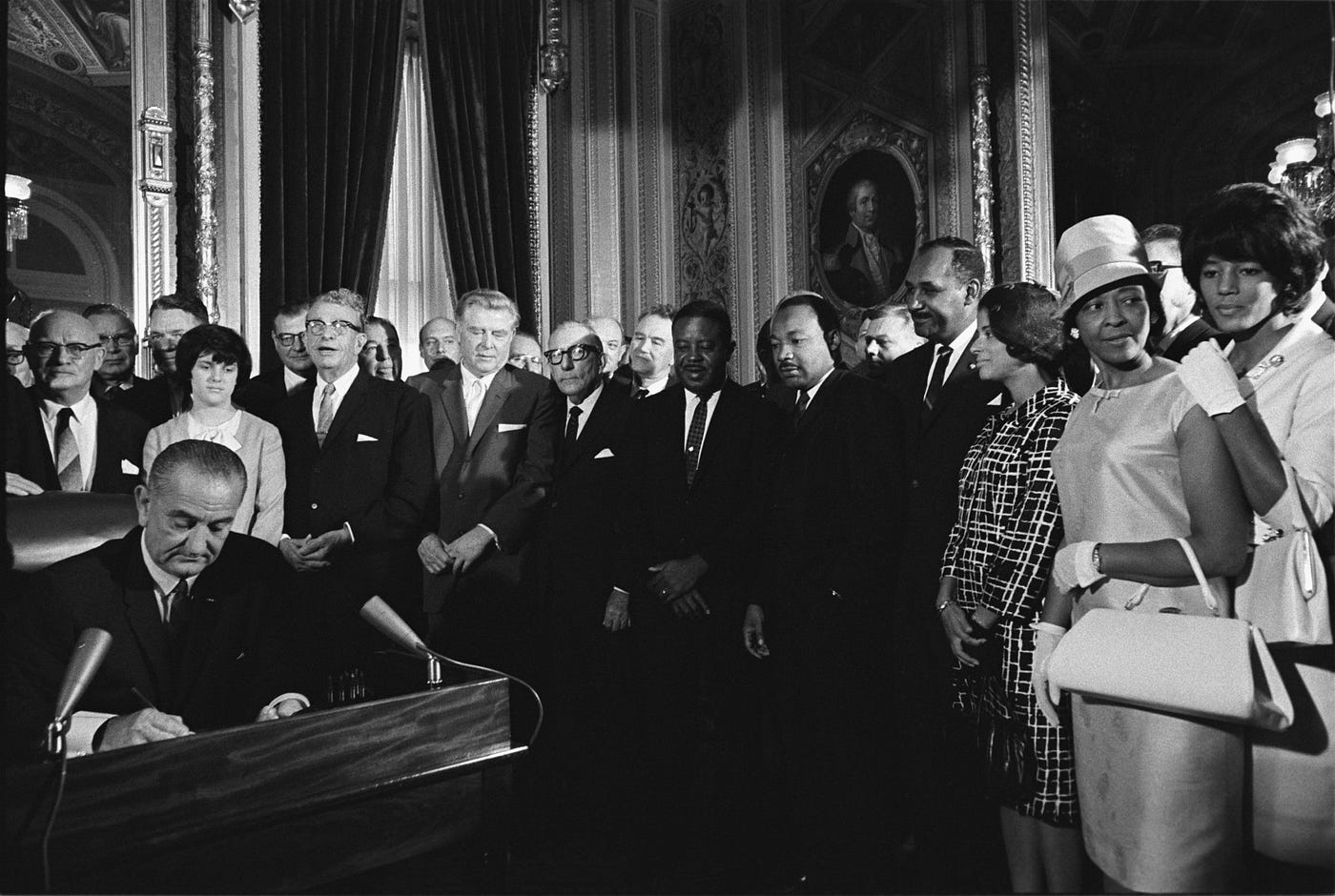
What followed was a decade-long assault on the public’s capacity to believe in its institutions. The assassinations were not merely tragedies; they were civic catastrophes. John Kennedy in 1963. Malcolm X in 1965. Martin Luther King in April 1968. Robert Kennedy in June 1968. Each death removed a node of meaning, a focal point around which a politics of aspiration might have organized itself. The murder of King — four days after President Johnson signed the Fair Housing Act, in a city where King had gone to support striking sanitation workers — produced the most widespread urban uprising in American history, with over a hundred cities burning. The murder of Kennedy came while he was winning the California primary, the last moment at which it seemed possible that the Democratic Party might nominate someone capable of ending the war in Vietnam.
The war. No single institution did more damage to the American civic faith than the United States government’s conduct of the Vietnam War. By the time of the Tet Offensive in January 1968, the Johnson administration had spent years assuring the American public that the war was being won — that the light at the end of the tunnel was genuine, that the body counts were meaningful, that the enemy was on the run. Tet, in which Viet Cong and North Vietnamese forces launched coordinated surprise attacks on more than a hundred South Vietnamese cities and towns, including the U.S. Embassy compound in Saigon, destroyed that narrative in a single news cycle. It did not matter that the offensive was, in strictly military terms, a catastrophic failure for the attackers — that the Viet Cong was effectively broken as a fighting force in its aftermath. The government had spent so many years manufacturing optimism that it had exhausted its own credibility. The images of fighting inside the Embassy compound were enough. Walter Cronkite, the most trusted man in America, flew to Vietnam and returned to tell his audience that the war was a stalemate and that the United States was “mired” in it.[8] Lyndon Johnson watched Cronkite’s broadcast and reportedly told an aide, “If I’ve lost Cronkite, I’ve lost Middle America.” He declined to seek re-election the following month.
What Tet made visible — the systematic dishonesty of official Vietnam policy — was confirmed and deepened by the Pentagon Papers, the classified Defense Department study leaked by Daniel Ellsberg and published by the New York Times and Washington Post in 1971. The papers revealed that successive administrations, from Truman through Johnson, had consistently misled the Congress and the American public about the origins, scope, and prospects of the war. This was not partisan spin or reasonable disagreement about intelligence assessments. This was sustained, deliberate deception of the sovereign people by their elected government about a war in which nearly 60,000 Americans and millions of Vietnamese would die.
The combination — assassinations, urban uprisings, the revelation of systematic governmental dishonesty — produced what might be called a structural cynicism in the American public. Institutions were revealed to be not merely fallible but actively corrupt. The distance between what America claimed to be and what it demonstrably was had become a chasm. And into that chasm stepped Richard Nixon.
IV. The Strongman and the Wages of Exhaustion
Nixon’s political genius lay in his understanding of what Washington had predicted: that when “the disorders and miseries” of democratic tumult become intolerable, people begin to “seek security and repose in the absolute power of an individual.” Nixon did not promise freedom. He promised order. His 1968 campaign, aimed squarely at what he called the “Silent Majority,” was explicitly a response to the chaos of the decade: the riots, the protests, the assassinations, the sense that the social fabric was unraveling. “Law and order” was not merely a policy preference; it was a psychological offer to an exhausted public. He was, in Plato’s precise terminology, presenting himself as the champion of the people against the disorder the people could no longer bear.
What the exhausted public did not know — what would only emerge years later — was that Nixon had already, before taking the oath of office, committed an act of treason against the republic he was about to govern.
In the autumn of 1968, the Johnson administration was negotiating a potential breakthrough in the Paris peace talks that might have ended the Vietnam War before the election — and very probably handed the presidency to Hubert Humphrey. Nixon’s campaign, through an intermediary named Anna Chennault, secretly contacted South Vietnamese President Nguyen Van Thieu and encouraged him to boycott the talks, promising a better deal under a Nixon administration.[9] Thieu complied. The talks collapsed. Nixon won by less than one percentage point of the popular vote. Tens of thousands of Americans and an uncounted number of Vietnamese would die in the years that followed before the war finally ended — on essentially the same terms that might have been available in 1968.
Lyndon Johnson knew about the Chennault Affair in real time. FBI surveillance and NSA intercepts made the outlines clear. He called it “treason” in private conversations.[10] He did not go public, in part because doing so would have required revealing classified intelligence methods, in part because he feared what it might do to the country. That silence was, in retrospect, its own kind of institutional failure — a decision to protect the republic’s surface calm at the cost of the truth that might have protected it more deeply.
Once in office, Nixon governed according to his conviction — stated openly to his counsel John Dean — that “if the President does it, that means it is not illegal.”[11] He ordered warrantless wiretaps on journalists and his own staff. He created the “Plumbers” unit to suppress leaks through illegal means. He used the CIA, FBI, and IRS as instruments of personal and political vengeance. When the Watergate burglars were caught in June 1972 attempting to plant listening devices in Democratic National Committee headquarters, Nixon did not ask what had gone wrong. He asked how to manage the cover-up.
It should not be forgotten — and it is too often forgotten — that through most of this period, the Republican Party was largely complicit. Congressional Republicans defended Nixon, minimized the revelations, attacked the investigators, and treated the entire affair as a partisan witch hunt. The institutional safeguards — the Senate Select Committee, the special prosecutor, the courts — operated under constant political pressure and in the face of fierce partisan resistance. It was not until the “smoking gun” tape of June 23, 1972, was released in August 1974 — Nixon’s own recorded voice directing the CIA to obstruct the FBI’s Watergate investigation — that Republican support finally collapsed. Senator Barry Goldwater led a delegation to the White House to tell Nixon that he did not have the votes to survive an impeachment trial. Nixon resigned two days later.
The system had worked. But it had worked by the narrowest of margins, and only because two conditions were met simultaneously: there existed an undeniable, recorded, documented truth that could not be spun away, and there existed enough public virtue in the American people — a sufficient reservoir of civic outrage, shared across party lines — to make continued Republican protection of Nixon politically impossible. The public demanded accountability over tribal loyalty. The soul of the republic, however diminished by a decade of betrayal, still had enough life in it to force the machine to function.
V. Ex Nihilo: The Manufacture of Reality
What has changed since 1974 is not the law. The constitutional mechanisms remain. What has changed — what has been systematically and deliberately dismantled — is the civic precondition for those mechanisms to function: the shared informational ecosystem, the minimal common reality, without which “public virtue” becomes meaningless because it has no shared facts to respond to.
In the wake of Trump’s first election, trying to understand the alternate universe the American right had constructed for itself, I wrote the following:
The Democratic People’s Republic of Korea… maintains control through the ruthless manipulation of reality. From birth, North Korean citizens are subjected to an unyielding cycle of propaganda that strictly limits the information they receive… The distinction between these examples is notable. In North Korea, the population is conditioned through an unrelenting propaganda campaign, with no freedom to evaluate alternative viewpoints. Truth manipulation is unavoidable because of the total control the government exerts over information. In the United States, however, there is no such constraint. Despite the abundance of freely available information, individuals… have willingly cocooned themselves within a delusional reality, effectively creating their perceived reality ‘out of nothing.’[12]
This is the phenomenon I call Ex Nihilo: the manufacture of a private reality not by coercion but by choice. North Korea’s citizens are imprisoned in falsehood. A significant portion of the American citizenry has elected imprisonment, has migrated willingly into an information ecosystem designed to confirm what they already wish to believe, and has walled out any stimulus that might require revision.
The consequence for public virtue is catastrophic. Washington understood that the spirit of party could only be held in check by the force of public opinion — and public opinion requires a common truth to respond to. The “smoking gun” worked in 1974 because there was a shared informational world in which the tape meant the same thing to Republicans and Democrats alike — a world in which Walter Cronkite’s verdict carried authority across factional lines, in which the facts of the Pentagon Papers were not contested but only their legality in publication. That world no longer exists.
In its place we have what Orwell named, with terrible foresight, doublethink: the capacity to hold simultaneously two contradictory beliefs and to accept both as true. When the spirit of party has become absolute, the smoking gun does not exist. Every documented abuse becomes, for the true believer, either a fabrication, a necessary counter-stroke against hidden enemies, or — most chillingly — a virtue. Federal agents deployed against American citizens in their own cities are not a constitutional crisis; they are the restoration of order. The rule of law is not being violated; it is being defended against those who would pervert it. The strongman is not destroying the republic; he is saving it.
VI. The Strongman in Full
Donald Trump entered the presidency in 2017 performing precisely the inversion of the liturgy of union. Where Jefferson found brotherhood beneath partisan difference, Trump found carnage. Where Lincoln appealed to the better angels, Trump conjured enemies. Where Reagan asked how we could love our country without loving our countrymen, Trump made clear that “our countrymen” meant only those who had voted for him. His inaugural address — darkly, deliberately dystopian — described “American carnage” and offered the only possible solution: “I alone can fix it.”[13]
This is the tyrant’s formula, as Plato described it twenty-four centuries ago and Washington warned of two centuries ago. The champion of the people cannot present himself as the solution until he has first established that the crisis is total. Trump’s contribution to this ancient template was its application to the most powerful democracy in human history.
His first term was held in partial check by what might be called the residual institutional immune system: career officials, military leaders, and a handful of appointed staff who placed some limit on the most extreme impulses. Defense Secretary James Mattis resigned rather than implement a Syria withdrawal he believed would abandon American allies to slaughter. White House counsel Don McGahn refused to execute the order to fire Special Counsel Mueller.[14] These were not heroic acts of resistance; they were the ordinary functions of a governmental system in which the people operating it still believed in something beyond the immediate will of their principal. They were, in miniature, the public virtue that held.
The second term has provided no such check. Trump has surrounded himself with loyalist goons willing to debase themselves publicly in pursuit of his favor — men and women who have traded whatever institutional integrity they once possessed for proximity to power, serving a president who has no inclination to return their fealty and who will discard them the moment they cease to be useful. The results are visible.
Federal forces have been deployed against American citizens in their own cities — in Minneapolis, Portland, and Los Angeles — in operations whose legal basis was either tenuous or nonexistent and whose tactical objective appeared, in significant part, to be the demonstration of executive power itself. Military assets have been deployed in foreign engagements without the congressional authorization the Constitution requires, pursued under objectives that shift with the news cycle, calculated not to achieve coherent strategic ends but to generate the spectacle of decisiveness. The judiciary has been attacked as corrupt when it rules against the administration. The press is routinely designated as the “enemy of the people.” The language of internal enemies — of vermin, of infestation, of those who are “poisoning the blood” of the nation — has become ordinary presidential rhetoric.
And the response, from a significant portion of the American public and from the congressional party that once considered itself the guardian of constitutional conservatism?
A yawn.
VII. The Silence of the Alarms
Here is what should stop us cold: the alarms are sounding, and no one is responding — not because they cannot hear them, but because they have heard them so many times that the sound no longer means danger. It means annoyance. We have become a nation of car alarms. The mechanism still works. The signal is still accurate. But we have been so saturated with constitutional crises, each one genuine, each one met with the full apparatus of outrage and then absorbed and normalized, that we have lost the capacity to be arrested by any of them. The first time, you ran to the window. By the hundredth time, you turned up the television.
In 1974, the equivalent of what we are witnessing daily would have produced a bipartisan coalition in Congress that moved swiftly and with moral clarity. It produced exactly that, once the smoking gun made continued complicity politically impossible. The difference is not that Republicans in 1974 were more principled than Republicans today — the record shows they were not, until the very end. The difference is that in 1974, continued complicity became politically impossible because the public demanded accountability.
Today, no such demand exists at sufficient scale or sufficient cross-partisan breadth to trigger the institutional response. This is not because the abuses are less documented. They are, if anything, more thoroughly documented, more brazenly committed in public, and more explicitly defended as a matter of principle. The president does not even bother with the kind of elaborate cover-up that destroyed Nixon. He simply acts, declares that he has the Article II authority to do whatever he wants, and dares the institutions to stop him.[15]
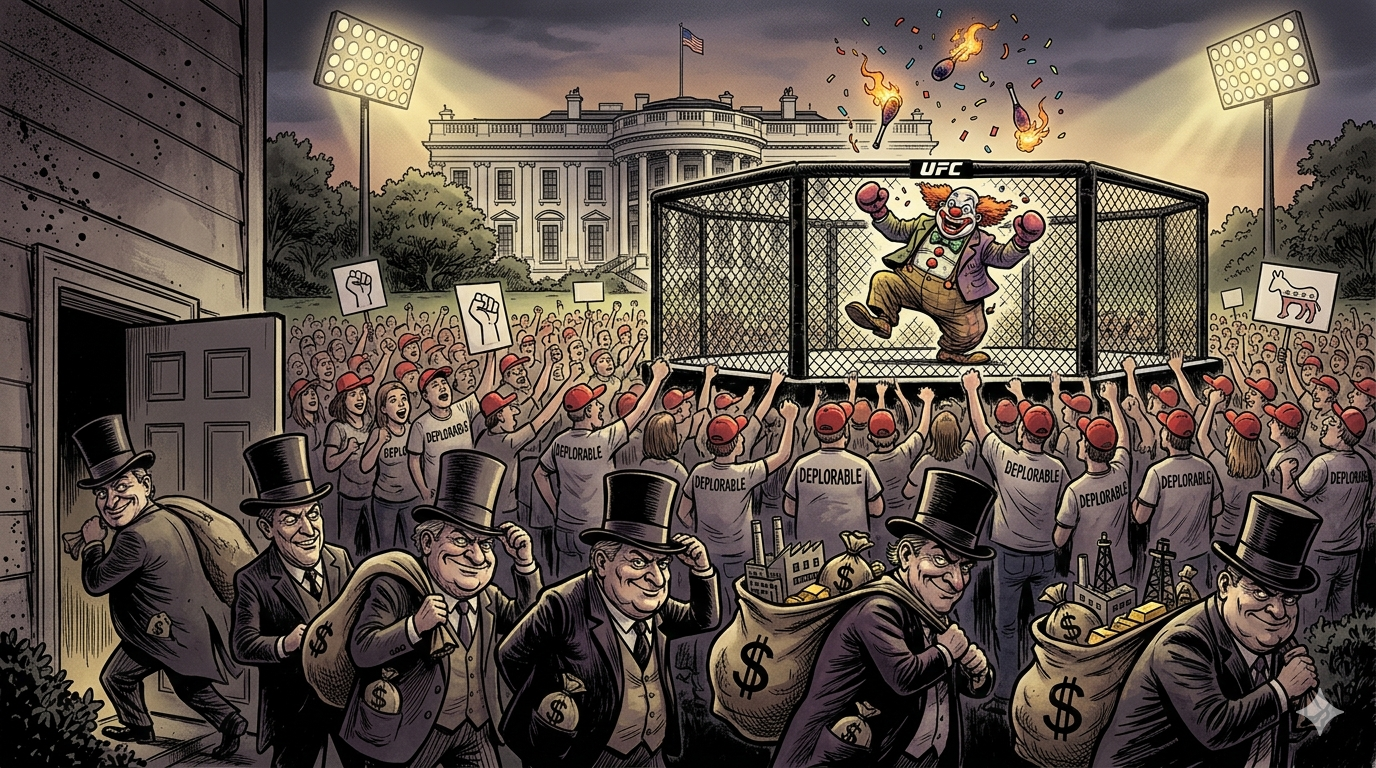
And the public — that significant portion of the public whose outrage is the precondition for institutional accountability — is not there. It has migrated into its Ex Nihilo reality, where what is seen is not an assault on constitutional governance but a long-overdue correction of a corrupt establishment, a righteous war against the “deep state,” a necessary force deployed against “internal enemies.” Washington’s “fraternal affection” is not merely absent; it has been replaced by its photographic negative — a fraternal hatred, carefully cultivated, in which the political opponent is not a fellow citizen with different views but a literal enemy of the nation whose defeat justifies any means.
The frustration of this moment — and I will not pretend to cool detachment here — is not that the institutions have failed us. The institutions are straining, bending, but have not yet broken. Federal judges are issuing orders. Some congressional members are raising their voices. Career officials are, at significant personal cost, speaking truth to power. The parchment barriers are holding, barely, because a minority of Americans with institutional positions are trying to make them hold.
The indictment falls on us — on the citizenry. Madison designed the machine to run on public virtue. Washington identified its necessity and warned what would happen without it. We have had two and a half centuries to cultivate it, to build the civic habits that would make it durable. And we have, in a remarkably short historical time, allowed it to be so thoroughly eroded that the strongman can operate in the open, can boast of the constitutional norms he is violating, can treat the republic’s founding documents as inconveniences to be dismissed — and be cheered for it.
We were given a republic. We are proving unable — no, worse, unwilling — to keep it.
VIII. Franklin’s Warning
Benjamin Franklin, emerging from the Constitutional Convention in September 1787, was reportedly asked by a woman on the street what sort of government the delegates had created. His answer has never stopped being relevant: “A republic, madam — if you can keep it.”[16]
The condition Franklin named was not institutional. It was moral. A republic is not a self-sustaining mechanism; it is a set of arrangements that requires continuous active maintenance by a citizenry capable of placing the common good above factional advantage. When that capacity atrophies — when the “spirit of party” that Washington feared becomes so absolute that half the population inhabits a manufactured reality in which no common truth can penetrate, no common outrage can be summoned, no common accountability can be demanded — the republic does not fall all at once. It does not require a coup or a collapse. It simply becomes a republic in name only, a shell of constitutional forms inhabited by a factional power that has learned to use those forms to entrench itself.
Franklin left us another warning, less often quoted but equally urgent. He is reported to have said that “those who would give up essential liberty to purchase a little temporary safety deserve neither liberty nor safety.”[17]
We are making that trade. We are making it not at gunpoint — no one is forcing the exchange — but willingly, eagerly, for the promise of security against neighbors we have been taught to fear, for the comfort of a leader who promises to punish our enemies, for the repose that Washington predicted an exhausted people would seek.
The mystic chords of memory can still be heard. But the chords set in a beautiful yet fragile arrangement have become a cacophony. They are being struck discordantly, one against another, until the chorus of the Union dissolves into noise — not by a tyrant’s hand, but by our own, banging mindlessly against the instrument.
Notes
[1] Plato, The Republic, Book VIII, trans. Benjamin Jowett. The classic account of anacyclosis and the democratic-to-tyrannical transition.
[2] James Madison, Federalist №10, November 22, 1787. The Avalon Project, Yale Law School.
[3] James Madison, Federalist №51, February 8, 1788. The Avalon Project, Yale Law School.
[4] George Washington, “Farewell Address,” September 19, 1796. George Washington’s Mount Vernon.
[5] Thomas Jefferson, “First Inaugural Address,” March 4, 1801. The Avalon Project, Yale Law School.
[6] Abraham Lincoln, “First Inaugural Address,” March 4, 1861. The Avalon Project, Yale Law School.
[7] Ronald Reagan, “Inaugural Address,” January 20, 1981. The American Presidency Project, University of California, Santa Barbara.
[8] Walter Cronkite, “Report from Vietnam,” CBS Evening News, February 27, 1968. The footage and transcript are widely available in broadcast archives.
[9] For the documentary record of the Chennault Affair, see John A. Farrell, Richard Nixon: The Life (New York: Doubleday, 2017), and the declassified LBJ administration files. The FBI surveillance records were confirmed by historians using materials released under FOIA.
[10] President Johnson’s recorded telephone calls from October 1968, now available at the Miller Center, University of Virginia Presidential Recordings Program.
[11] David Frost, I Gave Them a Sword: Behind the Scenes of the Nixon Interviews (New York: William Morrow, 1978). Nixon’s statement that “if the President does it, that means it is not illegal” was made during the 1977 Frost-Nixon interviews.
[12] Keith Cox, “Ex Nihilo: Manufactured Realities and American Unreason,” Unpublished.
[13] Donald Trump, “Inaugural Address,” January 20, 2017. The American Presidency Project, University of California, Santa Barbara.
[14] Robert Mueller, Report On The Investigation Into Russian Interference In The 2016 Presidential Election, Vol. II (Washington: U.S. Department of Justice, 2019), pp. 90–92.
[15] Trump stated variations on this claim — that Article II of the Constitution gives him “the right to do whatever I want” — on multiple public occasions, including at a July 2019 event at the Turning Point USA Teen Student Action Summit. The assertion has since become a recurring theme of his second administration.
[16] The remark is traditionally attributed to a Mrs. Elizabeth Willing Powel, and appears in the papers of James McHenry, a Maryland delegate to the Convention.
[17] The precise wording is disputed; the statement appears in a 1755 letter from the Pennsylvania Assembly to the Governor. The meaning, in context, has been somewhat distorted by common usage, but the core principle holds.
메타데이터
- post_id
- a005bd17b358
- slug
- george-washington-warns-across-the-centuries-a005bd17b358
- url
- https://medium.com/dispatches-from-exile/george-washington-warns-across-the-centuries-a005bd17b358
- canonical_url
- https://medium.com/dispatches-from-exile/george-washington-warns-across-the-centuries-a005bd17b358
- author_url
- https://medium.com/@cosmicgilligan
- status
- ok
- fetched_at
- 2026-06-14 16:15:44