Cloud Consulting Company vs In-House Team: Which Is Better for Growth?
Cloud decisions rarely stay technical for long.
Cloud Consulting Company vs In-House Team: Which Is Better for Growth?

Cloud Consulting Company vs In-House Team
Cloud decisions rarely stay technical for long.
At first, it may look like an infrastructure upgrade or an IT modernization effort. But for mid-market companies and enterprise businesses, cloud strategy quickly becomes tied to something much bigger: growth.
The way a company builds cloud capabilities affects how fast products launch, how efficiently teams operate, how secure systems remain, and how quickly the business can expand into new markets.
This creates an important leadership decision:
Should you hire a cloud consulting company or build an internal cloud team?
There is no one-size-fits-all answer.
Some organizations benefit from the speed and specialized expertise that cloud consulting partners bring. Others gain more value from developing in-house capabilities for long-term ownership and operational control.
The challenge is that many founders and executives evaluate this decision too narrowly. They compare hourly costs, headcount, or project budgets while missing the larger business impact.
The real question is not simply:
“Which option costs less?”
It is:
“Which option helps us grow faster, reduce execution risk, and build a stronger technical foundation?”
In this guide, we’ll break down the real advantages, limitations, and growth implications of both models so leadership teams can make a smarter long-term decision.
Understanding the Two Models Before Comparing Them
Before evaluating what works best for growth, it is important to understand what each operating model actually looks like in practice.
Many executives compare a cloud consulting company and an in-house team as if they deliver the same outcomes in the same way. In reality, the structure, expertise, and speed of execution can be very different.
What Is a Cloud Consulting Company?
A cloud consulting company helps businesses plan, implement, optimize, and manage cloud infrastructure without requiring the organization to build every capability internally.
Depending on business goals, consulting firms may support:
- Cloud migration planning
- Infrastructure architecture
- Security and compliance frameworks
- Cost optimization initiatives
- DevOps automation
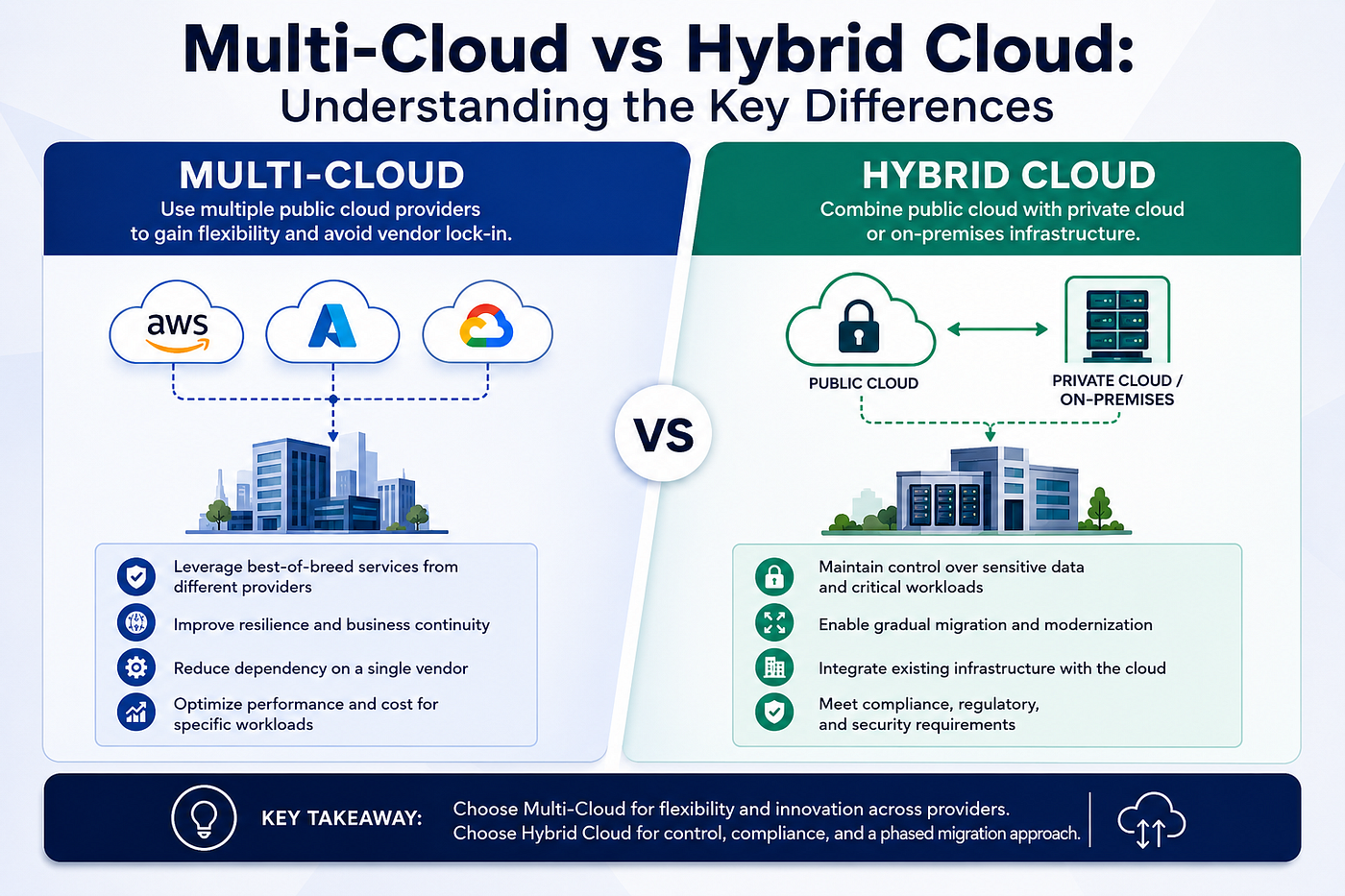
- Multi-cloud or hybrid-cloud strategies
- Ongoing managed cloud operations
Most companies work with cloud consultants in one of several ways:
Project-based engagement for migration or modernization initiatives.
Strategic advisory partnerships for long-term cloud transformation.
Staff augmentation to temporarily extend engineering capacity.
Managed services models where external teams oversee cloud environments continuously.
For organizations moving quickly, this model often provides immediate access to experienced specialists without long recruitment cycles.
What Does an In-House Cloud Team Look Like?
An internal cloud team operates as part of the company’s own engineering or infrastructure department.
Depending on company size, this may include:
- Cloud architects
- DevOps engineers
- Security specialists
- Infrastructure engineers
- Platform engineering teams
- Site reliability engineers (SREs)
In larger organizations, cloud capabilities are often centralized through a dedicated Cloud Center of Excellence (CCoE) or distributed across engineering teams.
The biggest advantage of internal teams is familiarity.
They understand internal systems, product priorities, technical debt, operational constraints, and company culture in ways external partners may initially lack.
However, building this expertise internally often requires significant investment in hiring, onboarding, training, and retention.
And in today’s market, experienced cloud talent is not always easy to hire.
The Real Growth Question: Speed, Efficiency, or Long-Term Control?
Many businesses frame this decision as an operational choice.
It is actually a growth strategy decision.
Every company scaling through digital products, global expansion, data systems, or customer-facing platforms eventually reaches a point where cloud maturity directly influences business performance.
The key question becomes:
What kind of growth challenge are you solving?
Growth Often Depends on Speed
For many mid-market and enterprise organizations, speed creates competitive advantage.
Launching products faster, improving internal systems quickly, and modernizing infrastructure sooner can directly influence revenue growth.
Cloud capabilities impact:
- Faster product deployment
- Better application performance
- Faster geographic expansion
- Improved customer experiences
- More scalable operations
This is one reason many organizations bring in cloud consulting expertise during critical transitions.
Waiting six to twelve months to build an internal team can slow momentum when execution timelines matter.
But Growth Also Requires Stability
Speed alone is not enough.
Poor cloud decisions often create expensive operational problems later.
Common issues include:
- Overengineered infrastructure
- Uncontrolled cloud spending
- Security vulnerabilities
- Vendor lock-in challenges
- Technical debt accumulation
A rushed migration or poorly planned architecture can eventually slow innovation rather than support it.
This is why the better option depends heavily on business maturity, technical readiness, and growth priorities — not simply preference.
When a Cloud Consulting Company Makes More Strategic Sense
A cloud consulting company is not automatically the better choice.
But in certain business situations, external expertise can create a measurable growth advantage.
This is especially true when speed, specialized knowledge, or execution certainty matter more than long-term internal ownership.
Faster Access to Specialized Expertise
One of the biggest advantages of working with a cloud consulting company is immediate access to highly specialized skills.
Most consulting partners already have teams that include:
- Certified cloud architects
- Migration specialists
- DevOps engineers
- Security and compliance professionals
- Cost optimization experts
- Multi-cloud specialists
Building this capability internally takes time.
Recruiting experienced cloud talent is increasingly competitive, and enterprise-grade expertise is rarely available overnight.
For leadership teams trying to modernize infrastructure or accelerate digital transformation, waiting months to assemble the perfect internal team can become an expensive delay.
A consulting partner can often shorten that timeline dramatically.
Faster Time-to-Market
For growing companies, execution speed matters.
Whether launching a new product, entering new markets, modernizing legacy infrastructure, or scaling operations, delays have real business consequences.
Cloud consulting companies often accelerate:
- Infrastructure deployment
- Cloud migration initiatives
- CI/CD pipeline implementation
- Automation processes
- Environment standardization
Instead of building frameworks from scratch, consultants typically rely on proven implementation patterns developed across multiple industries and projects.
That experience can reduce unnecessary trial and error.
For founders and executives, this often translates into something highly valuable:
Faster business execution with fewer technical bottlenecks.
Lower Execution Risk During Complex Projects
Cloud transformation projects rarely fail because of ambition.
They fail because of execution mistakes.
Complex migrations can introduce:
- Downtime risks
- Security gaps
- Compliance failures
- Budget overruns
- Architecture inefficiencies
This becomes even more important for organizations dealing with:
- Legacy systems
- Regulated environments
- Enterprise-scale infrastructure
- Multi-region expansion
- Hybrid-cloud environments
Experienced cloud consultants have often seen these problems before.
They know where projects commonly fail, which architectural shortcuts create future problems, and how to avoid expensive rework.
For CEOs evaluating risk exposure, this expertise can be more valuable than reducing short-term implementation costs.
More Predictable Costs Compared to Scaling an Internal Team
Many organizations assume in-house teams are always less expensive.
In reality, the financial picture is more complex.
Internal cloud teams require:
- Recruiting costs
- Competitive salaries
- Benefits and overhead
- Training investments
- Retention expenses
- Leadership management time
The hidden cost is often underestimated.
A senior cloud architect, DevOps engineer, and security specialist can significantly increase payroll obligations before implementation even begins.
By comparison, consulting engagements usually operate with clearer scopes, timelines, and budget expectations.
That predictability helps finance and leadership teams plan investments more effectively.
An External Perspective Often Improves Decision-Making
Internal teams sometimes become too close to existing systems.
Over time, inefficient workflows, outdated infrastructure, or technical shortcuts can feel normal.
Cloud consulting companies bring outside perspective.
Because they work across industries and architectures, they can often identify:
- Infrastructure inefficiencies
- Cost-saving opportunities
- Security blind spots
- Scalability limitations
- Better implementation models
Sometimes the biggest value is not execution.
It is helping leadership teams avoid making expensive architectural decisions too early.
The Potential Drawbacks of a Cloud Consulting Company
External expertise is valuable, but it also comes with trade-offs.
Some organizations experience challenges such as:
Reduced internal ownership
Heavy dependence on external teams can weaken internal technical understanding.
Knowledge transfer gaps
If documentation and onboarding are weak, expertise may leave when the engagement ends.
Partner dependency risks
Choosing the wrong consulting company can lead to poor communication, delayed execution, or overly rigid recommendations.
This is why partner selection matters.
If you’re evaluating vendors, understanding **how to choose the right cloud consulting company** becomes just as important as deciding whether to outsource in the first place. Experience with migrations, cloud certifications, governance capabilities, industry expertise, and transparent operating models all influence outcomes. We covered this topic in more depth in one of our related cloud strategy resources for leadership teams evaluating service partners.
Still, external support is not always the right answer.
For some organizations, building internal cloud capabilities creates stronger long-term advantages.
When an In-House Team May Be the Better Investment
In-house cloud teams often make the most sense when cloud infrastructure becomes a long-term competitive capability rather than a short-term implementation need.
For some businesses, ownership matters more than speed.
Stronger Institutional Knowledge
Internal teams understand the business in ways external consultants often need time to learn.
They already know:
- Product priorities
- Existing systems
- Internal dependencies
- Organizational workflows
- Engineering constraints
This familiarity becomes increasingly valuable as infrastructure grows more complex.
At enterprise scale, small architectural decisions can have long-term consequences.
Internal teams are often better positioned to align cloud strategy with broader business goals.
Greater Day-to-Day Operational Control
An in-house team gives organizations direct control over priorities and execution.
Leadership teams can shift focus quickly without depending on consulting timelines or contract structures.
This often results in:
- Faster internal communication
- Better alignment with product teams
- Stronger engineering collaboration
- More ownership over technical direction
For organizations with large engineering functions, this flexibility can become a meaningful advantage.
Better Fit for Continuous Cloud Innovation
Some businesses rely on cloud capabilities as a core part of their competitive advantage.
This is especially common among:
- SaaS businesses
- Platform companies
- Data-driven organizations
- High-scale technology firms
When cloud architecture directly affects product performance, customer experience, or innovation cycles, internal expertise often becomes strategically important.
In these cases, cloud operations are not simply infrastructure decisions.
They are product decisions.
Security and Governance Preferences
Certain industries prefer internal ownership due to compliance or governance requirements.
This may include businesses operating in:
- Financial services
- Healthcare
- Government-adjacent sectors
Internal teams may provide tighter control over access, governance, auditing, and operational policies.
However, stronger control does not automatically mean lower risk.
Execution quality still matters.
The Hidden Challenges of Building In-House
While internal ownership sounds attractive, scaling an internal cloud function comes with real challenges.
Common obstacles include:
- Slow hiring cycles
- Talent shortages
- High compensation expectations
- Retention difficulties
- Increased operational overhead
Many executives underestimate how difficult it can be to attract experienced cloud engineers in competitive markets.
The result?
Transformation timelines often move slower than expected.
And in fast-moving industries, delayed execution can quietly become a growth problem.
The Hidden Costs Most CEOs Miss in This Decision
Most cloud decisions look straightforward in spreadsheets.
Leadership teams compare consulting fees against salary costs and assume the cheaper number wins.
But the real business impact often sits in hidden costs that are harder to measure.
And these overlooked factors frequently determine whether cloud investments accelerate growth — or slow it down.
The Cost of Delayed Hiring
Building an internal cloud team sounds logical until hiring realities set in.
Experienced cloud architects, DevOps specialists, and platform engineers are in high demand.
Recruitment alone can take months.
Then comes onboarding, system familiarization, and internal ramp-up time.
For organizations facing urgent modernization goals, this delay can create measurable business consequences:
- Slower product delivery
- Delayed market expansion
- Reduced engineering velocity
- Postponed digital transformation goals
In fast-growth environments, waiting too long often becomes more expensive than the consulting investment itself.
The Cost of Cloud Mistakes
Poor cloud decisions rarely fail immediately.
They become expensive over time.
A weak architecture choice today may quietly increase costs for years.
Common examples include:
- Overprovisioned infrastructure that inflates cloud spending
- Weak governance policies that create security exposure
- Poor workload distribution that limits scalability
- Vendor lock-in that reduces future flexibility
These mistakes are especially expensive at enterprise scale.
Fixing cloud problems after implementation is usually harder — and significantly more expensive — than getting them right at the beginning.
The Hidden Engineering Burnout Problem
Many companies underestimate the operational burden cloud projects place on internal engineering teams.
When product engineers suddenly become responsible for infrastructure modernization, priorities begin competing.
Teams often find themselves balancing:
- Product releases
- Customer demands
- Infrastructure work
- Security updates
- Reliability improvements
Over time, this creates friction.
Engineering velocity slows.
Innovation suffers.
And retention challenges sometimes follow.
For organizations already operating with lean technical teams, cloud consulting support can help reduce this pressure.
Cloud Consulting Company vs In-House Team: Which One Scales Better?
There is no universal winner.
The better option depends on the type of growth a company is pursuing.
Still, a few clear patterns emerge.
If Speed to Execution Matters Most
Cloud consulting companies usually have the advantage.
They already have frameworks, specialists, and implementation experience in place.
For businesses facing aggressive growth goals, faster execution often creates meaningful business value.
If Long-Term Internal Ownership Matters Most
Internal teams typically perform better.
Organizations gain stronger institutional knowledge and tighter alignment between cloud systems and business strategy.
This becomes especially valuable when cloud infrastructure directly supports product innovation.
If Cost Predictability Matters Most
Consulting engagements often offer clearer budgeting upfront.
Internal teams, while potentially valuable long term, introduce recruiting costs, compensation expenses, retention risks, and ongoing management overhead.
If Technical Flexibility Matters Most
The answer depends on maturity.
Experienced internal teams may move faster once established.
However, consulting firms often provide broader expertise across multiple cloud environments and architectures.
If Scalability Is the Goal
Many businesses discover the answer is not choosing one side.
It is combining both.
The Hybrid Model: Why Many Growth-Focused Companies Combine Both
For many mid-market and enterprise businesses, the strongest approach is neither fully outsourced nor fully internal.
It is hybrid.
In this model:
Cloud consultants handle specialized execution
Such as:
- Cloud migration
- Infrastructure design
- Security frameworks
- Automation systems
- Governance implementation
Meanwhile, internal teams maintain ownership
By focusing on:
- Daily operations
- Product alignment
- Internal priorities
- Ongoing optimization
This structure often creates a practical balance.
Organizations gain:
- Faster implementation
- Access to specialized expertise
- Better internal knowledge transfer
- Lower hiring pressure
- Reduced long-term dependency
Rather than replacing internal teams, consulting partners become force multipliers.
For many organizations, this creates the best path toward sustainable growth.
Questions Founders Should Ask Before Making the Decision
Before deciding between a cloud consulting company and an internal team, leadership should ask a few strategic questions.
1. How urgent is execution?
If implementation speed affects revenue, expansion, or product delivery, external expertise may offer an advantage.
2. Do we already have strong cloud expertise internally?
A mature engineering team changes the equation.
If foundational cloud expertise already exists, building internally may become more practical.
3. Is cloud a core competitive advantage?
For technology-first businesses, cloud infrastructure may deserve long-term internal ownership.
For others, cloud may simply support operations.
4. What risks exist if implementation goes wrong?
Security, compliance, downtime, and operational disruptions should influence the decision — not just budget.
5. Can we realistically attract and retain top cloud talent?
Hiring expectations should match market realities.
In many regions, experienced cloud professionals remain difficult to recruit and expensive to retain.
The best decision is rarely based on theory.
It depends on business goals, technical maturity, and growth priorities.
Final Verdict:
So, which approach wins?
The honest answer is:
It depends on what type of growth your business needs right now.
A cloud consulting company often makes more sense when:
- Speed matters
- Internal expertise is limited
- Cloud migration feels high risk
- Execution timelines are aggressive
- Specialized knowledge is required
An in-house cloud team often makes more sense when:
- Cloud is central to the business model
- Engineering maturity is already strong
- Long-term ownership matters most
- Continuous cloud innovation is required
But for many mid-market and enterprise organizations, the strongest strategy is often a combination of both.
External expertise helps accelerate execution.
Internal teams maintain ownership and long-term operational continuity.
In the end, the smartest cloud decision is rarely about choosing the cheapest option.
It is about choosing the model that helps the business grow faster, reduce unnecessary technical risk, and create a stronger foundation for the future.
메타데이터
- post_id
- a006effe1fe4
- slug
- cloud-consulting-company-vs-in-house-team-which-is-better-for-growth-a006effe1fe4
- url
- https://medium.com/@GuruTechnolabs/cloud-consulting-company-vs-in-house-team-which-is-better-for-growth-a006effe1fe4
- canonical_url
- https://medium.com/@GuruTechnolabs/cloud-consulting-company-vs-in-house-team-which-is-better-for-growth-a006effe1fe4
- author_url
- https://medium.com/@GuruTechnolabs
- status
- ok
- fetched_at
- 2026-07-07 08:01:35