AI, Water, and the Mistake of Thinking Linearly
Before I dive in, it’s worth acknowledging my own perspective.
AI, Water, and the Mistake of Thinking Linearly
Before I dive in, it’s worth acknowledging my own perspective.
I’ve been following the AI revolution closely since late 2022. I consider myself a strong proponent of these technologies, and I generally lean toward acceleration rather than hesitation. Through MacroSift, I spend a significant amount of time tracking breakthroughs across AI, semiconductors, robotics, energy, biotechnology, quantum computing, and other exponential technologies. Looking at these fields together has shaped how I think about the future.
That doesn’t mean I dismiss legitimate concerns. Quite the opposite. The environmental impact of AI data centers deserves scrutiny, and companies should absolutely be held accountable for how they consume energy and water.
Where my perspective differs is that I don’t evaluate these problems as static. I view them through the lens of exponential technological progress.
The water debate surrounding AI data centers is real. It deserves serious attention. Communities should ask hard questions about how much water new facilities consume, where that water comes from, and whether local infrastructure can support future demand.
But there is another side to this conversation that often gets overlooked.
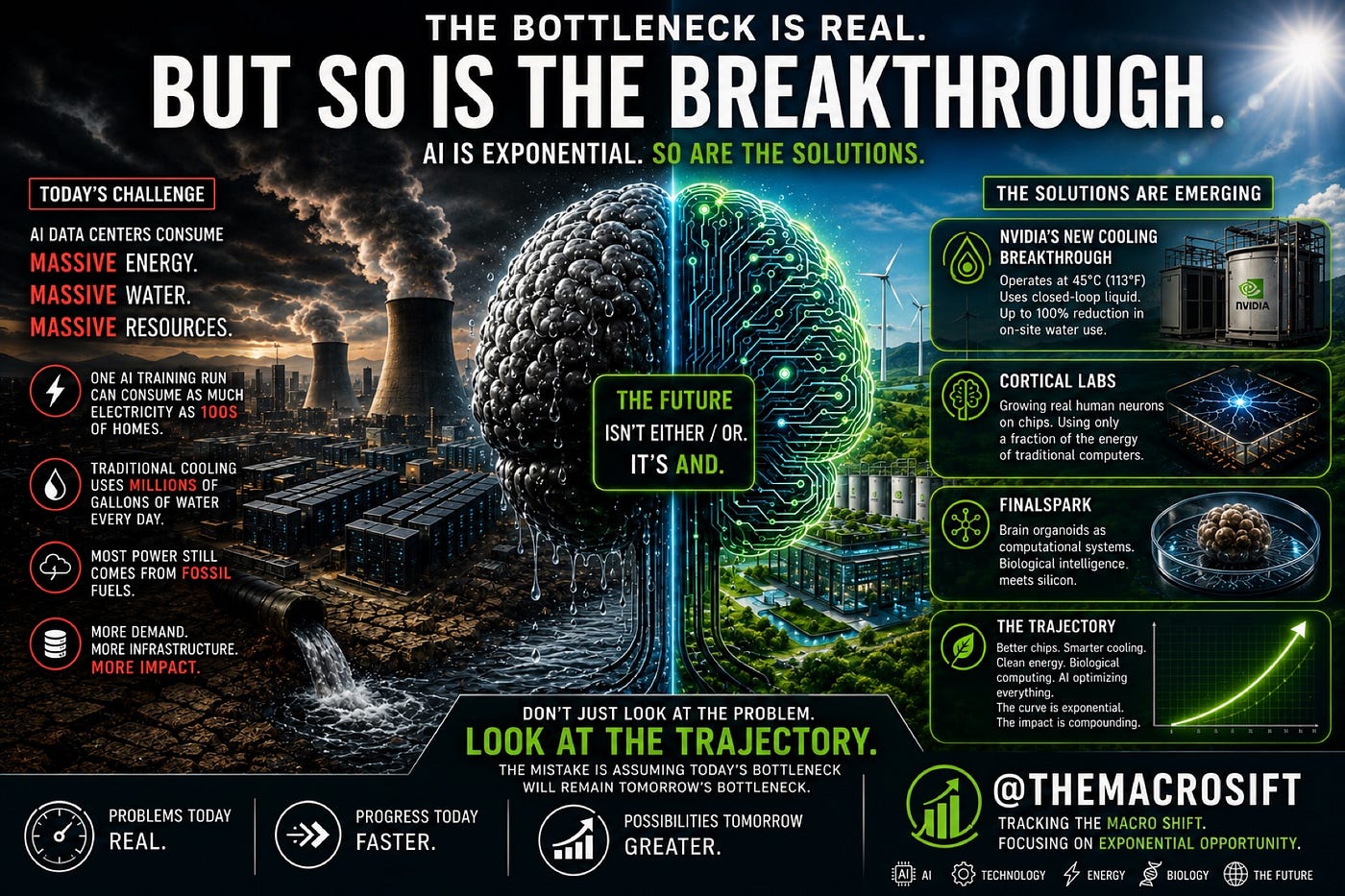
The part people may be missing in the data center and water debate is that they are thinking about the problem literally and linearly. AI development does not move linearly. It moves exponentially. The same technology creating today’s energy and water challenges is also accelerating the search for solutions.
Yes, data centers consume enormous amounts of electricity. Yes, many cooling systems rely on significant quantities of water. Those facts are not in dispute. What is less appreciated is how quickly the underlying technology is changing.
One of the best examples came this week from NVIDIA.
The company unveiled a new liquid cooling architecture for its next generation Rubin AI infrastructure that operates at temperatures as high as 45°C, or 113°F. At first glance, that sounds backwards. Hotter coolant should mean worse cooling. In reality, the opposite is true.
Because the coolant can operate at much higher temperatures, the system can reject heat using outdoor dry coolers rather than traditional evaporative cooling towers in many climates. The coolant itself circulates through a closed loop, meaning it is filled once and continuously reused rather than constantly consuming fresh water. NVIDIA says this approach can reduce on site cooling water consumption by up to 100 percent under favorable conditions while also lowering the electricity required for cooling.
That is an extraordinary engineering breakthrough if it performs as expected at scale. More importantly, it demonstrates something fundamental. The industry’s response to resource constraints is not to ignore them. It is to innovate around them.
Does this solve every environmental concern surrounding AI?
No.
Water is still consumed upstream through semiconductor manufacturing and, depending on the local energy mix, electricity generation. If an AI data center is powered primarily by fossil fuels, the broader environmental footprint remains significant. Cooling is only one piece of the equation.
That distinction matters because it keeps the conversation grounded in reality rather than marketing claims.
There’s another dynamic at work that deserves attention.
The media is structurally incentivized to focus on today’s problems rather than tomorrow’s solutions. Headlines about AI draining reservoirs, overwhelming power grids, or accelerating climate change generate immediate attention because they describe a present crisis. Headlines about improvements in cooling technology, chip efficiency, biological computing, or AI optimized infrastructure rarely receive the same level of attention because they don’t trigger the same emotional response.
That doesn’t necessarily make the reporting dishonest. News is designed to capture moments in time. Technological progress is a moving target.
The risk is that we begin treating today’s snapshot as if it were the final picture.
When people repeatedly hear that AI data centers consume enormous amounts of water, many naturally assume the future will simply require more of the same. But history suggests that’s rarely how exponential technologies evolve. Constraints become engineering challenges. Engineering challenges attract capital, talent, and innovation. Those innovations often arrive faster than public perception adjusts.
That doesn’t mean optimism should replace accountability. Companies should still be transparent. Regulators should still ask difficult questions. Communities deserve honest conversations about local impacts.
But innovation itself is part of the story.
Now zoom out.
History is filled with examples of industries that appeared unsustainable until technological progress fundamentally changed the equation. Early automobiles were inefficient. Solar panels were prohibitively expensive. Batteries had limited capacity. Computer chips consumed enormous amounts of power relative to the work they performed.
Innovation changed every one of those trajectories.
AI infrastructure is unlikely to be different.
In fact, there are already companies attempting something even more radical.
Cortical Labs has developed a biological computing platform that grows living human neurons on silicon chips. Rather than relying exclusively on transistors, these neurons perform computation while consuming remarkably little energy. The goal is not to replace GPUs tomorrow but to create specialized computing systems that combine biological efficiency with digital hardware.
Another company, FinalSpark, is pursuing a similar vision using brain organoids as computational substrates. Their long term objective is to create biological computers capable of learning and processing information using only a fraction of the energy required by today’s silicon based AI hardware.
Why is this exciting?
Because the human brain performs astonishing feats of perception, learning, adaptation, and problem solving while consuming roughly 20 watts of power. That’s less electricity than many household light bulbs.
No one is claiming today’s biological computers are equivalent to the human brain. They are not.
But they represent an entirely new direction in computing. Instead of forcing silicon to become infinitely more efficient, researchers are asking whether biology itself already solved many of these efficiency problems through millions of years of evolution.
That is exactly the kind of thinking exponential technologies encourage.
The public discussion often assumes that today’s AI data center is the permanent model for the future.
I think that’s a mistake.
The GPUs powering today’s frontier models are dramatically more efficient than the hardware used only a few years ago. Cooling systems continue to evolve. Chip architectures improve with every generation. Specialized inference processors are emerging. Optical computing is advancing. Neuromorphic computing continues to mature. Biological computing is beginning to leave the laboratory.
Every one of these fields is trying to accomplish the same objective.
Perform more computation while consuming less energy, less water, and fewer resources.
Meanwhile, AI itself is helping engineers optimize chip layouts, cooling systems, electrical distribution, and thermal management faster than human teams could accomplish alone. In other words, the same technology driving increased computational demand is simultaneously helping solve the engineering challenges created by that demand.
That feedback loop matters.
Innovation is now compounding upon innovation.
None of this means we should ignore today’s environmental costs. Communities deserve transparency. Governments should evaluate local water availability. Companies should be held accountable for sustainability claims.
But neither should we assume today’s bottlenecks define tomorrow’s possibilities.
The history of technology suggests the opposite.
Every major technological revolution begins by exposing constraints. Those constraints create incentives for innovation. Innovation removes many of those constraints, often faster than public perception catches up.
The debate surrounding AI data centers should absolutely continue.
It just needs to include both sides of the equation.
The costs are real.
The breakthroughs are real.
As someone who has spent the last several years immersed in the world of exponential technologies, I don’t see today’s data centers as the destination. I see them as a bridge.
The mistake is assuming today’s bottleneck will remain tomorrow’s bottleneck.
메타데이터
- post_id
- a01ac2ceebef
- slug
- ai-water-and-the-mistake-of-thinking-linearly-a01ac2ceebef
- url
- https://medium.com/@themacrosift/ai-water-and-the-mistake-of-thinking-linearly-a01ac2ceebef
- canonical_url
- https://medium.com/@themacrosift/ai-water-and-the-mistake-of-thinking-linearly-a01ac2ceebef
- author_url
- https://medium.com/@themacrosift
- status
- ok
- fetched_at
- 2026-07-20 11:39:40