Rethinking Rebel Music
Why we confuse what music is with what music does — and why listeners always hear more than artists intend.
Rethinking Rebel Music
Why we confuse what music is with what music does — and why listeners always hear more than artists intend.
Jerry Dammers, founder of The Specials and the 2 Tone label recalled how as a 10 year old, seeing The Who performing ‘My Generation’ on television in 1965 made him decide to form a band that would have the same kind of presence and power. For Dammers, the son of a clergyman growing up in a comfortable middle class home, rock (and later Jamaican music) was the catalyst for him to become something of a rebel, reacting against his cloistered home background.
But let’s look at another artist who is a contemporary of Dammers — Joe Jackson. Born in 1954 into a working-class family in Portsmouth, he discovered an early love of Beethoven and took lessons in both piano and violin at school. As the self-described “weird kid” studying classical music, he was the target of bullying by other children, yet it was this musical pursuit that enabled him to break from the working-class path that many of his peers seemed destined for.
Rock music in the 1960s was of course associated with all things anti-establishment and unconventional, traits that Dammers certainly embodied. Yet Jackson’s embrace of classical music was also a ‘rebellion’ of sorts — a quieter one that wasn’t about musical aggression or outlandish behaviour and more to do with going against certain inherited class assumptions. Here we have two people from highly contrasted backgrounds whose early encounters with music led them down a road not typical of their class. The choice of music may have differed - but the role it played in both of their lives was remarkably similar.
The truth is that there’s no such thing as “rebel music”. Music, in itself, is simply a collection of sounds; whether it becomes rebellious or conformist depends on how people use it.
The Listener as Co-Author
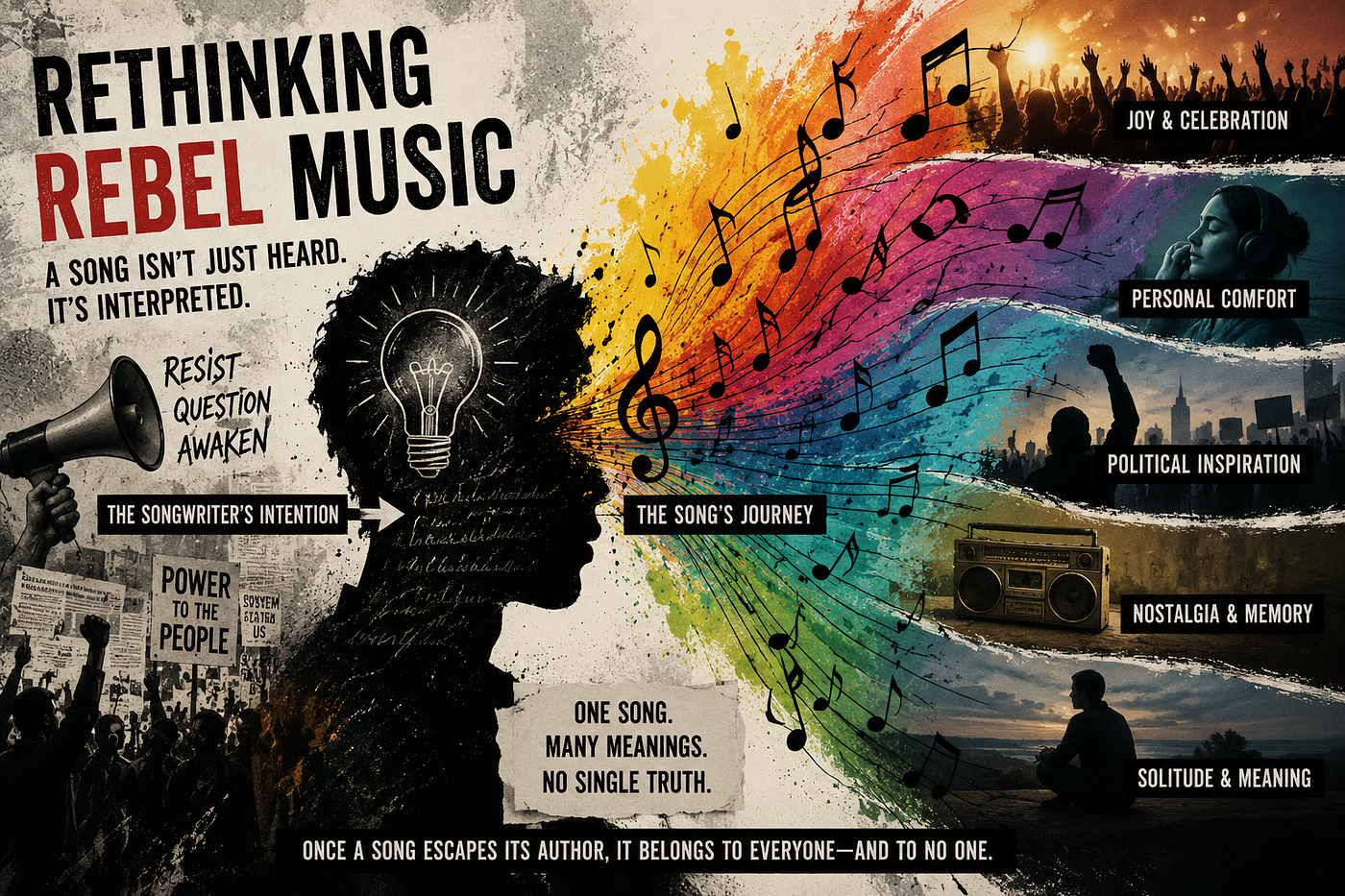
A single song can mean many different things to different listeners — so much so that you sometimes wonder whether they are even talking about the same piece. This is true of songs whose meanings are deliberately cryptic, but equally applies to songs whose lyrics seem plain and direct. In that sense, a song’s meaning is always a collaboration between artist and listener.
I’ve seen this firsthand as a musician. Songs I wrote with one intention have often been interpreted by listeners in ways I never anticipated — sometimes even by listeners whose worldviews sharply differed from my own. So, where do we go to find the meaning of a song? Is it located in the intention of the songwriter — or the experience of the listener?
The Death of the Author
Roland Barthes (1915–1980) was a French literary critic and philosopher who challenged the idea that authors controlled meaning. His 1967 essay “The Death of the Author”, which has implications for how we view music, argues that:
-
Meaning isn’t determined by the author’s creative intention.
-
Meaning comes from the reader’s interaction with the text.
Applying the above to music, ‘author’ is the artist, ‘reader’ is the listener and for ‘text’ we substitute ‘song’.
One of the essay’s most telling quotes is: “The birth of the reader must be at the cost of the death of the Author.” (Or, for our purposes: The birth of the listener must be at the cost of the death of the artist.) This didn’t mean the author’s literal physical death, nor was it a dismissal of the value of their artistry. Barthes is contending that the author’s intended meaning shouldn’t have absolute authority over how a text is understood.
Why is that? Once a song is released or performed to an audience, its meaning no longer belongs to the artist. Each listener will interpret it through their own unique experience — their emotional state, history, beliefs, memory, the context in which it’s heard. This alone guarantees that the song will have multiple meanings. Take ‘One Love’ by Bob Marley, originally written as a call for peace and unity in the troubled early years of Jamaica’s independence. It also turns up as a song for couples to get married to, as a fun track to dance to in clubs and at concerts, as a motivational anthem for athletes and other sports stars, as chill-out accompaniment after a hard day at work, and any number of other situations. It bears out what Barthes said about the reader finding their own interpretation of a text independent of its author.
The Stories That Tell Us
In the music of traditional cultures that predate Western industrialised societies, it’s perfectly normal for a single song to have a multitude of meanings for the people of the community, as each person encounters it and adapts it to their circumstances. So, when a single story is sung by a shaman or griot, or enacted collectively in song, dance, costume and drama, for one individual it may represent hope, for another sorrow or humour, or love, and a whole gamut of themes — unity, fertility, moral lessons, transformation, spiritual striving and more.
Applied to Western popular music — and in particular songs associated with rebellion, the same thing occurs but with a twist: The same song can become meaningful to people whose values, politics and experiences are worlds apart. In reality the audiences for roots reggae, punk rock, political hip hop, socially aware ska or any other music of dissent have always been diverse and have never been composed solely of politically driven or “conscious” people. This partly explains why protest songs can also turn up in all kinds of settings — as jingles on corporate advertisements, as cabaret, random video games, on holiday cruise ships, even as background muzak.
This reminds me again of my own experience as a songwriter. I’ve had listeners being very complimentary about my work without buying into its message. I understand — it’s something I’ve done myself when listening to other people’s music. Enjoying, valuing or even being deeply moved by a protest song doesn’t require the listener to share the artist’s politics.
Drawing Meaning
There are protest songs written in stark, unadorned language that state very conclusively: “This is how things are.” That kind of lyrical directness can certainly connect with listeners, and not only those who already share the artist’s worldview. However, given that audiences will inevitably construct its own meanings in any case, such plainspoken certainty may, in some instances, limit the interpretive openness that listeners naturally bring to music.
What if the aim of a song championing a cause is not to prescribe conclusions for the listener but to provoke questions? If a song’s meaning is always a collaboration between artist and listener, keeping the listener’s agency in mind can prove worthwhile for the artist. Elvis Costello offered the following reflections during a 2014 songwriting workshop:
“It’s very important for the listener to have somewhere to go in their imagination… one of the fallacies of protest music is that if it’s too dogmatic, it’s not a debate, it’s not stimulating. The same is true of a love song or any kind of spiritual song: If it’s too dogmatic then there’s no place for the listener’s imagination to go.”
[embed]
A few closing thoughts
Think of a well. People come to draw water from it for many different needs, but the water itself remains the same. That’s a good metaphor for how we use music and poetically expresses why a song associated with political protest can have an abundance of very different meanings when heard in other contexts. It also tells us why Beethoven’s music could prove every bit as rebellious to a child as the brash power of The Who, when encountered in the right circumstances. When we talk about “rebel music”, we’re really describing the function being played by the music and not its essential quality. That said, the most powerful songs of rebellion and protest actually might not be those that tell us exactly what to think — but instead, those that allow us the freedom to question and consider possibilities.
메타데이터
- post_id
- a0275410acc4
- slug
- rethinking-rebel-music-a0275410acc4
- url
- https://medium.com/@imanihekima/rethinking-rebel-music-a0275410acc4
- canonical_url
- https://medium.com/@imanihekima/rethinking-rebel-music-a0275410acc4
- author_url
- https://medium.com/@imanihekima
- status
- ok
- fetched_at
- 2026-07-13 11:29:01