How Representative is Swampscott’s “Representative” Town Meeting?
In Massachusetts, 292 of the 351 municipalities have a town form of governance. These towns are required to have at minimum an Annual Town…
How Representative is Swampscott’s “Representative” Town Meeting?
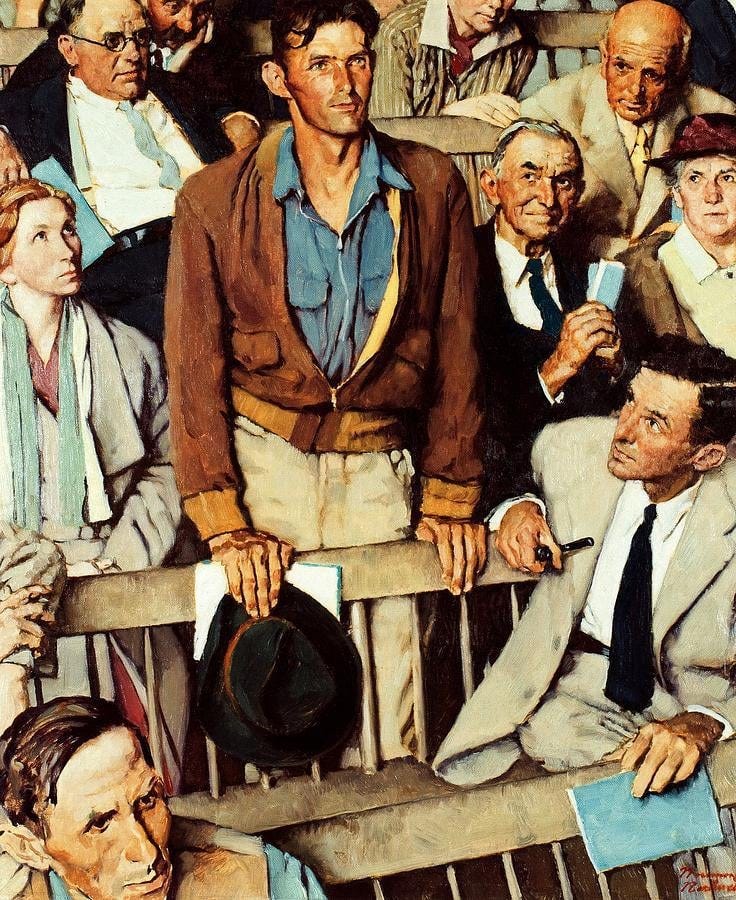
One of the other Town Meeting paintings by Norman Rockwell
In Massachusetts, 292 of the 351 municipalities have a town form of governance. These towns are required to have at minimum an Annual Town Meeting where residents come together as the town’s legislative body to vote on the municipal budgets, approve or deny new legislation (i.e. by-law changes), approve specific projects, and a number of other essential duties. While it is popular to claim that this form of government, which predates the founding of our country, is the first instance of democracy practiced on these lands, the claim ignores the history of the Indigenous peoples that had well-established forms of democracy long before European colonists even showed up.
Most Town Meetings are “open,” meaning that any registered voter can show up and have their vote counted. However, in 1926, the state allowed “larger” (over 6,000 in population) towns to hold elections for Town Meeting Members, and though most towns declined to do so (e.g. Marblehead and Brookline), Swampscott chose to implement this new form of a representative Town Meeting Member body. Town Meetings in both forms have been critiqued in more recent history over how well they represent the broader population.
It is worth asking then: How well do the current Swampscott Town Meeting Members represent the lived experience of the general public today?
First, it should be noted what demographic features can actually be easily obtained about Town Meeting Members and the population they are supposed to represent. In Swampscott, a public list of elected Town Meeting Members includes only each member’s name, address, precinct, and email address. Therefore, comparing and contrasting standard demographic attributes, like race, ethnicity, age, and gender, are not possible with the provided data. These attributes are also not collected at any point from the elected Town Meeting Members so requesting these data would not produce them.
What can be compared is housing. All property information for Swampscott is maintained by Patriot Properties and details such as the assessed value, housing type, and historic sales information can be found in this database. By comparing the contents of this database and its information regarding assessed property value with the provided addresses of Town Meeting Members, one can draw certain conclusions of how this data compares to the broader population in town.
Overall, the story is that Single Family Home owners, and particularly those with higher valued houses, are overrepresented in Town Meeting while everyone else is underrepresented. 86% of Town Meeting Members live in Single Family Homes (median value $826,542) compared to 60% of residents in Swampscott overall (median value $788,275).


Precinct 2 is the exception to being represented by higher valued home owners, but as can be seen in the following charts, that is greatly overshadowed by the difference in type of housing.
When comparing the types of housing Town Meeting Members live in to the broader public, the first thing to note beyond that Single Family Home owners are overrepresented is that there is a lack of diversity. In Swampscott overall, around 40% of all housing units are something other than Single Family Homes (11% Two Family, 20% Condos, 9% Other). When comparing the two charts above, you can see that not only are Two Family and Condo dwellers underrepresented in Town Meeting, but also that those living in places like apartment buildings or mixed-unit condos have no representation at all.
What are the possible implications of this? Town Meeting often votes on by-law changes and other policies that deal with what housing can even be built and where, infrastructure upgrades which include sewers and sidewalks, and even topics like how to handle short-term rentals. Single Family Home owners tend to value things like street paving, restrictions on housing density, and free parking, whereas those living in denser housing tend to value things like sidewalk and walkability improvements, public space access, and nearby amenities. Therefore, the lived experience of those living in around 40% of Swampscott’s housing units and the values, needs, and preferences that may come with that, are either underrepresented or simply not present in Town Meeting discussions.
Given that there is a disparity in representation with regards to the types of housing people live in, this could also indicate disparities in other demographic attributes such as age and race/ethnicity, since those are often related to housing patterns. Language, disability status, parental status, and even employment type are examples of additional characteristics where the lived experience of these individuals may not be informing policy decisions. The point of this exercise is not to say that the demographic make-up of the Town Meeting needs to perfectly reflect the broader population, but to point out what gaps may exist in understanding the ramifications of policy decisions (or lack of decisions) to certain subsets of the town.
In order to understand these gaps, though, it would take the government making an intentional effort to obtain these data. Though it does not appear to be common, there are limited examples of local governments trying to assess how representative their town meetings are of the broader public by simply asking the question in survey form. Unsurprisingly, a common response when Town Meeting Members are asked about why they ran for a seat, is that they want their voices heard in local matters. If Town Meeting were made up of a random sample of residents who were all supposed to only represent themselves, it may be a more truly representative body of the broader population than its current elected form.
While outreach is not historically something Swampscott has budgeted for, it is worth the investment to better understand the needs of the broader population. Swampscott is currently doing this with grant funding for the Municipal Vulnerability Preparedness (MVP) 2.0 outreach program which is specific to climate impacts, but there are lots of other areas where this outreach may be valuable. Perhaps asking Town Meeting Members to fill out a demographics survey after every election could be the first step for the town in assessing how representative the Town Meeting actually is of the broader population.
메타데이터
- post_id
- a030231bb7dc
- slug
- how-representative-is-swampscotts-representative-town-meeting-a030231bb7dc
- url
- https://medium.com/@swampscottrjag/how-representative-is-swampscotts-representative-town-meeting-a030231bb7dc
- canonical_url
- https://medium.com/@swampscottrjag/how-representative-is-swampscotts-representative-town-meeting-a030231bb7dc
- author_url
- https://medium.com/@swampscottrjag
- status
- ok
- fetched_at
- 2026-06-09 15:37:30