Between The Static: Listening for the Light We Cannot See
After migrating to Canada, I’ve always wondered what it meant to be Syrian. Abandoning my hometown created a rift in my connection to my…
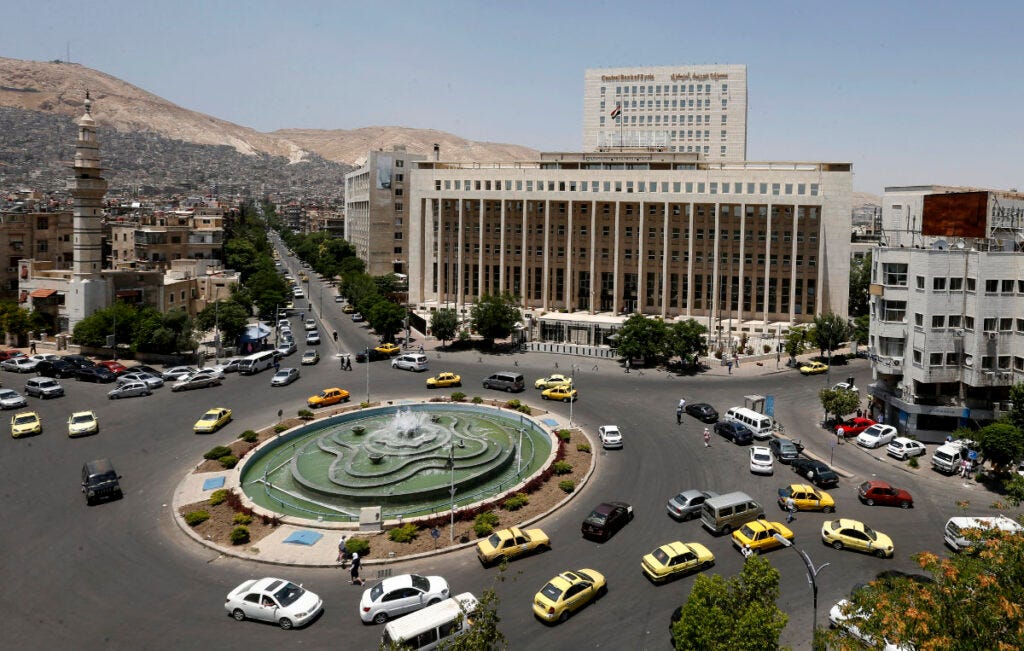
The Sabaa Bahrat square, Damascus.
Between The Static: Listening for the Light We Cannot See
After migrating to Canada, I’ve always wondered what it meant to be Syrian. Abandoning my hometown created a rift in my connection to my culture. My mother tongue, rugged and dense, paled in comparison to the melodic Arabic around me. I lived among its sounds but couldn’t replicate its beautiful woven letters. I was tuned to a different frequency, one where rejecting any Arabic conversation with visitors was more viable than pushing the words roughly out of my mouth. Listening to my family reminisce of Damascus made me realize how little I knew of it. The busy bazaars, buildings whose concrete was worn out by sun, rounded rooftops and open grocery stores that played radios broadcasting the Al-Jazeera to all who walked in. Back then that was the least of my worries, what actually mattered, was survival.
Growing up in Syria during war felt like living inside constant static. Survival was less dependent upon resources and avoiding the next shell, and more on hope, faith, connection, and a lack of patience. Waiting meant the rebels would advance their siege on more parts of Syria, and war would rage more ferociously. Beneath the constant noise of debris falling and the occasional gunshot was a powerful, invisible signal. Fear. The kind that sharpens your awareness, transmitting information on when the next best moment to visit the bakery safely was. As if each moment carried a hidden code, and the right course of action had to be taken in response like a needle through a haystack. I was completely oblivious to the peril lurking beyond our walls, absorbed in toys while my parents navigated plans and made calls that could decide our fate, their cellphones’ invisible waves reaching across borders, connecting them to places only dreamt about.
“We’re going to Lebanon.” my father said, fear seeping through his otherwise firm voice. To me it was no different, I’d pack my lavender GameBoy Advance enchanted with Mario games and play them elsewhere. For my parents though, this was everything. Our last time driving the Sabaa Bahrat roundabout with its centred fountain spewing a familiar mist carrying the faint smell of jasmine. Each droplet vibrating in different directions like the waves of a radio not yet understood. The streets were busy with panic, more than ever. Clogged with honking cars and swirling dust around faded concrete buildings. Hundreds of people speaking at once, broadcasting their words, which reverberated through the air. At least all Syrians were simultaneously experiencing the same thing, no one left behind. As crazy as it sounds, that made me feel more intact with my heritage. My parents made the hardest decision one could make, to leave everything behind. They did an excellent job of shielding me of the emotional pain that accompanied that choice, the two of them working together calmly, effectively. Dad drove and navigated, mom had our papers and food always ready, Manakish in large plastic bags, essential papers in a worn out navy backpack. I was very lucky. That inclination to leave the city was not of immediate danger, hefty bombardments and lockdowns, but the belief that staying was more dangerous than facing the unknown. Accepting that control was soon becoming an illusion. Invisibly displacing more than one million residents by the end of the year.
It was new, but stable, a sacrifice that 5 year old me couldn’t see. Arriving in Lebanon felt like finally tuning into a clear signal after years of static. Hundreds of thousands of other Syrian refugees came with us. Millions of waves bouncing off walls and buildings, each story colliding and forming a relationship. My first day in school, when my parents dropped me off at the daunting gate to Eastwood College in Beirut, I felt the world caving in on me, and nothing felt familiar. I managed to befriend most of my class but make no mistake, I wasn’t a great student. However one subject came alive, English. English dominated my life in Lebanon entirely, every memory beginning to hum its frequency. Learning to speak came naturally to me, each word a component, each sentence a wire connecting me to more people than ever, almost as if I was being prepared to pave a new path. I read books two grade-levels above my own, learning the different sentence structures and nuanced meanings of words. Going home only to whip out my newly purchased iPad, and keep reading. I was undefeated in my English pursuits, though I understood my limit, which was my own language.
My preparation was enough, and we finally moved one more time, to Canada. The first winter in Canada remains vivid in my memory. Snow blanketed the streets, the cold wind bit at my skin, as if the entire country screamed, “We don’t want you here.” However, the uncertainty eventually cleared up, our invisible trust for a terrifying new world paid off, we were at last, completely safe, and ready to settle, this time succeeding in school. The baked Manakish filled my cousin’s house with familiar aromas, a signal reaching me all the way from Syria. My fractured identity eventually found structure with them, my extended family, who was nice enough to accept us into their home with little warning.
Fouad, a name used in the Egyptian national anthem, meaning “heart.” The same name my grandfather bore, the luckiest kid in the world. I grew old enough to understand that being Syrian didn’t depend on speaking fluently or having the most violent war stories and barely scathing through. That my story was enough in itself, and that the future, although undetermined, and invisible, is brighter than it ever has been. I was the first of my family tree to spend more time in a country other than Syria, and me and my sister will be the first to establish ourselves in a first-world country, which is a beautiful wave of success in itself. Church is how I keep my culture intact nowadays, followed by my mother’s side of cousins who migrated four years later, and who we now regularly visit. All of us, my cousins, their husbands, my aunt, the echo of my entire family would spill into the room like memories stitched together, like frequently tapping into that old broadcast of Al-Jazeera. Laughter, games, bowls of rich, spiced dishes, bright tabbouleh, the air smelling of baharat like the parts of Syria I remember, with the fountain spewing and smelling of hope.
메타데이터
- post_id
- a05eada195eb
- slug
- between-the-static-listening-for-the-light-we-cannot-see-a05eada195eb
- url
- https://medium.com/the-silent-script/between-the-static-listening-for-the-light-we-cannot-see-a05eada195eb
- canonical_url
- https://medium.com/the-silent-script/between-the-static-listening-for-the-light-we-cannot-see-a05eada195eb
- author_url
- https://medium.com/@baghdanfouad
- status
- ok
- fetched_at
- 2026-07-11 23:27:18