MySQL UPSERT vs SELECT–UPDATE–INSERT
Race Conditions, Transactions, and updatedAt Gotchas (MySQL 5.7 & 8.0)
MySQL UPSERT vs SELECT–UPDATE–INSERT
Race Conditions, Transactions, and updatedAt Gotchas (MySQL 5.7 & 8.0)
Background
Modern SQL has introduced cleaner and safer patterns to handle common database operations. UPSERT is one of them, allowing inserts and updates to be performed atomically in a single statement.
This article explains why UPSERT exists, what problems it solves, and what trade-offs and side effects developers should understand when using it.
Executive Summary
When inserting or updating records in MySQL, developers often choose between:
- UPSERT
INSERT ... ON DUPLICATE KEY UPDATE- Manual logic
SELECT → UPDATE or INSERTAlthough both appear to achieve the same goal, they differ dramatically in correctness, concurrency safety, and side effects.
This article explains:
- why race conditions occur
- why
BEGIN/COMMITalone does not fix them - why UPSERT is concurrency-safe
- why
updatedAtchanges even when data doesn’t - what MySQL 8 row alias does and does not solve
1. The Core Problem: Race Conditions
The classic pattern (unsafe)
SELECT id FROM users WHERE id = 1;

-- if no row
INSERT INTO users (id, name) VALUES (1, 'Alice');
What goes wrong
With two connections running concurrently:
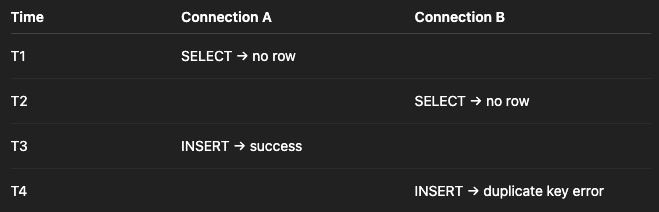
This happens because:
- The decision is made outside the database
- Another connection can change data between statements
This is a race condition.
2. Why BEGIN / COMMIT Alone Does NOT Fix It
A common misconception:
“If I wrap it in a transaction, it should be safe.”
Reality
BEGIN;
SELECT ...
INSERT ...
COMMIT;
Transactions:
- guarantee atomicity within one connection
- do not block other connections by default
If no locks are taken:
- other connections can still read/write the same rows
- the race condition remains
Key takeaway
BEGIN/COMMIT ≠ concurrency safety Locks (or single-statement writes) are required
3. Why UPSERT Is Safe (Even Across Connections)
Example
INSERT INTO users (id, name)
VALUES (1, 'Alice')
ON DUPLICATE KEY UPDATE
  name = VALUES(name);
Two connections, same time
- Both attempt INSERT
- InnoDB locks the unique index
- One INSERT succeeds
- The other automatically runs UPDATE
This is:
- atomic
- race-free
- enforced at the index level
Important distinction
UPSERT is one statement, so:
- no “decision window”
- no application-level guessing
- MySQL resolves the conflict internally
4. Lost Updates vs Last-Write-Wins
Safe example (no lost update)
INSERT INTO counters (id, val)
VALUES (1, 1)
ON DUPLICATE KEY UPDATE
  val = val + 1;
Two concurrent executions result in:
val = 2 ✅InnoDB serializes the updates using row locks.
Last-write-wins (expected behavior)
UPSERT col = 'A'
UPSERT col = 'B'
Final value depends on commit order.
This is not a race condition — it’s normal database behavior.
5. The updatedAt Surprise
The problem
If you have:
updatedAt TIMESTAMP
  DEFAULT CURRENT_TIMESTAMP
  ON UPDATE CURRENT_TIMESTAMP
Then any UPDATE will refresh updatedAt.
Even when data is identical
INSERT INTO my_table (id, col1)
VALUES (1, 'A')
ON DUPLICATE KEY UPDATE
  col1 = col1;
Result:
col1unchangedupdatedAtstill updated
Why?
- MySQL chooses the UPDATE path first
- triggers and auto-update columns fire
- MySQL does not optimize this away
6. Does MySQL 8 Row Alias Fix This?
MySQL 8 syntax
INSERT INTO my_table AS t (id, col1)
VALUES (?, ?)
ON DUPLICATE KEY UPDATE
  col1 = IF(t.col1 IS DISTINCT FROM new.col1, new.col1, t.col1);
What it improves
VALUES()is deprecated → alias is cleaner- Better readability
- Proper NULL-safe comparison (
IS DISTINCT FROM) - Avoids unnecessary data changes
What it does NOT fix
- UPDATE still runs
- UPDATE triggers still fire
updatedAtstill changes- binlog still records UPDATE
Row alias improves correctness of assignments, not UPDATE semantics
7. How to Prevent False updatedAt Updates
Control updatedAt manually
Remove auto-update behavior and update conditionally through code or SQL:
updatedAt =
  IF(
    t.col1 IS DISTINCT FROM new.col1,
    NOW(),
    t.updatedAt
  );
This works for:
- UPSERT
- UPDATE
- future queries
8. Are Concurrent UPSERTs a Race Condition?
No.
Even with:
- two different connections
- running at almost the same time
UPSERT is safe because:
- unique index locks serialize access
- InnoDB guarantees correctness
What can happen:
- triggers fire multiple times
- timestamps update multiple times
- last-write-wins behavior
But:
- no duplicates
- no lost updates
- no corrupted data
9. Practical Guidelines
Use UPSERT when:
- concurrency matters
- logic is simple
- performance matters
- batch imports or sync jobs
Avoid relying on:
ON UPDATE CURRENT_TIMESTAMP- SELECT → INSERT without locks
- application-level existence checks
Remember this rule
Single-statement writes are safer than multi-step logic.
Final Takeaway
- Race conditions come from decision gaps
- Transactions alone do not fix concurrency
- UPSERT is safe because MySQL resolves conflicts internally
- MySQL 8 row alias improves clarity, not behavior
updatedAtmust be handled explicitly with UPSERT
If you follow these principles, your MySQL writes will be:
- faster
- safer
- and far more predictable
메타데이터
- post_id
- a0602d0f699f
- slug
- mysql-upsert-vs-select-update-insert-a0602d0f699f
- url
- https://medium.com/@kenhuiskh/mysql-upsert-vs-select-update-insert-a0602d0f699f
- canonical_url
- https://medium.com/@kenhuiskh/mysql-upsert-vs-select-update-insert-a0602d0f699f
- author_url
- https://medium.com/@kenhuiskh
- status
- ok
- fetched_at
- 2026-07-15 07:36:08