Jariyah Legacies and The Well That Keeps Giving
A field guide for rethinking how resources move — and daily practices to integrate circulation into your life and legacy.
Jariyah Legacies and The Well That Keeps Giving
A field guide for rethinking how resources move — and daily practices to integrate circulation into your life and legacy.
By Post Growth Fellow, Aisha Marzuki

Creative Design & Illustration by Ramanza Revrindra (@ramanz.art)
A woman in rural Uganda used to walk five kilometers every day for contaminated water. Her children missed school to help carry it back. When a charity foundation built a well at her doorstep, something shifted. Now her kids attend school regularly. She’s growing vegetables and that well serves her entire village — and will still be serving people in 2074.
I keep coming back to this story, because it points to something I’ve been trying to understand for the past few years while working in development across multiple countries: what makes some investments keep generating value long after the initial input stops, while others don’t?
The answer, I think, has to do with how we design systems to move resources. And it challenges a lot of what those of us trained in Western economics take for granted about how economies should work.
Where I’m starting from
I spent a decade working in non-profits, foundations, innovation labs, social enterprises, think tanks — always operating within capitalist frameworks even when trying to transform them. Supporting mitigation efforts in vulnerable communities, designing resilient cities and facilitating dialogues for anticipatory actions, organizing market research for products with socio-environmental impact, advancing women’s economic empowerment in villages and coastal communities, and so on.
It’s important work, but something kept nagging at me.
We’d build capacity, run pilots, show proof of concept. Then funding cycles would end and political priorities would shift. The innovations would fade because they were designed with specific objectives that do not serve long-term horizons.
Meanwhile, across the same geographies, I kept encountering infrastructure and systems that had been working for decades or even centuries. Water systems, educational endowments, community support networks, amongst others. Even though they don’t look like it, many are rooted in Islamic economic practices I’d grown up around but never examined as actual systems design.
Capitalistic systems with accumulation at the core
Capitalism is really good at what it does — extract value, grow capital, compound returns. The system works exactly as designed. But what is it actually designed for?
It’s optimized for “can I get more?” not “is this enough?” For extracting maximum value in 3–7 years, not maintaining systems and things across generations. For hitting growth targets, not meeting actual needs.
We’re taught to see accumulation as a policy choice or cultural value. But it’s neither — it’s a mathematical necessity built into how money creation works.
When banks create money, they create equal debt at the same time. Get a loan, new money enters circulation, you owe it back plus interest. While it may seem balanced, money doesn’t flow evenly through the system. It moves faster toward people who already have it (dividends, capital gains, rent, inheritance) than it flows back to everyone else (wages, welfare). This doesn’t necessarily happen due bad actors or policy failures — it’s just how the plumbing works.
The numbers bear this out: $324 trillion in global debt vs $98 trillion in money supply. That gap is structurally required to widen. And currently, we’re watching the features of a system requiring infinite growth meeting finite limits: climate breakdown, institutions failing, widespread burnout, young people who can’t imagine a stable future.
So, what would it look like to design for something different?
Jariyah: When resources circulate instead of accumulate
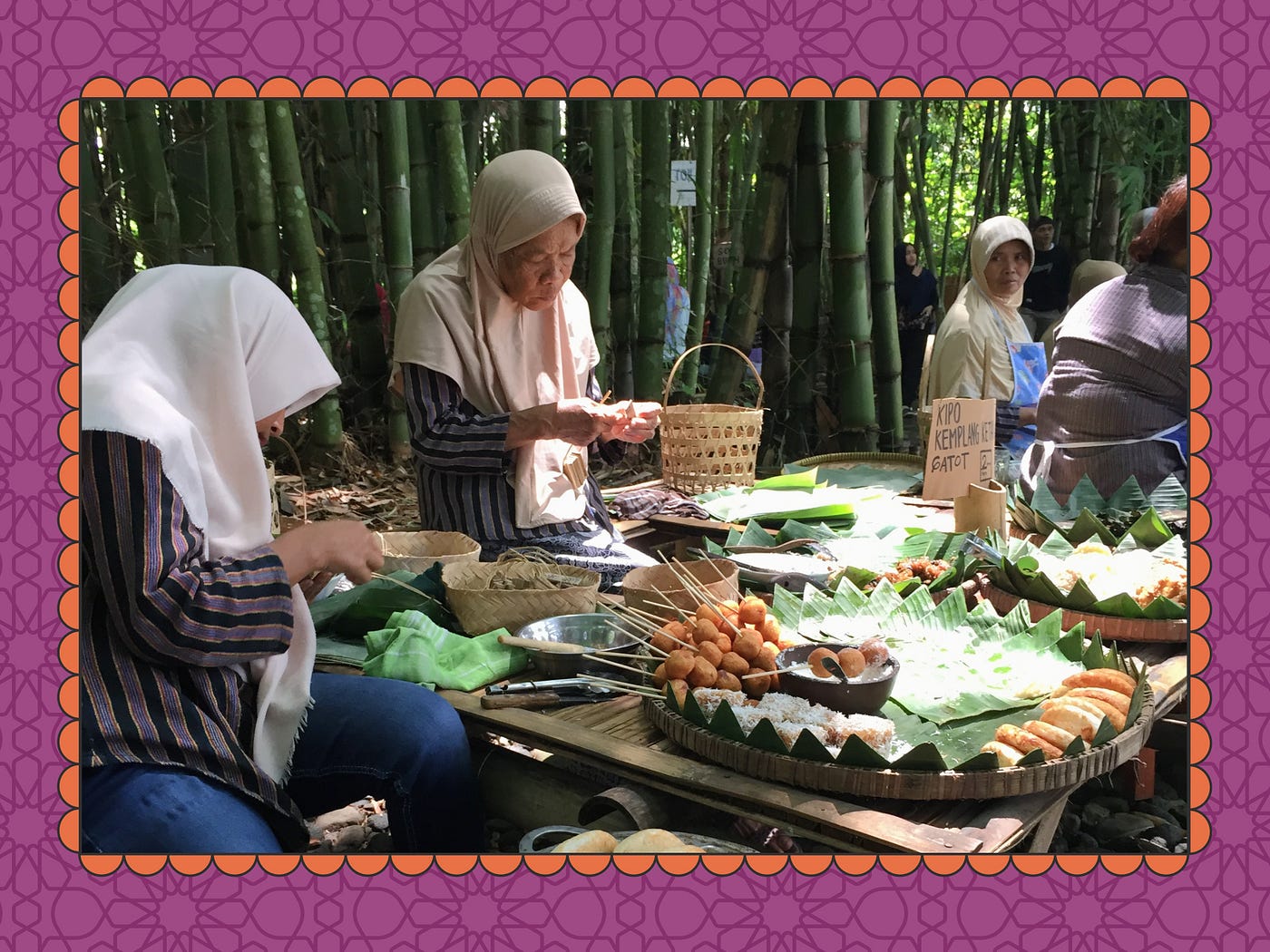
Sellers in Papringan Market, Central Java, Indonesia — a traditional Central Javanese bazaar held once every 35 days following a specific Javanese calendar, under a bamboo grove where visitors exchange rupiah for bamboo ‘pring’ currency to buy local produce, snacks, crafts.
I started looking into Sadaqah Jariyah (صدقة الجارية), or continuous charity, a couple years ago while looking at Islamic economic frameworks as potential alternatives to growth dependency. With billions of people already practicing this, I was intrigued at its scale and potential for change as it works completely differently than what I was trained to see as ‘common; economics.
The term itself comes from the Arabic sadaqah, which means voluntary charity or righteous deed; while jariyah means flowing or continuous. Together, Sadaqah Jariyah refers to charity that continues to flow and benefit others even after the giver has passed away. The concept comes from a hadith (saying of Prophet Muhammad PBUH): “When a person dies, all their deeds end except three: a continuing charity, beneficial knowledge, or a righteous child who prays for them.” This teaching fundamentally reframes economic contribution — from a one-time transaction to creating systems that keep generating benefit across generations.
The basic teaching is this: When you die, all your deeds end — except for three things: 1) knowledge that benefits others, 2) charitable works that keep serving (water wells, schools, hospitals) and 3) descendants — or people who have benefitted from our presence — that carry our values forward.
While initiated as a spiritual teaching, there’s value in viewing it as an alternative economic design — where your actions don’t stop at death, rather death just reveals which ones were actually built to last and which seeds keep growing.
Capitalism extracts value, converts it to capital, compounds returns, and concentrates wealth. Jariyah, on the other hand, extracts wisdom, converts it to teaching, compounds learning, and circulates the benefit.
When we compare the logic between them, it’s clear that one optimizes for accumulation, the other for circulation.
The everyday practice of resource circulation
This matters for those of us trying to build alternatives, because it shows that there are already decentralized movements emerging that can benefit from our support or we can take inspiration from. These movements do not look like each other on the surface, but structurally are running on the same logic as Sadaqah Jariyah: resource circulation rather than accumulation.
Malaysia has waqf institutions — endowments that never get spent down, only the returns circulate. The Al-Bukhary Foundation has deployed RM1.5 billion this way. Albukhary International University runs entirely on waqf, serving 80,000+ students — where the principal stays intact forever, only returns move. Similarly, Turkiye’s Diyanet Foundation operates an entire university this way. In East Africa, the Zakat Foundation built 688 water wells across 23 countries. This is infrastructure that keeps on working — more than a million people use them daily. Remember the woman in Uganda I mentioned at the start? Her well is one of those 688, and it’ll still be functioning in 50 years.
Practitioners emphasize that impact matters more than amount, noting that, “the legacy of giving is not measured by the size of the donation but by the depth of its impact.”
In this way, billions of dollars move through completely different logic than quarterly returns or shareholder value. What’s more, you don’t need (and are not expected to have) capital to start. You can share anything. You just need to notice that what we do today ripples forward. The Prophet Muhammad PBUH said even removing something harmful from the road counts, if it helps others.
Three patterns worth paying attention to
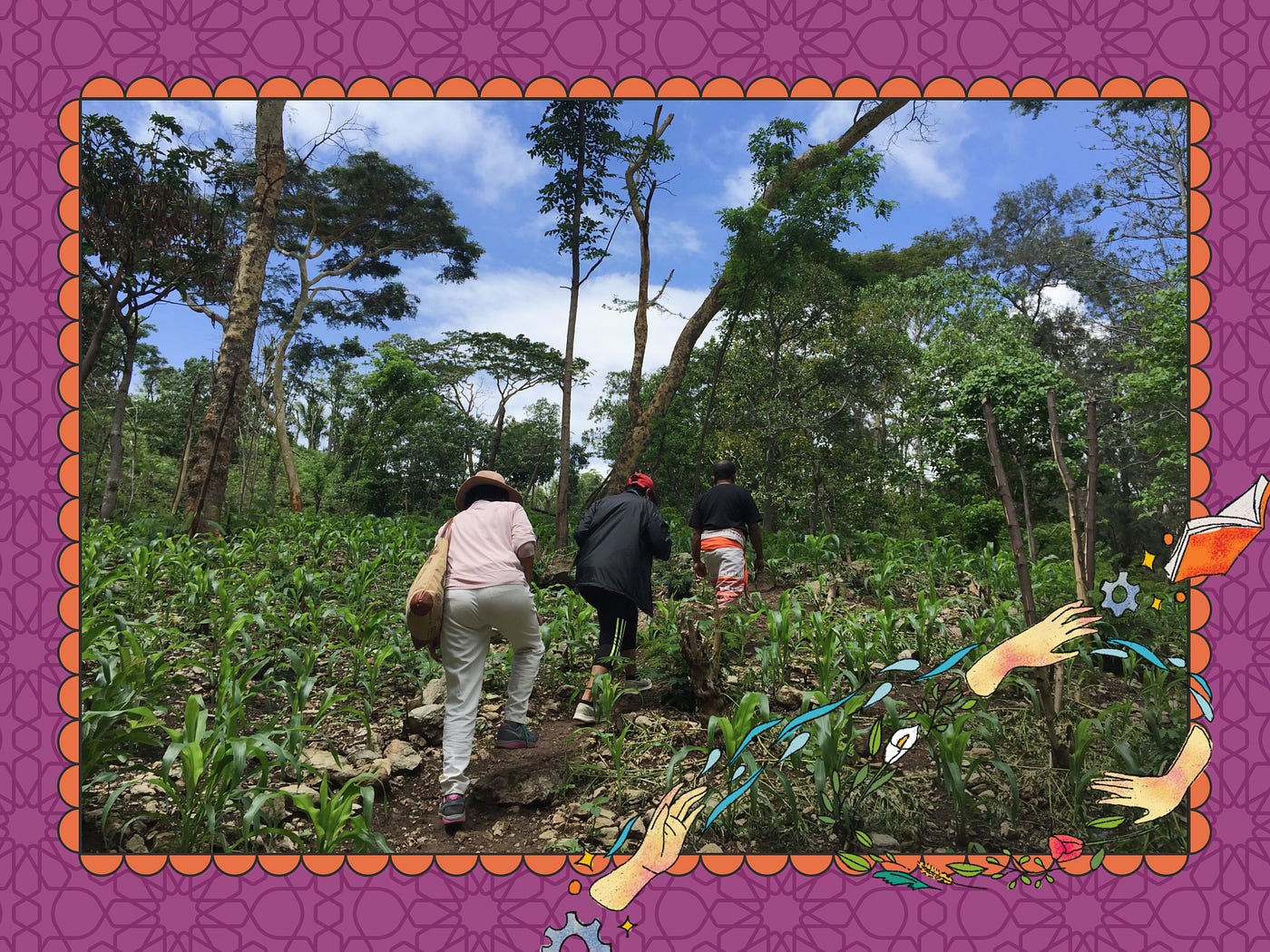
A forest in So’e, East Nusa Tenggara, Indonesia that is protected by indigenous communities that shared and passed down local wisdom and legends on water springs and food systems.
Knowledge that multiplies
When you share knowledge, you don’t lose it. This seems obvious but it’s completely opposite to how capitalism treats knowledge — patents, paywalls, proprietary everything. Jariyah says: share what you know because it compounds through use, not through protection. This also aligns with other teachings, such as those of Joanna Macy’s, “Be generous with your strengths and skills — they are not your private property. They grow from being shared.”
The organic farmers that I worked with in Salassae, Bulukumba, South Sulawesi, Indonesia, made it a rule: anyone who learns must teach others. They don’t sell their knowledge about making liquid fertilizer or natural pesticides — they spread it freely. “Siapa yang belajar maka selanjutnya ia wajib mengajar ke petani lain” (Whoever learns must then teach other farmers). Their success spread like a virus across the island, growing from dozens to hundreds of farmers. The value came from circulation, not control.
Resources that keep serving
Build wells, schools, hospitals. Plant trees you won’t sit under. The key thing is that these are investments in system resilience, not charity to ‘less fortunate’ people.
When the Xavante (A’uwẽ) communities in Brazil share meat collectively, they’re building insurance. Even if the hunt fails or someone falls sick, people can eat. The circulation creates the safety net.
This is exactly what I saw in village-level women empowerment programs — the women’s savings groups worked because they’d created circulation systems that held when everything else failed.
Relationships beyond transactions
This one’s hardest for those of us trained in efficiency thinking. It’s all about maintaining relationships with ancestors by keeping them in community memory; and maintaining relationships with descendants by making choices that account for people who aren’t born yet.
The Seven Generations Principle teaches exactly this: when sitting in council, leaders must consider not just themselves or their immediate families, but the well-being of seven generations forward. As Oren Lyons, a Faithkeeper of the Onondaga Nation, explains, Haudenosaunee leaders are guided by the idea that we are borrowing the Earth from future generations — which means every decision is a relationship maintained with people we’ll never meet.
In my work facilitating sessions on reimagining different future trajectories, the most powerful sessions were when we asked: “What would your grandmother say about this decision? What would your great-grandchildren need?” As Roman Krznaric suggests, how are we viewing ourselves as a ‘good’ ancestor for the world?
This also allows communities to transcend harmful ‘progress’ narratives, since circulation is inherently avoids the idea of moving in a straight line.
Resource circulation for wellbeing
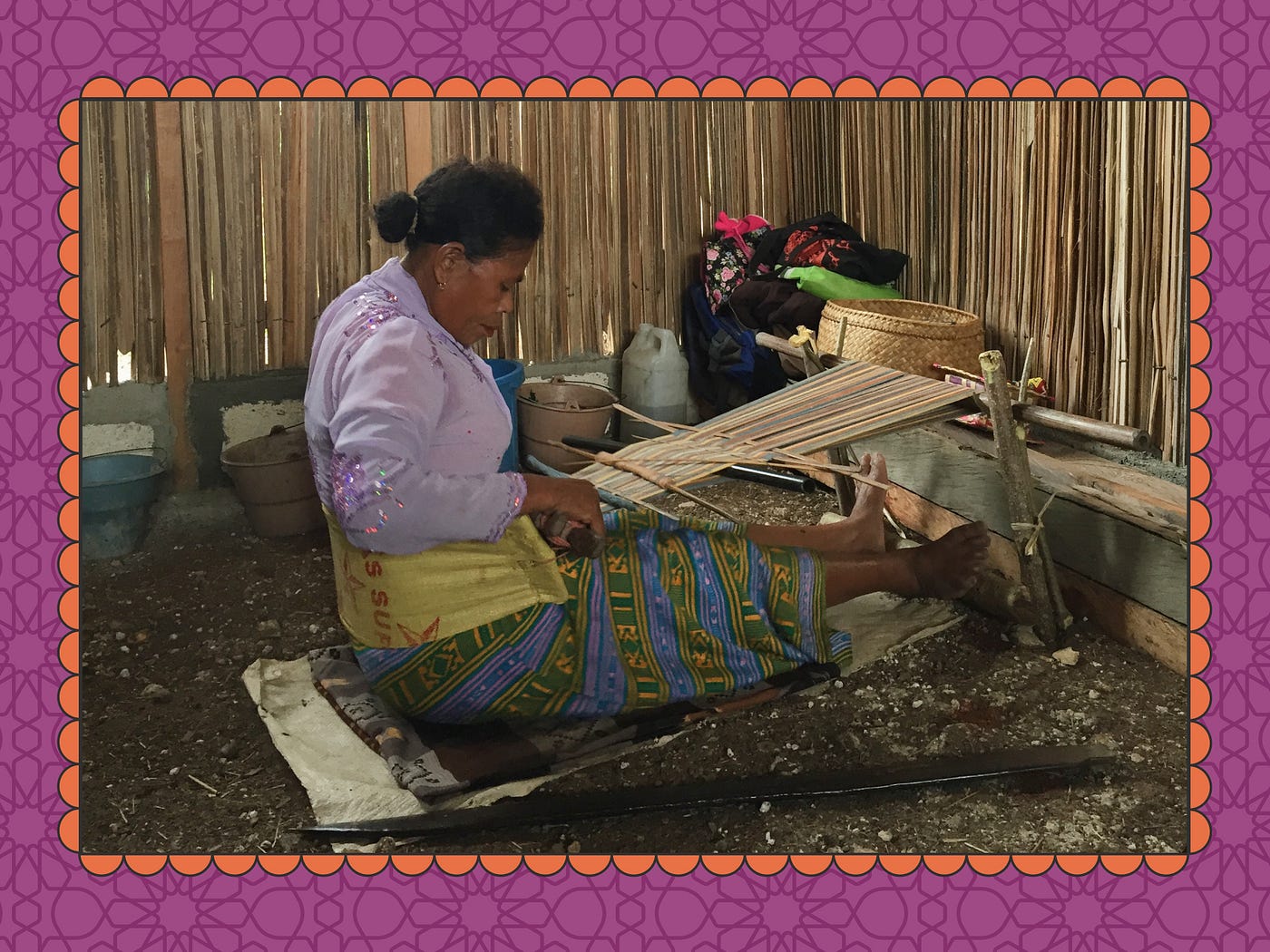
A craftswoman in Lakoat Kujawas is a grassroots community as part of an initiative in Taiftob village, East Nusa Tenggara, Indonesia that blends social entrepreneurship, cultural education, indigenous knowledge archiving, food sovereignty work, literacy and arts programs to empower local youth, strengthen cultural identity, and revive sustainable, locally rooted practices against marginalization and modern consumerism.
I’m testing the idea that systems organized around circulation are more stable than ones organized around accumulation, because they spread risk instead of concentrating it. They might turn resources into actual wellbeing more efficiently, because they cut out the waste that comes with hoarding.
Think about that math from earlier. Money flows toward people who already have it, leaving everyone else scrambling and in debt. The system needs constant growth just to service expanding debt, which creates:
- Planned obsolescence (stuff designed to break)
- Jobs that exist only to service debt, not meet real needs
- Buying things because you feel precarious, not because you need them
- Extraction way beyond sufficiency
Jariyah just needs sufficiency; enough to keep things circulating. No growth imperative means no waste imperative.
There’s a Confucian principle my colleague shared: 饮水思源 “When you drink water, think of the source.” When you poison the source for short-term gain, you poison yourself. When you maintain it for everyone’s benefit, you maintain yourself. This applies to the majority of fractures we are seeing globally: extractive mining, deforestation and monoculture, overfishing, and potential water scarcity due to unsustainable practices.
Potential pushback as an emergent system
Some might counter this hypothesis by arguing that it only works small-scale, in religious communities.
Maybe. But Jariyah scales through differentiation. Each place figures out sufficiency according to its own context. Working with mayors across Asia Pacific on systemic urban transformation, we were activating and optimizing local assets that were already there but disconnected.
Similarly, through his work, Chris Smaje (ex-sociologist turned small-scale farmer) makes the case for organizing societies around local, small-scale farming as a response to climate collapse and capitalist crisis. This is Jariyah logic applied to food systems: distributed land ownership rather than concentrated capital, community stewardship rather than extractive monoculture, common governance rather than shareholder value. Each bioregion figures out sufficiency according to its ecological base
Another counter-argument is that people are selfish.
To which I would respond: Exactly — Jariyah runs on self-interest, over longer time horizons. Those Brazilian communities are building insurance that directly serves them when luck turns.
Some say that without growth, the economy would stagnate.
This conflates growth with wellbeing. Capitalism needs growth because of that math — money concentrating up, debt piling below. Jariyah asks different questions, such as: “Are the needs of all generations — past, present, and future — actually met?”
To those who say this doesn’t fix inequality…
True, it doesn’t magically fix centuries of oppression. But inequality creation is baked into capitalism’s structure: money siphons upward faster than it pumps downward, and happens along racist, colonial, ableist lines — but all this would happen anyway because of how the plumbing works.
Jariyah turns off the engine that keeps regenerating inequality.
Daily practices to start with
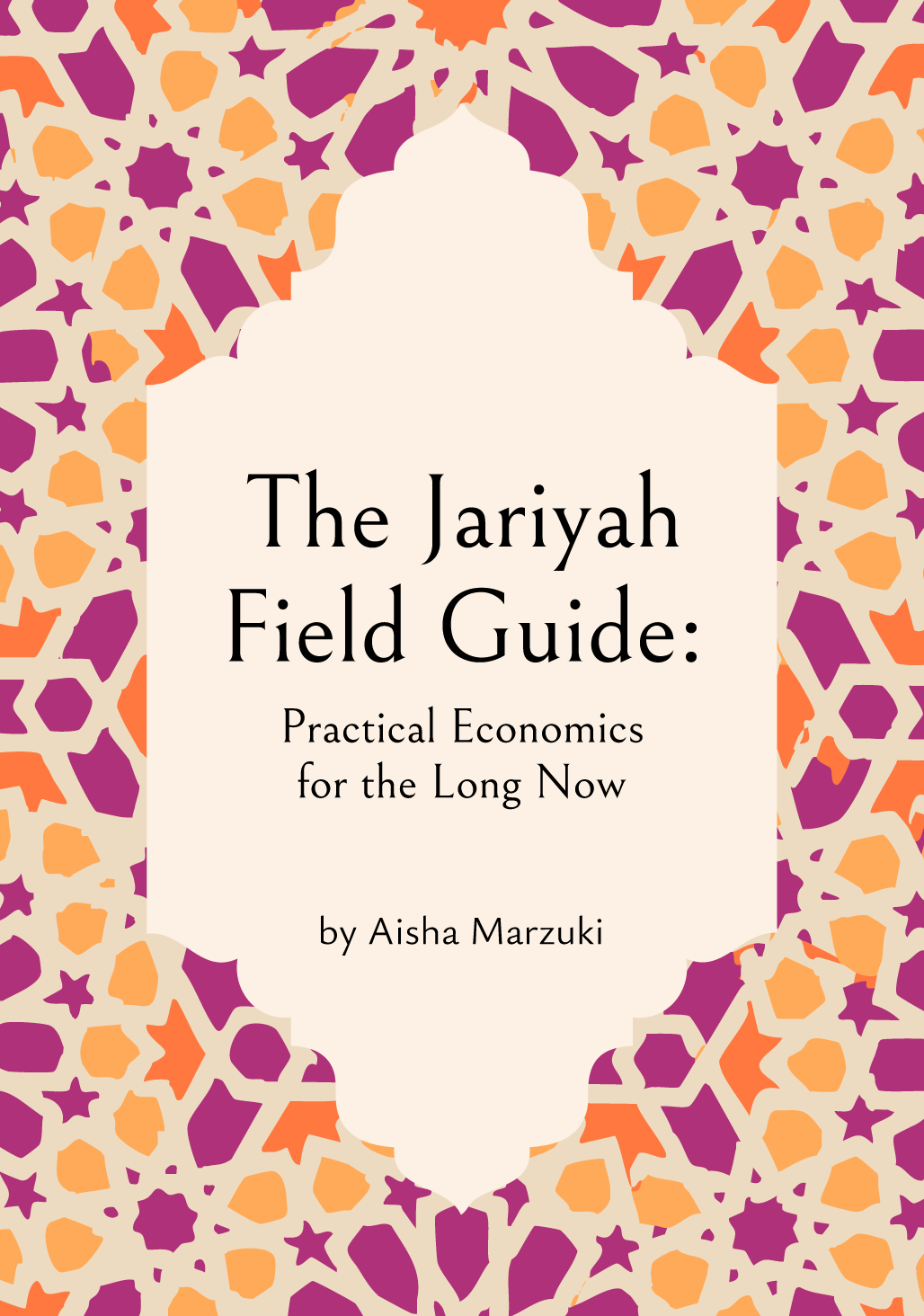
Jariyah Field Guide: Small-scale experiments on alternative growth models and mindsets. Download now.
As a way to document my hypotheses and small-scale tests, I’ve created a field guide with templates, case studies, and week-by-week practices for applying Jariyah principles with the essence as follows:
- Question the default logic. Before spending money, time, energy — pause. Am I optimizing for accumulation or circulation? This quarter or next generation? Just noticing the pattern changes things.
- Share from excess. Not just money: knowledge learned the hard way, tools sitting idle, connections that could help someone. The measure isn’t “did I create an impact?” It’s “did I remove barriers?”
- Build something that lasts. In my current work facilitating urban innovation portfolios, we questioned: What infrastructure keeps working when we leave? What knowledge stays in community hands?Sometimes this looks like formal institutions- those waqf endowments, those water wells. Other times, it looks like 40 years of effort from a couple that converted twenty acres of private land into a public garden that has been gifted to a nonprofit to be maintained as a public garden in perpetuity — now welcoming 14,000+ visitors annually. Turn accumulated resources (land, labor, decades of attention) into circulating benefits (public access, ecological health, community gathering space, annual programming).
- Keep relationships warm. Continuity itself has value that shows up during a crisis. Networks maintained when things are fine become the ones that hold you when they’re not.
- It’s a relay, not a sprint. What did I inherit from people before me? What will people after me need?
- Way forward and reflections
***Download the Field Guide here***.
The infrastructure already exists. It’s been persistently regenerating, running parallel to capitalism — in mosques, indigenous communities, mutual aid networks, practices people’s grandparents taught them.
Looking back, the projects that did work were the ones that tapped into existing circulation systems, builing on what communities were already doing. This proves it’s not about big budgets or fancy tech.
What Smaje gets is that we’re not just facing policy problems requiring better management. We’re watching a civilizational model hit its limits. The “liberal-modernist story” of endless progress and control over nature is breaking down. Which means the future will look more like re-localized, land-based communities than like global supply chains running on cheap energy.
We’re in an in-between time. Old systems showing their cracks, while new ones not fully formed yet. What we build, protect, and practice now will determine what makes it through.
We don’t need to invent something new. Instead, we can notice what already works, connect it across contexts, and join in.
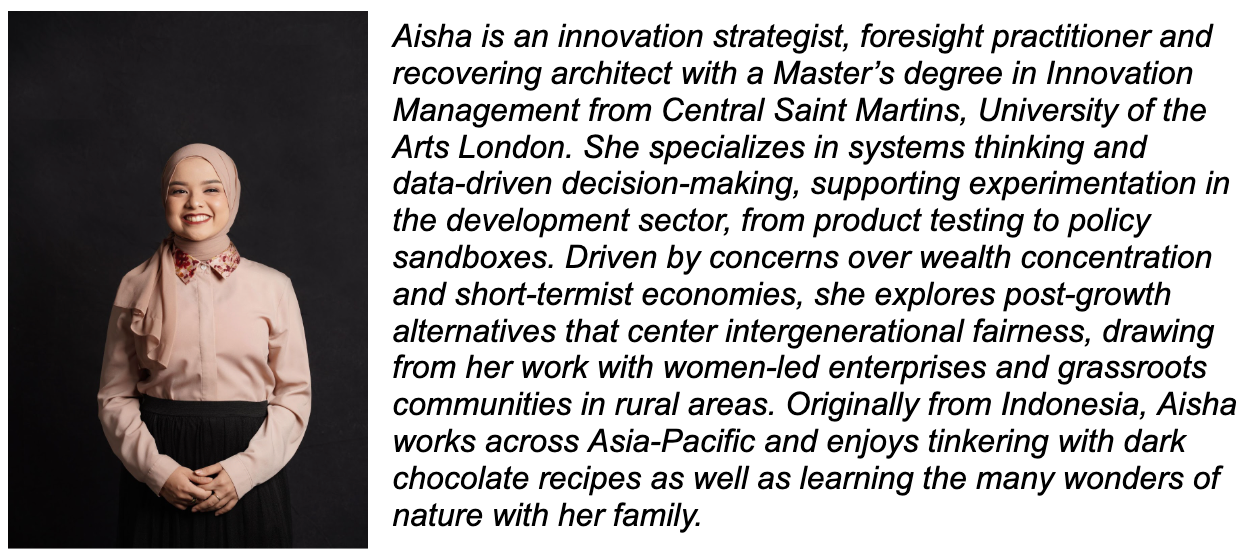
Inspired by this piece? Here are some suggested next steps:
- Explore the Post Growth Institute’s work on circulation economies, radical philanthropy and resource distribution beyond growth.
- Check out the Offers and Needs Market — a practice that embodies circulation over accumulation.
- If you’re working in development, philanthropy, or systems change and want to discuss how these principles might apply to your context, reach out via fellowship@postgrowth.org
- This essay emerged from three years of exploring Islamic economics alongside my work in the development practice in Asia Pacific and beyond, particularly with innovation labs and social enterprise — still learning. If you’re working on adjacent questions about post-growth alternatives that center intergenerational fairness, I’d be interested to hear what you’re finding — reach out via email or add a comment below.
Other resources and credits
On money, debt, and capitalism:
- Maclurcan, D. (2025). Presentation on “Capitalist monetary systems and structural inequality.” Post Growth Institute 2025 Fellows’ Session.
On indigenous practices and the notion of legacy:
- Insights through collaboration with 2025 Post Growth Institute’s Fellows including Sara El-Sayeh, Jane W. Wang, Kaime Silvestre, Trisha Janelle Gragera, Emilia Roig, Lecarl Lim, WarīŇkwī Flores, Konkankoh, and Soumabha Chakraborty through virtual conversations and written reflections.
Additional References & Sources
On Sadaqah Jariyah concept:
- Zakat Foundation of America. “What is Sadaqah Jariyah?”
Zakat Foundation water programs:
- Zakat Foundation of America. “Water Programs.” Zakat Foundation of America. “Zakat Foundation’s Mission to Provide Clean Water Globally.”
Al-Bukhary Foundation & Albukhary International University:
- Ahmed, H., Sabit, M. T., & Haron, M. H. (2017). “The Contribution of Waqf Institutions in Malaysia and Turkey in Improving the Socio-Economic Conditions of the Society.” Journal of Islamic Economics, Banking and Finance, 13(1).
- Albukhary Foundation. “Scholarship Programme.”
- Philanthropies.org. “Syed Mokhtar Al-Bukhary — Philanthropies.”
Diyanet Foundation & Istanbul 29 Mayıs University:
- Ahmed, H., Sabit, M. T., & Haron, M. H. (2017). “The Contribution of Waqf Institutions in Malaysia and Turkey.”
- *Türkiye Diyanet Foundation.*
- *Istanbul 29 Mayıs University.*
On indigenous economic practices:
- Welch, J. R. (2014). “Xavante Ritual Hunting: Anthropogenic Fire, Reciprocity, and Collective Landscape Management in the Brazilian Cerrado.” Human Ecology, 42(1), 47–59.
- Welch, J. R., et al. (2022). “A’uwẽ (Xavante) views of food security in a context of monetarization of an indigenous economy in Central Brazil.” PLOS One, 17(2).
- Indigenous Peoples in Brazil. “Xavante.”
- Tulane University Middle American Research Institute. “Ritual Hunting of the Xavante.”
On knowledge circulation in practice:
- Fajar, J. (2016). “Kisah Sukses Para Petani Salassae Tebar ‘Virus’ Organik” (The Success Story of Salassae Farmers Spreading the ‘Organic Virus’).” Mongabay Indonesia, August 30, 2016.
On intergenerational thinking:
- Smith, B. (2025). “Seven Generations Principle: Healing the Past & Shaping the Future.” The Indigenous Foundation, April 20, 2025.
On post-capitalist local economies:
- Smaje, C. (2020). A Small Farm Future: Making the Case for a Society Built Around Local Economies, Self-Provisioning, Agricultural Diversity and a Shared Earth. Chelsea Green Publishing. Goodreads link
- Bollier, D. (2025). “Chris Smaje’s Vision of a Post-Capitalist Eco-Localism that Works.” Resilience.org, October 15, 2025.
- Smaje, C. (2025). Finding Lights in a Dark Age. Explores post-market economic order and bioregional commerce.
On gardens as Jariyah:
- Nooney, J. (2025). Bedrock: The Making of a Public Garden. Peter E. Randall Publisher.
- *Bedrock Gardens.*
- NH Home Magazine. “Deep Roots at Bedrock Gardens” (June 2025).
메타데이터
- post_id
- a0667a05cfb5
- slug
- jariyah-legacies-and-the-well-that-keeps-giving-a0667a05cfb5
- url
- https://medium.com/postgrowth/jariyah-legacies-and-the-well-that-keeps-giving-a0667a05cfb5
- canonical_url
- https://medium.com/postgrowth/jariyah-legacies-and-the-well-that-keeps-giving-a0667a05cfb5
- author_url
- https://medium.com/@postgrowth
- status
- ok
- fetched_at
- 2026-06-10 22:59:55