How to Build a Family Emergency Communication Plan Before the Grid Fails
A serious family emergency communication plan requires five structural layers: verified contacts, out-of-area coordination, physical rally…
How to Build a Family Emergency Communication Plan Before the Grid Fails
Disclosure: This publication is reader-supported. Purchases made through integrated links may earn an affiliate commission at no additional cost to the consumer, funding ongoing preparedness research and operations. All technical recommendations remain independent and rooted in practical household resilience planning.
A serious family emergency communication plan requires five structural layers: verified contacts, out-of-area coordination, physical rally points, redundant communication channels, and a practiced PACE system that moves from phones to text, radio, printed instructions, and in-person fallback.
The purpose of a family emergency communication plan is not simply to store phone numbers. It is to preserve coordination when ordinary infrastructure becomes unreliable. A household that has not rehearsed its emergency communication plan is depending on memory, battery power, cellular networks, cloud services, and emotional composure at the exact moment those systems are most likely to degrade. A resilient grid down communication plan treats communication as an operational system: documented, distributed, redundant, and tested.
Why Do Family Communication Plans Fail During Real Emergencies?
Family communication plans usually fail because they are designed around convenience rather than failure. The weak point is rarely one broken device. It is usually a systems failure involving dead batteries, overloaded cellular networks, unavailable internet, missing chargers, no printed contact records, no assigned rally points, and no practiced routine.
Modern households are heavily dependent on infrastructure they do not control. Voice calls depend on cellular towers, switching centers, power availability, backhaul networks, and carrier capacity. Messaging apps depend on smartphones, battery power, internet access, app authentication, cloud servers, and data networks. Even a simple family text chain can become unreliable if phones are discharged, local towers are saturated, or a device is lost during evacuation.
This is why FEMA and Ready.gov emphasize household planning before a disaster, including documented contact methods, meeting places, and shared emergency procedures. The Federal Communications Commission has also encouraged short, efficient communication during emergencies because voice calls consume more network resources than text messages. In practice, SMS may succeed when voice calls fail because text can sometimes queue and transmit when network capacity becomes available.
The human factor is equally important. Under stress, people do not retrieve information as cleanly as they do in normal conditions. Children may forget numbers. Adults may assume someone else has already checked in. A spouse may drive toward home while another evacuates in the opposite direction. A written emergency contact plan reduces cognitive load by turning decisions into preassigned procedures. The goal is not to eliminate uncertainty. The goal is to prevent preventable confusion from becoming the primary failure mode.
A grid down communication plan must therefore be treated like household infrastructure. It should be visible, printed, rehearsed, and backed by tools that do not all depend on the same network.
What Should a Family Emergency Communication Plan Include?
A complete family emergency communication plan should include primary family contacts, backup contacts, one out-of-area coordinator, neighborhood contacts, school and workplace contacts, medical contacts, insurance and utility contacts, physical rally points, radio channels, printed cards, and a monthly drill schedule.
The structure matters because each category solves a different failure mode. Immediate family contacts solve direct coordination. Backup contacts solve the problem of a missing parent, unreachable spouse, or unavailable caregiver. The out-of-area contact solves local network congestion by moving coordination outside the affected zone. Neighbor contacts solve the problem of physical proximity when family members are not home. School, childcare, and workplace contacts solve the problem of institutional separation. Medical contacts solve the problem of treatment continuity. Insurance, property, and utility contacts solve the recovery phase after the immediate emergency has passed.
The plan should also include a backup communication system that extends beyond phones. That may include SMS, Wi-Fi calling, messaging apps, GMRS radios, NOAA Weather Radio, licensed Ham radio, vehicle radios, printed contact cards, and in-person rally points. The important point is not owning every device. The important point is assigning each tool a role inside the emergency communication plan.
A household plan should answer five questions without improvisation: Who do we contact first? Who receives status updates if local systems are congested? Where do we go if electronic communication fails? What radio channel do we use? What do children, guests, caregivers, or non-technical family members do if they cannot reach the primary adults?
If those questions are not answered in writing, the household does not yet have a serious family emergency communication plan. It has intentions.
Why Is an Out-of-Area Contact Structurally Important?
An out-of-area contact is not a sentimental addition to an emergency contact plan. It is a redundancy mechanism inside the communication architecture.
During regional disasters, local infrastructure may be congested or physically damaged while networks outside the affected area remain functional. A family member may not be able to call across town, but may still be able to send a text or short call to a relative in another state. That distant person can then act as a message relay: recording who is safe, who is missing, who is evacuating, and where everyone intends to go next.
This approach aligns with FEMA-style family communication planning: when household members are separated, they should know whom to contact and where to reconnect. The out-of-area coordinator becomes a central node in the plan. Instead of every family member attempting to contact every other family member during a congested period, each person checks in with one designated coordinator.
For high-net-worth households with multiple properties, travel schedules, household staff, children in private schools, or elderly relatives in different locations, this function becomes even more important. The out-of-area contact can receive structured updates, contact the estate manager or property manager, confirm school pickup status, and prevent duplicate or conflicting decisions.
A strong grid down communication plan should include at least one primary out-of-area contact and one backup. Their names, phone numbers, email addresses, messaging handles, and physical addresses should be printed in the home copy, vehicle copy, and 72-hour comms bag copy of the plan.
What Is a PACE Communication Plan?
A PACE communication plan is a layered communication model built around four levels: Primary, Alternate, Contingency, and Emergency. The purpose is to prevent the household from depending on one fragile pathway.
In a household context, the PACE communication plan should be practical, not militarized. It should define exactly how the family moves from normal communication to fallback methods as conditions degrade.
Primary communication includes normal calls, SMS, and direct family phone contact. This is the fastest and most familiar layer. It should remain the first attempt because it requires the least training. However, it depends on charged devices, functioning towers, and network capacity.
Alternate communication includes messaging apps, email, secondary phone numbers, Wi-Fi calling, and possibly a second carrier line for households that want extra redundancy. This layer is useful when voice calling fails but some data or Wi-Fi service remains available.
Contingency communication includes the emergency radio setup: FRS radios for short range, GMRS radio for families, vehicle-mounted GMRS radios, NOAA Weather Radio for alerts, and Ham radio for licensed operators. This layer is important because it can operate locally without relying on normal cellular service. It is not magic and it is not unlimited. It is a defined backup communication system with range, terrain, power, and licensing constraints.
Emergency communication includes printed instructions, physical rally points, written contact cards, scheduled check-ins, out-of-area relays, and in-person fallback. This is the layer that still works when devices are dead, networks are down, and no one can get a signal.
The value of a PACE communication plan is procedural clarity. Instead of asking, “What do we do now?” the family follows the sequence: call, text, app or email, radio, printed plan, rally point. A household that practices this sequence has a much stronger emergency communication plan than one that simply owns radios and assumes they will be useful.

How Should a Household Build Its Contact Architecture?
Contact architecture is the organized map of who must be reachable, why they matter, and what failure mode each contact solves.
Immediate family contacts form the core. Each person should have a primary phone number, alternate number if available, email address, and any relevant messaging app handle. For children, include school identification details, pickup permissions, and caregiver contacts.
The out-of-area contact is the relay node. This person should live far enough away that the same regional disaster is unlikely to affect them. The plan should clearly instruct each family member to check in with this contact if local communication becomes unreliable.
A nearby trusted neighbor solves the proximity problem. If parents are away from home, a neighbor may be able to check whether the property is damaged, whether pets are safe, or whether a child arrived home. This contact should be someone who has agreed to the role in advance.
School and childcare contacts solve the separation problem. A family emergency communication plan should include the school office, emergency pickup location, after-hours number, and names of authorized pickup adults. It should also state what the child should do if normal pickup is delayed.
Workplace contacts solve the adult separation problem. If one spouse is unreachable, the other should know the workplace address, office number, security desk number, and likely evacuation location.
Medical contacts solve continuity-of-care failure. Include primary care physicians, specialists, pharmacies, medication lists, allergy information, and health insurance contacts. This matters especially for children, elderly relatives, or anyone with chronic conditions.
Insurance and utility contacts solve the recovery-stage communication problem. Home insurance, auto insurance, flood insurance, health insurance, electric, gas, water, internet, alarm monitoring, and property management numbers should be available offline. During a disruption, the ability to begin claims, shut off utilities, or request service restoration may directly affect property protection.
For affluent households, include the property manager, estate manager, private security provider, attorney, family office, or trusted financial advisor where appropriate. These contacts should not clutter the children’s version of the plan, but they belong in the adult master copy and encrypted USB backup.
What Meeting Locations Should Be Included in the Plan?
Physical rally points are the final communication method when electronic systems fail. A meeting location is not just a place. It is a message expressed in advance.
The first location should be the primary home meeting point: the front porch, driveway, mailbox, gate, or another obvious place where household members gather if the emergency occurs while everyone is nearby. This location solves immediate confusion after a fire alarm, local outage, or neighborhood incident.
The second location should be a nearby neighborhood rally point. This may be a trusted neighbor’s house, community clubhouse, park entrance, church parking lot, or school perimeter. It should be close enough to reach on foot but far enough from the home to remain useful if the property itself is unsafe.
The third location should be an out-of-neighborhood site. This might be a library, hotel lobby, private club, relative’s house, or office outside the immediate affected area. It solves the problem of a neighborhood evacuation or blocked local access.
The fourth location should be an out-of-town family location or hotel option. This matters when a household must relocate after a wildfire, hurricane, civil disruption, extended outage, or major infrastructure failure. The plan should include the address, phone number, driving route, and expected check-in procedure.
A vehicle rendezvous point is also valuable. If family members evacuate in separate vehicles, they should know where to regroup along the route. This may be a highway rest area, fuel station outside the city, or predetermined parking lot.
School and workplace pickup locations should be written separately. A child should know where to wait if phones fail. Parents should know whether the school uses a main entrance, reunification site, or alternate evacuation location.
A resilient emergency communication plan treats these locations as operational instructions. If the network fails, the family does not wait indefinitely for a message. It moves according to preassigned logic.
How Do Radios Strengthen a Household Communication Plan?
Radios strengthen a household communication plan by adding a contingency layer that does not depend on normal cellular networks. However, radios are not a complete plan by themselves. A radio without assigned channels, charged batteries, trained users, and printed instructions is only equipment.
FRS radios are the simplest short-range backup. In the United States, FRS is license-free when using compliant radios. It is useful for very local coordination: within a property, around a neighborhood, during travel stops, or between vehicles at short range. Its limitations are range, terrain, power, and congestion.
GMRS is often the practical family radio layer. A GMRS radio for families can provide stronger capability than basic FRS equipment, especially when using higher-power handhelds, mobile radios, or repeaters where legally available. In the United States, GMRS operation requires an FCC license, and readers should verify current licensing terms directly with the FCC. For many households, GMRS radio for families offers the best balance of usability, range, and simplicity.
Midland is often associated with user-friendly GMRS radios and vehicle-mounted units suitable for non-technical families. Baofeng/BTECH offers more configurable GMRS options for users willing to learn menus, programming, and channel discipline. Both Midland and Baofeng/BTECH should be treated as tools, not substitutes for procedure. The family still needs a written channel card, call signs where required, charging discipline, and a monthly radio test.
Ham radio is the trained-operator layer. It can provide broader communication capability, but it requires licensing, practice, and responsible operation. ARRL describes amateur radio as a service that can operate without internet or cell phones and that becomes especially valuable when normal communication channels fail. Yaesu and Icom are established manufacturers for licensed Ham operators who want more capable handheld, mobile, or base-station equipment. In a household plan, Yaesu and Icom equipment belongs with the trained operator, not with untrained family members who may not know legal or technical constraints.
NOAA Weather Radio is the alerting layer. NOAA Weather Radio All Hazards broadcasts official weather and hazard information 24 hours a day, seven days a week, and should be included in the emergency radio setup. It is not a two-way communication tool, but it provides official situational awareness when internet access and mobile alerts are unavailable.
Vehicle-mounted GMRS is the stronger mobile layer. For households that travel, evacuate, or maintain rural property, a vehicle radio can extend the backup communication system beyond handheld range. It should be paired with printed channel instructions and power planning.
Radio laws vary by country. Readers outside the United States should verify current rules with their local communications authority before transmitting. Even within the United States, licensing rules, allowed power, equipment certification, and repeater use should be confirmed with current FCC guidance.
What Should Be Printed and Stored Offline?
Digital-only plans fail because they assume device availability, battery power, login access, and network connectivity. A serious family emergency communication plan must exist offline.
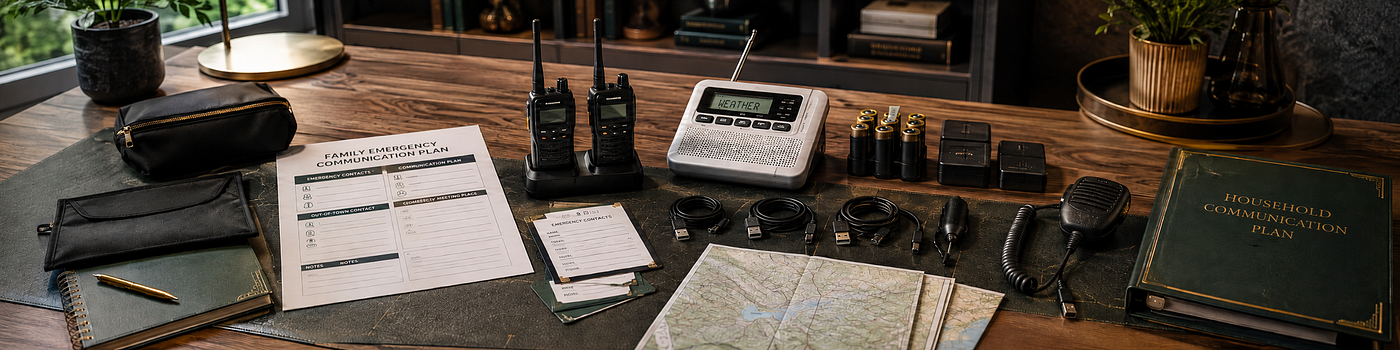
Printed copies should include the complete family emergency communication plan, contact cards, radio channel card, repeater information if applicable, medical summary, insurance contact sheet, property and utility contact sheet, paper maps, school and workplace pickup instructions, and out-of-area contact instructions.
The contact cards should be simple enough for children and non-technical adults. They should include primary family numbers, out-of-area contact, neighborhood rally point, out-of-neighborhood rally point, and the basic PACE sequence: call, text, app/email, radio, rally point.
The radio channel card should include the family GMRS or FRS channel, privacy tone if used, repeater details if applicable, NOAA Weather Radio frequency for the area, and Ham radio contact procedures for licensed operators. It should also state when not to transmit, especially on frequencies requiring a license.
The plan should exist in three physical locations: home, vehicle, and 72-hour comms bag. The home copy is the master reference. The vehicle copy is for separation, evacuation, or being away from home when the grid fails. The 72-hour comms bag copy is the mobile continuity copy, paired with radios, chargers, power banks, batteries, maps, and identification documents.
The 72-hour comms bag should not become a cluttered emergency drawer. It should be a structured communication module: printed plan, contact cards, backup power, emergency radio setup, charging cables, spare batteries, and protected digital backups.
How Should Communication Documents and Backup Electronics Be Protected?
There is a difference between operational documents and continuity documents.
Operational documents must be accessible. These include printed contact cards, rally point instructions, radio channel cards, and school pickup instructions. They should be stored in waterproof sleeves or document pouches where family members can reach them quickly. They should not be locked away in a safe that only one adult can access.
Continuity documents are deeper backups. These may include scanned IDs, insurance policies, property records, medical summaries, emergency communication plan copies, encrypted PDFs, and offline maps. They can be stored on encrypted USB drives or offline devices. The objective is not convenience. The objective is recovery if cloud access, phone access, or home office equipment fails.
Critical backup electronics should also be organized. Spare radios, USB drives, power banks, charging cables, adapters, offline-map devices, and backup phones should be stored together, charged on a schedule, and labeled clearly. This is where EMP proof radio storage becomes part of the broader continuity architecture.
EMP proof radio storage should be discussed carefully. No household storage method should be described as failure-proof. However, a verified Faraday pouch or bag can add a protective layer for backup electronics against radio-frequency exposure and unwanted wireless signals when used correctly. The point is not to make dramatic guarantees. The point is to avoid scattering critical backup devices across drawers, cars, bags, and offices where they cannot be found or verified.
Mission Darkness Faraday bags are a premium option for households that want organized Faraday storage for backup radios, encrypted USB drives, power banks, offline-map devices, charging cables, and small emergency electronics. Mission Darkness Faraday bags should be treated as part of a storage protocol: devices labeled, charged, tested, placed inside correctly, and inspected during monthly drills.
Why Protected Storage Completes the Communication Architecture
Spending money on radios, power banks, offline devices, and backup phones is incomplete if the continuity layer is scattered, discharged, or exposed. A household may own excellent tools and still fail operationally because the equipment is not in one place, not charged, not protected, or not understood by the people expected to use it.
Protected storage completes the communication architecture by connecting equipment to procedure. The printed plan tells the family what to do. The radio channel card tells them where to transmit. The 72-hour comms bag keeps the essentials portable. The Faraday pouch preserves a controlled backup electronics layer.
For premium household preparedness, Mission Darkness Faraday bags fit naturally into this continuity role. They are not a substitute for training, radio discipline, batteries, documentation, or monthly testing. They are a storage layer for critical backup electronics inside a larger emergency communication plan and grid down communication plan.
What Is the Monthly Testing Protocol?
A monthly testing protocol turns a written plan into an operational system. Without testing, the plan slowly decays. Phone numbers change, children move schools, employees change roles, batteries discharge, cables disappear, apps log out, and printed cards become inaccurate.
The monthly test should confirm all phone numbers, test SMS and calls, test GMRS radios, check battery levels, review meeting locations, update printed cards, confirm the out-of-area contact, inspect waterproof sleeves, inspect Faraday pouch closure if used, and replace missing cables or weak batteries.
The test should begin with the primary layer: each household member sends a text and places a short call. Next, the alternate layer is tested through email, messaging app, or Wi-Fi calling. Then the contingency layer is tested: turn on the GMRS radios, confirm the assigned family channel, conduct a short radio check, verify chargers, and confirm the NOAA Weather Radio works. If the household includes a licensed Ham operator, the operator should check the Ham station, antenna, battery, and local net schedule.
The emergency layer should also be rehearsed. Ask each family member to name the home meeting point, neighborhood rally point, out-of-neighborhood site, and out-of-area contact. Children should physically identify where the contact card is located. Adults should verify the vehicle copy and 72-hour comms bag copy of the plan.
This process should be calm and routine. A family emergency communication plan should not feel like an annual panic event. It should feel like maintaining smoke detectors, checking a generator, or updating insurance records.
Family Emergency Communication Plan Architecture


Family Emergency Communication Plan Architecture
Primary and Alternate Layers
- Primary phone contact — Direct family communication. Solves normal separation during daily life. Requires smartphones, saved contacts, and a printed contact list. Test monthly.
- SMS/text messaging — Low-bandwidth check-ins. Solves voice network congestion. Requires charged phones and SMS-capable service. Test monthly.
- Messaging apps or email — Alternate digital communication. Solves voice calling failure or partial data availability. Requires apps, email access, Wi-Fi, and secondary devices. Test monthly.
- Out-of-area contact — Central relay outside the affected zone. Solves local network congestion or regional disruption. Requires a designated coordinator and printed contact card. Test monthly.
Physical and Radio Layers
- Physical rally points — In-person fallback coordination. Solves total electronic communication failure. Requires printed addresses, maps, and household agreement. Review monthly and visit quarterly.
- GMRS family radio channel — Local two-way family communication. Solves cellular or internet outage. Requires GMRS radios, batteries, license where required, and a channel card. Test monthly.
- Ham radio operator layer — Trained extended communication. Solves wider infrastructure failure. Requires a licensed operator, Yaesu or Icom radio, antenna, and power. Test monthly.
- NOAA weather radio alerts — Official hazard awareness. Solves loss of mobile alerts or internet warnings. Requires NOAA Weather Radio, batteries, and charger. Test monthly.
Offline and Continuity Layers
- Printed contact cards — Offline contact recovery. Solves dead phone, stress, and memory failure. Requires laminated cards or waterproof sleeves. Review monthly.
- Vehicle copy of the plan — Communication plan while away from home. Solves separation during travel or evacuation. Requires printed plan, map, charger, and vehicle radio if used. Check monthly.
- 72-hour comms bag copy — Portable communication continuity. Solves evacuation or extended outage. Requires printed plan, radios, power bank, cables, and batteries. Check monthly.
- Encrypted USB backup — Offline digital document recovery. Solves cloud failure, device loss, or office damage. Update monthly or after major changes.
- Faraday pouch for backup electronics — Protected storage for backup devices. Solves disorganized, exposed, or unprotected electronics. Requires Mission Darkness Faraday bags or verified pouch and labeled electronics. Inspect monthly.
What Mistakes Cause Family Communication Plans to Collapse?
The first major mistake is keeping the plan only on a phone. A phone is convenient, but it is also fragile: it can run out of power, lose signal, break, require authentication, or disappear during evacuation. A real emergency contact plan must be printed.
The second mistake is not choosing an out-of-area contact. Without a relay outside the affected region, each family member may waste battery power trying to reach multiple people through the same congested local network.
The third mistake is failing to assign physical rally points. Electronic communication is not guaranteed. Physical locations are the analog communication layer.
The fourth mistake is buying radios without assigning channels. A GMRS radio for families is useful only if the family knows which channel to use, when to monitor, how to charge the radio, and what language to use during check-ins.
The fifth mistake is failing to teach children, elderly relatives, caregivers, or non-technical family members. The plan must work for the least technical person in the household, not just the person who bought the equipment.
The sixth mistake is forgetting chargers and spare batteries. A backup communication system without power planning is not a backup system.
The seventh mistake is never testing the plan. An emergency radio setup that has never been used will be slow, confusing, and unreliable under stress.
The eighth mistake is allowing printed contact cards to become outdated. A wrong number in an emergency is not a minor administrative error. It is a broken link in the chain.
The ninth mistake is assuming one communication method will always work. Phones, apps, radios, and in-person plans all solve different failure modes. None should carry the entire burden.
The tenth mistake is storing backup electronics without organization or protection. EMP proof radio storage, waterproof document protection, labeled cables, and charged power banks are not aesthetic details. They are continuity controls.
Why Is Communication a Wealth Preservation Layer?
Communication is a wealth preservation layer because it protects decision-making capacity. During disruption, information becomes a strategic asset. A household that can communicate can coordinate movement, verify safety, protect property, access documents, contact insurers, manage relocation timing, and make better financial decisions under pressure.
This matters because financial resilience is not only about assets. It is also about sequence. The family that can verify where everyone is, determine whether the home is safe, reach the property manager, contact the insurer, access documents, and coordinate relocation has a much stronger operational position than a family with assets but no communication.
During an extended disruption, confusion can become expensive. Missed insurance deadlines, delayed property mitigation, poor evacuation timing, duplicate hotel bookings, inability to reach advisors, and loss of documentation can all convert a physical emergency into a financial loss event.
A serious grid down communication plan therefore supports tactical wealth preservation. Before a family can think clearly about gold, silver, investments, insurance disputes, relocation, or long-term asset protection, it must secure the systems that protect judgment: water, power, food, security, communication, and documentation.
A family emergency communication plan is not a low-level preparedness worksheet. It is a command structure for the household. It tells people how to reconnect, how to relay information, where to go, what tools to use, and how to maintain enough clarity to make disciplined decisions when normal systems fail.
Securing your physical food supply is the ultimate insurance policy. Once your pantry is secure, the next step is securing your purchasing power. **Join the free Resilient Life newsletter** for weekly off-grid blueprints and tactical wealth preservation strategies.
Frequently Asked Questions (FAQ)
What is the most important part of a family emergency communication plan?
The most important part is the structure: verified contacts, an out-of-area coordinator, physical rally points, redundant channels, and a practiced PACE communication plan. If one element must be prioritized first, choose the out-of-area contact and printed contact cards because they give separated family members a clear relay point when local communication is unreliable.
Should every family have GMRS radios?
Not every family needs GMRS radios, but many households benefit from them. GMRS can be a practical contingency layer for local communication when phones are unavailable, especially for families with multiple vehicles, larger properties, rural exposure, or neighborhood coordination needs. A GMRS radio for families should be paired with licensing compliance, assigned channels, spare batteries, and monthly testing.
Do I need Ham radio for a household emergency plan?
Ham radio is not mandatory for every household. It is valuable when at least one family member is willing to become licensed, learn the equipment, and practice regularly. For most households, SMS, out-of-area coordination, GMRS, NOAA Weather Radio, printed instructions, and rally points may be the practical foundation. Ham radio adds depth for trained operators using equipment from brands such as Yaesu or Icom.
How often should we update our emergency contact plan?
Update the emergency contact plan monthly during a short household communication test. Also update it immediately after any change in phone numbers, school, workplace, medical provider, insurance provider, address, caregiver, property manager, or emergency contact. A plan that is six months out of date may fail at the exact moment it is needed.
Works Cited
- Federal Emergency Management Agency (FEMA). “Make a Plan” and “Safeguard Critical Documents and Valuables.” https://www.fema.gov/
- Ready.gov. “Family Emergency Communication Plan,” “Build a Kit,” and “Emergency Financial First Aid Kit.” https://www.ready.gov/
- Cybersecurity and Infrastructure Security Agency (CISA). “Emergency Communications” and “Leveraging the PACE Plan into the Emergency Communications Ecosystem.” https://www.cisa.gov/
- Federal Communications Commission (FCC). “General Mobile Radio Service,” “Family Radio Service,” “Amateur Radio Service,” and emergency communication guidance. https://www.fcc.gov/
- National Oceanic and Atmospheric Administration / National Weather Service. “NOAA Weather Radio All Hazards.” https://www.weather.gov/nwr
- American Radio Relay League (ARRL). “Getting Licensed” and “Technician License Resources.” https://www.arrl.org/
- Midland. “MicroMobile GMRS Radios and MXT275 Documentation.” https://midlandusa.com/
- BTECH / BaoFeng Tech. “GMRS Radio Documentation.” https://baofengtech.com/
- Yaesu. “Amateur Radio Transceivers.” https://www.yaesu.com/
- Icom America. “Amateur Radio Equipment.” https://www.icomamerica.com/
- Mission Darkness / MOS Equipment. “Faraday Bags and RF Shielding Products.” https://mosequipment.com/
메타데이터
- post_id
- a067dd1ae2e9
- slug
- how-to-build-a-family-emergency-communication-plan-before-the-grid-fails-a067dd1ae2e9
- url
- https://medium.com/@resilientlife-premium/how-to-build-a-family-emergency-communication-plan-before-the-grid-fails-a067dd1ae2e9
- canonical_url
- https://medium.com/@resilientlife-premium/how-to-build-a-family-emergency-communication-plan-before-the-grid-fails-a067dd1ae2e9
- author_url
- https://medium.com/@resilientlife-premium
- status
- ok
- fetched_at
- 2026-06-09 15:37:30