Mixture of Experts (MoE): Revolutionizing Deep Ensemble Learning
In the ever-expanding universe of machine learning, the quest for models that can navigate the complexities of vast and varied datasets has…
Mixture of Experts (MoE): Revolutionizing Deep Ensemble Learning
In the ever-expanding universe of machine learning, the quest for models that can navigate the complexities of vast and varied datasets has led to the evolution of sophisticated architectures. Among these, the Mixture of Experts (MoE) framework stands out as a pinnacle of deep ensemble learning, offering a blend of specialized networks, or “experts,” to tackle diverse tasks. This blog post delves into the intricacies of MoE, exploring its context, motivations, underlying science, common techniques, and applications, shedding light on why it’s considered a game-changer in the field.
Context and Motivations
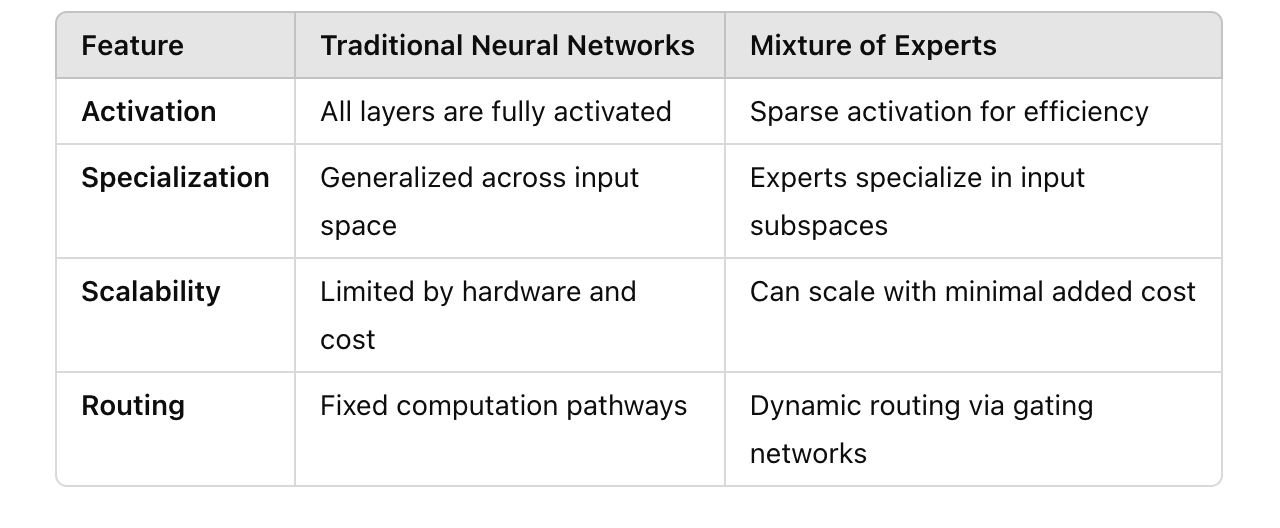
The MoE model is rooted in the idea that “many hands make light work.” In machine learning, this translates to leveraging multiple expert networks, each specialized in different aspects of the data, to achieve superior performance. The motivation behind MoE is to create a dynamic system where the strengths of various experts can be harnessed based on the input data, allowing for more flexible and accurate predictions than what a single model could achieve.
The Science Underpinning MoE
The Mixture of Experts (MoE) framework is a fascinating embodiment of the principle that combining the strengths of multiple specialized entities can lead to superior outcomes than relying on a singular, generalized approach. This concept, deeply rooted in the science of machine learning, hinges on the synergy between expert networks and a gating mechanism, creating a system that adapts dynamically to varying input data. Let’s delve deeper into the science underpinning MoE to understand its operation and the rationale behind its design.
Expert Networks: The Specialists
In an MoE model, each expert is essentially a neural network trained to perform well on a subset of the overall data or task. These experts are akin to specialists in a field, each bringing a unique perspective or skill set to the table. The common backbone network preceding these experts serves as a feature extractor, transforming raw input into a high-level representation that the experts can work with more effectively. This setup allows each expert to focus on patterns or data characteristics it’s best equipped to handle, leading to more nuanced and accurate predictions.
Gating Network: The Conductor
The gating network is what distinguishes MoE from a simple ensemble of models. It’s a trainable component that learns to allocate the right amount of attention (or weight) to each expert’s output based on the input data. This allocation is not arbitrary; it’s determined by the gating network’s assessment of which expert is most likely to produce the correct output for a given input. The gating mechanism effectively conducts the ensemble, directing the input to the most relevant experts and synthesizing their outputs into a cohesive prediction. This dynamic routing capability allows the MoE model to be highly adaptable and efficient, leveraging the most appropriate resources for each task.
Adaptive Learning and Decision Making
The gating network’s decision-making process is a critical aspect of MoE’s adaptive learning capability. It involves a soft weighting of experts’ contributions, where instead of selecting a single expert for each input, the model combines outputs from multiple experts, weighted by their relevance to the input as determined by the gate. This soft decision-making process ensures that the model can leverage complementary knowledge from different experts, enhancing its flexibility and robustness.
Common Techniques and Challenges
Training an MoE model is no small feat. It involves not only optimizing the individual experts but also fine-tuning the gating mechanism to ensure that it accurately identifies and leverages the strengths of each expert. A common challenge is dealing with unresponsive gate components, where the gate fails to allocate the input to the most suitable expert(s), leading to suboptimal performance.
To address these challenges, techniques such as sparsity regularization and gradient blending are often employed. Sparsity regularization encourages the gating network to use fewer experts per input, simplifying the decision-making process and reducing computation. Gradient blending, meanwhile, helps mitigate training instability by adjusting the learning signals sent to the experts and the gate.
Applications of MoE
The versatility and dynamic nature of the MoE framework make it suitable for a wide range of applications. In natural language processing (NLP), MoE models have set new benchmarks by effectively handling linguistic nuances across different languages and contexts. In computer vision, they excel in tasks requiring fine-grained recognition, such as identifying subtle differences in images that a conventional model might overlook.
Moreover, MoE models are making strides in personalized recommendation systems, where they can cater to the diverse preferences of users by engaging different experts for different types of content or user profiles. This ability to adapt and specialize based on the input data is what makes MoE particularly exciting for future applications.
Conclusion
The Mixture of Experts framework is a testament to the innovative spirit of the machine learning community, pushing the boundaries of what ensemble models can achieve. By intelligently combining the strengths of multiple expert networks under the guidance of a sophisticated gating mechanism, MoE models offer a level of flexibility, efficiency, and accuracy that is hard to match. As we continue to explore and refine this framework, the potential for groundbreaking applications across various domains seems limitless. The journey of MoE is just beginning, and its future in advancing artificial intelligence is undoubtedly bright.
메타데이터
- post_id
- a07cab67d2ae
- slug
- mixture-of-experts-moe-revolutionizing-deep-ensemble-learning-a07cab67d2ae
- url
- https://medium.com/@VectorWorksAcademy/mixture-of-experts-moe-revolutionizing-deep-ensemble-learning-a07cab67d2ae
- canonical_url
- https://medium.com/@VectorWorksAcademy/mixture-of-experts-moe-revolutionizing-deep-ensemble-learning-a07cab67d2ae
- author_url
- https://medium.com/@VectorWorksAcademy
- status
- ok
- fetched_at
- 2026-08-12 00:29:21