AI and Real Estate Tokenization: Building Smarter Property Investment Markets
Real estate has long been one of the most valuable and stable asset classes in the world. Yet despite its size and importance, the industry…
AI and Real Estate Tokenization: Building Smarter Property Investment Markets
Real estate has long been one of the most valuable and stable asset classes in the world. Yet despite its size and importance, the industry continues to face challenges that limit efficiency and accessibility. Property investments often require significant capital, transactions can take weeks or months to complete, and market data is frequently fragmented across multiple sources.
At the same time, investors increasingly expect digital-first experiences, real-time insights, and greater flexibility in managing their portfolios. This is where two transformative technologies — Artificial Intelligence (AI) and real estate tokenization — are beginning to reshape the future of property investment.
Real estate tokenization enables ownership interests in properties to be represented as digital tokens on a blockchain, making assets more liquid and accessible. AI complements this by providing advanced analytics, predictive insights, automated due diligence, and intelligent decision-making capabilities.
Together, AI and real estate tokenization are creating smarter property investment markets that are more transparent, efficient, and inclusive than traditional real estate systems.
Understanding Real Estate Tokenization
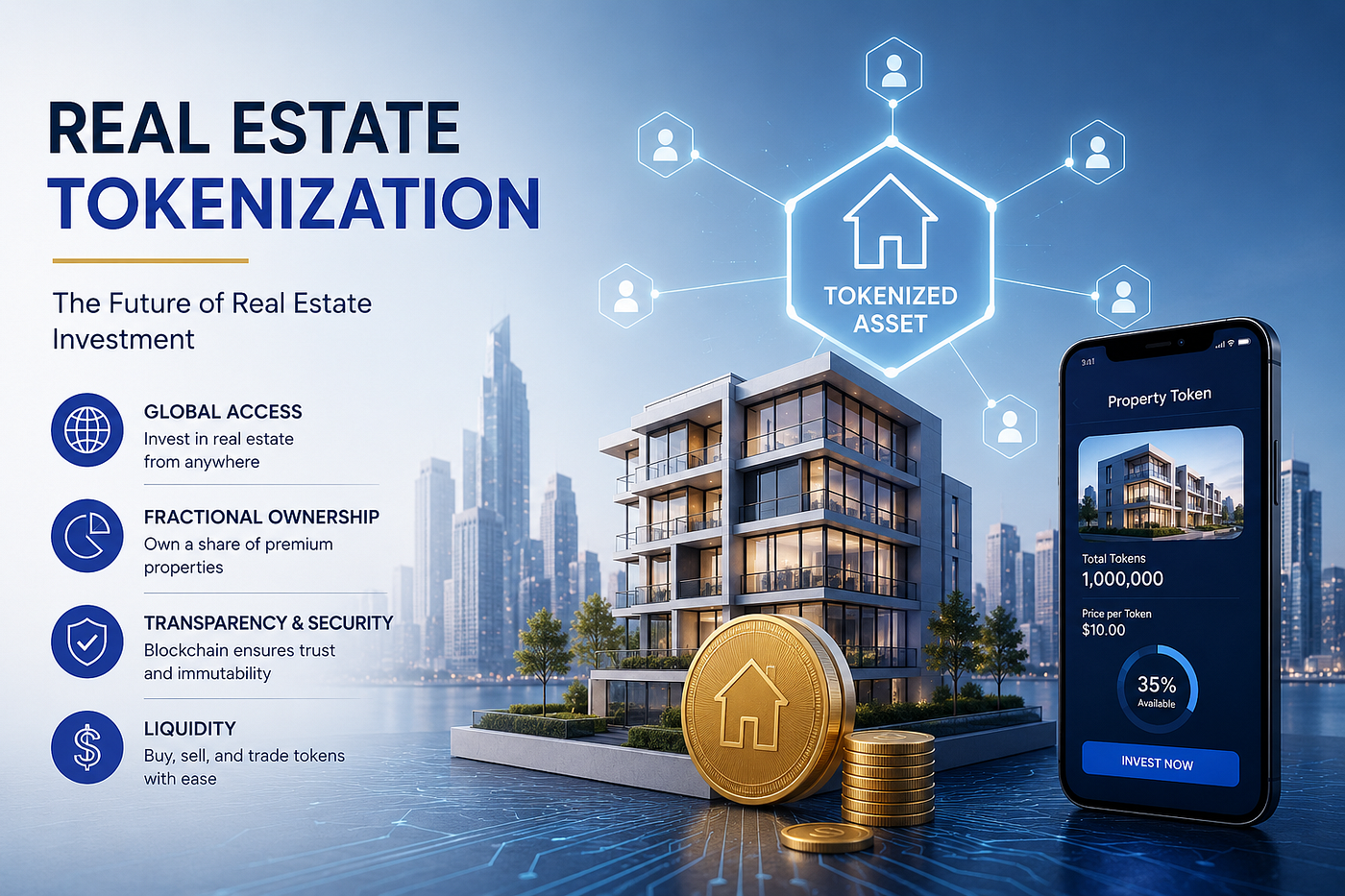
Real estate tokenization is the process of converting ownership rights in a property into digital tokens recorded on a blockchain. Each token represents a fractional interest in the underlying asset, allowing ownership to be divided among multiple investors.
Traditionally, investing in commercial buildings, residential developments, or large real estate projects has required substantial capital commitments. Tokenization lowers these barriers by enabling fractional ownership, allowing investors to purchase smaller portions of an asset rather than acquiring an entire property.
For example, a commercial office building valued at $10 million can be divided into thousands of digital tokens. Investors can purchase a fraction of the property and participate in potential rental income and capital appreciation based on their ownership percentage.
Key benefits of real estate tokenization include:
- Increased liquidity
- Fractional ownership opportunities
- Reduced investment thresholds
- Enhanced transparency
- Faster transaction processing
- Global investor participation
- Improved asset management efficiency
As blockchain technology modernizes ownership structures, AI is helping investors and asset managers make better decisions throughout the investment lifecycle.
The Role of AI in Modern Real Estate Markets
The real estate industry generates enormous volumes of data, including property records, market trends, economic indicators, demographic information, lease agreements, and transaction histories. AI helps transform this raw data into actionable intelligence.
Intelligent Property Valuation
Property valuation has traditionally relied on historical sales data, market comparisons, and professional appraisals. While effective, these methods can be time-consuming and may not always capture rapidly changing market conditions.
AI-powered valuation models analyze thousands of variables simultaneously, including:
- Historical sales data
- Neighborhood development trends
- Population growth
- Economic activity
- Rental demand
- Infrastructure projects
- Market sentiment
These systems continuously update valuations as new information becomes available, helping investors make more informed decisions.
Predictive Investment Insights
One of AI’s most valuable capabilities is its ability to identify patterns and forecast future outcomes.
Using predictive analytics, AI can help investors evaluate:
- Future property appreciation
- Rental yield potential
- Occupancy rates
- Market demand trends
- Geographic growth opportunities
Instead of relying solely on historical performance, investors can leverage AI-generated forecasts to identify emerging opportunities before they become widely recognized.
Automated Risk Assessment
Risk management is critical in real estate investing. AI systems can analyze large datasets to identify potential risks that may be overlooked through manual reviews.
Examples include:
- Market volatility indicators
- Legal disputes
- Environmental concerns
- Zoning restrictions
- Tenant default risks
- Regulatory changes
Automated risk analysis helps investors evaluate opportunities more thoroughly and make better-informed investment decisions.
How AI Enhances Real Estate Tokenization Platforms
While tokenization creates digital ownership structures, AI adds intelligence that improves platform efficiency and investor confidence.
Smarter Asset Selection
Not every property is an ideal candidate for tokenization.
AI can evaluate thousands of potential assets based on:
- Market demand
- Revenue generation
- Occupancy performance
- Asset quality
- Geographic attractiveness
- Investor interest
This enables tokenization platforms to identify high-potential properties that are more likely to attract investors and generate liquidity.
Automated Due Diligence
Due diligence is often one of the most time-consuming phases of real estate transactions.
AI-powered systems can automate the review of:
- Property records
- Ownership documents
- Lease agreements
- Compliance reports
- Financial statements
- Insurance records
Machine learning models can flag inconsistencies, missing information, or potential risks, significantly reducing review times while improving accuracy.
Dynamic Pricing Models
Traditional property valuations may only be updated periodically. Tokenized real estate markets require more dynamic pricing mechanisms.
AI can continuously monitor:
- Market activity
- Investor demand
- Rental performance
- Economic indicators
- Comparable property transactions
This enables more accurate token pricing and creates a more responsive marketplace for buyers and sellers.
Investor Personalization
Different investors have different objectives.
Some prioritize stable rental income, while others seek long-term appreciation or diversification opportunities.
AI-powered recommendation engines can analyze investor profiles and suggest opportunities that align with:
- Risk tolerance
- Investment goals
- Preferred property types
- Geographic preferences
- Portfolio allocation strategies
This creates a more personalized investment experience and improves investor engagement.
Building Smarter Property Investment Markets Through AI and Tokenization
The combination of AI and real estate tokenization offers significant advantages over traditional property investment models.
Greater Liquidity
Real estate has historically been an illiquid asset class. Selling a property can take months and often involves substantial transaction costs.
Tokenization enables fractional ownership and secondary market trading, while AI helps optimize pricing and market matching, creating more liquid investment opportunities.
Real-Time Market Intelligence
AI continuously analyzes market conditions, providing investors with real-time insights that support faster and more informed decisions.
This contrasts with traditional real estate investing, where critical information is often delayed or fragmented.
Fractional Ownership at Scale
Tokenization opens property investments to a broader range of participants.
Investors no longer need substantial capital to gain exposure to premium real estate assets. AI further enhances accessibility by helping investors identify opportunities that match their financial goals.
Automated Compliance
Compliance is a major challenge in regulated investment markets.
AI-powered compliance tools can automate:
- KYC verification
- AML screening
- Investor eligibility checks
- Regulatory monitoring
- Transaction reporting
Combined with blockchain’s immutable recordkeeping, this creates a more secure and compliant investment ecosystem.
Faster Transactions
Smart contracts automate many processes traditionally handled by intermediaries.
AI supports transaction efficiency by streamlining due diligence, verification, and risk assessment, reducing delays throughout the investment lifecycle.
Improved Transparency
Blockchain provides an immutable record of ownership and transactions, while AI delivers deeper visibility into asset performance and market conditions.
Together, they create a more transparent investment environment for all stakeholders.
Real-World Use Cases
Commercial Real Estate Tokenization
Office buildings, retail centers, industrial facilities, and mixed-use developments can be tokenized to attract a broader investor base.
AI helps evaluate asset performance, forecast occupancy rates, and optimize investment strategies.
Residential Property Investment Platforms
Residential real estate tokenization enables investors to participate in housing markets without purchasing entire properties.
AI can assess neighborhood growth potential, rental demand, and long-term appreciation prospects.
REIT Tokenization
Real Estate Investment Trusts (REITs) can benefit from tokenization by improving liquidity and expanding investor access.
AI assists in portfolio optimization and risk management across diversified property holdings.
Cross-Border Property Investments
International real estate investments often involve significant legal and administrative complexities.
Tokenization simplifies ownership structures, while AI supports compliance checks and market analysis across multiple jurisdictions.
Smart Rental Income Distribution
Smart contracts can automatically distribute rental income to token holders based on ownership percentages.
AI can forecast revenue performance and identify opportunities to maximize returns.
Secondary Trading Markets
Tokenized property interests can be traded on regulated digital marketplaces.
AI-driven pricing models help maintain fair valuations and improve market efficiency.
Benefits for Stakeholders
Investors
Investors gain access to:
- Lower minimum investment requirements
- Greater portfolio diversification
- Enhanced transparency
- Improved liquidity
- Data-driven investment insights
Property Owners
Asset owners can benefit from:
- Faster capital raising
- Expanded investor reach
- Improved liquidity options
- Reduced transaction friction
- Efficient asset management
Financial Institutions
Banks, investment firms, and asset managers can leverage AI and tokenization to:
- Modernize investment products
- Reduce administrative costs
- Enhance compliance processes
- Improve operational efficiency
- Unlock new revenue opportunities
Challenges and Considerations
Despite the promise of AI-powered real estate tokenization, several challenges remain.
Regulatory Uncertainty
Regulatory frameworks for tokenized securities continue to evolve across jurisdictions. Market participants must ensure compliance with local laws governing securities, ownership rights, and investor protections.
Data Quality
AI models are only as effective as the data they analyze. Inaccurate, incomplete, or outdated property data can affect investment recommendations and valuation accuracy.
Privacy and Security
Real estate transactions involve sensitive information. Organizations must implement robust security controls to protect investor and property data.
Smart Contract Risks
Smart contracts automate critical investment functions. Poorly designed or inadequately audited contracts can introduce operational and security risks.
Investor Education
Many investors are still unfamiliar with tokenized assets. Education and transparency will be essential for broader adoption.
Market Adoption
The success of tokenized real estate depends on ecosystem development, including regulatory support, investor participation, and secondary market infrastructure.
The Future of AI-Powered Real Estate Tokenization
The convergence of AI and blockchain is still in its early stages, but the long-term potential is significant.
Future developments may include:
- Autonomous investment platforms that continuously optimize portfolios
- AI-driven property marketplaces with real-time pricing
- Advanced digital identity systems for seamless compliance
- Automated asset management powered by smart contracts
- Global tokenized property exchanges operating 24/7
- Intelligent investment advisors tailored to individual investor objectives
As these technologies mature, real estate markets could become more accessible, efficient, and data-driven than ever before.
Conclusion
Real estate tokenization is transforming how property assets are owned, traded, and managed. At the same time, AI is bringing unprecedented intelligence to investment analysis, valuation, compliance, and risk management.
Together, these technologies create a powerful foundation for smarter property investment markets. By combining blockchain-based ownership with AI-driven insights, organizations can unlock greater liquidity, improve transparency, reduce operational complexity, and expand access to real estate investment opportunities.
The future of property investing will not simply be digital — it will be intelligent, programmable, and globally accessible. Organizations that embrace AI-powered real estate tokenization today will be better positioned to lead the next generation of real estate innovation.
Ready to Explore the Future of Real Estate Investment?
Discover how enterprise-grade asset tokenization platforms can help digitize property ownership, automate compliance, enable fractional investing, and unlock new liquidity opportunities through blockchain-powered real estate solutions.
메타데이터
- post_id
- a09daf95e6fa
- slug
- ai-and-real-estate-tokenization-building-smarter-property-investment-markets-a09daf95e6fa
- url
- https://medium.com/@spydra/ai-and-real-estate-tokenization-building-smarter-property-investment-markets-a09daf95e6fa
- canonical_url
- https://medium.com/@spydra/ai-and-real-estate-tokenization-building-smarter-property-investment-markets-a09daf95e6fa
- author_url
- https://medium.com/@spydra
- status
- ok
- fetched_at
- 2026-08-11 18:46:33