The Virtual Precipice: Physics-Based AI and the Dystopian Future of Military Dominance
Executive Summary
The Virtual Precipice: Physics-Based AI and the Dystopian Future of Military Dominance
Executive Summary
We stand at the edge of a technological singularity that is not defined by consciousness, but by physical competency. The convergence of physics-based Artificial Intelligence (AI), hyper-realistic virtual training environments, and autonomous robotics has created a new paradigm in global warfare and societal control. As of early 2026, the gap between simulation and reality has effectively closed.
This document analyzes the rapid militarization of “Physical AI” — systems that understand and predict the laws of physics with superhuman precision. We examine how recent advancements, such as NVIDIA’s Cosmos platform and Luminary Cloud’s defense-specific models, are enabling a level of military dominance previously reserved for science fiction. Drawing parallels to the corporate-military efficacy of the RDA in the Avatar film franchise, and the sociopolitical control mechanisms of China’s Social Credit System, we project a future where “Sim-to-Real” capabilities strip humanity of privacy, agency, and physical resistance. The report outlines the ethical precipice we face as 156 nations struggle to contain Lethal Autonomous Weapons Systems (LAWS) before they become the irreversible standard of global order.
I. The Physics-Based AI Revolution
The year 2026 marks the definitive transition from Generative AI (text and image) to Physical AI (motion and matter). While Large Language Models (LLMs) dominated the early 2020s, the current frontier is defined by Foundation Models for the physical world. These systems do not merely “hallucinate” plausible movement; they calculate it based on rigorous laws of thermodynamics, fluid dynamics, and material science.
NVIDIA Cosmos and the Laws of Physics
Central to this revolution is the NVIDIA Cosmos platform. Unlike previous simulation engines which required manual coding of physical interactions, Cosmos serves as a “World Foundation Model.” It has learned the causal relationships of the physical world, allowing it to predict how light, gravity, and friction interact with complex machinery. For the military, this means a robot trained in a Cosmos simulation does not need to be retrained in the real world. It arrives on the battlefield with millions of hours of “experience” derived from synthetic data.
Luminary Cloud: The January 2026 Shift
On January 12, 2026, the landscape changed irrevocably with Luminary Cloud’s release of three specialized defense AI models: SHIFT-CCA (Collaborative Combat Aircraft), SHIFT-Submarine, and SHIFT-Pump. These are not general-purpose tools; they are weaponized engineering accelerators.
The SHIFT-CCA model allows for the optimization of autonomous drone swarms that operate alongside crewed fighters, instantly calculating aerodynamic loads and energy efficiency in combat maneuvers that would tear a human pilot apart. SHIFT-Submarine applies similar physics-based rigors to maritime stealth, optimizing hydrodynamic efficiency to extend the range of autonomous underwater vehicles (AUVs) designed to loiter undetected for months. By compressing engineering cycles from years to seconds, these models ensure that the United States Department of War maintains a “velocity of innovation” that adversaries cannot match through traditional R&D.
II. Virtual Worlds as Military Crucibles
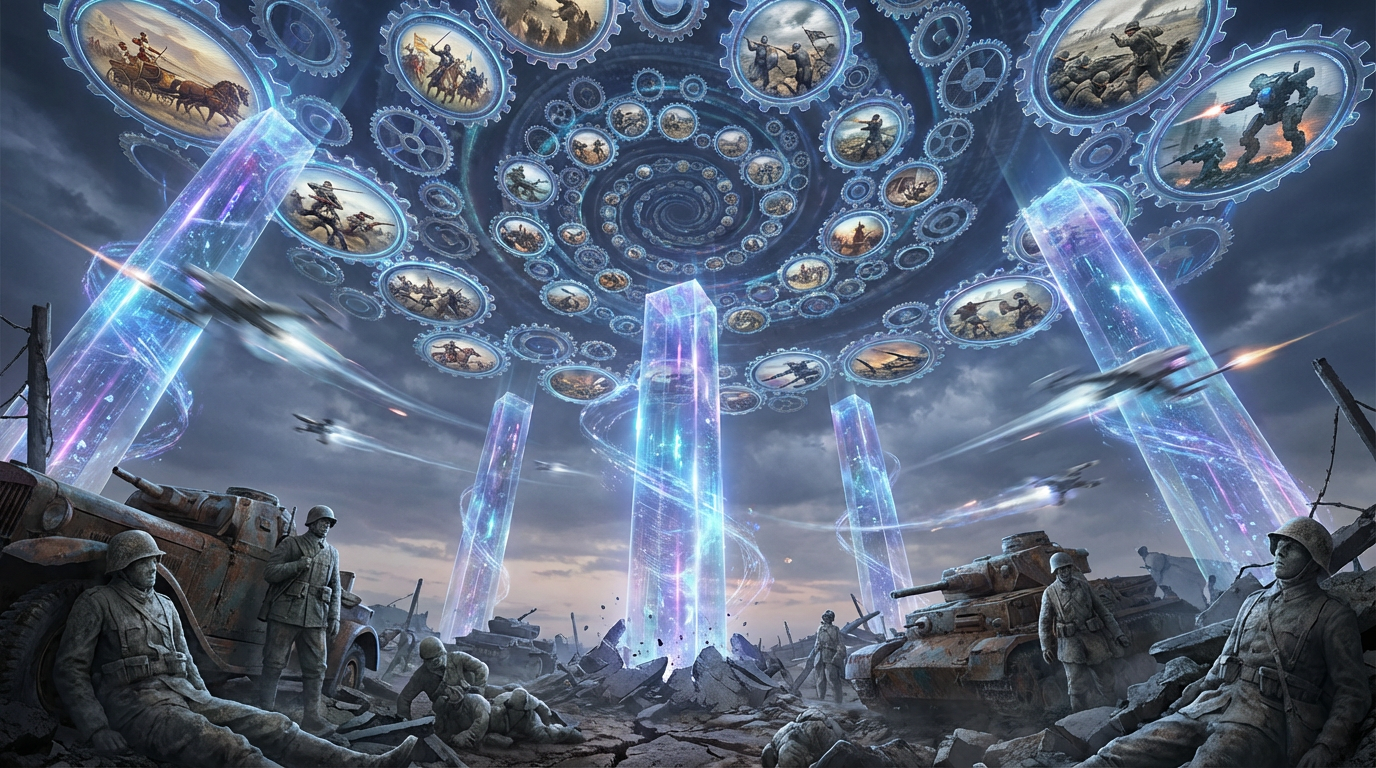
The training ground for the next world war is not a desert in Nevada or a swamp in Florida; it is a server rack. The U.S. Army’s Synthetic Training Environment (STE) has matured into a convergence of Live, Virtual, and Constructive (LVC) simulations that map the entire globe.
The One World Terrain
The STE utilizes “One World Terrain,” a 3D geotypical and specific replication of the Earth. In 2026, this is no longer a static map. Physics-based AI populates these worlds with dynamic weather, destructible environments, and adaptive adversaries. Soldiers — and more importantly, autonomous agents — train in these environments millions of times before a single shot is fired in reality.
Johns Hopkins GenWar Lab
Complementing the physical simulation is the strategic intelligence of the Johns Hopkins Applied Physics Laboratory’s “GenWar Lab.” Here, AI wargaming has moved beyond rigid rule sets. Large Language Models integrated with tactical simulators allow military planners to run thousands of iterations of conflict scenarios against AI opponents that think, adapt, and bluff. This “in silico” warfare allows the military to optimize strategies for dominance with a mathematical certainty that renders traditional human intuition obsolete.
III. The Weaponization Pipeline
The “Sim-to-Real” gap — the discrepancy between how a robot performs in a simulation versus the real world — was once the primary bottleneck for autonomous weapons. With Physics AI, that gap is now negligible. This pipeline enables the rapid deployment of Lethal Autonomous Weapons Systems (LAWS).
We are witnessing the rollout of robotic platforms that possess “general purpose agility.” These are not the clumsy robots of the early 2000s. Powered by models trained in friction-perfect simulations, bipedal and quadrupedal machines can now navigate rubble, breach buildings, and engage targets with reaction times measured in milliseconds. The capability to “print” soldiers — software-defined robotic assets that can be mass-manufactured — fundamentally changes the calculus of attrition. A nation no longer needs to convince its youth to enlist; it simply needs compute power and raw materials.
IV. The Avatar Parallel: RDA as Tomorrow’s Reality
James Cameron’s Avatar presented the Resources Development Administration (RDA) not merely as a villain, but as the ultimate expression of corporate-military efficiency. In 2026, the RDA is no longer a fictional allegory; it is the operating model for the future of warfare.
Total Dominance of the Asset
In the film, the RDA employs advanced exoskeletons (AMP suits), gunships, and private military contractors to secure resources (Unobtainium). The technology is utilitarian, brutal, and overwhelmingly superior to the indigenous population. Today’s Physics AI enables exactly this type of asymmetry. The goal is “dominance of the asseted target” — whether that target is a mineral deposit in the Global South or a data center in a contested region.
Privatization of Force
Just as the RDA operated with quasi-governmental authority, the reliance on private tech giants (NVIDIA, Luminary Cloud, Palantir) to provide the backbone of military capability blurs the line between state and corporation. We are moving toward a future where corporate armies, equipped with proprietary AI models and autonomous hardware, can project power without the political drag of deploying national troops. The result is a sterile, remote-controlled occupation where the occupying force is immune to fear, fatigue, or moral hesitation.
V. China’s Social Credit System: The Control Template
While the West perfects the hardware of dominance, the East has perfected the software of control. China’s Social Credit System has evolved from a financial credit score into a comprehensive “moral operating system” for society. By 2026, this system has integrated advanced computer vision and gait recognition, powered by the same class of Physics AI used in robotics.
The Quantified Citizen
In this system, a citizen is a data point. Compliance is rewarded with access to travel, loans, and fast internet; dissent is punished with digital erasure. The integration of “Physical AI” means that surveillance cameras can now interpret
behavior and intent based on body language analysis, not just facial recognition. An individual moving erratically in a crowd can be flagged by an AI model trained on physics-based simulations of “riot behavior,” triggering a preemptive arrest before a crime is committed.
This point-based existence creates a psychological panopticon. Humanity acts not out of moral conviction, but out of algorithmic necessity. The fear of the “low score” becomes a more effective prison than any physical wall.
VI. The Double-Edged Sword: Legitimate Applications of Physics-Based AI
Training
Before we descend into the darkest implications, it’s critical to acknowledge that physics-based AI and virtual world training are not inherently malevolent technologies. In fact, they represent some of humanity’s most promising tools for survival, exploration, and crisis response. The question is not whether these technologies are powerful — they are. The question is who controls them, and to what ends.
A. Space Exploration: Training for the Untrainable
Simulating the Impossible
Space is the ultimate hostile environment. There is no atmosphere to breathe, no gravity to anchor you, and no room for error. Physics-based AI allows astronauts and autonomous spacecraft to train in perfect replicas of Mars, the Moon, or the vacuum of deep space without leaving Earth. NVIDIA’s Cosmos platform can simulate the reduced gravity of Mars (0.38g) or the microgravity conditions of the International Space Station with absolute precision.
In these virtual environments, astronauts practice emergency repairs on spacecraft modules, autonomous rovers rehearse navigating treacherous Martian terrain, and AI mission controllers run through thousands of iterations of orbital rendezvous maneuvers. The “Sim-to-Real” advantage means that by the time a human or robot lands on another world, they have already “been there” millions of times in simulation. This drastically reduces mission risk and accelerates the timeline for humanity becoming a multi-planetary species.
Autonomous Space Systems
The distances involved in space exploration make real-time human control impossible. A signal from Earth to Mars takes between 4 and 24 minutes depending on orbital positions. In such scenarios, autonomous systems trained in physics-perfect virtual worlds are not optional — they are mandatory. Physics AI enables spacecraft to make split-second decisions about landing zones, obstacle avoidance, and resource allocation without waiting for instructions from mission control.
These same technologies are being used to design self-repairing satellites and deep-space probes that can adapt to unforeseen conditions.
B. Planetary Defense: Responding to Existential Threats
Asteroid Impact Scenarios
One of the most legitimate uses of military-grade Physics AI is in defending Earth from cosmic threats. NASA’s Planetary Defense Coordination Office uses advanced simulations to model asteroid trajectories and test deflection strategies. In 2022, the DART mission successfully altered the orbit of the asteroid Dimorphos — a proof of concept developed entirely through physics-based simulations.
By 2026, Physics AI models like Luminary’s SHIFT platform are being adapted to simulate kinetic impactors, nuclear deflection devices, and gravity tractors — all methods to redirect or destroy an incoming asteroid. Virtual worlds allow scientists to test thousands of scenarios: What if the asteroid is rotating? What if it’s a loose rubble pile rather than solid rock? What if we only have six months’ warning instead of six years? These simulations are run in hours, not decades, compressing the timeline for developing planetary defense infrastructure.
Solar Storm Response
Similarly, Physics AI is used to model the effects of solar flares and coronal mass ejections on Earth’s power grids and satellite networks. By simulating electromagnetic pulse (EMP) scenarios in virtual environments, engineers can design hardened infrastructure and develop rapid-response protocols. The ability to “rehearse” a civilization-wide blackout scenario allows governments to coordinate emergency responses — from grid restoration to communication backups — without causing real-world chaos.
C. Rapid Crisis Response: The Advantage of Pre-Simulation
Disaster Relief and Humanitarian Operations
The same autonomous systems designed for warfare can be repurposed for earthquake rescue, flood response, and
wildfire containment. Robotic systems trained in physics-based simulations can navigate collapsed buildings, identify survivors using thermal imaging, and deliver medical supplies in conditions too dangerous for human responders. The U.S. Army’s Synthetic Training Environment is increasingly used to train both military and civilian emergency response teams in joint operations.
For example, autonomous drones trained to navigate urban warfare environments can be retasked to map disaster zones after hurricanes, providing real-time 3D models to rescue coordinators. The speed and precision of these systems — honed through millions of simulated scenarios — directly translates to lives saved. In this context, Physics AI is not a tool of oppression, but of salvation.
Pandemic Response and Medical Logistics
During the COVID-19 pandemic, logistics optimization algorithms (a precursor to full Physics AI) were used to model the distribution of vaccines, ventilators, and personal protective equipment. By 2026, more sophisticated systems simulate entire supply chains in virtual worlds, optimizing delivery routes, warehouse placements, and manufacturing priorities in real time. In a future pandemic scenario, autonomous delivery systems trained in virtual environments could deploy vaccines to remote populations within hours of production, bypassing the delays and corruption that plague traditional logistics.
D. Imminent Threat Decision-Making: The Speed Imperative
Nuclear Early Warning Systems
One of the most terrifying aspects of modern warfare is the short decision window in nuclear conflict. From launch detection to impact, a nation may have as little as 15 minutes to decide whether to retaliate. Physics AI systems trained in virtual worlds can model the trajectories of incoming missiles, assess the credibility of threats, and recommend responses with a speed and accuracy no human command structure can match.
In this scenario, the “good” application of autonomous decision-making is not in launching a counterstrike, but in preventing accidental escalation. AI systems can distinguish between a malfunctioning satellite and an actual missile launch, reducing the risk of false positives that could trigger World War III. The Johns Hopkins GenWar Lab uses these simulations to test de-escalation protocols, ensuring that autonomous systems are biased toward verification rather than retaliation.
Cyber-Attack Countermeasures
In the cyber domain, attacks happen at machine speed. A sophisticated cyberweapon can compromise a nation’s
infrastructure in seconds — far faster than human analysts can respond. Physics AI trained in virtual cyber-ranges can detect, isolate, and neutralize threats in real time. These systems simulate millions of attack vectors, learning to recognize patterns that indicate a state-sponsored intrusion versus routine criminal activity. The result is a defensive posture that reacts faster than any human SOC (Security Operations Center) team, preventing cascading failures in critical systems like power grids, water treatment facilities, and financial networks.
E. The Paradox: The Same Tool, Different Hands
The uncomfortable truth is that the technologies enabling asteroid deflection are the same technologies enabling autonomous kill drones. The simulations that save lives in earthquakes can be used to optimize urban pacification. The AI that prevents nuclear war can also be used to wage it more efficiently.
This is the paradox of dual-use technology. A surgical scalpel can remove a tumor or sever an artery. The tool itself is neutral; the intent of the wielder is everything. Physics-based AI and virtual world training are civilization-level power-ups. They compress time, eliminate uncertainty, and grant dominance over the physical world. Whether that dominance is used to build a Mars colony or enforce a surveillance state depends entirely on the governance structures we build around these technologies.
The danger, then, is not in the technology itself, but in the asymmetry of control. If only militaries and corporations possess these capabilities, the bias will always trend toward control and extraction. If these tools are open-sourced, democratized, and subject to transparent oversight, they could genuinely serve humanity’s survival and flourishing.
VII. The Convergence: Military AI + Corporate Power + Surveillance State
The true dystopian horror lies in the convergence of these three vectors. Imagine the tactical lethality of the U.S. military’s autonomous weapons combined with the pervasive, point-based social control of the Chinese model, all administered by supra-national corporations akin to the RDA.
In this convergence, the “battlefield” is everywhere. The same autonomous drones used to secure a perimeter in a war zone can be repurposed to police a neighborhood with a low social credit score. The same digital twins used to simulate tank warfare can be used to simulate — and suppress — civil unrest. We face a future where the government does not need to negotiate with its population because it possesses an insurmountable monopoly on force and information.
VIII. The Dystopian Endgame: Four Trajectories
Based on current technological vectors, we project four potential future scenarios:
- The High-Tech Feudalism (The RDA Scenario)
Corporations with superior Physics AI capabilities become de facto states. They control resources and security zones. The wealthy live in high-tech enclaves protected by autonomous systems, while the rest of humanity struggles in resource-poor peripheries, irrelevant to the economic engine.
- The Algorithmic Leviathan (The Total Compliance Scenario)
The Chinese model goes global. Governments adopt “Safety AI” that mandates total surveillance for public protection. Physical AI predicts crime and civil disobedience with 99% accuracy. Free will is effectively legislated out of existence in favor of algorithmic safety.
- The Asymmetric Collapse (The Resistance Scenario)
Asymmetric warfare evolves. Rebel groups, unable to match the physical dominance of AI swarms, resort to “poisoning” the data. Anti-AI terrorism targets server farms and sensor networks. Society fractures into “connected” (controlled) and “disconnected” (feral) zones.
- The Hybrid Control State
The most likely outcome. A veneer of democracy remains, but rights are conditional based on a hidden social score.
Military-grade AI police maintain order. dissent is not crushed with violence, but with “access denial” — your smart car won’t start, your digital wallet is frozen, and your doors won’t open.
IX. The Ethical Precipice
The international community is aware of the danger, but the geopolitical prisoner’s dilemma prevents de-escalation. By 2026, 156 states have expressed support for a UN General Assembly resolution to restrict Lethal Autonomous Weapons Systems (LAWS). However, the major powers — the U.S., China, and Russia — are locked in an arms race that makes compliance impossible.
To stop developing Physics AI is to cede strategic dominance. To continue is to erode the value of human life. We are creating entities that can kill with mathematical perfection, stripping warfare of the “human error” that ironically provided the only opportunities for mercy.
메타데이터
- post_id
- a09e209bd6af
- slug
- the-virtual-precipice-physics-based-ai-and-the-dystopian-future-of-military-dominance-a09e209bd6af
- url
- https://medium.com/@thegaijin.wolfenstein/the-virtual-precipice-physics-based-ai-and-the-dystopian-future-of-military-dominance-a09e209bd6af
- canonical_url
- https://medium.com/@thegaijin.wolfenstein/the-virtual-precipice-physics-based-ai-and-the-dystopian-future-of-military-dominance-a09e209bd6af
- author_url
- https://medium.com/@thegaijin.wolfenstein
- status
- ok
- fetched_at
- 2026-06-09 15:37:30