OPINION: The big questions AFLW and its pathways face
This weekend marks four months to go until the start of the tenth Australian Football League Women’s (AFLW) season.
OPINION: The big questions AFLW and its pathways face
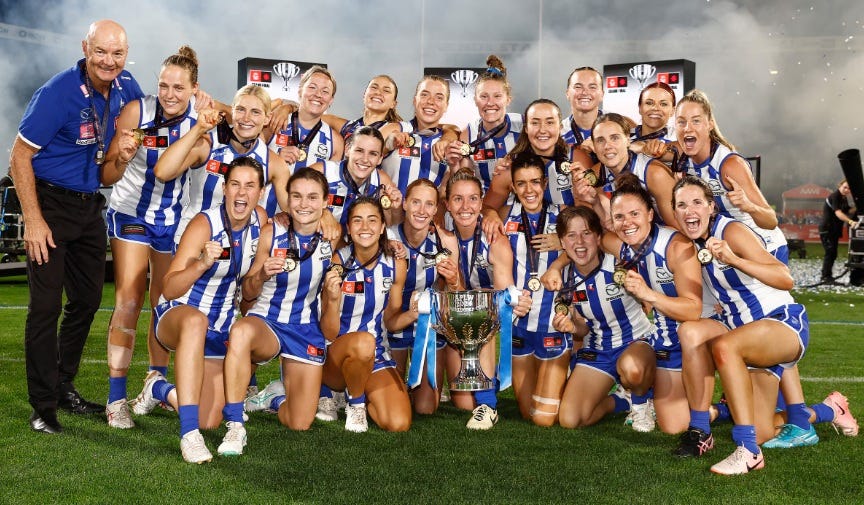
2024 AFLW Premiers the North Melbourne Tasmanian Kangaroos. Photo by AFL Photos.
This weekend marks four months to go until the start of the tenth Australian Football League Women’s (AFLW) season.
Fans of the competition continue to wait patiently for any sign of what we might be in for this year. We know the season will start the week of August 11th and that it will run for 12 Rounds, without a compressed fixture.
It will overlap with the final two weeks of the AFL regular season, meaning it is likely we’ll have to wait until the days and times of those matches are locked in, before the AFLW fixture can be completed.
The women waiting for the men to be done. As David Byrne once sung with Talking Heads, “same as it ever was, same as it ever was”.
A pause in any AFLW news gives us a moment to not only reflect on where the competition currently sits, but what is the way forward?
Perhaps the thing that holds back the AFLW the most is that there is too many questions unanswered about its way forward.
These are just a few of the questions the AFLW community, and it pathways, need answers on.
When will the teams all play each other once (again)?
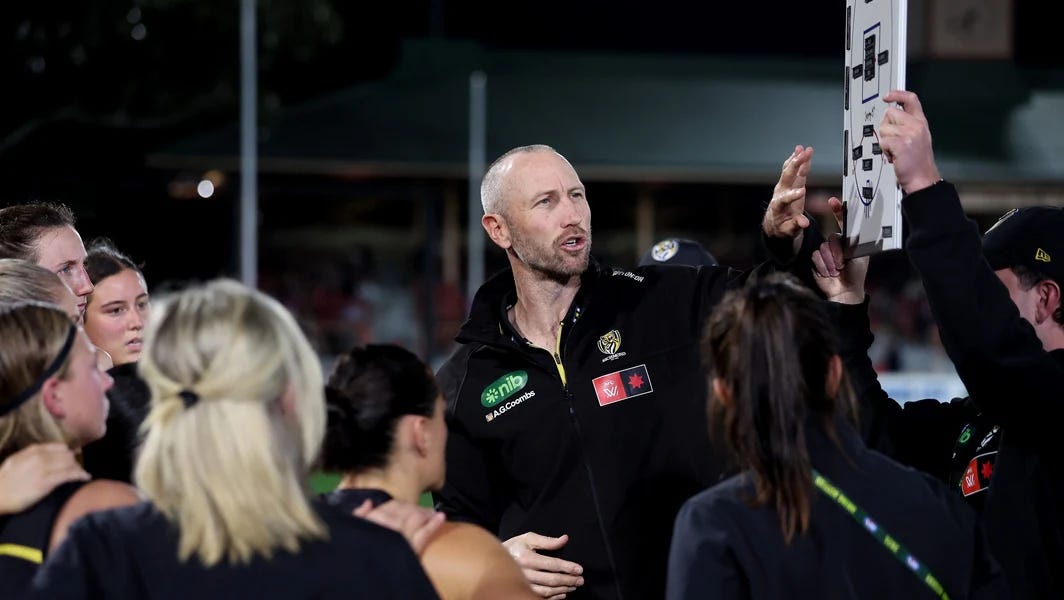
Then Melbourne footballer, now West Coast Eagles coach, Daisy Pearce called the AFLW a “gimmicky” league back in 2018 during a segment on 1116 SEN. It was in reference to the competition going for only two months, with then Collingwood footballer Georgie Parker bemoaning the fact that pre-season went twice as long as the actual season.
At least at that stage of the competition’s history (two seasons in), we could all gauge the strength of each team, as all of the eight teams played each other once.
Then the problems came.
The AFLW expanded from eight teams to eighteen teams in just three and a half years. For context, the VFL (now AFL) took 28 years to get from eight to twelve teams. It not only created obvious squad depth issues for the AFLW and its pathways, but fixturing problems with League Headquarters not wanting to commit the resources to have a fair and even AFLW schedule — everyone playing each other once.
The unpopular conference system came in for the 2019 and 2020 seasons, before being scrapped. With those at Docklands reluctant to extend the season beyond a round a year at best, the AFLW was then left with lopsided fixtures as former West Coast Eagles coach Michael Prior complained, and last year a compressed fixture that physically drained players and drew condemnation from broadcasters and supporters alike.

A further wrinkle in AFLW fixturing will possibly come in 2028 — the addition of the Tasmania Devils into the competition. For the first time in the competition’s history, there will be an uneven number of teams (19) with byes having to be accounted for. Plus, with the addition of another team, or perhaps two if the league does not want a bye, will the amount of teams who play finals be increased to ten or twelve?
All of this means, in theory, the AFLW would be going (with finals) to a season that last 24 weeks at some stage in the future, opposed to this year’s 16 week (including finals) season.
The question remains, will League Headquarters commit to a timetable of getting where we are now, to that fair everyone plays each other once schedule, and give players, coaches, club staff, fans, broadcasters and corporate sponsors long-term faith in the direction of the AFLW?
When will we get to 40 players on each AFLW club’s list?
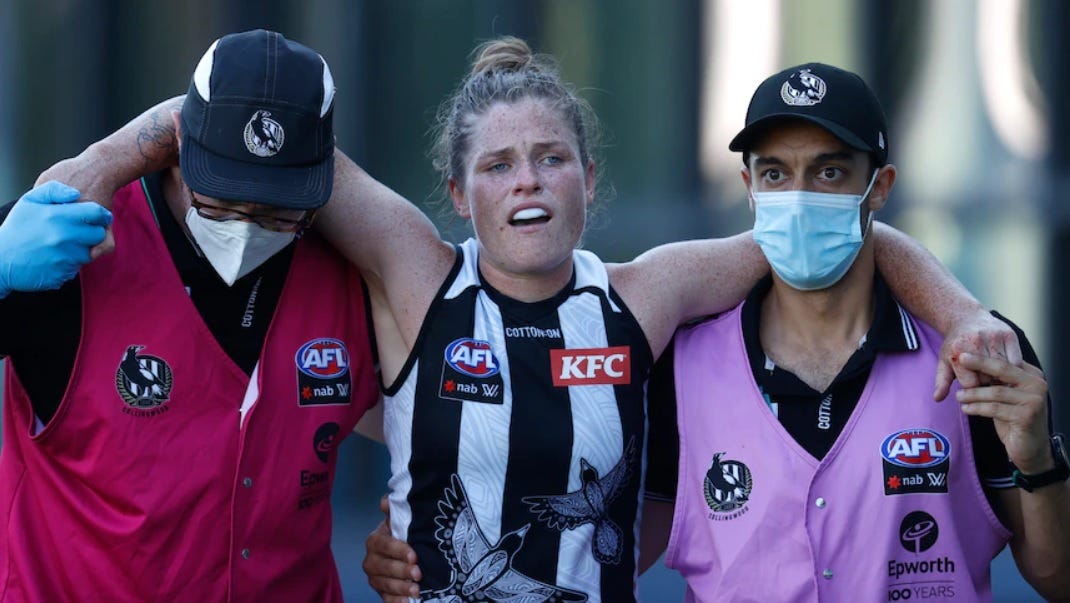
A casualty ward was the best way to describe some playing lists last season. Teams like Collingwood and Melbourne dipping into their collection of “train on” players, just to put a side out there on the park.
With AFLW squads currently at 30 players, a club with a fully fit squad will have 21 players run around in a game, and nine spare. The make up of those nine players and they positions they normally play could be anything depending on the club’s recruiting strategies.
For example, how many rucks would you keep on your list of 30? Geelong faced that nightmare last year when first in May, Olivia Fuller announced she was stepping away to focus on her career, then a month later Erin Hoare announced her retirement. With two quality rucks out, it forced Geelong to not only shift other players into the ruck, it created holes in other areas of their structure.
At this stage the AFL has not lined out, nor has the AFLPA publicly proposed, a timetable or method to increase the size of AFLW squads as the seasons further grow in length.
It also posses the darker question, how many players have played injured, or will feel obligated to play whilst injured, when their ‘fit to play’ squad numbers are low like Collingwood’s and Melbourne’s were?
Should there be AFL/AFLW double-headers or reverse fixtures?

The Western Bulldogs play host to Port Adelaide at the MCG. Photo by AFL Photos.
With Season 10 of the AFLW due to start on the week of August 11th this year, league headquarters will need to find a way to schedule 18 matches of elite football (AFL and AFLW) over a period of between three and five days, for at least two weeks. Maybe one more, accounting for that postponed Gold Coast v Essendon AFL Men’s match.
This two week window will give an insight of what the AFLW might look like if played as a winter competition, including what platforms Foxtel (DAZN) and the Seven Network choose to show the league on, what time and locations the AFL want to use, and if fans will embrace it.
The AFL/AFLW double-header concept has been kicked around for awhile and has its pros and cons. Those who argue for the ‘one club’ theme sell the idea that fans of the men’s team will come early or stay behind to watch the women’s team, just like in the days when there was the reserve grade (and even Under 19s) on before the ‘main game’. Clubs may also enjoy the benefit of having staff work with both their teams at the same location.
I was fortunate as a kid to be part of the generation that would watch the reserves and seniors at the same ground on the same day. Back then, it was only a 20 minute gap between games — just the right amount of time to go grab a pie and coke then return to my seat as the seniors ran through the banner. Now, it’s different. With the clubs wanting to give their players an hour’s warm-up, the gap is too large (if two games are on) for most people to want to stick around.
The last point leans into the cons territory, especially enhancing the case of those that fear the AFLW will only ever been seen as a ‘curtain raiser’ or equivalent to the men’s VFL, never respected as an equal to the AFL.
Another option for the AFL to go down is the ‘reverse fixture’ route. This has been used decades ago in the VFL/AFL, but is more commonly used in club cricket. That is, when the firsts are at home, the seconds are away, and vice-versa.
As an example, if in the AFL men’s competition the Bombers were playing host to the Lions at Marvel Stadium, that same weekend the AFLW Bombers would travel away to Queensland to play the Lions at Brighton Homes Arena. One benefit would be clubs turning their AFL memberships, that would normally be valid for 11 home games, into club memberships gaining access to all AFL and AFLW home games. So, if Lions members in Queensland couldn’t travel south for the AFL match, their membership would get them into that weekend’s home AFLW game.
On the negative side it would stretch club staffing resources, unless the games were on different days. Even then, with an extra day of work for staff, somewhere has to be found for them to enjoy some time off.
From a broadcasters point of view, the double-header saves costs, whilst the reverse fixture increases costs.
Is the AFLW going to be a summer or winter competition?

Essendon and Richmond battle it out in Darwin. Photo by AFL Photos.
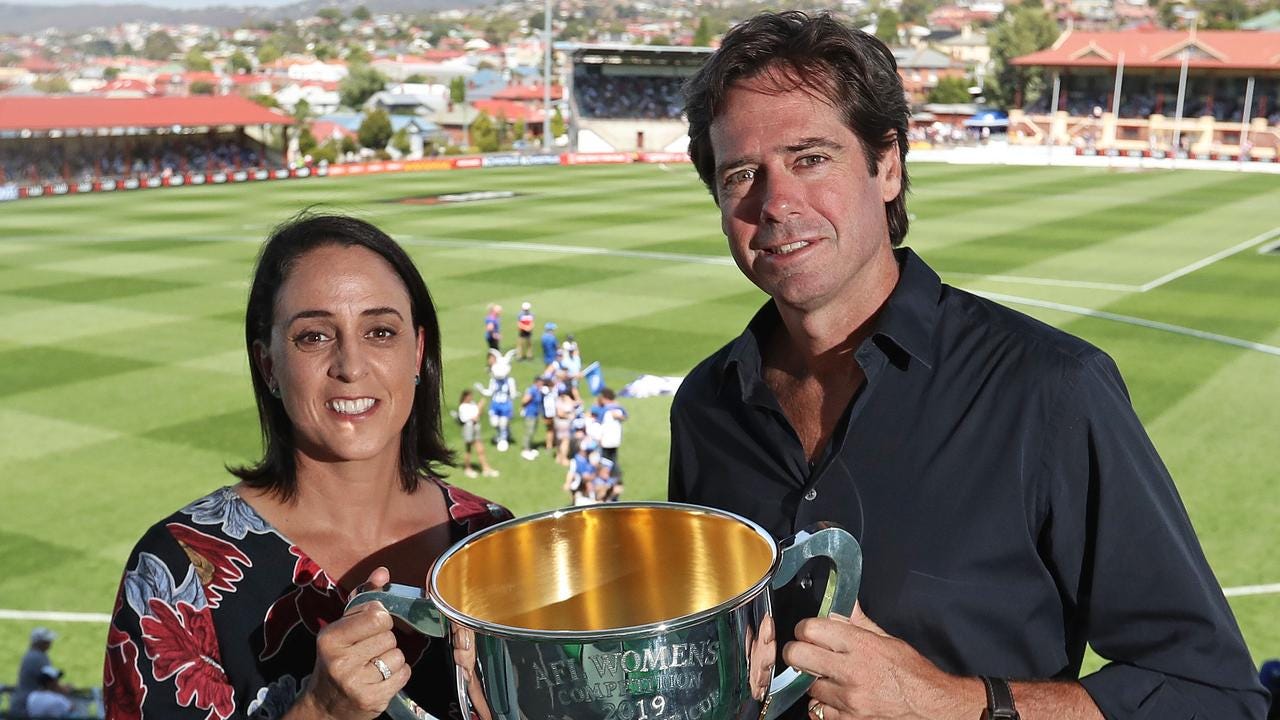
Nine years ago Gillon McLachlan boasted he was bringing the start of a national women’s league forward three years earlier than planned. Since that time league headquarters has not been able to figure out and promote with any certainty if the AFLW is a summer or winter competition.
The last person to attempt to give some type of certainty was former boss of women’s footy Nicole Livingstone, who proclaimed at the 2021 VFLW season launch that the state leagues moving to a summer start were “part of their vision” to align them with the AFLW — only to just 13 months later pull the rug from everyone and move the AFLW to the spring.
It feels like the AFL Commission need to step in and force the hand of the league executives one way or another. Go with a Summer competition for more “clear air”, but timing of games, when the pathways will play, and what grounds can be used will need to be addressed; or go with a Winter competition, where pathways can be better aligned, more grounds available, but suffer in publicity as the media treats the competition as an after thought.
When will the state leagues play, or is time for a reserves competition?
The scheduling of the women’s state league competitions over the last half-decade or so has been like Donald Trump’s economic polices — an all over the place mess with the those in power pretending it’s all part of the plan.
A classic example was Friday night when the SANFLW played host to the VFLW at Alberton Oval. The SANFLW squad was picked from footballers who were already four weeks into their Home and Away season, whilst the VFLW squad had to be picked based on practice match form or reputation, as the Victorian league does not start until this coming Good Friday.
If the VFLW squad was picked three years ago, the footballers would have been about six or seven rounds into the season. The start of the VFLW season between 2019 (excluding 2020 due to Covid) and 2025 has yo-yo’d with April, February and March starts, and finishing anywhere between July and September, as officials try to figure out exactly where it is meant to land on the calendar to compliment (or not) the AFLW.
This haphazard scheduling even affected the QAFLW one year, not only with the shift in the season starting, but also clashing with underage representative fixtures. One club saw a dramatic change in form, from Grand Finalists to bottom of the ladder, due to player availability problems.
With leagues like the VFLW not properly aligned with the AFLW, the AFL clubs themselves have been left to question their existence in the state league. Last year saw a total farce when Collingwood considered closing down its VFLW program to align with Williamstown. By the time they reversed course, they had lost all but one player from their previous year’s squad. Richmond, who had previously pulled out of the VFLW just before the 2021 season to align with Port Melbourne, announced just before the start of this season that their alignment with the Borough was over, with no firm plans yet on where their fringe or new AFLW players can get some game time before the AFLW season kicks off.
Speaking to one official at an AFL club back in mid-2023, there were very few benefits of running a VFLW side as only a limited number of AFLW listed players participated (due to the seasons not lining up correctly) and they didn’t gain anything special like first access in the draft to those players on their state league list.
For AFLW players not selected to play for their club during a particular round in-season, the only way to currently find form is through an AFL-organized scrimmage match. This is where players (and some coaches) from multiple clubs are thrown together to create two sides for a game.
While the AFL website claimed that clubs believed these matches were of ‘higher standard’ than the state leagues, one former AFLW footballer who played in these games called them a “waste of time” highlighting that due to the mixed squads, they couldn’t play (and perfect) their club’s game plans and structures, and might also be played out of position.
When the AFLW season starts to further extend its duration, with larger squads being required, the AFL will have to begin considering the concept (and costs) of a reserves competition or again moving the state leagues.
When will there be AFLW purpose built grounds?

The Gardiner Stand at IKON Park (AFLW Grand Final venue). Photo by Carlton FC.
The AFLW Grand Final venue of the last two years, IKON Park, is an embarrassment to women’s sport.
In the past couple of years, we’ve seen the USA women’s (college and professional) basketball finals pack out world class venues. In our own backyard, the Women’s Big Bash League final was played on the hallowed turf of the Melbourne Cricket Ground.
Meanwhile, the AFLW has gone from packing out the marvelous Adelaide Oval in 2019, to a dump in Carlton North.
I don’t care how much money they claim to have poured into the venue, or how it was meant to be the “home of women’s footy”; it’s an AFL men’s training facility with some extra women’s toilets in the changerooms.
Just watch back any AFLW game there on TV. The Royal Parade end is a big administration block with no space for fans to sit behind the goals. On the city side, there’s not even a proper race for the players to run out — it’s literally a run out through the crowd situation. On the Northern side, the Gardiner Stand is a safety hazard, and fans are not allowed to sit in it.
Now, could you imagine for a minute, Whoopi Goldberg, who is behind the new Women’s Sports TV network AWSN, sitting down to watch the AFLW’s biggest game of the year, about to consider if she and her partners should make an offer to air globally what should be Australia’s premier domestic women’s sporting competition, and seeing IKON Park?
As much as I’ve bagged Carlton’s home ground, there’s others that have had ‘upgrades’ which are underwhelming. Mission Whitten Oval’s new grandstand looks great, but the facility (and it’s fold-up door) behind the Barkly Street goals make it look like the home team is running out of a garage. Speaking of the Barkly Street goals, the 25m gap between the goals and the fence also robs the venue of an intimate feel at that end of the oval.
Even my beloved Windy Hill, which is a quarter of what it use to be, had hopes of a being a dedicated AFLW ground, with plans for a $50 million rebuild. Instead, there will be around just $4 million for upgrades, which probably means a new coat of paint for the Cookson Stand, and a couple of portable buildings (Punt Road style) for opposition changerooms.
All the above highlights the problem, that there is no ground (excluding Brighton Homes Arena) that has been specifically built for the AFLW — including for now or its future growth.
Marvel Stadium has been floated as a venue that should host standalone AFLW games, and although that might make sense for the Grand Final, for a regular season game it does not. One just needs to look to Geelong for an example. The Cats average AFLW attendance at GMHBA Stadium is just over 2,700. Whilst respectable for a growing competition, a stadium that’s 90% empty on TV is not a good look.
Even prior to the AFLW’s creation, the need for a small to medium sized elite Australian Football stadium in Victoria has been there. Melbourne’s AFLW home of Casey Fields was one venue initially pegged to fill that void. It never got developed to its proposed 15,000 seat capacity, and like the ghost of Waverley Park, it never got its planned train station.
Along the way there were also proposals for grounds at E-Gate (next to North Melbourne station) and the Royal Melbourne Showgrounds.
When the AFLW finally… hopefully… grows beyond the capacity of the old suburban grounds, but not quite enough to be financially viable to play out of the AFL stadiums (or unable to due to cricket and other events), where can the teams go? With Governments looking to tighten their belts due to increasing debts and uncertain global economic times ahead, the cash to develop grounds may not be there as it was a decade ago.
When will the AFLW think outside the Fox Sports (DAZN) and Seven Network duopoly?
Was it a strange idea for a competition that was meant to break the status quo, to go with broadcast partners that are the status quo?
Not knocking the effort of some of the commentators, but the overall production by the TV networks give fans the impression the AFLW is just an obligation for them, and not something they are excited about broadcasting.
One just needs to look at last year’s compressed fixture. The AFLW had mid-week games scheduled during school holidays not just to keep the competition in a certain window of the year, but in hopes of capturing the same attention the Big Bash League did during the summer holidays.
Even if the crowds were not to come, which they barely did, there was a hope Prime Time TV viewing numbers would be big. Spoiler alert, they weren’t. If they were, the AFL would have been screaming them from the rooftop every morning in a new press release.
What made the Big Bash League initially successful (taking away the debate of how elite something is) was that all games were on free-to-air TV, during a time of year that TV networks don’t air their most popular shows, and it was Network Ten’s first real go at airing the cricket and wanted to impress.
If the AFLW mid-week games were to succeed on TV, hiding most of them away on subscription TV didn’t help. Neither the fact that Fox Sports didn’t do anything to make each game feel like ‘event TV’, and as soon as the game was over and the victors sung their song, they cut the feed. No post game analysis — a subconscious nod to the viewer that the broadcast was just an obligation.
There’s a term in retail called a ‘loss leader’. It’s usually during a sale when you sell a product at, or just below, cost price to entice shoppers to come in the door and hopefully also buy your other products, where you’ll make your profit.
When the AFLW first began, and into its early years, League Headquarters failed to get the Nine Network, Network Ten, or a new streaming partner like Amazon Prime or Optus Sport on board. With the AFL men’s rights up for grabs (back then), they might have used the AFLW as a ‘loss leader’, showcasing different ways they could cover (and promote) the game. Increasing both their chances of getting a slice of the broadcast rights and the quality of coverage the AFLW gets.
As it sits right now, without new TV/streaming partners for at least seven years, where’s the incentive for the current broadcasters to enhance their AFLW coverage beyond their current contractual obligations?
When will the AFLW take a proactive approach with social media?

Many former Twitter users are jumping to BlueSky. Photo from ABC News.
Since the creation of the AFLW, social media has played an important part in its growth, but has also proven not to be a safe space for its players and fans.
From questioning the league’s existence to vulgar comments made about Tayla Harris’ kicking pose, as well as homophobic slurs aimed at Kate Dempsey and the body shaming of Madison Prespakis, the calls for the AFLW, its clubs and media partners to monitor their social media and make it a safer space for all continues to go unheard.
One of the most toxic places online for the AFLW fan where clubs have a social media presence is the site formerly known as Twitter. Since Elon Musk purchased the site and renamed it X, along with global politics veering right, the site has seen increased harassment.
The solution for many has been to leave X and join the rival site, BlueSky. As of writing, the site has more than 34 million registered accounts, and is generally praised by its users for being a more friendly (although not perfect) social media environment, where they are able to engage in real conversations.
Considering when Meta tried to start a rival to X called Threads, which saw a number of AFL clubs start up accounts there, the question remains on why there is no AFL/AFLW club presence on the friendly BlueSky.
The NFL in America has at least come out and explained it’s due to their current contractual situation with X, but silence from the AFL
When will the Head of AFLW talk like a real person?
“I think it’s a huge opportunity in how we tell the story and for how we can connect W and what is so special about the W and the way the women play the game to connect that with audiences.”
That was a quote last year from AFLW General Manager, Emma Moore.
When you first read that comment, what do you immediately think she was talking about? Sounds like she was announcing there would be a documentary series done about the AFLW.
No. It was about the ball-tracking technology stuff-up during the Collingwood v Gold Coast game at Punt Road Oval!
Many, including I, criticized the Nicole Livingstone tenure, who always gave the impression she was there for the photos ops and corporate luncheons, rather than for the game.
After Livingstone’s departure, it was hoped the AFLW would finally have a leader that would treat the league as serious as the head of the AFL would treat the men’s league. Early on, it feels like we now have a PR hack.
When is the point that we have to “hit reset” on the AFLW?
Despite all the questions and gripes we have with the AFLW, its fans (and most who read this piece) have hopes that over the long-run, the league can be a success with packed out stadiums and big TV/streaming ratings.
However, we must also be realistic. There is no guarantee of success.
Looking again to the USA and the success of the WNBA, that not only took years to build, but there was another league before it which didn’t last.
In women’s soccer, where on the world stage the USA team has dominated tournaments and packed out stadiums for years, they are on their third attempt at a women’s professional league, with the NWSL.
With that in mind, perhaps not now, but maybe down the road, if the viewing numbers and crowds do not grow at an acceptable rate, is there a point where we have to ‘hit reset’? That includes everything from not just time of year and length of season, but to the actual teams participating in a professional Women’s Australian Football league?
We hope that day never comes, but you can never say never.
Peter Holden is the founder of Women’s Australian Rules Football Radio, and has broadcast in excess of 350 women’s matches, including AFLW regular season matches, VWFL regular season matches and finals, VFLW regular season matches and finals, AFLW Exhibition Matches, AFLW Practice Matches, Interstate Representatives Matches, AFL International Tournaments and USAFL National Tournaments.
메타데이터
- post_id
- a0a3e49f74fe
- slug
- opinion-the-big-questions-aflw-and-its-pathways-face-a0a3e49f74fe
- url
- https://medium.com/@peterholden-warfradio/opinion-the-big-questions-aflw-and-its-pathways-face-a0a3e49f74fe
- canonical_url
- https://medium.com/@peterholden-warfradio/opinion-the-big-questions-aflw-and-its-pathways-face-a0a3e49f74fe
- author_url
- https://medium.com/@peterholden-warfradio
- status
- ok
- fetched_at
- 2026-06-16 19:09:56