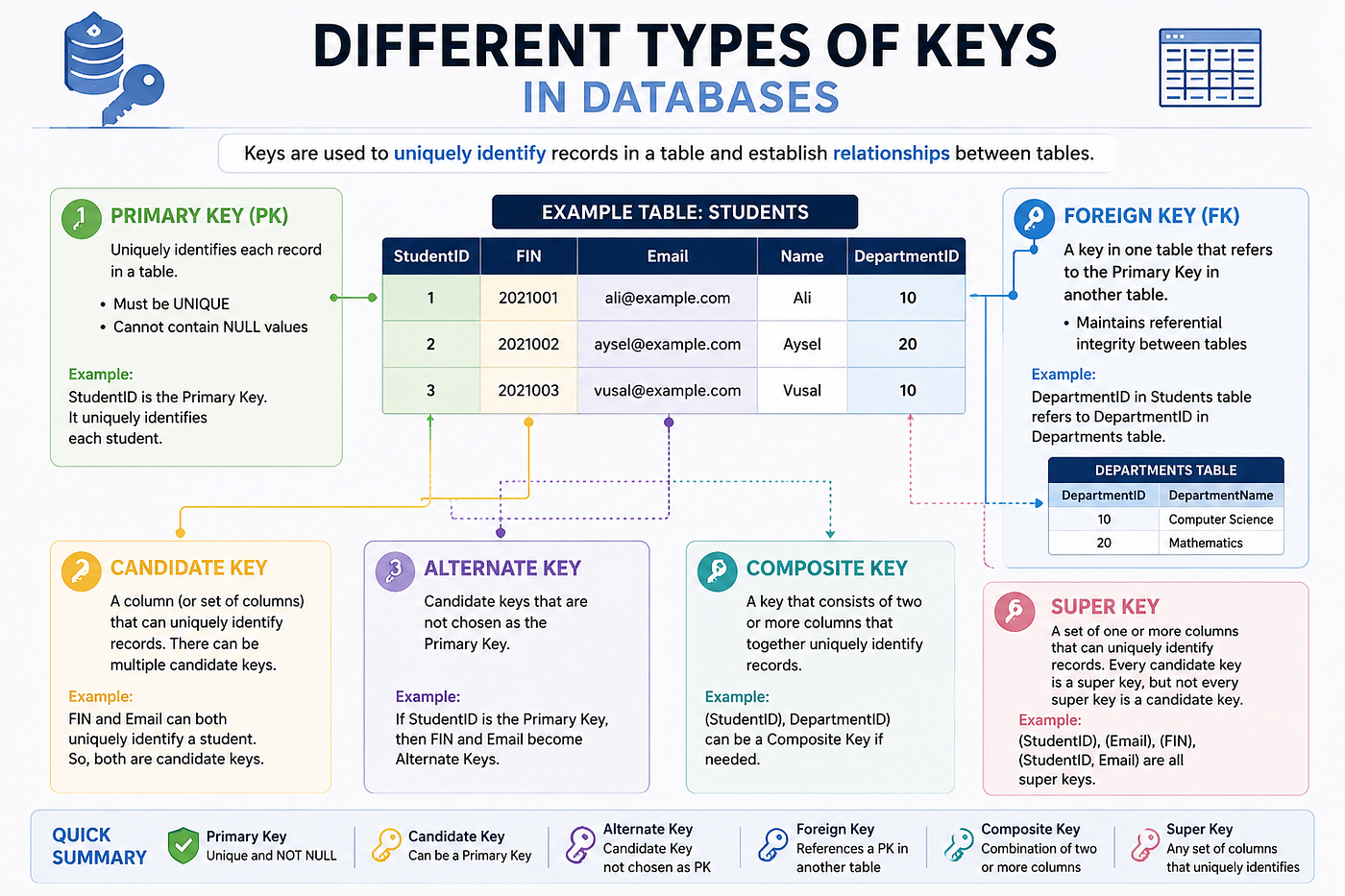
SQL vs NoSQL
The magical difference between these 2 concepts. Probably you heard a lot about them. But did you wonder What is the difference between…
SQL vs NoSQL
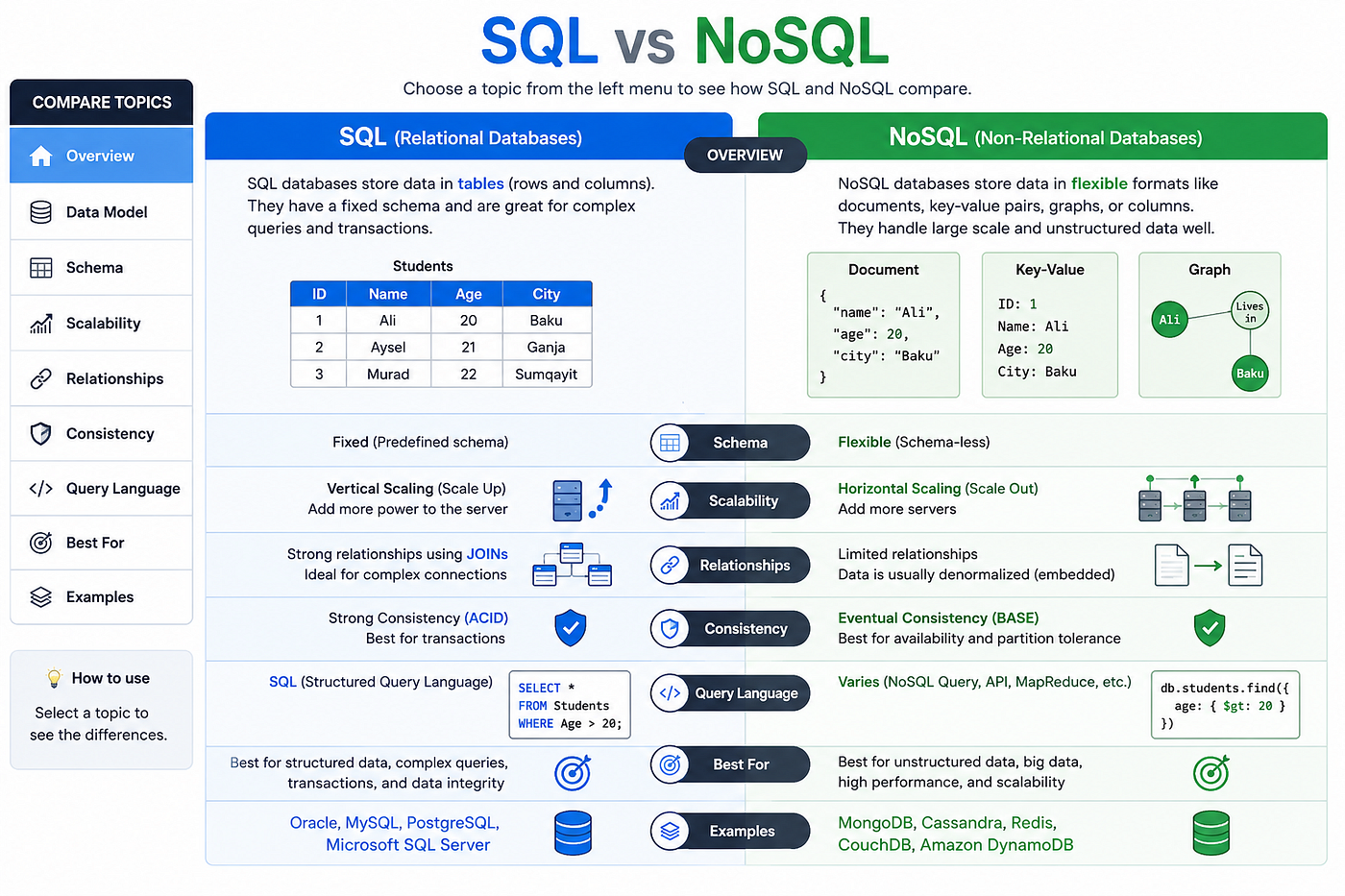
The magical difference between these 2 concepts. Probably you heard a lot about them. But did you wonder What is the difference between them?
You know over world there are many data and they are stored in different versions.
Firstly, let’s talk about what is database because SQL and NoSQL are the two concepts of the database.
DBMS(Database Management System) — it is software used to create,manage,query, and secure databases ├─ SQL (Relational Databases) └─ NoSQL (Non-relational Databases)
Students table data → Database Oracle/MySQL → DBMS SELECT * FROM Students; → SQL
“Where is data stored?” → Database “Who manages the data?” → DBMS “How do we communicate with it?” → SQL
So, really what is database? Probably you heard about it. Database — organised collection of related data which is stored electronically and managed for easy access,retrieval, and updating. So, basically it is where the data is stored.
Now, what about SQL( Structured Query Language)?
SQL — it is structured query language. they require relation between tables. It is language and basically gives queries to DBMS and tells what to do.

SQL is used to store, retrieve, update, delete data and create database objects.
SQL DB is relational model and consists of tables, rows, columns, transactions. Examples of SQL DBMS: Oracle, MySQL, PostgreSQL
CREATE TABLE STUDENTS ( ID NUMBER, NAME VARCHAR2(50), AGE NUMBER );


As you see, every row follows the same structure and there is relation(Enrollments Table) between the tables. Foreign key ensures this relations.
NoSQL — I think as dictionary in python. It stores each row info as dictionary, documents. It has flexible schema. Not necessarily each row should follow the same structure. As you see below they have different fields, not the same structure is defined beforehand.

NoSql
NoSQL DB is non-relational model and consists of document, key-value, graph, column-family. Examples of NoSQL DBMS: MongoDB, Redis, Cassandra, Neo4j

And the main difference is Scalability
What is Scalability?
Scalability — The ability of a system how it handles without losing performance when the amount of users, data or workload increases.
There are 2 types of scalability: Vertical(Scale Up) and Horizontal(Scale Out)
Okay, let’s talk a little bit about them.
Vertical Scaling(Scale Up) — It is about SQL systems
upgrade the same server . So, it means that it increases the size,capacity of RAM or CPU
It is easy but expensive and hardware limit exists
Horizontal Scaling(Scale Out) — It is common in NoSQL systems
add more servers
- Server 1 Server 2 Server 3 Server 4
Work is distributed among them. It is better for massive traffic and can grow almost indefinitely but it is more complex.
One line summary of their main difference:
SQL → Accuracy, Transactions, Relationships
- Banking
- Payroll
- Hospitals
- Universities
- Orders & Payments
We should consider these: consistency, transactions, ACID, relationships, JOINs, structured data
NoSQL → Scale, Flexibility, Huge Data
- Social media
- Chat apps
- IoT sensors (Internet of Things)
- Logs
- Analytics
- Recommendation systems
We should consider these: big data, scalability, distributed systems, flexible schema, high traffic
메타데이터
- post_id
- a0a817f0798e
- slug
- sql-vs-nosql-a0a817f0798e
- url
- https://medium.com/@aysel.msyv/sql-vs-nosql-a0a817f0798e
- canonical_url
- https://medium.com/@aysel.msyv/sql-vs-nosql-a0a817f0798e
- author_url
- https://medium.com/@aysel.msyv
- status
- ok
- fetched_at
- 2026-06-15 20:49:13