Why Trees Become Stunted and Disappear at High Elevations
A Journey to Nepal’s High Himalayas Reveals the Science Behind Treelines, Krummholz Forests, and Life Above 4,000 Meters
Why Trees Become Stunted and Disappear at High Elevations
A Journey to Nepal’s High Himalayas Reveals the Science Behind Treelines, Krummholz Forests, and Life Above 4,000 Meters
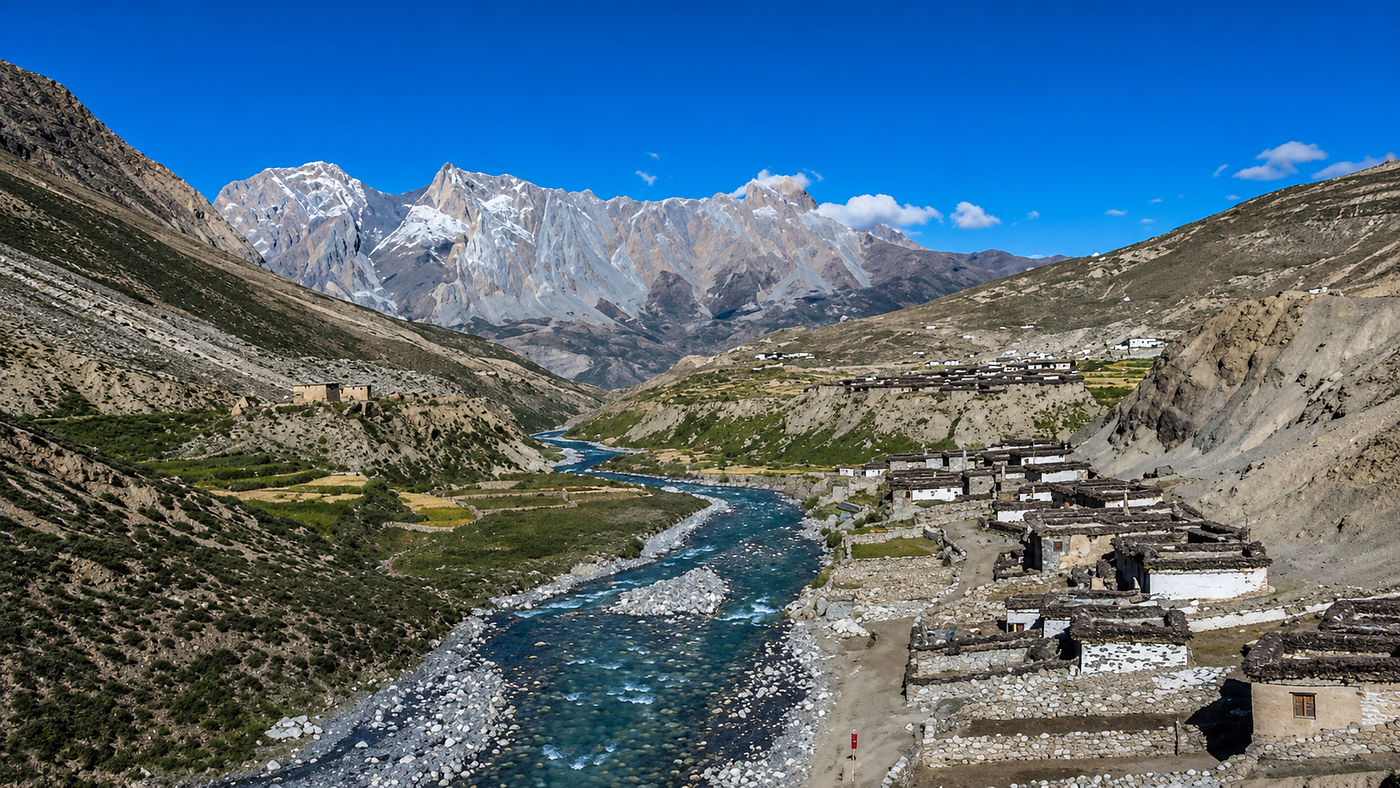
Photo credit: ‘Cultural Heritages of Nepal’ Facebook page. Image quality has been enhanced using chatGPT.
Sonam Bhuti Sherpa, a 21-year-old teacher, works at a local school in Chharka village, near Nepal’s Tibetan border.
She was featured on ‘**Herne Katha**’, one of Nepal’s most popular YouTube channels. The channel highlights stories of people carrying out impactful work at the grassroots level of Nepali society. Stories feature individuals and communities.
This channel, co-founded by Bidhya Chapagain and Kamal Kumar, former BBC employees, is highly popular and widely respected.
**Sonam **describes the difficulties she encounters as a teacher. She finds it difficult to introduce trees to the students as there are no tall trees in the area. The vegetation mainly consists of low, knee-high shrubs and dwarf plants in these areas.
Why is that so?
Chharka village is located in Upper Dolpa at an elevation of 4,300 meters (14,100 ft) above sea level and is considered one of the highest human settlements in the world.
The climate of the Dolpo region (northwestern Nepal) does not allow trees (usually >2 m) to grow above 4,000 meters. The treeline here generally lies between 3600 and 4000 metres.
The alpine treeline is typically a transition zone between closed forest below and treeless alpine tundra above. In 2024, Shiba Raj Ghimire and colleagues reported that Himalayan fir (Abies spectabilis) represents the upper elevational limits of large upright tree species in this trans-Himalayan semi-arid environment.
If you watch the **video**, you can see patches of dwarf vegetation along the trail, possibly krummholz forms of high-altitude shrubs such as juniper. These plants grow in the region up to the alpine meadows.
Why do trees stop growing above a certain elevation (treeline)?
Trees stop growing beyond the treeline. Above this elevation, cold summers and short growing seasons are the main factors which prevent plants from generating enough energy for growth, maintenance and tissue repair.
In other terms, soil temperature rarely reaches levels high enough to support the metabolic processes needed for cell growth and water uptake. Consequently, vital functions such as leaf development, photosynthesis, and storage of energy reserves for winter are greatly reduced.
Treeline elevations vary across regions because they are influenced by latitude, regional climate, and local topography. However, they are primarily determined by a minimum growing season length of roughly 94 days with a mean temperature of about 6.4°C.
In the northern hemisphere, treelines on north-facing slopes occur at lower elevations than those on south-facing slopes. Snowpacks persist longer in these areas due to reduced solar radiation and increased shade, resulting in a shorter growing season.
In the southern hemisphere, the pattern is reversed; south-facing slopes receive less direct sunlight, retain snow for longer periods, and therefore experience shorter growing seasons.
According to treeline scientist Christian Körner, tall trees (usually over 2 m) struggle to sustain themselves because they cannot remain insulated from the cold nighttime atmosphere. As a result, they lose heat from their canopy and upper tissues, which reduces apical meristem activity and ultimately limits tree growth.
Additionally, harsh winds and heavy snowpack make the environment too hostile for large trees to survive. As a result, trees become stunted and twisted, forming what is known as krummholz. In such environments, only the parts of the tree protected beneath the snow cover can survive winter conditions. Consequently, trees tend to grow laterally, as this is the only viable growth form.
However, scientists have recently warned that temperatures are rising even in high-elevation regions due to global warming. As a result, growing seasons in these cold environments are becoming longer. Consequently, trees may be able to grow at elevations above the present-day treeline.
However, the broader consequences of climate change remain a serious concern.
The upward movement of the treeline may have several ecological consequences for alpine ecosystems, which I have described in one of my **earlier** articles.
References:
- *Ghimire et al. (2024): Climatic Response of Himalayan Silver fir (Abies spectabilis) from TreeLine of the Dolpa, Northwestern Nepal. Journal of Physical and Life Sciences 1 (1–13).*
- Schickhoff, U., Bobrowski, M., Böhner, J., Bürzle, B., Chaudhary, R. P., Gerlitz, L., Heyken, H., Lange, J., Müller, M., Scholten, T., Schwab, N., and Wedegärtner, R. (2015): Do Himalayan treelines respond to recent climate change? An evaluation of sensitivity indicators, Earth Syst. Dynam., 6, 245–265. https://doi.org/10.5194/esd-6-245-2015.
- Körner, C. (1999): Alpine Plant Life: Functional Plant Ecology of High Mountain Ecosystems. Berlin/Heidelberg, Springer-Verlag.
메타데이터
- post_id
- a0ab3286958a
- slug
- why-trees-become-stunted-and-disappear-at-high-elevations-a0ab3286958a
- url
- https://medium.com/the-environment/why-trees-become-stunted-and-disappear-at-high-elevations-a0ab3286958a
- canonical_url
- https://medium.com/the-environment/why-trees-become-stunted-and-disappear-at-high-elevations-a0ab3286958a
- author_url
- https://medium.com/@krishnababu.shrestha
- status
- ok
- fetched_at
- 2026-06-13 07:35:29