96% of Agents Expect Challenges in 2026. The Ones Who Will Survive Are Already Doing These 4 Things
The market is not going to save you. But these four things might.
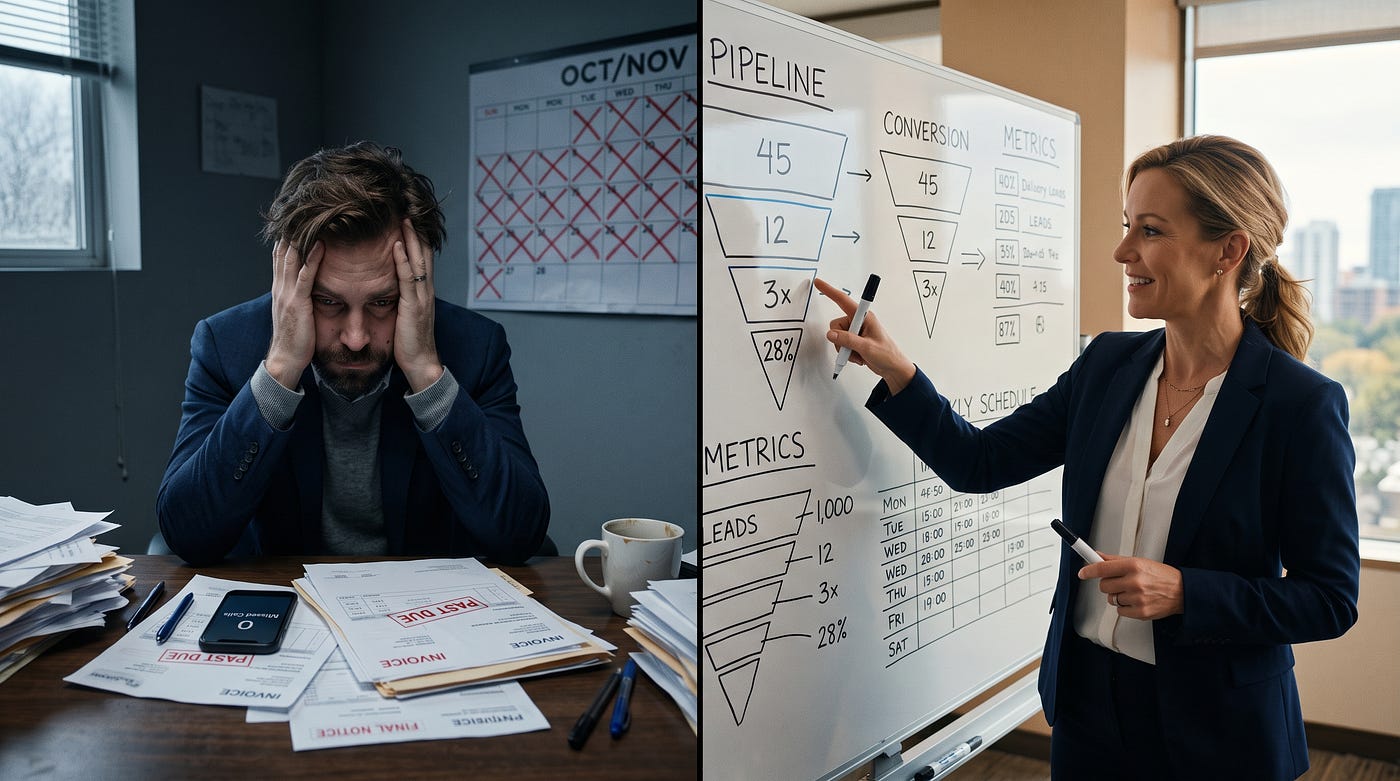
Image generated using Google Flow (AI)
96% of Agents Expect Challenges in 2026. The Ones Who Will Survive Are Already Doing These 4 Things
The market is not going to save you. But these four things might.
Pull up any real estate news site right now and the headlines read like a slow-motion warning.
NAR membership has plummeted from a pandemic peak of 1.6 million to a projected 1.2 million in 2026 — a loss of 400,000 members in just a few years. 96% of agents anticipate challenges ahead in 2026. More than half expect trouble closing deals as a result. National Association of REALTORS
That is not a fringe group of struggling newcomers. That is almost every active agent in the country staring at the same difficult market and wondering what comes next. Deloitte Insights
But here is what the same data also shows: a meaningful percentage of those agents are not waiting for conditions to improve. They are building something specific while everyone else watches and hopes.
The agents most likely to succeed this year are not waiting for the market to improve. They are building systems that work regardless of conditions.RealEstateNews.com
Here is exactly what those systems look like.
Thing 1 — They Prospect Every Single Day Without Exception
This sounds obvious. It is not obvious in practice.
Top producers spend two and a half to three times more time prospecting than median agents. Not ten times. Not a hundred times. They do the boring work consistently. That is the entire difference.
Most agents prospect when they feel like it. When the pipeline looks thin. When a closing falls through and panic sets in. Top producers prospect on a fixed daily schedule regardless of how full or empty the pipeline looks. The discipline is not in working harder. It is in treating prospecting like a non-negotiable appointment that cannot be moved.
The agents who make it understand early that the phone is still the fastest path to income. Most new agents spend time on Instagram, their website, their CRM — anything that feels productive but keeps them away from rejection. The survivors lean into the phone before they are comfortable doing it.
Two hours. Every morning. Before anything else. That single habit separates more agents than any other factor in the data.
Thing 2 — They Know Their Numbers Cold
Top producers do not guess how their business is performing — they know their numbers cold—every day they track dials made, conversations had, appointments set, listings taken, contracts written and closings completed. They review these metrics at the end of each day and adjust their approach accordingly.
Most agents track one number: commissions earned. The agents surviving 2026 track the entire funnel. They know their lead-to-appointment conversion rate. They know how many conversations produce one closed deal. They know their average days from first contact to signed contract.
When you know those numbers, you can predict your income three months out. When you do not know them, you are permanently surprised by both feast and famine.
The agents who survive establish systems, referral networks, and consistent financial practices that sustain them through slow markets. Knowing your numbers is not optional for building those systems. It is the foundation they are built on. RealEstateNews.com
Thing 3 — They Have a Cost Structure That Survives Slow Months
This is the one nobody talks about during good markets. It becomes the only thing anyone talks about during bad ones.
Agents operate as independent contractors and pay upfront desk fees and dues out of their own pockets. When transaction volume dries up, and homes sit on the market longer, those recurring costs drain bank accounts quickly.
The agents still standing right now are not necessarily the ones who closed the most deals in 2025. They are the ones whose fixed costs were low enough that a slow quarter did not become a financial crisis.
An agent paying $400 in monthly desk fees, $150 in technology fees, $300 in transaction fees per deal, and giving up 30% of every commission has a completely different stress level during a slow stretch than an agent paying a flat $98 per month with zero transaction fees and a CRM included.
The market does not care how hard you work. It does not adjust for your overhead. Controlling your cost structure before the market slows is the only time you actually have the leverage to do it.
Thing 4 — They Treat Past Clients Like Active Business Assets
Agents increasingly see themselves, not institutions, as the primary source of clarity and credibility for consumers navigating uncertainty. In a market where buyers and sellers are frozen by economic anxiety, the agent who stays consistently present with their existing relationships is the one who gets the call when someone finally decides to move. RealEstateNews.com
Consistent prospecting habits and systematic lead follow-up are the two biggest differentiators between top producers and everyone else — more than talent, more than zip code, more than market conditions.
Past clients are not a completed chapter. They are a renewable resource that most agents abandon the moment the commission clears. A monthly touchpoint. A quarterly check-in. A handwritten note after a closing anniversary. These habits cost almost nothing and compound into referral income that survives any market cycle.
The agents treating their past client database as their most valuable business asset in 2026 are not doing anything radical. They are doing what top producers have always done — and what most agents keep meaning to start.
The Market Will Not Save You. Your Systems Will.
The profession is no longer waiting for ideal conditions. It is preparing to perform under imperfect conditions.
The 400,000 agents who have left the industry since 2022 did not all quit because they lacked talent. Most of them quit because they never built the infrastructure that makes a real estate business survive what the market inevitably does.
Daily prospecting. Tracked metrics. Controlled costs. Consistent client relationships.
Four things. None of them requires a better market. All of them are available to every agent reading this right now.
The ones still standing in 2027 will not be the ones who got lucky with timing.
They will be the ones who built something while everyone else was waiting.
I write about the frustrations, mistakes, and breakthroughs that real estate agents experience every day because most of what agents need to hear is never said out loud in this industry.
메타데이터
- post_id
- a0acb6de3d08
- slug
- 96-of-agents-expect-challenges-in-2026-the-ones-who-will-survive-are-already-doing-these-4-things-a0acb6de3d08
- url
- https://medium.com/illumination-local-news-and-documentary/96-of-agents-expect-challenges-in-2026-the-ones-who-will-survive-are-already-doing-these-4-things-a0acb6de3d08
- canonical_url
- https://medium.com/illumination-local-news-and-documentary/96-of-agents-expect-challenges-in-2026-the-ones-who-will-survive-are-already-doing-these-4-things-a0acb6de3d08
- author_url
- https://medium.com/@tevelherbstman1
- status
- ok
- fetched_at
- 2026-07-09 05:26:43