The Year 1921
A year of nations finding their feet and seeking independence
The Year 1921
A year of nations finding their feet and seeking independence
Political cartoon in “New York World”. Public domain image
The knottiest problem of all in the wake of the First World War was the payment of reparations, the money the victorious Allies hoped to extort from a “war guilty” Germany to cover the entire cost of the conflict. In 1921, this sum was fixed at a fantastic 132 billion gold marks.
According to the Allies, Germany had already fallen behind in her payments; consequently, in January the French occupied three industrial cities of the Ruhr to force her hand. The Germans had no alternative but to agree to the Allied terms, although the future was to show that these were hopelessly unrealistic. Continuing Allied pressure led to the two-year occupation of the area in 1923 and was directly responsible for the collapse of the mark.
Poland
The Treaty of Versailles had left the major part of Poland’s borders undefined. A plebiscite in Upper Silesia showed that the majority of the population wished to remain German. Poland refused to accept this, since Germany had sent in over 200,000 “emigrant” voters, while 40% of the qualified residents abstained from voting. Insurrection broke out on 3rd May, followed by six weeks fighting between Polish forces and German irregulars; ultimately Allied arbiters partitioned the province, awarding Poland the lion’s share.
In 1920, the Poles had also tried to seize the Ukraine in a counter-offensive against the belligerence of the Red Army who were attempting to liberate revolutionary Germany and Poland. A Polish-Soviet peace treaty was concluded on 18th March 1921 at Riga.
Economic collapse and famine threatened, and a naval mutiny at Kronstadt — once a Bolshevik stronghold — convinced Lenin that he would have to rethink his policy of requisition.
The introduction of the New Economic Policy (NEP) meant that peasants could sell their surplus produce for a profit, and a considerable degree of private enterprise was allowed to function in the Soviet cities.
Kronstadt Mutiny
The increasing discrepancies between the promises of the Bolshevik party and their performance led to the revolt of sailors of the Baltic fleet based at Kronstadt, near St Petersburg. After a failed infantry attack across the ice on 3rd March, a second assault was launched against the rebels a fortnight later. By the following day the fighting had escalated into a massacre and the uprising was quashed.
The Red Army advancing across the ice. Public domain image
Ireland
In Ireland, rebellion, independence and civil war followed one another in quick succession. Officially and unofficially, the war between Sinn Fein and the British government had been going on since late 1919, greatly embittered during 1920 by the introduction of a government volunteer force, the notorious “Black and Tans”. In July 1921 a truce was agreed, but the intransigent republican Eamonn De Valera refused to accept Lloyd George’s offer of Dominion status.
Five months later, in De Valera’s absence, Arthur Griffiths and Michael Collins accepted not only Dominion status for the proposed Irish Free State, but also the effective partition of Ireland separating Protestant Ulster from the Free State.
By one of the ironies of history, one of the earliest actions of the first independent Irish government was to fight a bitter civil war using British artillery against the rejectionists led by De Valera.
The Northern Ireland parliament was inaugurated in June 1921 by George V. Unionists gained the majority of the seats just as Sinn Fein controlled the Dail Eireann or National Assembly of the Irish Republic in the south. Fine lines of division in Ireland were becoming more sharply marked.
Anti-Colonialists
In 1921, the Turkish nationalists under Mustapha Kemal were fighting for survival against an invading Greek army.
There were anti-British riots in Egypt and India too was in turmoil, with risings against landlords and moneylenders and clashes between Hindus and Moslems. Gandhi launched his first civil disobedience campaign, but violence was to continue undiminished.
The Government of India Act of 1921 was passed as it was considered time that responsible self-government was introduced in the subcontinent, but only as an integral part of the British Empire. However, Indian participation in the war, the shock waves created in the Amritsar massacre of 1919, and not least a burgeoning sense of nationalism, created an atmosphere of antipathy and discontent with the British Raj. The time was ripe for Mohandas Gandhi to begin his campaign of peaceful non-cooperation with the Raj.
In the autumn of 1921, he addressed a crowd of 60,000 in Bombay (Mumbai), only a short distance from where the Prince of Wales landed on a royal visit. However, this peaceable demonstration against British rule flared into violence. Although the Bombay riot soon quietened and Gandhi was imprisoned a few months later, the Raj would never be the same again. India was on the long road to independence.
However, the most successful anti-colonialists of 1921 were the Moroccan Rifs, who inflicted such a humiliating defeat on the Spaniards that their general committed suicide.
The Cairo Conference
At the beginning of 1921, Winston Churchill was appointed British Colonial Secretary with the additional responsibility of sorting out the Middle East after the chaos left in the wake of the Turkish withdrawal. He soon organized a team of experts (including Gertrude Bell and T. E. Lawrence) which met at Cairo in March. The key decision of the conference was to hand over Iraq to Feisal, leader of the Arab Revolt, so as to maintain indirect British rule over the strategic oil-rich state which had revolted against the Anglo-Indian administration only the year before.
The Arts
The same year that the British biographer Lytton Strachey published Queen Victoria, the first public edition of D. H. Lawrence’s notorious Women in Love appeared, with extensive cuts. Considered by many critics to be his finest, and written in 1920, it was not published in his native Britain until 1921 by Martin Seeker, who, unlike other publishers, was prepared to risk prosecution. The Rainbow (1915) had been suppressed as obscene, but Women in Love escaped prosecution.
The year 1921 also saw the first performance of Prokofiev’s delightful opera The Love of Three Oranges and, sadly, the death of Camille Saint-Saens, perhaps best known for his composition, The Carnival of The Animals.
Max Ernst (1891–1976) began his artistic career in 1916 and soon rejected Expressionism in favour of the Dadaist anti-art movement. Ernst’s study of psychology and fascination with the unconscious led him to use a variety of images with which he created dreamlike juxtapositions.
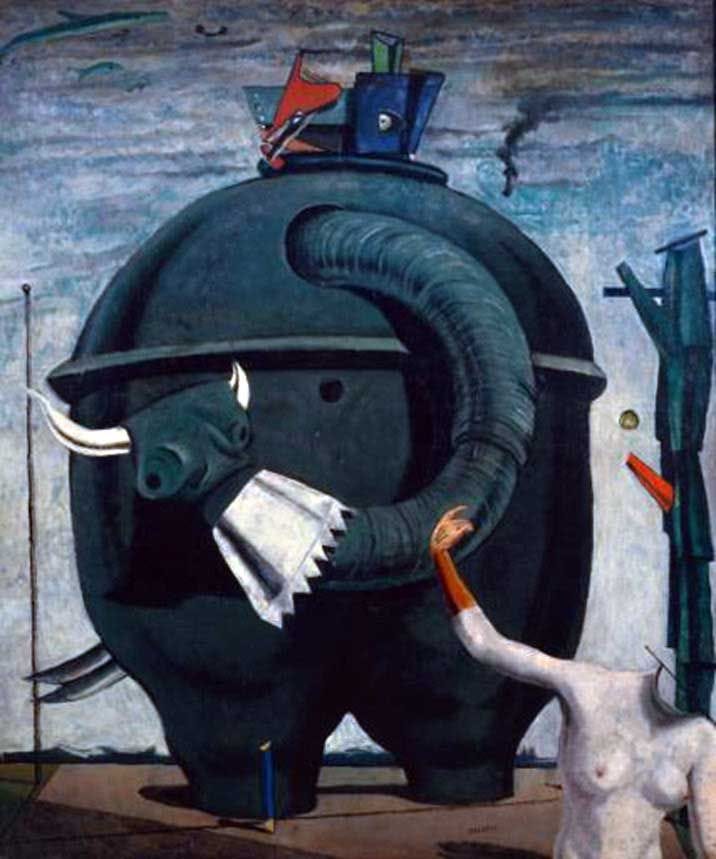
Public domain artwork
In his extraordinary painting Celebes, painted in 1921, an elephantine creature with a bull’s head on its tail confronts a headless but gloved nude in a landscape whose very context appears ambivalent — fish seem to swim in the sky.
You might also like:
[embed]The Year 1925 An optimistic year, but problems lay aheadmedium.com
[embed]The Year 1929 The Wall Street Crash was not the only eventmedium.com
[embed]The Year 1933 The events of an important year in the 20th centurymedium.com
For other similar pieces, see my List:
For my Twitter feed of links to other pieces, and quotes, follow @welfordwrites
Follow this link to join Medium, where you can read many more pieces by me and other members, if you have not already done so!
If you do, please be aware that a portion of your (very low!) membership fee will go to me.
메타데이터
- post_id
- a0c087f029cc
- slug
- the-year-1921-a0c087f029cc
- url
- https://medium.com/lessons-from-history/the-year-1921-a0c087f029cc
- canonical_url
- https://medium.com/lessons-from-history/the-year-1921-a0c087f029cc
- author_url
- https://medium.com/@johnwelford15
- status
- ok
- fetched_at
- 2026-07-25 12:44:45