How to Increase Website Traffic Organically in 90 Days (2026 Guide)
There’s a question I hear almost every week from website owners:
How to Increase Website Traffic Organically in 90 Days (2026 Guide)
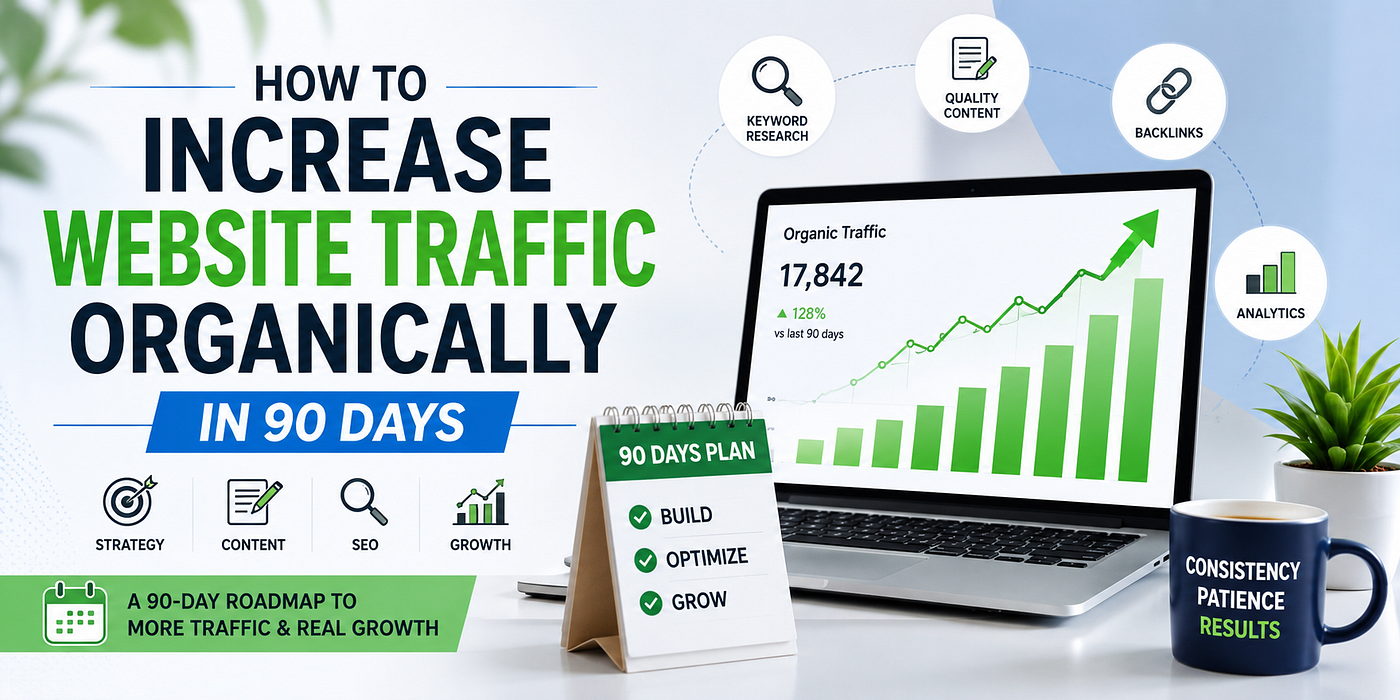
There’s a question I hear almost every week from website owners:
“I’ve published articles, optimized my website, and even shared my content on social media. Why am I still not getting traffic?”
A few months ago, a small business owner reached out to the team at **Biziffy** with exactly the same concern.
He had invested in a professional-looking website, written several blog posts, and even hired freelancers to improve his SEO. Yet after nearly six months, his analytics dashboard looked almost empty.
The first thing we asked wasn’t about keywords or backlinks.
It was much simpler.
“Are you creating content people are actually searching for?”
There was silence for a few seconds.
Like many business owners, he believed that simply publishing articles would automatically bring visitors.
Unfortunately, that’s not how organic traffic works anymore.
In 2026, Google has become significantly better at understanding search intent, content quality, and user experience. At the same time, AI-powered search platforms like ChatGPT, Gemini, and Google’s AI search experiences are changing the way people discover information online.
That sounds intimidating, but it also creates opportunities.
The websites gaining the most organic traffic today aren’t necessarily the biggest brands with the largest marketing budgets. They’re the ones consistently publishing helpful content, solving real problems, and earning trust over time.
At **Biziffy**, we’ve worked with businesses across different industries, and one pattern keeps repeating itself.
The websites that commit to a structured SEO plan usually start seeing noticeable improvements within a few months — not because of shortcuts, but because consistency compounds.
This guide walks you through a practical 90-day roadmap that can help increase your website traffic organically.
No overnight promises.
No secret hacks.
Just proven strategies that continue to work in today’s search landscape.
Why Organic Traffic Is More Valuable Than Ever
Organic traffic is different from paid advertising.
When someone discovers your website through Google or another search engine without clicking on an ad, they’re usually looking for answers, products, or services with genuine intent.
That often makes organic visitors more valuable.
Instead of paying for every click, your content keeps working long after it’s published.
One well-written article can continue attracting visitors for months — or even years.
That’s one of the biggest reasons businesses continue investing in SEO.
At **Biziffy**, we’ve seen articles published more than a year ago still generate leads because they answered questions people continue searching for today.
Organic growth takes longer than paid campaigns, but its long-term value is difficult to ignore.
Can You Really Increase Website Traffic in 90 Days?
Yes — but expectations matter.
If your website is brand new, you probably won’t jump from zero visitors to hundreds of thousands within three months.
However, 90 days is enough to build momentum.
Many websites begin seeing improvements in:
- Search impressions
- Keyword rankings
- Click-through rates
- Organic visitors
- Website engagement
- Brand awareness
The key is following a structured plan instead of trying random SEO tips every week.
Days 1–30: Build a Strong Foundation
The first month isn’t about chasing rankings.
It’s about fixing the basics.
Many websites struggle because they skip this step entirely.
At **Biziffy**, we usually begin by asking a simple question:
“If Google visited your website today, would it clearly understand what your business offers?”
Surprisingly, the answer isn’t always yes.
That’s why the first month should focus on creating a strong technical and content foundation.
Understand Your Audience First
Before writing another article, spend some time understanding who you’re trying to reach.
Think about the questions your customers ask every day.
What problems are they trying to solve?
What information are they searching for before making a decision?
The best-performing content usually starts with real customer questions rather than keyword tools alone.
When you solve genuine problems, SEO becomes much easier.
Perform a Basic Website Audit
You don’t need expensive software to spot obvious issues.
Check whether:
- Your pages load quickly.
- Navigation is easy to follow.
- Every page has a clear title.
- Images are optimized.
- Broken links are fixed.
- Mobile experience feels smooth.
Visitors rarely stay on websites that feel slow or confusing.
Neither do search engines.
Build Content Around Search Intent
One mistake we often notice at **Biziffy** is businesses creating content they want to publish instead of content people actually want to read.
Search intent should always come first.
For example, someone searching:
“Best running shoes for beginners”
expects recommendations.
Someone searching:
“How to clean running shoes”
expects a practical guide.
Although both keywords involve running shoes, the user’s intention is completely different.
Understanding that difference can dramatically improve content performance.
Publish Helpful Content Consistently
Consistency still matters.
Rather than publishing ten rushed articles in one week, aim for a steady publishing schedule.
For many small businesses, one high-quality article each week is more than enough.
At **Biziffy**, we’ve found that consistency often beats intensity.
A website that publishes useful content every week usually performs better over time than one that’s active for a month and then disappears.
Focus on Quality Instead of Word Count
Many people still believe longer articles automatically rank better.
That’s no longer true.
Length only matters if every section adds value.
Instead of asking:
“How many words should this article have?”
Ask:
“Will the reader leave with a complete answer?”
Sometimes that’s 900 words.
Sometimes it’s 2,500.
The goal isn’t writing more.
The goal is helping more.
Create Content That Deserves to Be Shared
One useful way to evaluate an article is to ask yourself:
“Would someone recommend this to a friend?”
If the answer is no, it’s probably worth improving before publishing.
Helpful examples, original insights, practical advice, and real experiences often make content far more memorable than generic information repeated across dozens of websites.
That’s another principle we consistently follow at **Biziffy**.
Instead of creating content for algorithms, create something genuinely useful for readers.
Search engines have become much better at recognizing the difference.
Don’t Ignore On-Page SEO
Even the best article needs clear signals to help search engines understand it.
Before publishing, review the basics:
- Write a descriptive title.
- Use headings to organize ideas.
- Include your primary keyword naturally.
- Add meaningful image alt text.
- Write compelling meta descriptions.
- Link to related pages on your own website.
None of these steps are complicated, but together they make your content easier to understand — for both readers and search engines.
By the end of the first 30 days, your website should have a much stronger foundation than when you started.
That’s important because the next phase isn’t about fixing problems.
It’s about expanding your reach, earning authority, and giving Google more reasons to trust your website.
The second month is where many websites begin seeing meaningful progress — provided the groundwork has been done properly.
Days 31–60: Build Authority and Earn More Visibility
Once your website has a solid foundation, the next step is helping more people discover it.
This is where many websites begin to separate themselves from the competition.
At **biziffy**, we’ve noticed that businesses often spend weeks perfecting their websites but very little time promoting the content they’ve created. Publishing an article is only half the job. Getting it in front of the right audience is equally important.
Strengthen Your Internal Linking
Think of your website like a map.
Every useful article should naturally guide readers toward another helpful page. Internal links make it easier for visitors to continue exploring your website while also helping search engines understand how your content is connected.
For example, if you’re writing about SEO, you can naturally guide readers to related articles covering keyword research, technical SEO, or content marketing.
The goal isn’t to add links everywhere. It’s to help readers find the next piece of information they genuinely need.
Start Earning Quality Backlinks
One of the biggest misconceptions about SEO is that backlinks are something you buy.
The best backlinks are usually earned.
Consider:
- Writing guest posts on reputable websites.
- Publishing original research.
- Creating useful guides people want to reference.
- Sharing industry insights based on real experience.
- Networking with bloggers and business owners.
At **Biziffy**, we’ve seen that even a handful of relevant backlinks can outperform dozens of links from low-quality websites.
Refresh Existing Content
Not every traffic increase comes from publishing something new.
Sometimes your best opportunity is improving what you already have.
Look through older articles and ask yourself:
- Is the information still accurate?
- Have search trends changed?
- Could I add better examples?
- Are there newer statistics available?
- Can I answer additional questions readers may have?
Small updates often produce surprisingly positive results.
Improve Your Click-Through Rate
Ranking on Google’s first page is helpful.
Getting people to click your result is even more important.
Review your page titles and meta descriptions.
Would they make you click if you saw them in search results?
Instead of writing something generic, focus on explaining exactly what the reader will learn.
Clear, specific titles usually perform better than vague ones.
Make Better Use of Images
Images don’t directly guarantee higher rankings, but they certainly improve the reader’s experience.
Where possible, include:
- Original screenshots
- Simple charts
- Infographics
- Step-by-step illustrations
- Process diagrams
At **Biziffy**, we’ve found that articles with useful visuals often keep visitors engaged for longer, which is always a positive sign.
Days 61–90: Build Momentum
By now, your website should have:
- Better content
- Improved structure
- More optimized pages
- Growing search visibility
The final month is about building momentum rather than starting from scratch.
Monitor What People Are Actually Searching For
Google Search Console is one of the most useful free SEO tools available.
Instead of guessing what people search for, review the keywords that are already bringing impressions.
Sometimes an article ranks on page two for an unexpected search term.
With a few improvements, it can move onto page one.
These small opportunities often become some of the easiest traffic wins.
Focus on Topical Authority
Rather than covering dozens of unrelated topics, build depth around one subject.
For example, instead of publishing random marketing articles, create a complete collection covering:
- Keyword research
- On-page SEO
- Technical SEO
- Content marketing
- Link building
- AI SEO
- Local SEO
When your website consistently demonstrates expertise in one area, search engines begin understanding exactly what your website represents.
That’s an approach we strongly encourage at **Biziffy** because it creates long-term growth rather than short-term spikes.
Pay Attention to User Experience
Traffic means very little if visitors leave within a few seconds.
Ask yourself:
Can visitors quickly find what they came for?
Is the text easy to read?
Are paragraphs too long?
Does the page feel trustworthy?
Simple improvements often make a noticeable difference.
Google’s 2026 Search Landscape
SEO continues evolving.
Google isn’t simply matching keywords anymore.
Today’s search systems try to understand:
- Whether your content genuinely helps people.
- Whether your website demonstrates expertise.
- Whether readers trust your information.
- Whether your content deserves to be recommended.
At the same time, AI-powered search experiences are becoming more common.
Platforms like ChatGPT, Gemini, and Google’s AI-generated search results increasingly highlight brands that have built credibility across the web.
That’s one reason **Biziffy** encourages businesses to think beyond rankings.
Visibility today comes from creating useful content people remember and recommend.
Mistakes That Slow Organic Growth
Sometimes it’s not about what you’re doing.
It’s about what you’re doing too often.
Some of the most common mistakes include:
Publishing Without a Plan
Random articles rarely build momentum.
Every piece of content should support a broader strategy.
Expecting Instant Results
SEO isn’t a weekend project.
It rewards consistency.
The websites growing today are usually the ones that stayed committed while others gave up too early.
Ignoring Older Content
Many businesses focus entirely on publishing new articles while forgetting about the dozens already sitting on their websites.
Refreshing existing content can often produce faster improvements than starting from zero.
Writing Only for Search Engines
Readers should always come first.
If your content feels robotic, repetitive, or written only around keywords, people usually notice.
Search engines are becoming better at recognizing that too.
At **Biziffy**, every content strategy begins with one question:
“Will this genuinely help someone?”
If the answer is yes, optimization becomes much easier.
What We’ve Learned at Biziffy
Working with different businesses has taught us something surprisingly simple.
The websites experiencing the strongest organic growth rarely rely on complicated SEO tricks.
Instead, they consistently:
- Publish useful content.
- Improve existing pages.
- Listen to customer questions.
- Build relationships.
- Stay patient.
There isn’t one secret technique responsible for long-term success.
It’s usually the combination of many small improvements repeated consistently.
That’s the philosophy we continue following at **Biziffy**, and it’s one we’ve seen produce sustainable results across different industries.
Final Thoughts
If there’s one thing we’ve learned at **Biziffy**, it’s this: organic traffic isn’t something you chase — it’s something you earn.
Every helpful article you publish, every page you improve, and every question you answer adds another layer of value to your website. Some changes will make an impact quickly, while others may take weeks or even months to show results. That’s completely normal.
The businesses that grow steadily aren’t always the ones with the biggest teams or the highest marketing budgets. More often, they’re the ones that stay consistent when others lose patience.
So, if you’re hoping to see more visitors over the next 90 days, don’t try to do everything at once. Start with the basics, improve a little each week, and keep building on what works.
Small, consistent actions have a way of turning into meaningful results over time.
That’s exactly the mindset we encourage at **Biziffy**, and it’s one that continues to work in an ever-changing search landscape.
This article was written by Biziffy.
Frequently Asked Questions
How long does it usually take to see organic traffic growth?
Every website is different, but many businesses begin noticing improvements within a few months when they consistently publish useful content and improve their existing pages.
Can a new website increase traffic in 90 days?
Yes. While dramatic results shouldn’t be expected immediately, ninety days is enough time to build a strong foundation, improve visibility, and begin attracting more visitors from search engines.
Is publishing more articles always the best strategy?
Not necessarily. Updating older content, improving user experience, and strengthening your website’s structure can be just as valuable as creating new articles.
Do I need expensive SEO tools to grow organically?
No. Many excellent resources, including Google Search Console and Google Analytics, are available for free. The strategy you follow usually matters more than the software you use.
What’s the biggest mistake businesses make with SEO?
One of the most common mistakes is expecting instant results. Organic growth takes time, but websites that consistently provide value often see the strongest long-term outcomes.
Written by Biziffy Helping businesses improve their online visibility through practical SEO, content marketing, and sustainable digital growth strategies.
메타데이터
- post_id
- a0d1542e9353
- slug
- how-to-increase-website-traffic-organically-in-90-days-2026-guide-a0d1542e9353
- url
- https://medium.com/@shailvi2101/how-to-increase-website-traffic-organically-in-90-days-2026-guide-a0d1542e9353
- canonical_url
- https://medium.com/@shailvi2101/how-to-increase-website-traffic-organically-in-90-days-2026-guide-a0d1542e9353
- author_url
- https://medium.com/@shailvi2101
- status
- ok
- fetched_at
- 2026-06-28 04:42:08