Álvaro Acero
Episode: 288
Álvaro Acero
Episode: 288
There’s a question I’ve been asking myself for a while, one that found an unexpected answer this week in a conversation with someone who started his career training and playing on the same team. How much of what we do on the court serves us off it? And how much of what we think works in the locker room is actually well-packaged noise?
Álvaro Acero has spent years working in high-performance environments from an unusual position: that of the coach who didn’t start from the bottom building the pyramid, but the other way around. He started at the top, with the senior team, and worked his way down toward youth development. That gave him something rare: the ability to break down complexity and understand why things that seem simple are anything but when you’re facing someone who is learning how to think.
What struck me most about our conversation wasn’t the tactical side, but the human side. Álvaro talks about players as people with histories, with habits built over years, with different needs depending on the moment. A 35-year-old player with seasoning doesn’t need the same training as an 18-year-old. That seems obvious. And yet, how often do we apply the same treatment to people who are at radically different points in their development, their career, their life.
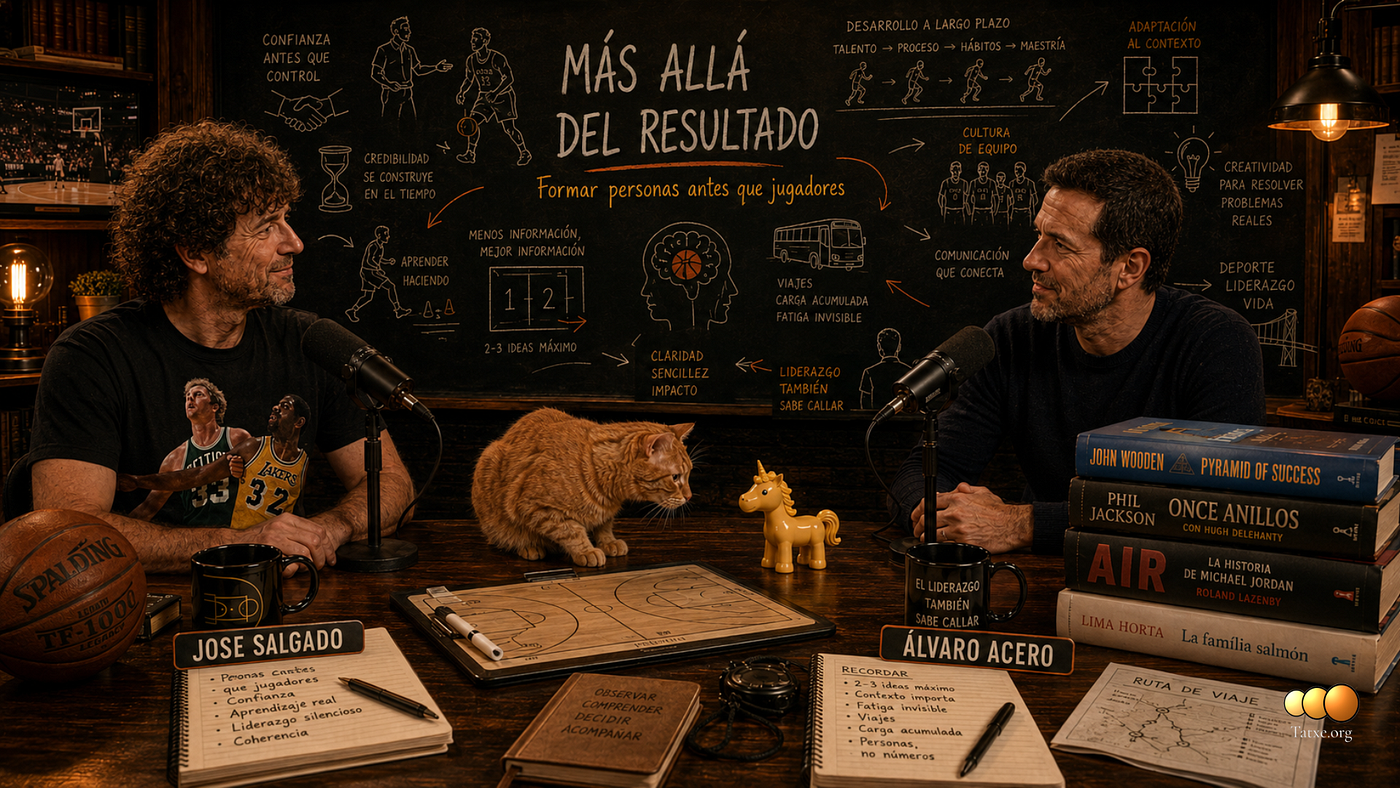
He talked to me about managing a group in semi-professional categories and the reality behind bus rides, games played the same day you arrive, accumulated loads that no one records in any spreadsheet. That invisible fatigue — the kind that doesn’t show up in GPS or RPE data, but that a good coach can read in his players’ posture when they walk into the locker room. You don’t need a doctorate to know that someone who’s been in a van for four hours needs to stretch before warming up. What you need is to have lived it and paid attention.
One of the moments that made me think most was when we talked about tactical information during timeouts. Álvaro is clear on this: if two or three things land well, you can consider yourself satisfied. If three things get through, you’re bordering on a miracle. Not because players don’t want to understand, but because they’re running at 1,000 rpm and cognitive processing has very real limits. The same thing happens to a professional in the middle of a crisis: don’t ask them to absorb ten priorities at once. Give them one. The right one.
This connects to something I believe deeply: effective leadership isn’t the one that talks the most, but the one that knows when to be quiet. The coach who turns to the bench to berate a player who’s on the court is managing his own frustration, not the team’s performance. There’s enormous maturity in biting your tongue and saving feedback for the moment it can actually be received. Álvaro put it with disarming simplicity: “sometimes you do your job well by staying silent.”
We also touched on something I find especially relevant for those of us who lead teams outside of sport: how you sell a project to a group. Álvaro is direct about it. On day one, everyone buys in. Initial motivation is almost free. Where you truly measure whether a project has substance is at months three and six, when the novelty has evaporated and what remains is the coherence between what you promised and what you’re actually being. Marketing can get you placed. Work is what keeps you there.
And then there’s the reflection on youth development, which is perhaps the one that resonates most with me. We’re increasingly training kids who never played in the street, who never solved problems without someone telling them what to do, who are so structured that when the moment to improvise comes, they freeze. The talent for solving problems in uncertain contexts doesn’t develop on a whiteboard. It develops through playing, making mistakes, finding solutions no one has validated yet. The most creative teams I’ve seen aren’t the ones with the best system. They’re the ones with the courage to try something new when the system isn’t working.
This is just a small part of what we discussed. The conversation has far more depth than I can summarize here, and there are threads that deserve to be heard calmly: defense as a development tool, the relationship between trust and long-term credibility, and how to build stable lines of work without falling into the dogmatism of the coach who changes tactical models every time he hears an interesting talk.
Today, with all of us, Álvaro Acero.
Listen: https://open.spotify.com/episode/0CVQvtydsd7OCjJDCUAttp?si=wAA07uFLQNiJDAsmLu9gFQ
메타데이터
- post_id
- a0d71b0f0914
- slug
- álvaro-acero-a0d71b0f0914
- url
- https://medium.com/@tatxeorg/%C3%A1lvaro-acero-a0d71b0f0914
- canonical_url
- https://medium.com/@tatxeorg/%C3%A1lvaro-acero-a0d71b0f0914
- author_url
- https://medium.com/@tatxeorg
- status
- ok
- fetched_at
- 2026-06-12 22:02:08