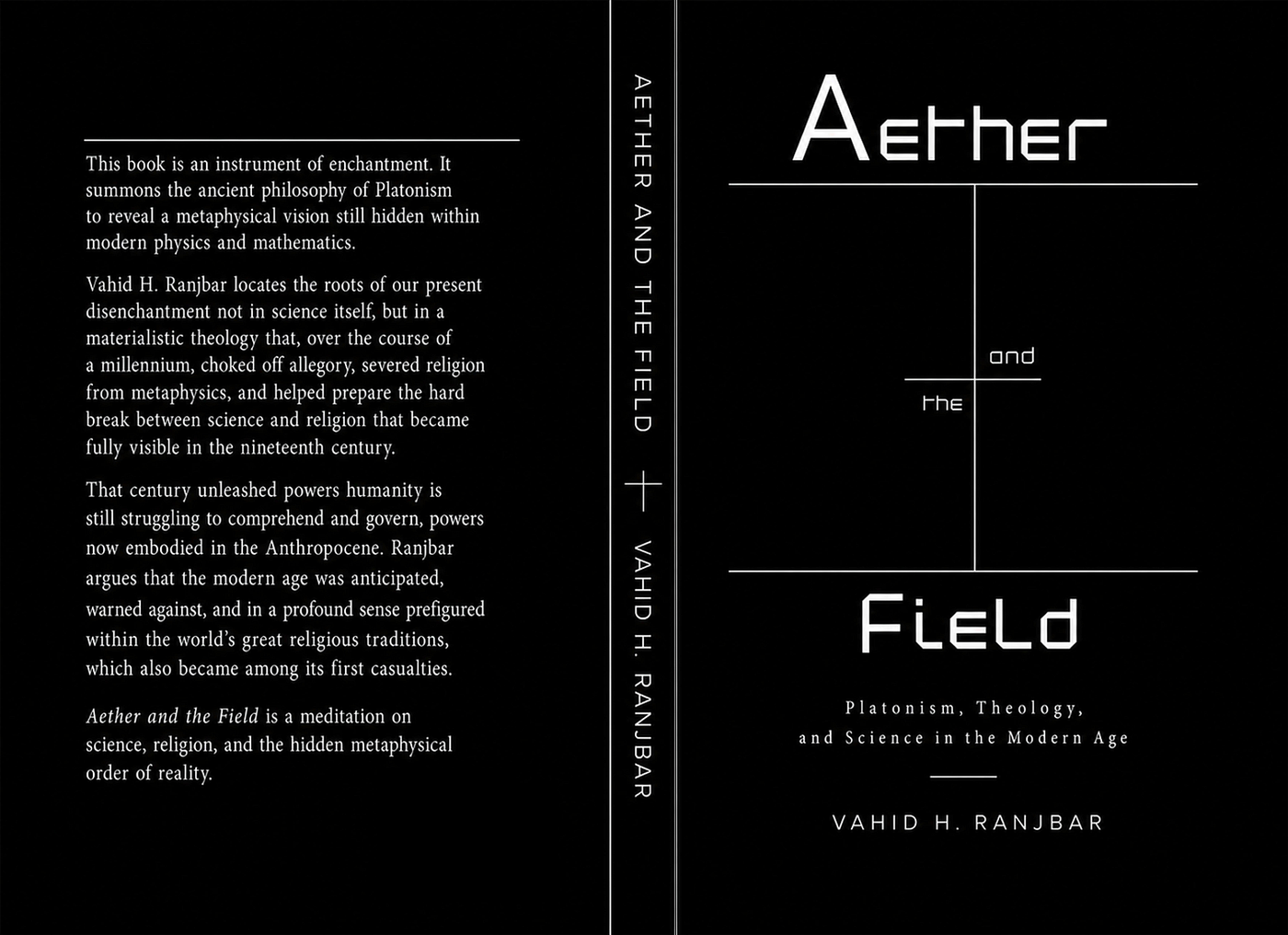
Æther and The Field Book (Excerpt)
The world’s equilibrium hath been upset through the vibrating influence of this most great, this new World Order. [2] — Bahá’u’lláh
Æther and The Field Book (Excerpt)
The world’s equilibrium hath been upset through the vibrating influence of this most great, this new World Order. [2] — Bahá’u’lláh

Something truly momentous happened during the 19th century. Something that changed every aspect of life on the planet; some- thing that unleashed wonderful and terrible powers. These powers have allowed humans to touch another world, and yet are capable ofdriving the next mass extinction or ending life as we know it.
If you examine any metric of human activity, such as population growth, economic development, scientific research, artistic produc- tion, or literary output, you will find a clear inflection point in the 19th century. Every aspect of human society was transformed, in- cluding race, class, and gender roles as well as political structures.
These events were followed in the 20th century by the most terrible conflict humans have ever witnessed. During two world wars, nations fought battles across the globe, culminating in the horrors of the Holocaust and the atomic bombings of Japan. Many living during World War I viewed it in apocalyptic terms, calling it ‘the War to end all Wars’. As if to echo this sentiment, one of the final battles of World War I occurred on the very plane described in Revelation.

World population growth since 0 C.E., with the 19th century highlighted

World economic output since 0 C.E., with the 19th century highlighted
In September 1918, the Battle of Megiddo was fought. It was the climactic engagement of the Sinai and Palestine campaign, during which German and Ottoman forces were encircled by British forces under the command of General Allenby.
Even on planetary time scales, the 19th century can rightly be regarded as ushering in one of the most significant transformations to affect our species and the life of the whole world. Climate and en-

Cumulative CO2 emissions, with the 19th century highlighted
vironmental scientists now recognize that we are entering the next great extinction event, which has been dubbed the “Anthropocene extinction”. There have been five major extinction events on Earth, caused by meteor impacts and geological upheavals. Each resulted in a mass dying, with up to three-quarters of all species eliminated. The Anthropocene is being driven by human activity and its acceleration is a direct consequence of enormous technological and industrial ca- pacities unleashed since the 19th century.
The Great Awakening
We are taught that this transformation in the world was a natural product of the Industrial and Scientific Revolutions. The confluence of banking, industry, and the sustained and effective use of the scientific method reached a tipping point, driving a dramatic explosion of technology. However, outside of secular thought, most major religions today have struggled — and for the most part failed — to grapple with these changes. This presents a grave challenge, since how humanity collectively manages these changes will determine the sur- vival of much of life on this planet. Thus, the values and institutions that guide our collective decisions — such as religion, morality, and governance — matter more than ever. Their failure to address these changes could have dire consequences. If ever divine guidance was needed, the time is now.
The birth of the transcendentalist movement had echoes of this need for guidance when in 1838 Ralph Waldo Emerson famously addressed the Harvard Divinity School and said:
“I look for the hour when that supreme Beauty which ravished the souls ofthose eastern Men, and chiefly those of the Hebrews, and through theirlipsspoke oracles to all time, shall speak in the West also … I look for the new Teacher that shall follow so far those shining laws that He shall seethemcome full circle; … shall see the world to be the mirror of the soul; shallsee the identity of the law of gravitation with purity of heart; and shall show … that Duty is one thing with Science, with Beauty, and with Joy” [3].
The transcendentalist movement drew on Judeo-Christian mysticism, as well as Hindu and Islamic traditions. I believe Emerson’s observation was rooted in a shared expectation found across the great world religions. This expectation anticipates an important and convulsive event for humanity. For example, the Sanskrit scriptures speak of the end of the Kali Yuga and the appearance of the tenth Avatar. Buddhists await the coming of the fifth Buddha. Zoroastrians await the coming of Shah Brahman. Muslims, like Jews and Christians, await the Messiah and the Day ofJudgment.
Although little known today, Emerson was likely responding to a surge of messianic expectation that arose in the late 18th and early 19th centuries across the Christian and Islamic worlds. In the Christian world, these expectations were known as the Great Awakenings. During the Second Great Awakening, many Christians expected a dramatic change in human affairs. A significant number of believers were convinced that this transformation would take place around the middle of the 19th century. In 1818, William Miller, a lay Baptist minister from Massachusetts, determined after careful studyof the Book of Daniel that “in about twenty-five years (1843)
… all the affairs of our present state would be wound up.” [4] He would later become one of the more well-known advocates for the impending return of Christ. He attracted many followers who waited for this event in 1843 and later in 1844. A similar sort of expectation even led a group of Protestant Germans, known as the Templars, to move topresent-dayIsrael to await the descent of Christ. In Haifa

William Miller (top) and a newspaper clipping about his prophecy.
in 1868 they established a substantial colony at the base of Mount Carmel. Of course, when the followers of these movements did not observe Christ physically descend from the heavens as expected, most abandoned these beliefs. To this day, the non-fulfillment of Miller’s prophecy in 1844 is known as the “Great Disappointment”. However, the legacy of these expectations still survives in religious groups such as the Seventh-day Adventist Church, Jehovah’s Witnesses, and the Church of Jesus Christ of Latter-day Saints.
The Rise of Materialism
And yet each step in the explosive growth of scientific and technological knowledge casts serious doubt on traditional religious un- derstandings of Heaven, Hell, angels, and the origin of humans and the world. Further, the major religions appeared incapable of explaining or coming to terms with the tremendous changes occurring. This, of course, seemed particularly strange, especially for those who believed that the Divine had guided humanity in the past. Thus, they were faced with an important question: If our scriptures are really divinely inspired, why did they not warn humanity about an event of this magnitude? Logically, if the sacred scripture from any of these traditions had a valid claim to divine inspiration, it would have at the very least foreseen this event and warned humanity. Even more damning was the fact that most religions remained wedded to outdated political and social institutions that were rapidly crumbling. Instead of anticipating and embracing these changes, they reacted by turning backward, struggling to rebuild and re-create an imagined glorious past. Thus, the events of the 19th century also coincided with the rise of materialistic and atheistic philosophies and the precipitous decline of religious belief. It saw the birth of more radical philosophies like those of Marx and Nietzsche, as well as a more general rejection of God and all forms of religion.
However, the decline of religious belief was not solely caused by scientific progress. A deeper issue — what I call “religious materialism” — played a crucial role. This refers to the tendency of religious followers to interpret scripture literally, rather than as allegorical reflections on the spiritual condition of humanity. For example, many interpret references to ‘Heaven,’ ‘Life,’ ‘Death,’ and ‘Resurrection’ as describing physical events rather than spiritual states of being. I believe it is this religious materialism, which took root centuries earlier, that has driven a wedge between science and religion. As a result, many on both sides have viewed religious and scientific belief as mutually exclusive or at the very least, belonging to completely different spheres of knowledge. Religious practitioners often attempt to resolve the conflict by avoiding any intersection with science and instead rely on ‘faith’ to explain the serious logical and physical problems within their scriptural interpretations.
The fruit of this is that religion, in particular traditional theism, appears to be in full retreat in the broader culture. Attacks on theism have grown in intensity, spreading beyond the intellectual class and into broader society. This antagonism is likely fueled by disgust at the wholesale murder, tyranny, corruption, and the celebration of ignorance that have been committed in the name of religion. At times, the rejection of theism is so dogmatic and unthinking that it is not unlike the mindset of the ultra-religious literalist. Any expression of theism is labeled as anti-scientific or tyrannical delusion and dismissed without consideration.
On the other side are those who still adhere to literalist traditional beliefs. Although their numbers are dwindling, their rejection of science and intellectualism has become more entrenched than ever. Others have constructed a theology of continual anticipation. Convulsive events — such as wars, the formation of new nation-states, and shifts in moral norms — are interpreted as signs that their long- awaited spectacle will soon unfold in the heavens. This ignores the reality that the wave of change has already broken over their heads. Meanwhile, the rest of the world struggles to build institutions and mechanisms for global governance, which are essential for the survival of our species. These efforts are viewed as at best, unnecessary or at worst the plotting of some malignant forces. The widespread dismissal of scientific consensus by large segments of the population presents a profound challenge to our species’ continued viability. This is why I believe the divide between science and religion must be addressed.
To be sure, there are many traditional theists who accept rationality and the authority of modern science. Yet their voices seem quieter, their arguments for belief vaguer, and at times science itself appears to strain against their stance. This may be partly because many are unfamiliar with how Platonic philosophy can address these questions in a way that aligns with contemporary science. This approach has a very deep historical connection to their respective faiths. It is my hope that this book will help reconnect these readers to their great philosophical and theological heritage.
메타데이터
- post_id
- a0d93100ed3d
- slug
- æther-and-the-field-book-excerpt-a0d93100ed3d
- url
- https://medium.com/@vahidhoustonranjbar/%C3%A6ther-and-the-field-book-excerpt-a0d93100ed3d
- canonical_url
- https://medium.com/@vahidhoustonranjbar/%C3%A6ther-and-the-field-book-excerpt-a0d93100ed3d
- author_url
- https://medium.com/@vahidhoustonranjbar
- status
- ok
- fetched_at
- 2026-08-21 01:15:16