Book 1.2 → Steal like an Artist
Ideas from Austin Kleon , PART 2!
Book 1.2 → Steal like an Artist
Ideas from Austin Kleon , PART 2!
CHAPTER 2: Don’t wait until you know who are to get started!
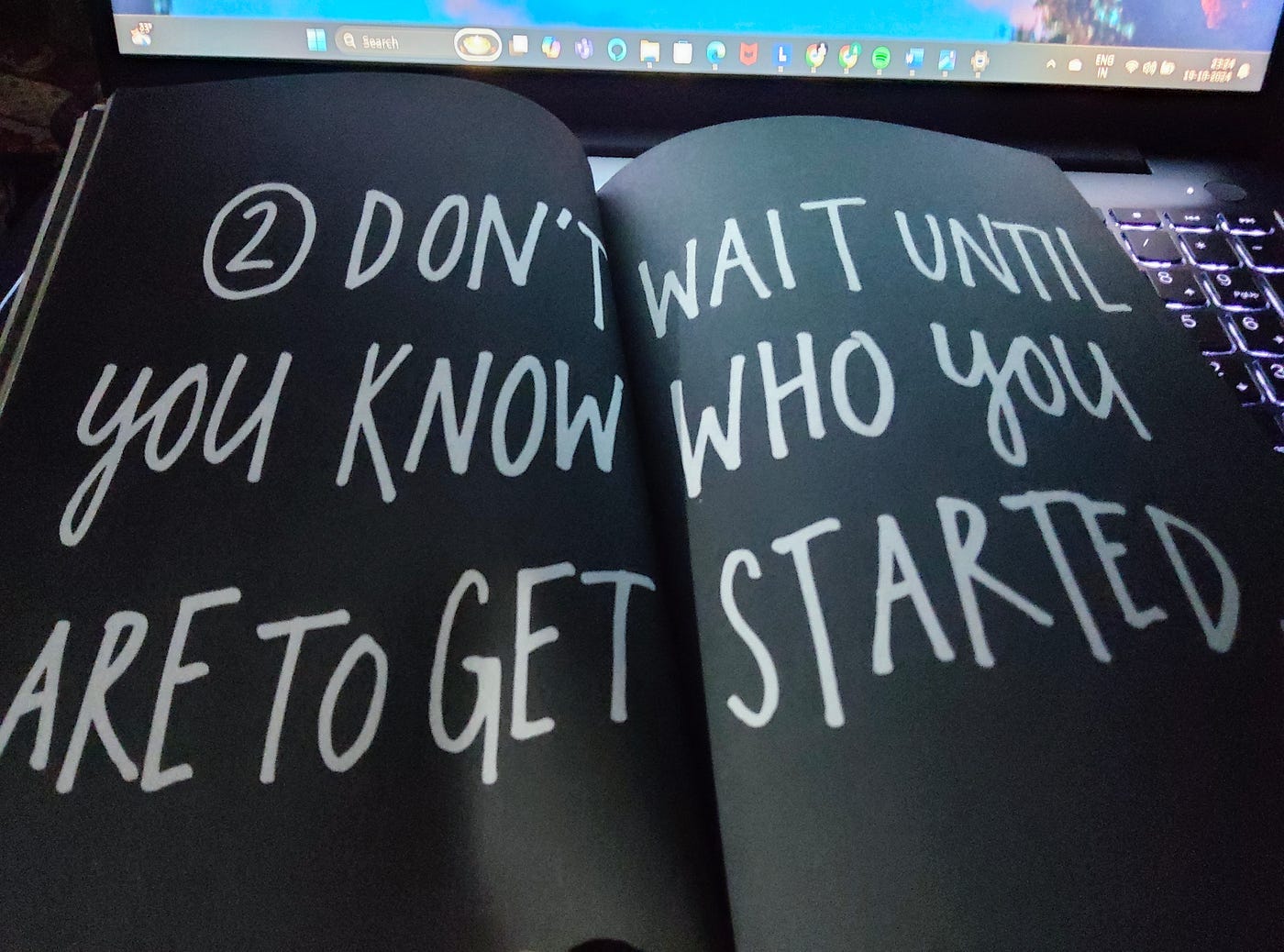
- Make things know thyself
This chapter is basically the author grabbing you by the shoulders and saying, “Stop overthinking and just start.”
The author flips that idea, saying you don’t find yourself and then make stuff — you make stuff to find yourself. Impostor syndrome?
Completely normal. Everyone feels like they’re faking it, even the people doing amazing work. The difference is they still show up.
You’re ready. Start making stuff.
Creativity isn’t about confidence or clarity — it’s about showing up scared and doing it anyway.

- Fake it, till you make it!
He says, Dramaturgy is the idea that life works like a stage, a concept Shakespeare captured centuries ago when he wrote that we all play many roles over time.
This way of thinking leads to the popular advice “fake it till you make it.” It doesn’t mean lying — it means stepping into the role of who you want to become before you fully arrive there. You dress for the job you want and begin doing the work you hope to be known for.

You start out as a phony and become real.” — Glenn O’Brien
Dress for the job you want and begin doing the work you hope to be known for.
- Start copying
This passage explains that no one is born with a clear style or creative voice — it’s something we develop over time. At the start, we learn by copying our heroes, not by stealing their work, but by studying how it’s made.

Start copying what you love. Copy copy copy copy. At the end of the copy you will find your self.” — Yohji Yamamoto
Just like musicians practice scales or painters recreate masterpieces, copying helps us understand the craft from the inside. Even legendary artists like The Beatles began by imitating others before finding their own sound.
The key is to learn from many influences, not just one, so your work slowly becomes your own. Most importantly, the goal isn’t to copy the surface of someone’s style, but to understand how they think and see the world. That deeper understanding is what eventually leads to original work.
4.Imitation is not flattery
This passage highlights how creative growth moves from imitation to emulation. At first, we borrow from our heroes — not to steal, but to learn — and through that process, we slowly discover our own voice.

As Francis Ford Coppola suggests, what we take from others naturally transforms once it passes through us.
“We want you to take from us. We want you, at first, to steal from us, because you can’t steal. You will take what we give you and you will put it in your own voice and that’s how you will find your voice. And that’s how you begin. And then one day someone will steal from you.” — Francis Ford Coppola
Examples from Kobe Bryant and famous comedians show that trying to copy our idols often fails, but that failure is exactly what makes us original. Because we’re not built the same — physically or creatively — we’re forced to adapt, and that’s where individuality begins.
In the end, originality isn’t about creating something from nothing; it’s about becoming yourself through everything you’ve learned and tried to be.
In the end, merely imitating your heroes is not flattering them. Transforming their work into something of your own is how you flatter them. Adding something to the world that only you can add.
That’s where we leave off for now — Chapter 3 is waiting, and it takes this idea a step deeper. Bye Bye!
메타데이터
- post_id
- a100b7309aaa
- slug
- book-1-2-steal-like-an-artist-a100b7309aaa
- url
- https://medium.com/@yazhini.ap02/book-1-2-steal-like-an-artist-a100b7309aaa
- canonical_url
- https://medium.com/@yazhini.ap02/book-1-2-steal-like-an-artist-a100b7309aaa
- author_url
- https://medium.com/@yazhini.ap02
- status
- ok
- fetched_at
- 2026-06-25 07:00:49