Multi-User Interaction Scenario, quantum state management
Multi-User Interactive Systems: A State-Based, Emergent Approach
Multi-User Interaction Scenario, quantum state management
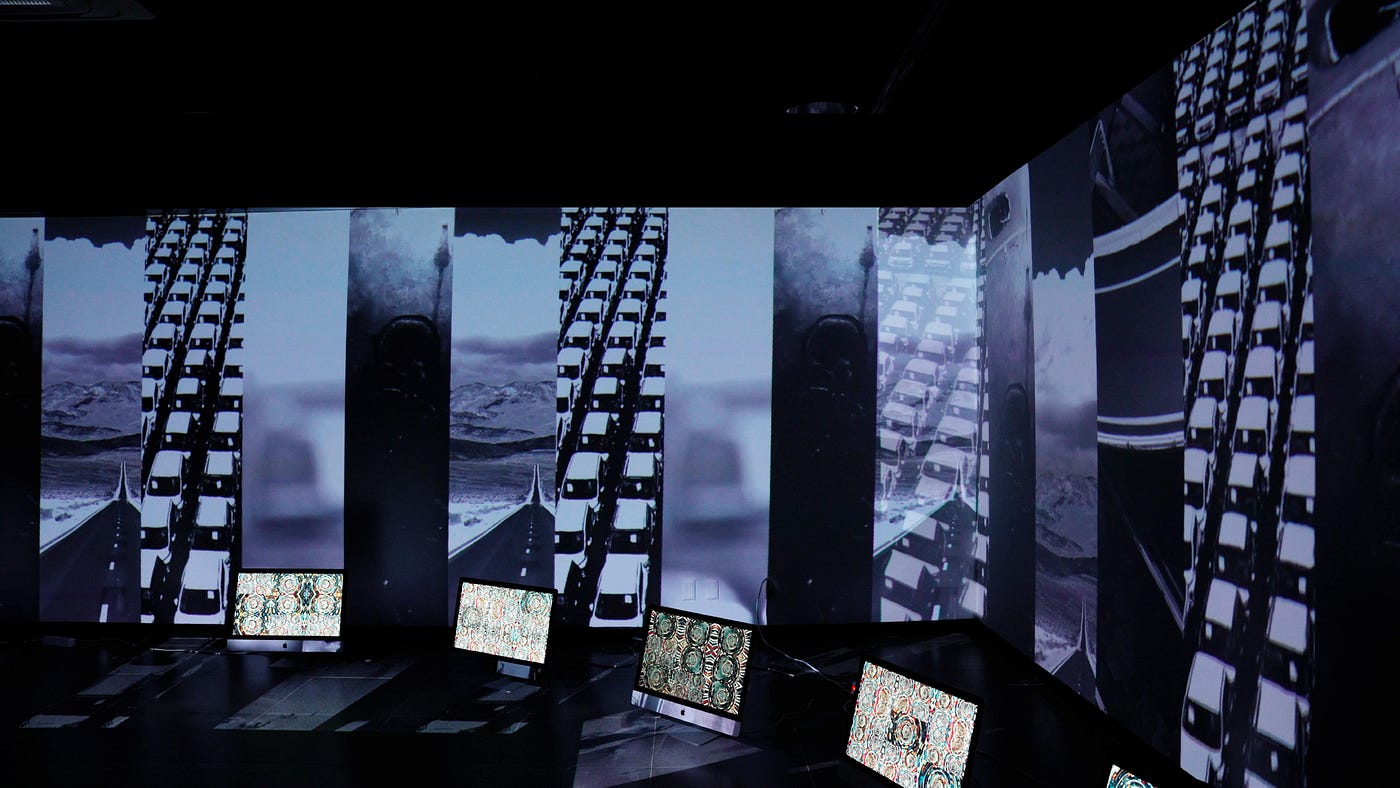
Multi-User Interactive Systems: A State-Based, Emergent Approach
Introduction
Traditional Multi-Device Web Art (MDWA) projects often center on single-user progressive storytelling. In contrast, the proposed multi-user interactive framework leverages the superposition of states — a methodology inspired by concepts from quantum mechanics, graph theory, and stochastic processes — to enable simultaneous interaction by M users across N output channels. In this system, individual user inputs dynamically “interfere” like waves, resulting in emergent, decentralized behavior that transforms the interface into a living, urban-like ecosystem.
1. Conceptual Overview
At its core, the system is designed to harness the interplay of multiple user state commands. Each user contributes a distinct “state command” that, when combined, produces a superposition of potential outcomes on each output channel. Rather than following a predetermined narrative, each channel oscillates probabilistically between the different states — akin to a quantum system that exists in several eigenstates until a measurement (or output) collapses it into one particular state. This model not only embraces non-deterministic computing but also reflects an environment where the collective user influence drives an ever-shifting, emergent output.

2. Theoretical Underpinnings
Graph Theory and Network Dynamics
The system’s architecture can be viewed as a dynamic network or graph where each node represents a user input, and subgraphs may be reconfigured in real time. Such modularity allows the interface to remain adaptive, mirroring the flexible and interconnected nature of contemporary digital ecosystems.
Quantum State Analogies and Superposition
Drawing on quantum mechanics, the user commands are likened to eigenvalues in a quantum system. Just as quantum entities exist in a superposition until an observation “collapses” the state, each channel here fluctuates among user-defined states until one is emergently expressed. This quantum-inspired perspective offers a compelling metaphor for non-linear, multi-agent interaction.

Stochastic Processes and Markov Chains
The probabilistic transitions between states can be effectively modeled using Markov chains. In this framework, the likelihood of a channel shifting from one user-influenced state to another is determined solely by its current state, capturing the inherent randomness and memoryless nature of the interactions. Over time, these transitions yield emergent patterns that are statistically governed yet visually dynamic.
Decentralized Control in Complex Systems
Parallel to multi-agent systems in industrial engineering, the decentralized nature of this interactive design ensures that no single user dominates the output. Instead, the emergent global behavior is the product of localized decisions — a phenomenon that resonates with modern approaches in supply chain management and self-organizing networks.
3. Implementation Considerations
Multi-Channel Output and Dynamic Oscillation
The envisioned system distributes output across multiple screens (N channels). Each channel continuously oscillates between the various user-provided states, much like a bustling train station platform where individual movements aggregate into a complex, ever-changing pattern.
Feedback and User Agency
A critical design challenge is balancing the system’s inherent randomness with clear, intuitive feedback. While state transitions are probabilistic, robust interface design must ensure that users perceive their actions as meaningful, thereby maintaining a sense of agency within the emergent ecosystem.
Computational Complexity and Real-Time Processing
Implementing real-time Markov models and managing dynamic state transitions across multiple channels requires efficient algorithms and possibly distributed processing. This technical complexity must be addressed to preserve the responsiveness and fluidity of the interactive experience.
4. Aesthetic and Experiential Implications
Emergent Urban Aesthetics
The overall experience is intended to evoke the image of a vibrant, kinetic urban environment. As individual channels shift between states, the visual and auditory outputs create a platform art-like effect, reminiscent of a train station or bustling cityscape. This aesthetic is further enriched by techniques such as audio-visual disentanglement, where the interplay between separate sensory elements fosters an uncanny, thought-provoking experience.
From Deterministic Narratives to Fluid Interactions
By moving away from linear storytelling, this state-based approach reflects contemporary digital interactions — dynamic, decentralized, and continuously evolving. The system’s design underscores the idea that modern interfaces can be both expressive and algorithmically complex, capturing the essence of a hyperreal, emergent ecosystem that mirrors the multiplicity of human interactions.
Conclusion
Integrating principles from graph theory, quantum mechanics, and stochastic modeling, the multi-user interactive system represents a novel paradigm in MDWA. By allowing user inputs to “interfere” and dynamically shape the output across multiple channels, the system creates a decentralized, emergent narrative that is both artistically compelling and technically innovative. Future work will focus on refining state transition probabilities, enhancing user feedback mechanisms, and addressing computational challenges to fully realize the potential of this dynamic, non-deterministic framework.
메타데이터
- post_id
- a102de63f2a4
- slug
- multi-user-interaction-scenario-quantum-state-management-a102de63f2a4
- url
- https://medium.com/@ericggul/multi-user-interaction-scenario-quantum-state-management-a102de63f2a4
- canonical_url
- https://medium.com/@ericggul/multi-user-interaction-scenario-quantum-state-management-a102de63f2a4
- author_url
- https://medium.com/@ericggul
- status
- ok
- fetched_at
- 2026-08-03 20:32:42



