Understanding Urban EV Feature Prioritization & Pricing Strategy: A Data-Driven Guide to…
“Would you pay more for extra miles of range, or choose faster charging at a lower price? For urban commuters shopping for EVs, this isn’t…
Understanding Urban EV Feature Prioritization & Pricing Strategy: A Data-Driven Guide to Preferences
“Would you pay more for extra miles of range, or choose faster charging at a lower price? For urban commuters shopping for EVs, this isn’t hypothetical it’s the decision that will determine which vehicle sits in their driveway.”
The EV market is flooded with options, each promising different combinations of range, charging speed, price, and features. Manufacturers are betting billions on what they think matters most. But here’s the problem: they’re often guessing.
Urban commuters who make up 60% of potential EV buyers face a unique decision. Unlike long-distance drivers, they have different priorities, different constraints, and different trade-offs to consider.
So, To answer this I ‘ve analyzed exactly how urban commuters value different EV attributes through a conjoint study of 20 respondents through statistical analysis. Here, I found something interesting and let me take you over through it and see What we found challenges conventional wisdom about EV preferences.
Introduction:
Before, starting it out let’s understand CONJOINT ANALYSIS
Conjoint analysis is a market research tool for developing effective product/service design. It works by presenting respondents with various product profiles each with different combinations of attributes and asking them to choose their preferred option or rank them. By analyzing these choices, researchers can determine:
- Which attributes matter most to consumers?
- How much each attribute contributes to overall preference?
- The trade-offs consumers are willing to make (e.g., pay more for better range vs. accept less range for lower price)
- The relative importance of each feature in the decision-making process.
For my study, I took four attributes that i thought could help in my study and took respective levels for those attributes as mentioned below:
- Price — 90k, 120k, 250k
- Range per charge — 80km, 120km, 180km
- Charge Capacity — Standard(More than 2 hrs.), Fast(1hrs-2hrs), Rapid(30min — 1hr)
- Brand- Established, Startup.
Methodology:
Data Preprocessing:
- Apart from the findings some data preprocessing was done to the data that it was converted from wide format to Long format and reversed the scale from 1- best -> 10- worst and 1-> Worst to 10 -> Best for our regression based analysis and keep our interpretation consistent. As shown below:
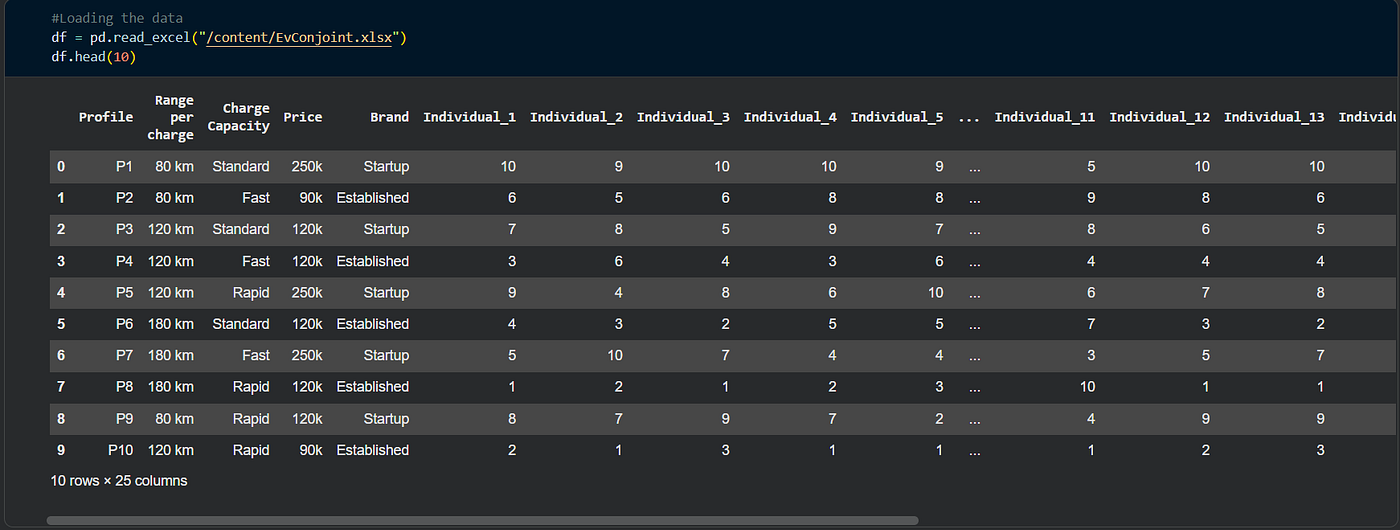
This was the wide format of our data at the beginning
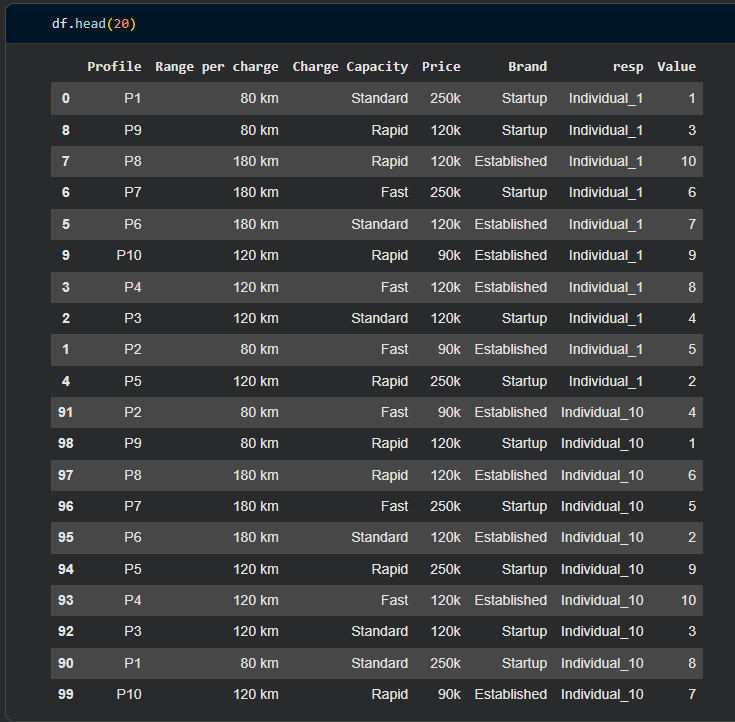
Wide format was converted into the long format so that it would be easier for our regression analysis.
Visually, went through each of the attribute levels preferred by individuals.
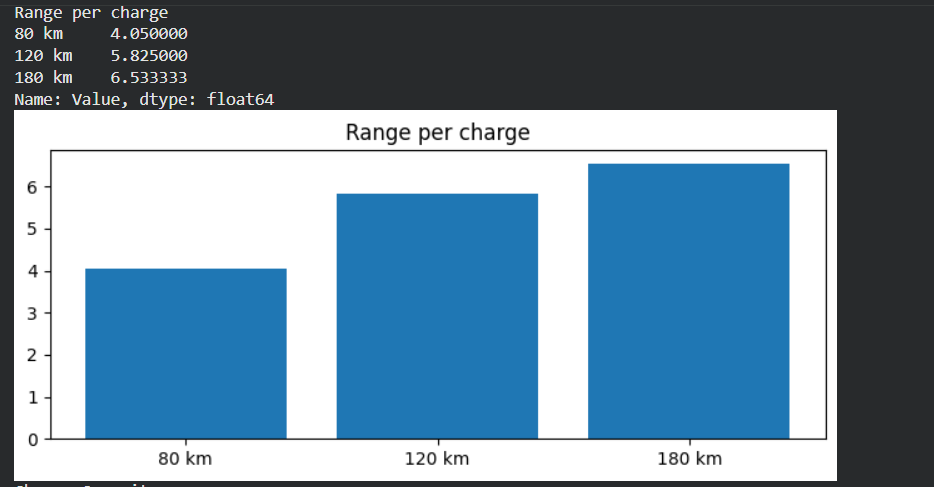
Range per Charge
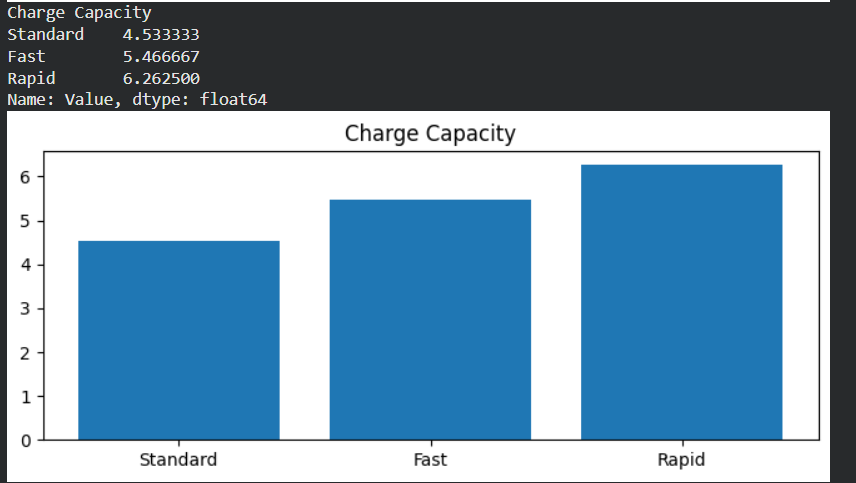
Charge Capacity
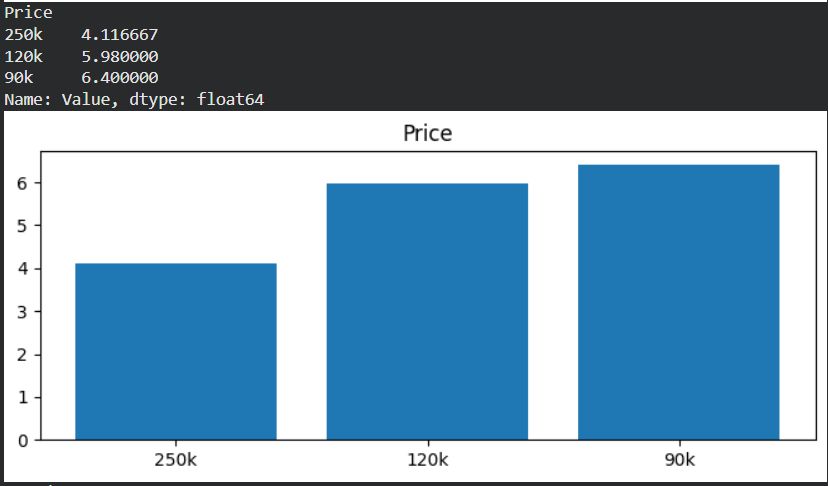
Price
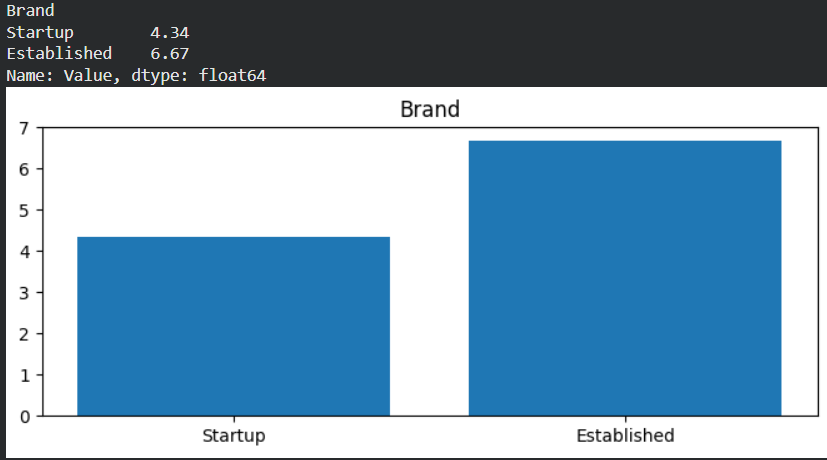
Brand
But, this not what we want we need to see rather we try to see the trade offs also and how each attributes are give importance. So, for this built a regression model using the Statistical analysis. So, here the regression coefficients are Converted to part-worth utilities to decode the customer preference mathematically. and then Utilities tell you why people prefer. Importance tells you what drives decision. A full factorial design is designed to get all possible combinations and Logit simulation tells you who will win market share.
Feel free to dive into my notebook step by step via this link.
Observations:
What Urban Commuters Really Want in EVs
When analyzed the trade-offs urban commuters make when choosing electric vehicles, clear patterns emerged. Here’s what the data reveals about EV purchase decisions in India’s urban markets:
1. Range Still Reigns — But Not How You’d Expect:
Range per charge accounted for 38.2% of purchase decisions nearly 1.5 times more important than price. This confirms what manufacturers suspected: range anxiety is real and dominates the decision-making process.
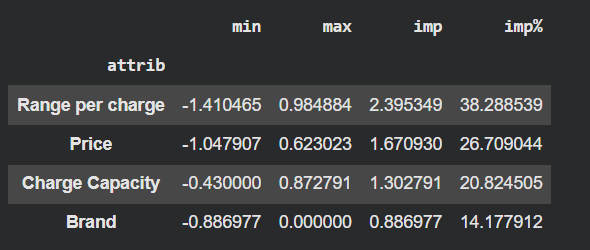
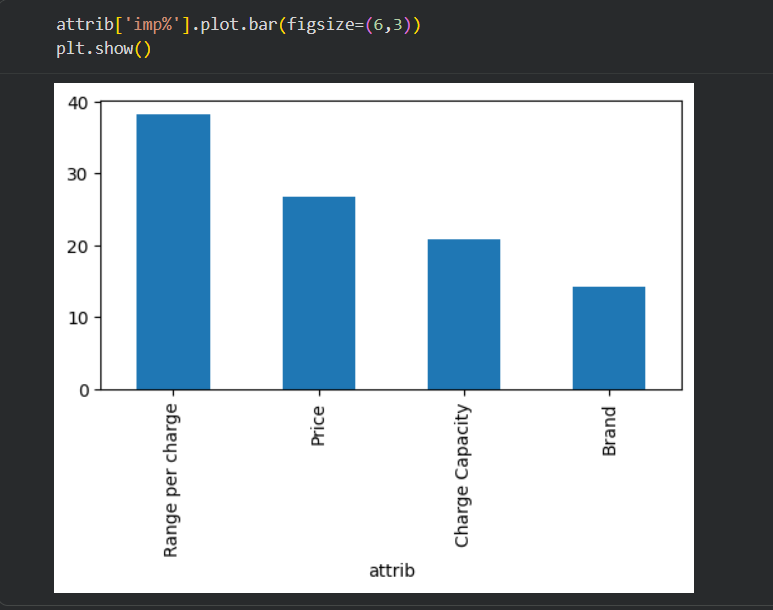
What’s truly surprising? Range is crucial, but it’s not everything. Urban Commuters also ask Do extra miles justify the extra cost and charging hassle?
2. Insights That Challenge, What We Think We Know:
* The Range Sweet Spot: People Higher Preference
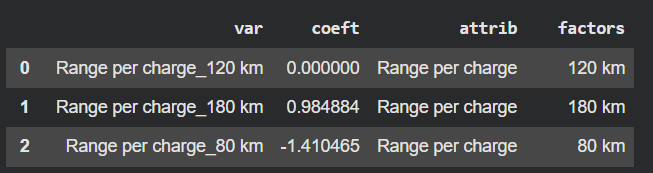
Range per charge strongly influences preference. A 180 km range is most preferred, 120 km is neutral, and 80 km is disliked. Customer perception of EV range is not linear once a vehicle crosses the ~120 km (100+ mile) psychological milestone, it suddenly feels practical for daily use. The jump from 80 km to 120 km feels significant, while 120 km to 180 km adds capability but with less perceived impact. Around 180 km, buyers gain enough confidence for daily travel and unexpected trips, after which factors like price, brand, charging time from our attribute level become more important.
* Understanding The Price And Value:
Price sensitivity is real but nuanced. The data reveals a clear preference hierarchy:

A ₹90,000 EV is strongly preferred, while ₹2,50,000 luxury models face less preference. However, urban commuters are willing to pay more for the right features.
This shows that commuters focus on value for money. They are willing to pay extra for features that improve daily travel (like faster charging or reliability), but not for features that don’t add real everyday value.
* Rapid Charging Commands More Than Other Features:
While charging speed ranked third in overall importance (20.8%), the gap between standard and rapid charging is dramatic:

Urban commuters are willing to pay more or give up some features if the scooter offers rapid charging. For city users, charging time is crucial since many rely on public chargers or need flexibility for longer trips. Reducing charging time from 3 hours to 30 minutes feels like a major upgrade.
In fact, the preference gain from rapid charging (1.30 points) is greater than the improvement from increasing range from 80 km to 120 km, showing that charging convenience matters more than extra range for daily use.
* Brand Matters Least (This Changes Everything):
I found something unexpected that brand is the least important factor at just 14.2%. Urban commuters care 2.7× more about range and 1.9× more about price than whether it’s an established manufacturer or an unknown startup.
The brand utility scores reveal as follows:

This creates a big opportunity for New startups in the market. If a company offers around 180 km of range or more than, fast charging, and an affordable price, strong brand recognition becomes less important. In fact, a price advantage or noticeably faster charging can easily overcome the disadvantage of being a new or lesser-known brand.
3. The Critical Trade-offs: What Buyers Sacrifice (And What They Won’t)
When we simulated market competition across all possible EV configurations (combinations of range, charging, price, and brand), clear patterns emerged about which compromises buyers accept and which are deal-breakers.

Image showing the combination of features that gives the highest individual preference which leads to highest market share.
Action/Recommendation:
For EV Manufacturers: Product Development Strategy:
1. Optimize Your Feature Mix (Don’t Over-Engineer):
Redirect R&D budget from extreme range to rapid charging infrastructure and cost reduction. A 180 km vehicle with rapid charging at ₹1.1L will outperform a 250 km vehicle with fast charging at ₹1.5L.
2. Strategic Charging Infrastructure Investment:
Charging speed is very important (20.8% importance). The big jump in preference from standard to rapid charging shows that people strongly prefer faster charging.
So, companies should:
- Make rapid charging standard in every EV. Standard charging is seen as a disadvantage.
- Partner with charging networks and offer 6–12 months of free rapid charging. This makes higher prices easier to accept.
- Provide workplace charging solutions by working with offices and corporate campuses. If people can charge at work, they worry less about range.
3. For Pricing Teams: Revenue Optimization Strategy:
The ₹90K-₹1.2L Sweet Spot
Price importance is 26.7% with clear utility scores:
• ₹90,000: +0.62 coefficient (maximum price preference)
• ₹1,20,000: 0.00 coefficient (acceptable baseline)
- ₹2,50,000: -1.05 coefficient (strong negative reaction)
4.Competitive Pricing Against Established Players
If you are a startup competing with well-known brands that offer similar features, here’s a simple strategy:
- Price your scooter ₹10,000–₹15,000 lower than established brands. This lower price can make up a strong reason to impact the strong brand names too.
- Offer attractive launch bundles. For example, “₹1,05,000 + 2 years of free rapid charging.” Even if the actual discount is small, customers feel they are getting much more value.
- Be transparent about your pricing. Clearly explain why your scooter costs less such as no dealer margins or direct-to-consumer sales. This builds trust and makes customers feel confident about choosing your brand.
Overall Summary:
The conjoint analysis reveals that urban EV buyers are rational, data-driven, and feature-focused. They prioritize range (38.3%) and practical charging solutions (20.8%) over brand heritage (14.2%). Price sensitivity is real (26.7%), but buyers will pay for meaningful improvements.
The winning formula is clear: 150–180 km range + rapid charging + competitive pricing (₹90k-₹1.2L). Companies that deliver this combination will capture market share regardless of brand heritage. Those who reduce the range, neglect charging infrastructure, or high price will struggle to compete.
The urban EV market rewards practical excellence over aspirational maximization. Build, market, and price accordingly.
Thanks for reading!
메타데이터
- post_id
- a112f4e56df6
- slug
- understanding-urban-ev-feature-prioritization-pricing-strategy-a-data-driven-guide-to-a112f4e56df6
- url
- https://medium.com/@pravalikagivaji02/understanding-urban-ev-feature-prioritization-pricing-strategy-a-data-driven-guide-to-a112f4e56df6
- canonical_url
- https://medium.com/@pravalikagivaji02/understanding-urban-ev-feature-prioritization-pricing-strategy-a-data-driven-guide-to-a112f4e56df6
- author_url
- https://medium.com/@pravalikagivaji02
- status
- ok
- fetched_at
- 2026-06-29 01:02:39



